Politics
Mace, green lasers, screeching soundtracks: Inside the UCLA encampment on a night of violence

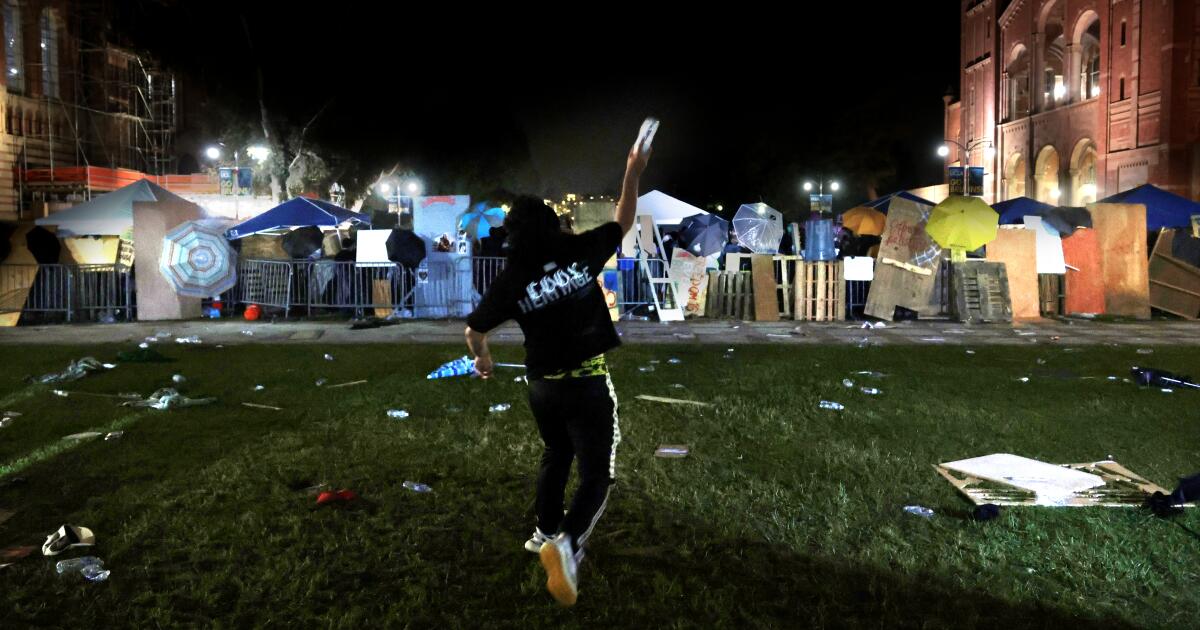
The noise — unsettling and dissonant — has been a constant inside the barricaded pro-Palestinian encampment at UCLA.
Soon after protesters, most of them students at the Westwood campus, pitched tents on Dickson Court on April 25, pro-Israel counterdemonstrators showed up with megaphones. Some shouted racist, homophobic and anti-Islamic slurs, according to campers interviewed.
They set up a giant video screen near the camp that played and replayed videos of Hamas militants. They broadcast a running torrent of loud, disturbing sounds over a stereo — an eagle screeching, a child crying — and blasted a Hebrew rendition of the song “Baby Shark” on repeat, late at night, so that campers could not sleep.
They returned night after night.
A woman kneels in prayer before a line of CHP officers at a pro-Palestinian encampment at UCLA.
(Wally Skalij / Los Angeles)
Inside the encampment, pro-Palestinian protesters, who occupied scores of tents on the grassy expanse, said they tried to maintain a tranquil space during the daylight hours when they felt some sense of control. They led Islamic prayers, observed Shabbat and hosted grief circles that included breath work and trauma therapy.
“It’s still an emotional, heavy space, but it’s also a very open, welcoming and loving space,” said Marie, a 28-year-old graduate student who, like many protesters interviewed, declined to provide her full name because she feared for her safety, physically and online. “Unfortunately, we experience the harassment and the terrorizing at night, which can be really upsetting.”
On Tuesday night, Dickson Court exploded into savagery and chaos. A large, mostly male crowd of masked counterdemonstrators tried to break into the encampment, ripping down wood and metal barriers, spraying bear mace, igniting stink bombs and tossing fireworks near the camp perimeter — and in at least one case inside the camp.
They aimed their green lasers at camper’s faces, prompting shouts of, “Shield your eyes!”
“They attacked us from physical and psychological fronts,” said Mona, a third-year student who also declined to provide her last name. “The outside aggressors have been working hard to create a harsh environment and make us feel unsafe.”
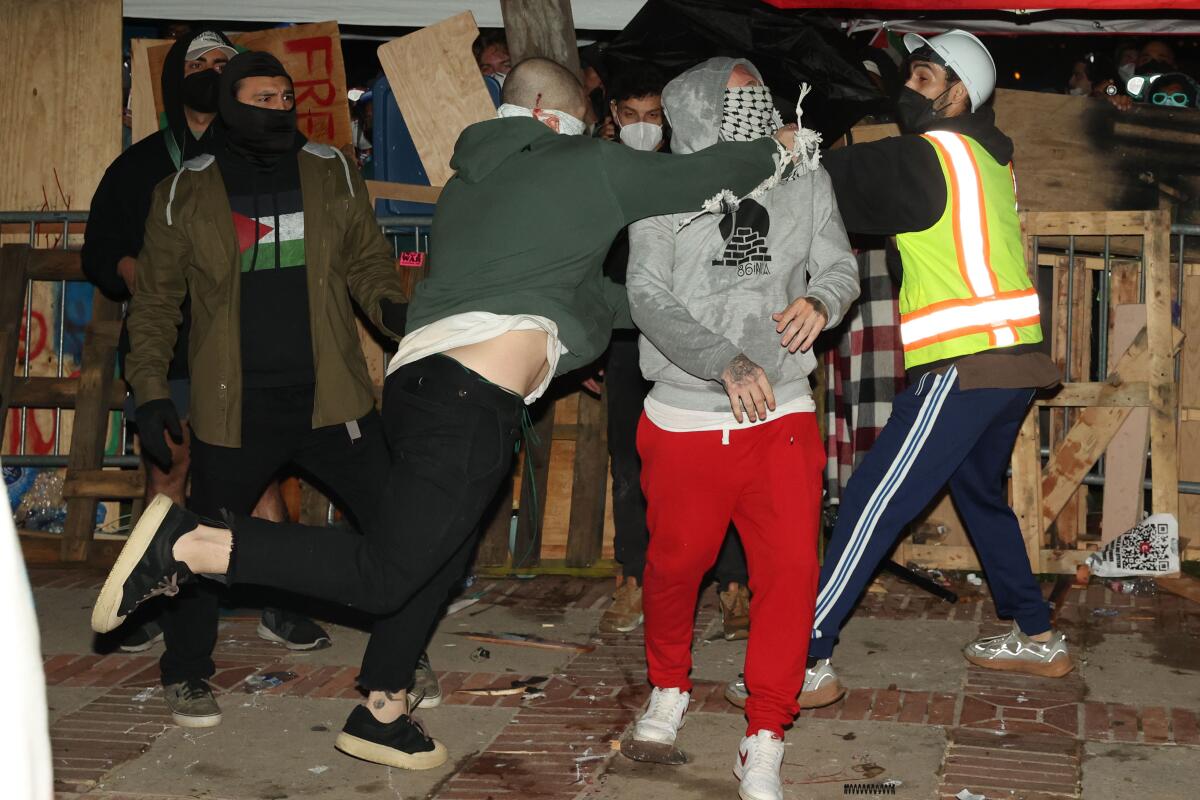
A pro-Palestinian protester, second from right, is assaulted by pro-Israel counterdemonstrators at a UCLA encampment.
(Michael Blackshire / Los Angeles Times)
After Tuesday’s late-night melee — and a slow campus response that a spokesperson for Gov. Gavin Newsom’s office called “unacceptable” — the encampment remained. And the pro-Palestinian protesters, who are demanding divestment from Israel and an end to the country’s military actions in Gaza, were defiant.
Kaia Shah, 23, a postgraduate researcher who has acted as a spokesperson for the encampment, said demonstrators got notice Tuesday from a university liaison that the encampment was unlawful and that students who continued to occupy the space could face suspension or expulsion.
Nonetheless, she said, “We plan on staying here until we get UCLA to divest.”
Shah described the scene Tuesday night as “violent and terrifying chaos,” and said her throat burned from inhaling all the mace in the air. She and another female demonstrator said some of the counterprotesters threatened to sexually assault women inside the encampment.
Shah said that, at one point, she saw police cars — it was unclear from which agency — pull up, turn around in a circle and leave. “The cops came and left as we were getting violently attacked by the Zionists,” she said.
Dueling chants rang out.

Pro-Palestinian protesters at UCLA huddle behind a makeshift barricade under attack by pro-Israel counterdemonstrators.
(Michael Blackshire / Los Angeles Times)
From inside the camp, they shouted: “Free, free Palestine!” and “Hold the line for Palestine!”
Outside, some counterdemonstrators screamed: “Second Nakba!” referring to the mass displacement and dispossession of Palestinians during the 1948 Arab-Israeli War. Others chanted: “USA! USA!”
As the violence unfolded, Citlali, a 25-year-old from Santa Ana who works for the organization Youth Organize! California and declined to provide her last name, said she frantically texted her younger brother, a student who was inside the encampment.
“Hey can you answer? Are you okay?? It’s okay to retreat,” she texted.
She said her brother was sprayed with bear mace and left the encampment Wednesday morning to wash up in his dorm room. “It’s gut-wrenching,” Citlali said. “I couldn’t sleep until 4 a.m. when he texted me that he was OK.”
After sunrise Wednesday, the UCLA chapter of Students for Justice in Palestine posted a list of their needs at the encampment: gas masks, skater helmets, shields, “super bright flashlights with strobe,” EpiPens, inhalers, hot lunches, gluten-free food.
Campus security teams, faculty members and California Highway Patrol officers guarded entrances to the encampment Wednesday morning.
Hannah Appel, an assistant professor of anthropology, stood at one entrance, where people dropped off medical supplies, face masks and water bottles. Only students with wrist bands indicating they were previously in the encampment and those who had someone on the inside vouching for them were allowed to enter, Appel said.
“Because of the escalated violence last night, we have to be very vigilant and careful about who can come in and out,” Appel said, before stepping aside to let a student squeeze through the barricades.
Vanessa Muros, an archaeology researcher at UCLA, showed up outside the encampment with finger cymbals, maracas and a tambourine. She said a call was sent out to students and faculty who participated in a band during a 2022 UC academic workers’ strike. The musicians were asked to help boost morale at the encampment.
“Apparently morale is low in there, and playing music or just making noise will help rally people together,” she said.
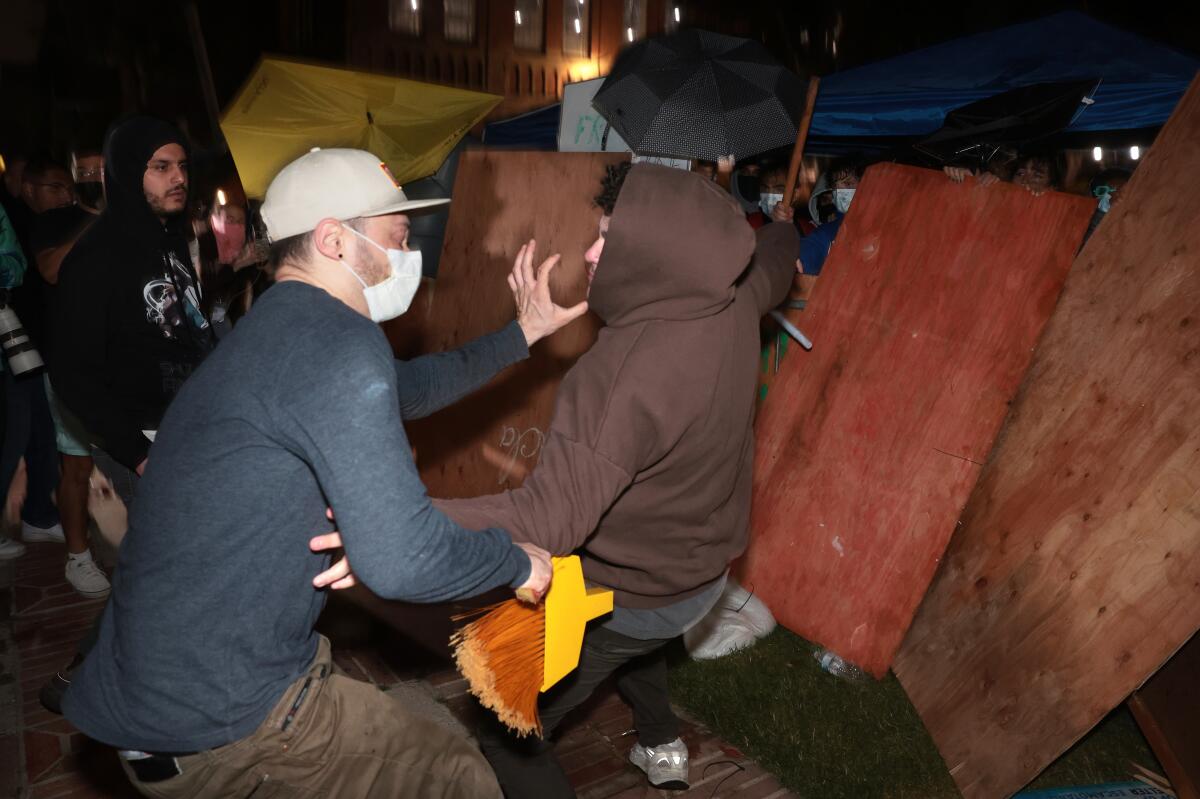
Pro-Palestinian protesters clash with pro-Israel counterdemonstrators at a UCLA encampment.
(Wally Skalij / Los Angeles Times)
Muros has worked at UCLA for 19 years and said she has never seen such mayhem on campus. “It’s upsetting, and I feel like the administration will blame the chaos on the students who have been peacefully protesting,” she said.
Renee Tajima-Peña, a senior faculty member, stood in a line outside Royce Hall to make a donation for the protesters: solar phone chargers, a poncho, some respirators.
“The story has been that all these students are irresponsible or causing problems,” she said. “I teach here and this encampment has been beautiful.”
Tajima-Peña was on campus Sunday when campers tussled with pro-Israel counterdemonstrators, who, she said, spit at students and shouted racial slurs.
“I was shoved by a guy a foot taller than me,” she said. “Another woman, a colleague of mine, also got shoved by some guy.
“But the students — they were so stoic. They didn’t want to engage and didn’t want to escalate. I was so proud.”
Times staff writer Safi Nazzal contributed to this report.


NEWYou can now listen to Fox News articles!
Rep. Diana DeGette, D-Colo., a 30-year incumbent, lost to a Democratic Socialists of America (DSA)-backed challenger in a high-profile primary on Tuesday evening.
Melat Kiros, a 29-year-old socialist, defeated DeGette in a Democratic primary for a deep-blue House seat anchored in Denver, according to The Associated Press, scoring a major victory for the socialist left on Tuesday evening.
The DSA had been aiming to cast DeGette’s loss as evidence of its growing momentum after a slate of socialist candidates won Democratic primaries in New York City last week.
“Today, the East Coast, next week the Mountain West,” the DSA wrote in a social media post last week.
Rep. Diana DeGette speaks during a press conference outside the U.S. Capitol building in Washington, D.C., on Jan. 10, 2024. (Samuel Corum/Getty Images)
SOCIALISTS CHEER ‘SHOCKWAVE’ PRIMARY NIGHT AS DSA-BACKED CANDIDATES WIN, ADVANCE ACROSS THE MAP
If elected in November, Kiros, who was born in Ethiopia, will likely join the ranks of the far-left group known as the Squad and become one of a handful of the House chamber’s outspoken socialists.
The millennial challenger was endorsed by Sen. Bernie Sanders, I-Vt., Rep. Alexandria Ocasio-Cortez, D-N.Y., and the anti-incumbent leftist organization Justice Democrats. Controversial socialist streamer Hasan Piker, who has said Hamas is “a thousand times better” than Israel and praised the Chinese Communist Party, also backed Kiros’ insurgent primary run.
DeGette, a member of the Congressional Progressive Caucus who supports abolishing Immigration and Customs Enforcement (ICE), sought to win a 16th House term by flexing her leftist bona fides. She argued her seniority on an influential House committee would allow her to push for Medicare-for-All legislation — a longtime priority of the party’s far-left flank.
DeGette, who was endorsed by former CPC Chairwoman Pramila Jayapal, D-Wash., also spotlighted her experience as an impeachment manager during Trump’s second impeachment trial in 2021.
Though DeGette and Kiros shared few policy disagreements, they diverged sharply over Israel and antisemitism. Kiros also sharply criticized DeGette for accepting corporate PAC contributions.
Kiros, a PhD student and lawyer, was fired from a New York firm in 2023 after publishing an open letter, arguing that pro-Palestinian student protesters calling for the elimination of Israel were not antisemitic and appearing to defend Hamas.
Melat Kiros participated in a League of Women Voters Congressional District 1 candidate forum at Montview Presbyterian Church in Denver on May 28, 2026. (RJ Sangosti/MediaNews Group/The Denver Post)
WATCH: HOUSE DEMS UNLOAD ON TEXAS DEMOCRAT OVER ‘DEMENTED’ ANTISEMITIC COMMENTS
She has also described the Oct. 7, 2023, attacks against the Jewish state as the “inevitable consequence of apartheid” and declined to characterize the deadly firebombing of protesters in Boulder last year who were urging the release of hostages held by Hamas in Gaza as antisemitic.
“I don’t know what was in the heart of the perpetrator,” Kiros told Colorado’s 9News in a recent television interview. “All I know is that he went and attacked innocent people because of what they might have believed.”
A June 2025 bipartisan resolution condemning the attack as part of a “rise in ideologically motivated attacks on Jewish individuals” won every present lawmaker’s support, except for Reps. Rashida Tlaib, D-Mich., and Thomas Massie, R-Ky., who voted present.
Kiros has also suggested the United States deserved 9/11.
“Inevitable in the sense that we destabilized a lot of the Middle East that forced people to believe that another act of violence was the only response,” Kiros told 9News when asked if she thought the terror attack was “the inevitable consequence of American foreign policy.”
“And again, just like I said before, our responsibility is to get rid of those conditions that lead to violence in the first place,” Kiros continued.
DeGette argued that Kiros’ embrace of Piker and her comments about antisemitism and 9/11 were disqualifying.
“I’m shocked and disgusted that Kiros is doubling down on excusing terrorism and the murder of innocent people,” the 30-year incumbent wrote on Facebook earlier this month.
Streamer and creator Hasan Piker speaks at a press conference during day two of Web Summit Vancouver at the Vancouver Convention Centre in Vancouver, Canada, on May 13, 2026. (Sam Barnes/Web Summit via Sportsfile via Getty Images)
CLICK HERE TO DOWNLOAD THE FOX NEWS APP
Colorado’s 1st Congressional District is the most liberal seat in the state and voted for former Vice President Kamala Harris by 56 points in 2024.
The primary fight was further scrambled by University of Colorado Regent Wanda James, also running for DeGette’s seat. Though James did not pose the same threat as Kiros, her vote share could ultimately have swayed the contest.

Gov. Gavin Newsom has signed off on a 100% state tax on money any Californians receive from Trump’s $1.8-billion “anti-weaponization” fund for his political allies.
Newsom unveiled his proposal in May, after Trump’s Justice Department said it would create a fund to compensate Trump’s allies who claim they have “suffered weaponization and lawfare” under Biden’s Justice Department.
The settlement fund was criticized by politicians on both sides of the aisle, including Sen. Mitch McConnell (R-Ky.), who described it as a “slush fund to pay people who assault cops.”
The fund remains in legal limbo. Earlier this month, a federal judge in Virginia extended a court-ordered block on the plan, which critics warned could be used to pay pardoned Jan. 6 rioters.
Fast-tracked into law as part of Senate Bill 122, Newsom’s plan imposes “a tax on any settlement fund payment from the federal Anti-Weaponization Fund, or any subsequent fund, settlement, or agreement, as provided, at a rate of 100%,” according to the bill text. The tax applies to all tax years between 2026 and 2030.
Newsom signed the bill Tuesday. In a statement, his office said the tax is meant to ensure that, should Trump’s fund proceed, California recipients won’t “receive favorable state treatment on those payments.”
“We believe democracy is worth defending, the rule of law matters, and public dollars should support victims—not those who attacked the very institutions that protect our freedoms,” Newsom said in the statement.
University of Southern California law professor Ariel Jurow Kleiman, an expert on tax law and policy, said that while Newsom’s tax is a “novel legal strategy,” she believes there is “no categorical legal restriction” preventing California from implementing it.
States have a “wide degree of discretion” to design their tax systems — including how they define income — so long as they do not violate their constitutions, Jurow Kleiman said.
If a California resident wanted to challenge the tax in court, they would need to show they were harmed by it to have standing to sue, according to Jurow Kleiman. That would mean receiving a payment from Trump’s settlement fund and then paying the 100% California tax. Unless the settlement fund is established and distributes payments, that scenario is unlikely.
While there have been proposals to levy a 100% tax on income above certain thresholds — Sen. Bernie Sanders (I-Vt.) in 2023 said he supports a 100% tax on income exceeding $1 billion — Jurow Kleiman said she is not aware of any governments that have adopted such a policy.

NEWYou can now listen to Fox News articles!
The House has officially shipped a colossal bipartisan housing package to President Donald Trump, and lawmakers are hoping that, at the very least, he doesn’t veto it.
Trump was supposed to sign the 21st Century ROAD to Housing Act last week, but his last-minute decision to ghost the signing ceremony with House Speaker Mike Johnson, R-La., and Senate Majority Leader John Thune, R-S.D., put into question whether the bill was dead.
His refusal to sign the bill, which passed with overwhelmingly bipartisan support in both chambers, was to leverage the Safeguarding American Voter Eligibility (SAVE) America Act, which doesn’t currently have the votes to succeed in the Senate.
WARREN TELLS TRUMP TO ‘SIGN THE DAMN BILL’ AS BIPARTISAN HOUSING PACKAGE REMAINS STALLED IN WASHINGTON
Trump has refused to sign the 21st Century ROAD to Housing Act. (Shawn Thew/EPA/Bloomberg via Getty Images)
Trump appears to be in no hurry to sign the bill, despite Republicans who are hungry for a win in the affordability fight ahead of the midterm elections.
“It’s so unimportant … compared to the SAVE America Act,” Trump told reporters in the Oval Office on Monday. “I think the SAVE America Act is exactly what it says. It’s saving America from crooked elections.”
“Here’s what I would like to sign, much more than a bill that — big deal, it’s a yawn,” he continued. “Some people say it’s wonderful. To me, compared to the SAVE America Act, just about everything is a big yawn.”
GOP INFIGHTING OVER TRUMP’S VOTER ID BILL ERUPTS AS TOP SENATOR CALLS STRATEGY ‘FANTASY’
It’s legislation that is loaded with nearly 60 provisions from both sides of the aisle in both chambers that’s designed to make it easier for homes to be built and for younger Americans to buy their first home. It also includes a ban on hedge funds buying up housing stock that Trump pushed Congress to include during the State of the Union earlier this year.
Sen. Elizabeth Warren, D-Mass., one of the architects behind the bill in the upper chamber alongside Sen. Tim Scott, R-S.C., charged that Congress handed the bill to Trump “on a silver platter.”
“When you ask me what happens next, if he cared about the American people, he’d have already signed the damned thing, and we’d be underway,” Warren said on WCVB’s “On the Record” on Sunday.
But Trump doesn’t have to put his signature on the bill for it to become law.
IRATE REPUBLICANS ACCUSE TRUMP OF HANDING DEMOCRATS A WIN AFTER BLOWING UP HOUSING PACKAGE
The Senate advanced a massive, Trump-backed housing package geared toward lowering the costs of homes and supercharging the housing supply. Sen. Elizabeth Warren, D-Mass., pitched it as legislation to prevent America from becoming a “nation of renters.” (Jemal Countess/Getty Images for Protect Borrowers; Anna Moneymaker/Getty Images)
The Constitution grants presidents the ability to veto a bill within 10 days of it being transferred over to the White House. In that scenario, Congress could override a veto of the housing package.
It’s happened before under the Trump administration. In early 2021, Congress overrode Trump’s veto of the annual National Defense Authorization Act — a massive Pentagon funding authorization package that some House Republicans are trying to use as a vehicle to pass the SAVE America Act.
But during that 10-day period, if Trump doesn’t sign the bill, it would automatically become law. That’s unless Congress completely adjourns, in which case a “pocket veto” could happen. The Senate is currently in recess and the House is scheduled to leave town by week’s end, but neither count as a full adjournment.
CLICK HERE TO DOWNLOAD THE FOX NEWS APP
Johnson, who spent the last few days meeting with Trump at the White House about the housing bill and the SAVE America Act, said: “I hope he does sign it.”
“If he doesn’t, it’s still law,” Johnson said. “We’ll still celebrate it, but he’s trying to make a point, and I think he’s making it very effectively. And the fact that you all ask me every three steps down the hallway illustrates that he has achieved the desired objective, and that is to make SAVE America the number one thing, because if we don’t get that right, everybody’s concerned about what happens next.”
-
Montana3 seconds ago
Montana Lottery Mega Millions, Big Sky Bonus results for June 30, 2026
-

 Nebraska7 minutes ago
Erstad joins Nebraska golf program
-

 Nevada10 minutes ago
‘Arrive Alive’ initiative with Nevada Department of Public Safety, FOX5
-

 New Hampshire15 minutes ago
This NH Short Film Festival Returns in July, and Every Film Clocks in at 15 Minutes or Less
-

 New Jersey22 minutes ago
New Jersey’s $60.7 billion budget signed into law by Gov. Mikie Sherrill • The Jersey Vindicator
-

 New Mexico25 minutes ago
Community Champions: New Mexico’s Flo Valdez inducted into NFHS
-

 North Carolina30 minutes ago
North Carolina mail carrier kidnapped and killed while on her route, authorities say
-

 North Dakota37 minutes ago
June ND severe weather recap: 5 tornadoes, damaging winds impact numerous towns

