California
California’s exodus isn’t just billionaires — it’s regular people renting U-Hauls, too

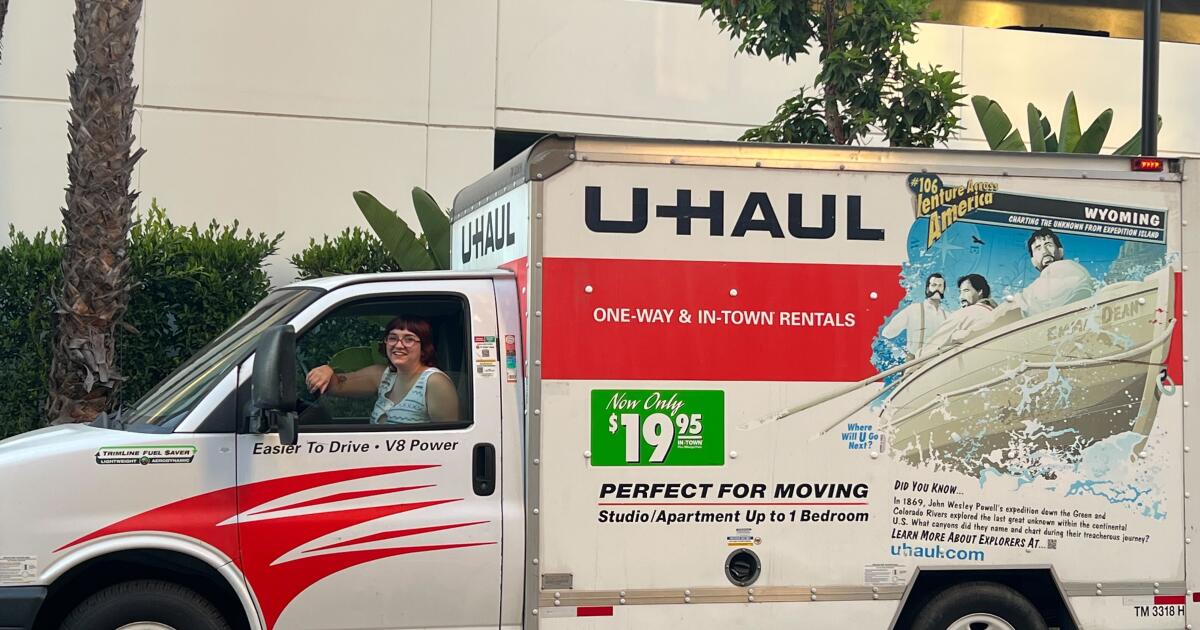
It isn’t just billionaires leaving California.
Anecdotal data suggest there is also an exodus of regular people who load their belongings into rental trucks and lug them to another state.
U-Haul’s survey of the more than 2.5 million one-way trips using its vehicles in the U.S. last year showed that the gap between the number of people leaving and the number arriving was higher in California than in any other state.
While the Golden State also attracts a large number of newcomers, it has had the biggest net outflow for six years in a row.
Generally, the defectors don’t go far. The top five destinations for the diaspora using U-Haul’s trucks, trailers and boxes last year were Arizona, Nevada, Oregon, Washington and Texas.
California experienced a net outflow of U-Haul users with an in-migration of 49.4%, and those leaving of 50.6%. Massachusetts, New York, New Jersey and Illinois also rank among the bottom five on the index.
U-Haul didn’t speculate on the reasons California continues to top the ranking.
“We continue to find that life circumstances — marriage, children, a death in the family, college, jobs and other events — dictate the need for most moves,” John Taylor, U-Haul International president, said in a press statement.
While California’s exodus was greater than any other state, the silver lining was that the state lost fewer residents to out-of-state migration in 2025 than in 2024.
U-Haul said that broadly the hotly debated issue of blue-to-red state migration, which became more pronounced after the pandemic of 2020, continues to be a discernible trend.
Though U-Haul did not specify the reasons for the exodus, California demographers tracking the trend point to the cost of living and housing affordability as the top reasons for leaving.
“Over the last dozen years or so, on a net basis, the flow out of the state because of housing [affordability] far exceeds other reasons people cite [including] jobs or family,” said Hans Johnson, senior fellow at the Public Policy Institute of California.
“This net out migration from California is a more than two-decade-long trend. And again, we’re a big state, so the net out numbers are big,” he said.
U-Haul data showed that there was a pretty even split between arrivals and departures. While the company declined to share absolute numbers, it said that 50.6% of its one-way customers in California were leaving, while 49.4% were arriving.
U-Haul’s network of 24,000 rental locations across the U.S. provides a near-real-time view of domestic migration dynamics, while official data on population movements often lags.
California’s population grew by a marginal 0.05% in the year ending July 2025, reaching 39.5 million people, according to the California Department of Finance.
After two consecutive years of population decline following the 2020 pandemic, California recorded its third year of population growth in 2025. While international migration has rebounded, the number of California residents moving out increased to 216,000, consistent with levels in 2018 and 2019.
Eric McGhee, senior fellow at the Public Policy Institute of California, who researches the challenges facing California, said there’s growing evidence of political leanings shaping the state’s migration patterns, with those moving out of state more likely to be Republican and those moving in likely to be Democratic.
“Partisanship probably is not the most significant of these considerations, but it may be just the last straw that broke the camel’s back, on top of the other things that are more traditional drivers of migration … cost of living and family and friends and jobs,” McGhee said.
Living in California costs 12.6% more than the national average, according to the U.S. Bureau of Economic Analysis. One of the biggest pain points in the state is housing, which is 57.8% more expensive than what the average American pays.
The U-Haul study across all 50 states found that 7 of the top 10 growth states where people moved to have Republican governors. Nine of the states with the biggest net outflows had Democrat governors.
Texas, Florida and North Carolina were the top three growth states for U-Haul customers, with Dallas, Houston and Austin bagging the top spots for growth in metro regions.
A notable exception in California was San Diego and San Francisco, which were the only California cities in the top 25 metros with a net inflow of one-way U-Haul customers.


BAKERSFIELD, Calif. (KBAK/KBFX) — The California Highway Patrol is urging drivers to stay focused on the road as they head out for Fourth of July celebrations.
The holiday weekend can be a dangerous time on our roads as millions of drivers are expected to travel.
CHP Officer Jorge Toro joined Eyewitness News Mornings to share how drivers can stay safe behind the wheel.
Officer Toro also highlighted the importance of sober driving over the holiday.
BE THE FIRST TO COMMENT
He says anyone hosting a party should make sure all of their guests get home safely, ensuring anyone who may be impaired doesn’t drive.

California is returning a stretch of rugged Mendocino County coast to the Indigenous nations whose ancestors once stewarded its shores.
State transportation officials recently approved the transfer of Blues Beach and the surrounding bluffs to Kai Poma, a nonprofit founded by representatives of the Sherwood Valley Band of Pomo Indians, Round Valley Indian Tribes and Coyote Valley Band of Pomo Indians.
The transfer of 136 acres just south of the community of Westport will mark the first time land managed by the California Department of Transportation has been returned to Indigenous tribes.
“This is beyond huge,” said J. Carlos Rivera, tribal chairman of the Sherwood Valley Band of Pomo Indians. “It’s enormous from our tribal perspective that we are basically obtaining the land that our people once lived on before colonization.”
California purchased the swath of rocky cliffs and windswept shoreline in the 1960s to expand the construction of Highway 1 and create a scenic viewpoint for highway travelers, according to a California Coastal Commission report.
More recently, public access has been largely unregulated, and summer weekends and holidays have drawn large groups who camp and party on the beach, at times driving through sensitive areas, damaging cultural sites and leaving behind trash, the report states.
Kai Poma plans to conduct cultural and archaeological resource studies and environmental surveys and then prepare a resource management plan for the property, according to planning documents. The nonprofit and the Coastal Commission have drafted a public access management plan that states the land will be open from sunrise to sunset.
Rivera described the entire property as a sacred site. The coastal waters are used by tribal people for seaweed and abalone gathering, and the shores host youth cultural camps, he said. “Protecting the land, it has a deeper meaning for us because we’re connected to the land,” he said.
The effort to acquire the land took years — and required a change in state law. Caltrans lacked the ability to transfer land to tribal governments until 2021, when Gov. Gavin Newsom signed a bill sponsored by state Sen. Mike McGuire (D-Healdsburg) that enabled the transfer, according to a news release issued at the time. The law also bars commercial activity on the property and requires public access be maintained.
“With 136 acres now officially transferred into tribal stewardship, one of the most spectacular stretches of the Mendocino Coast will be forever protected,” McGuire said in a statement.
“This agreement, the first of its kind in California, gives these three dynamic Native American tribes the rightful opportunity to reclaim sacred lands and cultural traditions on this special piece of earth. And it’s about damn time.”
The land transfer cleared its last regulatory hurdle June 26 with the approval by the California Transportation Commission, said Neil Thapar, an attorney who works as an advisor and legal consultant to Kai Poma. Caltrans staff will next record the deed transferring the title from the state of California to Kai Poma, which is expected to happen any day, he said.


Fireworks Safety Guide
Essential safety tips for buying, handling, and watching fireworks to ensure a safe celebration.
With July 4 falling on a Saturday this year, many businesses and organizations are taking the day off Friday, July 3, to mark America’s 250th birthday. From banking to mail service, here’s what’s open and closed for the holiday weekend.
Most federal offices closed, mail service to continue
Non-essential federal offices will be closed on July 3. However, mail service will continue as normal, and post offices are scheduled to remain open.
Most California government offices to remain open
Most California government offices will be open on July 3, with some exceptions.
DMV offices throughout the state will be open. However, the Employment Development Department will be closed.
DMV offices that offer Saturday hours will be closed on July 4.
Private parcel services to remain open
UPS and FedEx are both scheduled to operate normally on July 3, but will suspend service on July 4.
Stock markets closed
Both the New York Stock Exchange and Nasdaq will be closed on July 3.
Most banks to stay open
While most banks were expected to operate normally on July 3, some may operate under modified holiday hours. All banks will be closed on July 4.
Online banking services should remain operational.
Grocery stores
Most major grocery chains will be open on both July 3 and July 4. Trader Joe’s locations will be open for regular business on July 3 but will close early at 5 p.m. on the Fourth of July.
Retailers
Many major retail stores, such as Walmart and Target, plan to operate under normal business hours on both July 3 and 4. All Costco warehouse stores operate under normal business hours on July 3, but will close on July 4.
Restaurants
Most major restaurant chains remain open on July 4, but some will have limited hours. All Raising Cane’s locations will close on July 4.
-

 Health22 minutes ago
Is Skipping Breakfast Bad? The Weight-Loss Truth May Surprise You
-
 Lifestyle37 minutes ago
Nearly half of Americans surveyed don’t know what America 250 commemorates
-

 Technology47 minutes ago
Amazon updated 2023’s Fire HD 10 tablet with 4GB of RAM
-

 World52 minutes ago
Interpol issues red notice for Ukrainian woman wanted for Monaco apartment bombing targeting oligarch
-

 Politics59 minutes ago
Mamdani blasts ICE agents, Elon Musk and ‘supremacy’ in America 250 speech ahead of July 4 weekend
-

 Health1 hour ago
What killed Americans in 1776? The answer is dramatically different from today
-

 Sports1 hour ago
Knicks champion says he hopes ‘truth comes out’ after leaving team for Eastern Conference rival
-

 Technology1 hour ago
Cheap streaming box could hijack your home internet

