California
After exile, California tribes could help run their ancestral redwoods again

Daniel Felix, 10, looks out from atop a gargantuan stump of an old-growth redwood on his tribe’s ancestral land. Once, this forest on California’s North Coast was replete with the ancient behemoths that can live beyond 2,000 years.
Only a fraction are left now, depleted by a logging company before the state acquired the forest in the 1940s.
This is unique public land, Jackson Demonstration State Forest, spanning 50,000 acres. Trees are plentiful here, but they might not live a millennium. California’s 14 demonstration forests are required to produce and sell timber to show — or “demonstrate” — sustainable practices. Money from logging — roughly $8.5 million a year — pays for management of the forests by the California Department of Forestry and Fire Protection, or Cal Fire.
Daniel’s tribe, the Coyote Valley Band of Pomo Indians, has pushed to rein in the cutting — spearheaded by his late great-grandmother, Priscilla Hunter. They’re part of a diverse coalition that includes environmental activists, local politicians and other tribes.
Now they may finally get their wish. Assemblymember Chris Rogers (D-Santa Rosa) has introduced a bill that would nix the forests’ logging mandate, instead prioritizing values such as carbon storage, wildfire resilience and biodiversity.
The bill represents the latest chapter in a region legendary for fierce battles over logging, and it marks an uncommon alliance between tribes and the environmental movement.
Under Assembly Bill 2494, there could still be logging, but it would have to support those new principles, and the forests would be funded differently.
And it proposes another significant change. It would pave the way for giving tribes a say in managing the lands for the first time since they were forcibly evicted more than a century ago, and for integrating Indigenous knowledge — like cultural burning — into the forests.
“It’s what we dreamed of,” said Polly Girvin, Hunter’s former partner and a retired lawyer focused on Native American issues. “And to have it come true? I’m used to movements that sometimes take 30 years in Indian Country to get to the justice you’re seeking.”
Kids play in the stump of an ancient redwood during a potluck held after the spirit run in Jackson Demonstration State Forest last month.
(Paul Kuroda / For The Times)
Some backers say the bill offers a new economic path forward for communities behind the so-called redwood curtain. With the decline of logging and cannabis, they see tourism driven by ultramarathons, mushroom foraging and other outdoor activities as a financial savior.
“If we had an increase of 10% of visitors coming to our county because of recreational opportunities, that would more than surpass all of the timber tax in our county,” Mendocino County Supervisor Ted Williams said, projecting an increase in money from a lodging tax.
But the push to reshape forest management is fiercely opposed by loggers and mill owners, who say their work is sustainable and provides blue-collar jobs in a region where they’ve dwindled. Already California imports most of its wood from Oregon, Washington and Canada.
“California has the most rules and regulations of anywhere in the world so all they’re doing is exporting the environmental impact to somewhere else, still using the product,” said Myles Anderson, owner of a logging company in Fort Bragg founded by his grandfather. “It’s pretty disgusting, really.”
Anderson believes the bill will greatly reduce logging, even stop it altogether. In his office, with photos of him and his father at a logging site decades ago, he points out it’s sponsored by the Environmental Protection Information Center. Why else would they and other environmental groups “support it if they didn’t see the same thing that I’m seeing?”

Last month, activists who have sought to rein in logging at Jackson held their first major gathering in about four years, galvanized by the bill that they see as a significant step in the right direction.
(Paul Kuroda / For The Times)
A new but old fight
About five years ago, community members caught wind of plans to chop down towering redwoods within Jackson, near the coastal town of Caspar. Priscilla Hunter would come out to the forest “and could hear them crying — it was our ancestors,” said her daughter Melinda Hunter, the tribe’s vice chairwoman. “Then she had to protect [the trees].”
Environmental activists and Native Americans, not historically allies in the region, joined forces to fight it. “Forest defenders” camped out high in the canopy and blocked logging equipment with their bodies. Some were arrested.
The uprising harked back to the 1980s and 1990s, when iconic environmentalist Judi Bari led Earth First! campaigns against logging in the region. Many of the old tree sitters — white-haired and brimming with stories of Bari — have come out of the woodwork for the latest battle.
For them, it was a win. Cal Fire paused new timber sales and, citing public safety, halted some that were underway — including one expected to generate millions of dollars for Myles Anderson’s logging company.
“We were left with nothing,” Anderson said.
Then, last year, Cal Fire approved the first harvest plan since that hiatus. It riled up the sizable, ecologically minded community.
Jessica Curl, 47, remembers growing up nearby “in a terrain of trunks” as trucks carried out logs. Now the redwoods are regrowing, “gorgeous” and gobbling carbon, she said.
“We’re so lucky to live in an area where we have this amazing climate-change mitigation tool, that if we would just leave it alone would do this amazing work that we’re trying to think of all these cool, inventive things to do.”

Isidro Chavez receives burning sage, or smudging, after a run in Jackson Demonstration State Forest. Smudging is a ritual used to cleanse spaces and individuals of negative energy, promote calm and improve mood.
(Paul Kuroda / For The Times)
Tears of grief, resolve
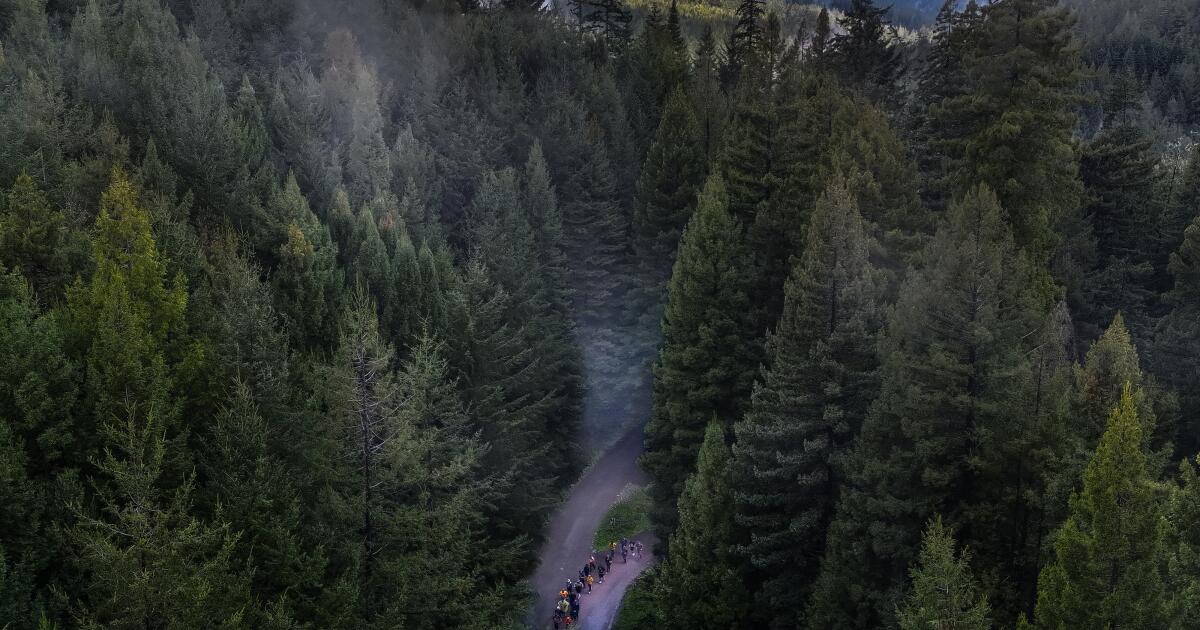
A group of “spirit runners” — a Native American tradition of bringing prayer — sprinted through the heart of Jackson forest as rain poured through the canopy. The mid-April event marked activists’ first major gathering since protests wound down in 2022.
Attendees gathered in a circle to wait for them. Misty Cook, of the Sherwood Valley Band of Pomo Indians, read a statement as eyes misted all around:
“All the living things around us, they miss us. They miss the language. They miss our touch, our hands, touching all of the things — the water, the plants. They miss the songs. They miss the beat of our footsteps and our voices, and they miss the children’s laughter and play, which was so important. They want us to gather them, to use them and to share them. Otherwise they will get sick and possibly die.”
Cal Fire launched a tribal advisory council to bring Indigenous perspective into Jackson. But some local tribes say it’s not enough because they lack decision-making power.
When the runners arrived, the circle absorbed them. Then they continued on to the site of a controversial proposed harvest, Camp Eight. They wrapped a bandana that belonged to Priscilla Hunter around a small tree — a quiet, somber act where she took her last stand. Runners took turns embracing the trunk.
Redwoods at the Capitol
In March, Rogers’ bill cleared a committee and is now in the Assembly Appropriations Committee’s suspense file. A hearing is set for Thursday.
Funding is a major point of contention. Environmentalists say funding these forests with timber operations incentivizes cutting bigger trees. Cal Fire maintains decisions are driven by forest health, not industry demand.
AB 2494 would fund the forests through a tax on lumber and engineered wood products. The shift could create “[o]ngoing state costs and cost pressures of an unknown but potentially significant amount, possibly in the low millions of dollars annually,” according to a legislative analysis.
The California Forestry Assn., a timber industry trade group, says the idea is a nonstarter.
Cal Fire declined to comment on pending legislation but Kevin Conway, the agency’s staff chief for resource protection and improvement, said its nearly 80-year history managing Jackson reflects “care and attention.” Since the state acquired the forest, “we have more trees on the landscape, more habitat and those trees are trending larger,” he said.
For the tribes who have rallied and prayed, a burning question is whether the land will again reflect their vision, or remain shaped by decisions made by others.
Buffie Campbell, executive director of the InterTribal Sinkyone Wilderness Council — co-founded by Priscilla Hunter and one of the groups supporting the bill — said young people wouldn’t be able to fathom the significance of the legislation passing. Maybe that’s a good thing.
“Maybe they don’t need to know about all the fighting that we have to do before they get to go out and enjoy and be tribal guardians stewarding their land.”


CALIFORNIA CITY, Calif. (KERO) — A 12-year-old boy is dead and another child was hospitalized after two unleashed dogs attacked a group of children at Central Park in California City on Friday, June 18.
California City Mayor Edwin Hawkins said police responded to the scene after reports that four children had been mauled.
Fernando Torres Moreno, 12, jumped into a nearby lake to escape the charging dogs. Officers pulled Fernando from the water, and he was taken to the hospital, where he died the next day.
A second child suffered serious, though non-life-threatening, dog bite wounds and has since been released from the hospital. Two additional children were shaken but did not require medical treatment.
Authorities say the dogs, both mixed breed, were off-leash but in the presence of their owner when the attack unfolded.
The investigation remains active and ongoing. No arrests have been made.
This story was reported on-air by a journalist and has been converted to this platform with the assistance of AI. Our editorial team verifies all reporting on all platforms for fairness and accuracy.
Stay in Touch with Us Anytime, Anywhere:

California’s high school baseball season may be over, but that means football season is on the horizon.
In just a matter of weeks, California’s top programs will return to the field looking to make their mark in one of the nation’s most competitive high school football landscapes.
The 2025 season delivered plenty of memorable moments, from Santa Margarita’s CIF Open Division State Championship Bowl Game title and a No. 3 spot in USA TODAY Sports’ Super 25 football rankings to major offseason roster moves. Now, a new stage is set as teams look to earn their way to the top stages in high school football.
When do teams return to action for the 2026 season? Here are all the dates to know:
California high school football season start dates: CIF
First practice date: July 27, 2026
Date of first games: Aug. 21, 2026
High school football practices for teams competing within the CIF in “Week 0” games get underway on July 27, 2026, with the date of the first games set for Aug. 21. Teams who have a bye in their schedule will play on this timeline.
Teams that do not have a bye in their schedule, and therefore do not have a “Week 0” game, will kick off on Aug. 28 with their first practice date set for Aug. 3.

The body of singer Oliver Tree was back in California this weekend after he was listed as a passenger on a helicopter that crashed above Rio de Janeiro one week ago.
His social media accounts on Sunday afternoon announced the return of his body after the June 14 collision of two helicopters, which killed all six people on board.
“Oliver is now back in California where he can finally rest,” the post said.
According to The Associated Press, police identified the five other people as Gaspar Prim Díaz, a popular Argentine YouTuber known as Gaspi; another Argentine, Lucas Vignale; and Brazilians Lucas Brito, Charles Marsillac and Alexandre Souza.
The cause of the collision was under investigation. The AP reported last week that authorities were investigating the possibility of human error by a pilot or air traffic controllers.
Tree, 32, had been performing in South America as part of a world tour. He had a show scheduled for June 6 in São Paulo, according to a schedule on his Facebook page.

The post Sunday thanked fans and supporters for an outpouring of devotion to the memory of the quirky and uplifting artist.
“The constant love, support and positivity is helping the family, friends and collaborators make it through these extremely difficult times,” it said.
Tree, whose real name was Oliver Tree Nickell, was from Santa Cruz. His father, Jesse Nickell, said he learned of his son’s death from a producer working on music with him in Brazil.
“Peace be with Oliver,” he said by text last week.
Tree was recognizable for his bright fashion, mullet haircut with prominent bangs, thin mustache and encouraging outlook. A motto on his Instagram account says, “No matter how strange you think you look, no matter how ugly you feel, you are beautiful.”
Tree also worked with marquee names in pop and electronic dance music. His biggest tracks were “Life Goes On,” which peaked at 71 on the Billboard Hot 100 in 2022, and “Miss You,” with German musician Robin Schulz, which peaked at 84 on the chart the same year.
Tree’s influence spread beyond chart data, however, and tributes poured in far and wide following last week’s news that he was on the passenger list of one of the aircraft.
The post on his social media accounts said he had been working on an endowment that would produce a grant and that the plan would be moving forward.
“‘Dr. Oliver Tree’s Extremely Epic Grant For Baby Geniuses’ coming soon,” the post said. “We will make sure his wish comes to fruition so that more joy, love and art can be spread into the world, that was his final wish.”
Speaking on the “Zack Sang Show” on YouTube in April, Tree discussed the grant and said his music was likely to be more valued after he died.
“That’s when people appreciate you, when you’re not there anymore,” he said.
The Instagram statement offered some assurance.
“Your legacy will live on forever,” it said.
-

 Health2 minutes ago
Popular mommy blogger dies at 48 two years after devastating cancer diagnosis
-

 Sports7 minutes ago
2026 World Cup Goals: Every Group-Stage Score Ranked From Best To Worst
-
 Business14 minutes ago
Bed Bath & Beyond begins reopening in California with a bonus: Old coupons will be honored
-
 Entertainment17 minutes ago
Liam Payne’s 9-year-old son is the sole beneficiary of his multimillion-dollar estate
-

 Lifestyle22 minutes ago
Frame: From Scandal to $300 Million in Sales
-
 Politics29 minutes ago
Facing FCC pressure, ABC launches campaign to support ‘The View’ and its TV stations
-
 Sports37 minutes ago
Dodgers defeat Twins, but lose Kyle Tucker and catcher Dalton Rushing
-

 World47 minutes ago
Belgium issues visas to Taliban delegation for EU migration talks

