North Carolina
Delta Sigma Theta Sorority, Inc. honors the legacy and fortitude of N.C. civil rights leader Dr. Willa Cofield


At the nexus of Black History Month and Women’s History Month, North Carolina educator and civil rights leader Dr. Willa Cofield was recently honored for her ongoing impact through activism.
The Enfield-Roanoke Rapids Alumnae Chapter of Delta Sigma Theta Sorority, Inc. recognized Dr. Cofield’s impact on March 2. The ceremony, hosted at First Baptist Church in Enfield, consisted of a voter awareness initiative, documentary screening, and march to Dr. Cofield’s new historic marker.
Delta Sigma Theta’s political awareness and involvement
Delta Sigma Theta Sorority, Inc. (DST) is a private, nonprofit organization with over 1,000 collegiate and alumnae chapters throughout the world. It is one of nine organizations that is part of the National Pan-Hellenic Council, also referred to as the “Divine Nine.” The sisterhood was founded on Jan. 13, 1913 by 22 women on the campus of Howard University. Deltas commit to a lifetime of public service, the first action dating back to the Women’s Suffrage March of 1913.

Since its establishment in 1975, the Enfield-Roanoke Rapids Alumnae (ERRA) chapter has specifically served Halifax and Northampton counties in North Carolina. Their recent event in Enfield focused on “political awareness and involvement,” one of the sorority’s national initiatives that are collectively termed the “Five Programmatic Thrusts.”
Ahead of the final days before the primary elections in North Carolina, ERRA extended an open invitation for candidates to attend, offered presentations to spread voter awareness, and discussed critical legislative issues at local, state, and national levels. In addition, family, friends, sorority sisters, and former students all recognized Dr. Cofield for her contributions as an educator and activist from the community.
A victory for both civil rights and academic freedom
Several major cities across the south have been identified as landmarks in the civil rights movement, particularly during the mid-through-late 1900s. Dr. Cofield continues to amplify the history and work that transpired in rural regions like Eastern North Carolina in the fight for social justice.
The Halifax County native transitioned to Virginia to pursue higher education at Hampton Institute, now Hampton University. It was there that her journey as a Delta took root as one of 37 women to charter the Gamma Iota chapter of the sorority.
In the years following, Dr. Cofield became an educator, teaching English at the all-Black Thomas S. Inborden High in Enfield. She was terminated because of her leadership in mobilizing her students through voter rights education during her time in the classroom. These kinds of actions are what contributed to the displacement of Black educators during that period.

According to the N.C. African American Heritage Commission (NC AAHC), in 1964, the larger Halifax Voters’ Movement successfully raised Black voter registration in the county, in addition to executing other non-violent demonstrations such as economic boycotts of white-owned businesses that discriminated against Black patrons.
Compounded by Dr. Cofield’s and her family’s deep civil rights and political engagement, they became targets for hatred and intimidation tactics from local law enforcement and the Klu Klux Klan. At the ceremony, Dr. Cofield shared her vivid recollection of a burning cross that the Klan planted in her front yard.
Despite the threats on her life, with the support of the National Education Association (NEA), Southern Conference Educational Fund (SCEF), and other advocates, Dr. Cofield filed a lawsuit against the Halifax County School Board and the State of North Carolina. The NCAAHC states that the ruling for the Johnson vs. Branch case ultimately impacted 100,000 teachers in the American South, adding that, “A victory for Johnson would mean protection for those current educators and future generations of Black teachers who would protest and demonstrate for the cause of civil rights.”

In August 1966, the Southern Patriot newspaper quoted John Salter, then a SCEF organizer, who described Dr. Cofield as “one of the very few teachers in that whole northeast section of the state who took a positive public stand on civil rights.” The court case decision was “a tremendous victory for both civil rights and academic freedom,” he added.
Rodney Pierce is a middle school social studies teacher at Gaston Stem Leadership Academy with Northhampton County Schools. Having learned of the history in Enfield, he submitted the application for the NCAAHC N.C. Civil Rights Trail for a Johnson vs. Branch historical marker to be placed in Enfield.
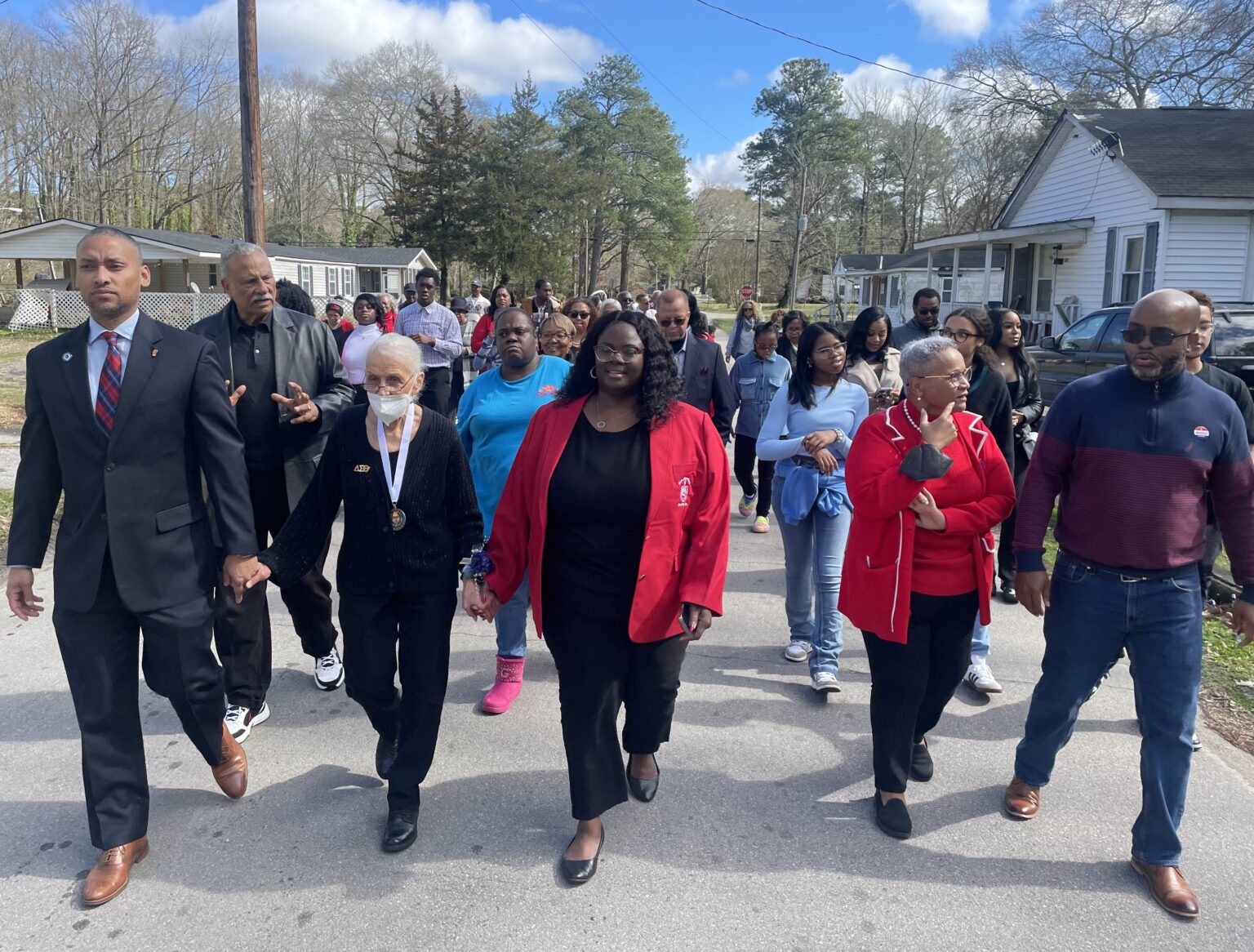
In celebration, Dr. Cofield led the march on March 2 from First Baptist Church to the location where a piece of her legacy is now publicly engraved.

‘Where were you when the whistle blew?’
Dr. Cofield eventually moved to New Jersey, where she received her doctorate in urban planning at Rutgers University. At the age of 95, Dr. Cofield continues her work as an activist and educator.
She has held roles with various organizations and programs over the decades, some of which include the North Carolina Fund, Livingstone College, the New Jersey Department of Education, and the SEED Project. Dr. Cofield also co-founded the NJ Black Women’s History Conference, a nonprofit whose mission statement is “to educate its members and the larger community regarding the historical achievements and contemporary concerns of Black women.”
Dr. Cofield has further explored storytelling through film in recent years. In 2011, she produced a documentary titled, “The Brick School Legacy.” Having been raised in Enfield, she grew up just a few miles away from what is now the Franklinton Center at Bricks. The Brick School, founded by Thomas Sewell Inborden in 1895, provided education for Black students in Eastern North Carolina and was the school that Dr. Cofield’s mother, Mae Cofield, graduated from. This documentary is the first of two produced by Dr. Cofield, capturing the oral history of the school and the land located in Whitakers, North Carolina.
Dr. Cofield’s second documentary, “The 9 O’Clock Whistle,” was co-produced by Karen Riley and Gail Cruise-Roberson. A screening was provided at the ceremony, where she shared that the title refers to a whistle that blew throughout the town once the clock struck 9 p.m. The documentary explains that the sound signaled that all of the Black people had to go home — a representation of segregation and injustice that rang throughout the south.
“The 9 O’Clock Whistle” official website provides the following description of the documentary’s contents:
“Set in the 1960s in Enfield, North Carolina, a small segregated town in northeastern North Carolina, the story unfolds through the memories of participants, some of whom were only fourteen and fifteen years old when the events took place. These brave souls stood up to mental and physical intimidation tactics and fought back, along with their adult counterparts. It was a Black Lives Matter movement that was 58 years ahead of its time.”
The narratives shared in “The 9 O’Clock Whistle” are also captured in a book format. For more information on how to request a screening of the documentary, visit the 9whistle website.



How to protect yourself against a shark
A safety diver calmly pushes away a shark, explaining how to stay safe if approached. (Credit: @mermaid.kayleigh/@andriana_marine via Storyful)
Claire Hardwick, Storyful
The Atlantic Ocean’s largest tagged great white shark in history recently resurfaced off the coast of North Carolina near the Outer Banks, scientists said.
At nearly 14 feet long, the big fish named “Contender” appears to be heading toward Cape Cod and the eastern coast of Canada, according to a OCEARCH, a global non-profit marine research group tracking shark sightings and migration.
Researchers first tagged the massive great white shark on Jan. 17, 2025 off the Florida-Georgia coast, according to online data from the non-profit.
Most recently Contender breached the surface just before 2 p.m. ET on July 10.
Prior to that, the shark had pinged several times including on April 14 and on April 23.
A ping means the Smart Position and Temperature Transmitting tag attached to the fish’s dorsal fin was spotted above the surface for a brief period as it swam, transmitting a near-live location signal to the OCEARCH shark tracker.
The visit comes at the time of year when great white sharks start migrating north to warmer waters for a larger food supply, as previously reported by USA TODAY.
How much does the largest great white shark tagged weigh?
According to OCEARCH’s shark tracker page, Contender weighs 1,653 pounds.
An adult male, the shark believed to be just over 30 years old.
“Contender’s name is in honor of Contender Boats, a longtime OCEARCH partner, whose industry-leading sport fishing and pleasure boats enable our research missions,” the non-profit wrote on its website.
See live view of tagged sharks that are tracked:
To track Contender and other tagged marine life online, download the OCEARCH Global Shark Tracker App, available on iOS, Android, and on desktop at ocearch.org.
Natalie Neysa Alund is a senior reporter for USA TODAY. Reach her at nalund@usatoday.com and follow her on X @nataliealund.

BUNCOMBE COUNTY, N.C. (WLOS) — Copper theft is becoming a growing problem across North Carolina, with AT&T officials warning that the crime can leave entire neighborhoods without phone or internet service and, in some cases, disrupt emergency communications.
According to AT&T, the company has recorded 215 copper theft incidents across North Carolina so far this year. Buncombe County alone has seen about 40 incidents over the past two years. Thieves often cut down or dig up communication lines, strip the copper from the wire and sell the metal for scrap.
“It’s problematic, largely from a public safety standpoint,” said Trey Rabon, president of AT&T North Carolina. “If folks need to call emergency services, need to call 911, they’re not able to access the infrastructure necessary to complete that call.”
“Sometimes we see instances where emergency communications are disrupted, communications between public safety agencies are disrupted,” Rabon added. “It has become an acute challenge, particularly in western North Carolina.”
5 CHARGED AFTER AT&T WIRE THEFTS CAUSED WIDESPREAD OUTAGES IN BUNCOMBE COUNTY
Rabon said thieves frequently target both residential and commercial communication lines, taking advantage of remote mountain locations where utility poles are often out of sight from nearby homes.
“In the mountains, oftentimes personal property is not in line of sight for other neighbors,” Rabon said. “Would-be thieves have the ability to climb a pole, disconnect a line, drive to the next pole and disconnect that line.”
In May, five people were charged in connection with multiple copper thefts across Buncombe County that investigators said caused widespread outages. Law enforcement also discovered several wire-stripping sites in Swannanoa and Leicester.
The thefts have also impacted local businesses.
SWANNANOA PIZZA SHOP SAYS INTERNET WIRES WERE STOLEN, FORCING A DAY CLOSURE
In early June, thieves cut and stole internet lines serving Good Pizza Company. Owner George Peyton said the outage forced the restaurant to close because employees could not access essential business systems.
“Nobody could clock in, couldn’t print tickets, couldn’t take phone orders, and that’s about 80 to 85% of the business,” Peyton said.
AT&T officials say one of the most effective ways to prevent copper theft is for communities to remain vigilant and report suspicious activity.
“They don’t like to operate in the light of day, and they certainly don’t want to operate with a hyper-aware and vigilant community,” Rabon said.
Anyone who suspects someone is stealing communication wire is encouraged to contact local law enforcement.

MYRTLE BEACH, S.C. (WPDE) — The Myrtle Beach Police Department announced Monday the arrest of a man wanted in North Carolina.
Officers arrested Leko Jones, 46, who was wanted by authorities in Burlington, North Carolina, according to the Myrtle Beach Police Department.
Jones is charged with attempted first-degree murder and assault by strangulation.
The arrest resulted from a coordinated effort between the Myrtle Beach Police Department’s Patrol Division and Investigations Division, working alongside the South Carolina Law Enforcement Division and the North Carolina State Bureau of Investigation.
Investigators said they safely located Jones and took him into custody.
-

 Utah5 minutes ago
Muslim man stabbed at Utah mall over his religion, authorities say
-

 Vermont11 minutes ago
Ben & Jerry’s Foundation says it will shut down amid legal dispute with parent company – VTDigger
-

 Virginia17 minutes ago
Drought emergency declared for parts of Virginia; governor warns of water restrictions
-

 Washington23 minutes ago
Trump fires WA US Attorney within an hour
-

 Wisconsin29 minutes ago
Wisconsin Lottery Powerball, Pick 3 results for July 15, 2026
-

 West Virginia35 minutes ago
Concerned West Virginians speak out against proposed Monongalia County power plant – WV MetroNews
-

 Wyoming41 minutes ago
July 15 recap: Wyoming news you may have missed today
-

 Crypto47 minutes ago
Luno Pushes South Africa to Rewrite Crypto Rules Through Parliament, Not Proclamation

