Vermont’s Attorney General’s Office and Human Rights Commission said Thursday that the state will continue to enforce local laws that protect people from discrimination based on their gender identity.
This comes after President Donald Trump signed an executive order stating that the federal government will only recognize two, unchangeable sexes — male and female — and will rework federal funding and policies accordingly.
Trump’s executive order effectively rejects the widely recognized medical condition known as gender dysphoria. That’s when someone experiences psychological distress because of a mismatch between their sex assigned at birth, and their gender identity.
The American Psychiatric Association says that forcing someone with gender dysphoria to identify as their sex assigned at birth can harm a person’s mental health, including increasing the risk of suicide.
Advertisement
Elodie Reed
/
Vermont Public
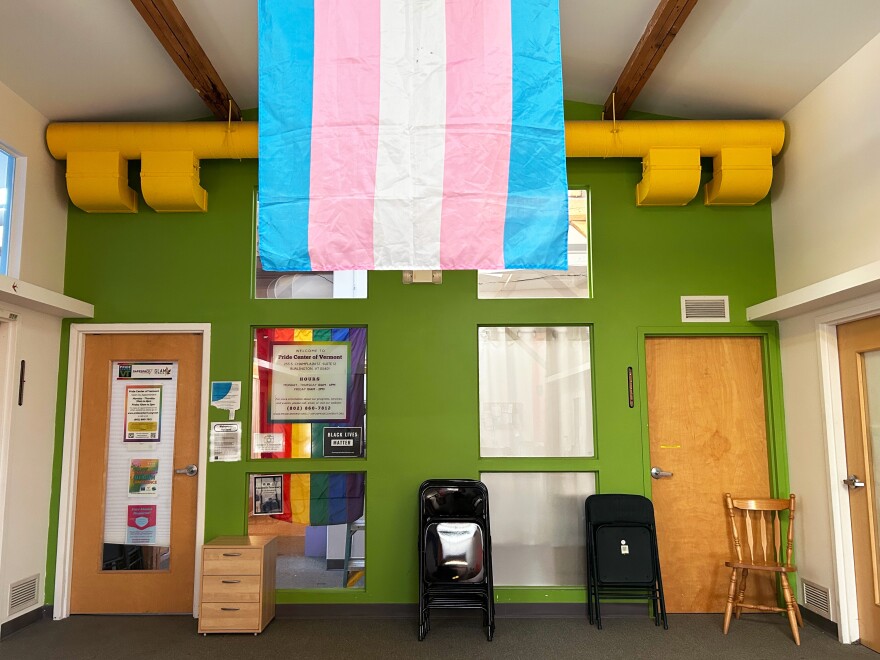
Signage at the Pride Center of Vermont is pictured on Wednesday, Jan. 22.
While state officials in Vermont are pledging to protect transgender and nonbinary people, organizations that work with these communities say people are worried. And they’re trying to prepare for the changes happening at the federal level.
Advertisement
Planned Parenthood of Northern New England, for example, has reported an increase in calls from patients wanting to talk about maintaining access to gender-affirming care.
And at the Pride Center of Vermont, Trans Program Manager and SafeSpace Advocate Em Russo says people are thinking through gender markers on their documents, coming together in support group settings and — finding moments of joy.
Russo sat down this week with Vermont Public health equity reporter Elodie Reed inside the Pride Center’s library in Burlington.
This interview was produced for the ear. We highly recommend listening to the audio. We’ve also provided a transcript, which has been edited for length and clarity.
Elodie Reed: We now have one executive order that Trump has signed, declaring there are two sexes. I guess I’m wondering how that’s landing — I know it’s only been a couple days, but how that’s landing so far in the community?
Advertisement
Em Russo: I mean, I think the vibes are palpable here — and I think that it’s a tough time. And that first executive order is obviously so harmful and invalidating for so many folks in our community.
But we, you know, added a couple of additional support spaces right before this to try to, like, lead up, for people to come and talk about what’s coming up for them. And then doing some more of that behind-the-scenes work with the ACLU and legal teams to know more of our rights, and know what implications this will have on us as an organization and also a community.
We can’t be erased. We have always been here. We always will be here.
Elodie Reed
Advertisement
/
Vermont Public
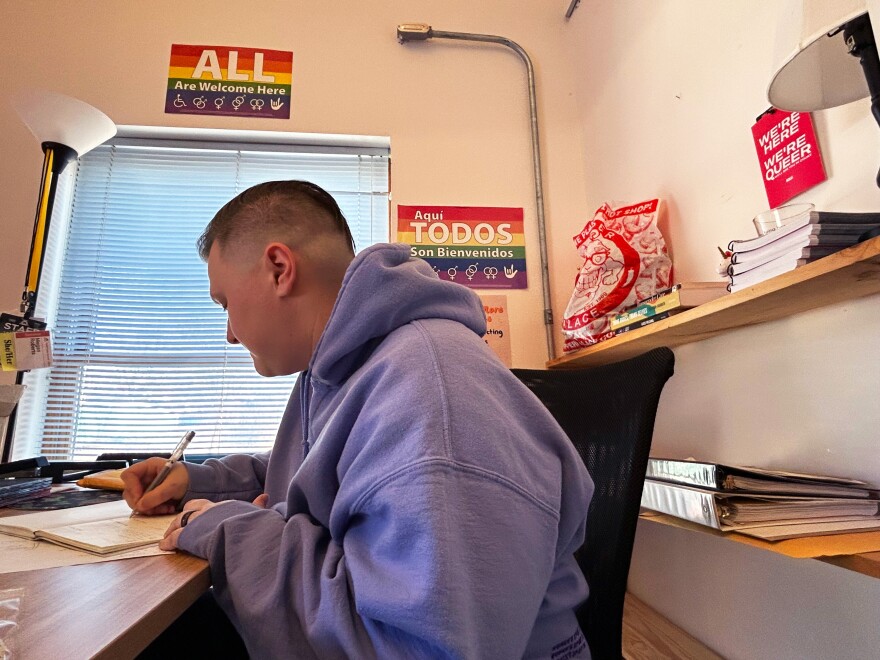
Em Russo in their office at the Pride Center, where they’ve worked for four years.
Elodie Reed: Do you know what the implications will be yet?
Em Russo: Invalidating so, so many people’s identities, obviously doesn’t feel good, but what legal implications that will have, we don’t necessarily know what that will look like yet.
There were ways that we were working with folks beforehand to kind of — if this happens, what can we do to protect ourselves? Is it changing your paperwork now before anything goes to the courts? And that is like an individual’s choice, right? So some people think, “Yes, I want all my things to match,” or “No, that’s not feasible.”
Advertisement
Elodie Reed: And by paperwork, you’re talking about, like, people’s gender marker on their official documents, passport?
Em Russo: Yeah, that. We also did a session with a family law attorney about how to protect your family, like your queer family, at this time. And that had to do a lot with paperwork around adoption and making sure for people who are like having children to know how to best protect them and their family here in Vermont. But then also, like, when you’re traveling.
Elodie Reed: Do you get federal funding for the Pride Center, and what happens now with that?
Em Russo: Yeah, we do receive federal funding. We don’t know anything for certain yet. But we’ve worked a lot on having plans. And just like, I think that is also kind of leaning on our communities, leaning on the allies that, you know, support us.
Now is the time to come together and find diverse funding streams and figure out because we’re not going anywhere. So if we have to shift course a little bit, we’ll shift course.
Advertisement
Elodie Reed
/
Vermont Public
The entrance to the Pride Center of Vermont in Burlington.
Elodie Reed: What are the resources folks are needing most?
Advertisement
Em Russo: So I think lately, the needs have been really focused on accessing services. There’s a lot of not knowing whether people will have access to medical care, and being able to have access to hormones has been a really big topic, as of late. We are working with pharmacies to see — ’cause we’ve heard there have been some shortages of hormones.
Housing is another big resource that we hear the most need for. We work with some other organizations to kind of give those resources for different housing and shelter options for folks.
And focusing our work on trans joy. So trying to, like, open this space up, the center space, to have folks drop in and be able to get some food and some warmth and just be here with community.
Elodie Reed: Can you talk a little more about joy events?
Em Russo: It’s such a big focus, I think,especially now when it feels like so many rights are being taken away from our community, to create spaces where we exist and we’re able to celebrate our identities and validate each other.
Advertisement
We have a TransPlant sale every year. That’s one of our happiest events, I feel. It’s where we just see a ton of people come together and get to, like, all dork out about plants and stuff, but then also be in space together, in kind of like a block party-style event.
Elodie Reed
/
Vermont Public
Advertisement
The entrance to Em Russo’s office at the Pride Center of Vermont, where they work as the Trans Program Manager and SafeSpace Advocate.
Elodie Reed: Do you mind if I ask, like, how you’re feeling when this is, you know, your life, but also your work?
Em Russo: I am part of the community that I work in, and so I definitely have some feelings of grief. And on Inauguration Day, had some spirally thoughts as I just kind of absorbed everything that was going on. And I think it was really easy to like, just kind of feel a lot of doom and sadness and realizing just how layered and deep this is for our community.
And we have seen a lot of people leaving places where they or their kids can’t get health care. And coming to Vermont as a place where there’s more access to gender-affirming care and it’s not illegal. Kind of just like feeling all of the weight of that, and then some gratitude of the state we live in, and just holding my friends and my community close.
It’s still a little fresh, but also ready to do what’s next and make sure that we’re protecting people as best as we can.
Elodie Reed: I appreciate you doing this with me during a complicated week.
Advertisement
Em Russo: Yeah, I thank you for having this conversation, it’s really important.
If you or someone you know is in crisis, you can call or text the National Suicide Lifeline at 988.
Have questions, comments, or tips? Send us a message.
ARLINGTON — The Preservation Trust of Vermont has officially presented The Arlington Common and Nick Albert of Albert Construction with a 2026 Preservation Award at the annual Downtown and Historic Preservation Conference.
The Preservation Awards recognize outstanding contributions to the preservation and revitalization of Vermont’s historic buildings and community spaces. The Arlington Common was selected for its “exceptional impact on community gathering and historic stewardship.”
The success of The Arlington Common relies heavily on the dedication of local partners who brought the vision to life. Among the key honorees was Albert Construction, led by Nick Albert, whose exceptional craftsmanship and dedication to historic integrity were vital to the project’s completion.
Advertisement
“Preserving historic structures requires more than just standard construction; it demands a deep respect for original materials, architecture, and community legacy,” said Don Trachte, Head of the Buildings and Grounds Committee and Arlington Common Board Member. “Nick Albert and the team at Albert Construction went above and beyond to ensure that every detail honored the past while engineering a space that will serve Arlington for generations to come.”
Powerball, Mega Millions jackpots: What to know in case you win
Here’s what to know in case you win the Powerball or Mega Millions jackpot.
Just the FAQs, USA TODAY
The Vermont Lottery offers several draw games for those willing to make a bet to win big.
Advertisement
Those who want to play can enter the MegaBucks and Lucky for Life games as well as the national Powerball and Mega Millions games. Vermont also partners with New Hampshire and Maine for the Tri-State Lottery, which includes the Mega Bucks, Gimme 5 as well as the Pick 3 and Pick 4.
Drawings are held at regular days and times, check the end of this story to see the schedule.
Here’s a look at June 25, 2026, results for each game:
Winning Gimme 5 numbers from June 25 drawing
13-14-18-21-22
Check Gimme 5 payouts and previous drawings here.
Advertisement
Winning Pick 3 numbers from June 25 drawing
Day: 2-1-4
Evening: 0-7-1
Check Pick 3 payouts and previous drawings here.
Winning Pick 4 numbers from June 25 drawing
Day: 5-4-4-9
Evening: 5-5-1-1
Advertisement
Check Pick 4 payouts and previous drawings here.
Winning Millionaire for Life numbers from June 25 drawing
03-13-14-34-45, Bonus: 01
Check Millionaire for Life payouts and previous drawings here.
Feeling lucky? Explore the latest lottery news & results
Are you a winner? Here’s how to claim your lottery prize
For Vermont Lottery prizes up to $499, winners can claim their prize at any authorized Vermont Lottery retailer or at the Vermont Lottery Headquarters by presenting the signed winning ticket for validation. Prizes between $500 and $5,000 can be claimed at any M&T Bank location in Vermont during the Vermont Lottery Office’s business hours, which are 8a.m.-4p.m. Monday through Friday, except state holidays.
Advertisement
For prizes over $5,000, claims must be made in person at the Vermont Lottery headquarters. In addition to signing your ticket, you will need to bring a government-issued photo ID, and a completed claim form.
All prize claims must be submitted within one year of the drawing date. For more information on prize claims or to download a Vermont Lottery Claim Form, visit the Vermont Lottery’s FAQ page or contact their customer service line at (802) 479-5686.
Vermont Lottery Headquarters
1311 US Route 302, Suite 100
Barre, VT
Advertisement
05641
When are the Vermont Lottery drawings held?
Powerball: 10:59 p.m. Monday, Wednesday, and Saturday.
Mega Millions: 11 p.m. Tuesday and Friday.
Gimme 5: 6:55 p.m. Monday through Friday.
Lucky for Life: 10:38 p.m. daily.
Pick 3 Day: 1:10 p.m. daily.
Pick 4 Day: 1:10 p.m. daily.
Pick 3 Evening: 6:55 p.m. daily.
Pick 4 Evening: 6:55 p.m. daily.
Megabucks: 7:59 p.m. Monday, Wednesday and Saturday.
Millionaire for Life: 11:15 p.m. daily
What is Vermont Lottery Second Chance?
Vermont’s 2nd Chance lottery lets players enter eligible non-winning instant scratch tickets into a drawing to win cash and/or other prizes. Players must register through the state’s official Lottery website or app. The drawings are held quarterly or are part of an additional promotion, and are done at Pollard Banknote Limited in Winnipeg, MB, Canada.
This results page was generated automatically using information from TinBu and a template written and reviewed by a Vermont editor. You can send feedback using this form.
Champlain Valley senior Zoey McNabb has been named the Vermont high school girls track and field athlete for the 2026 season, Gatorade announced Thursday, June 25.
The Gatorade award recognizes athletes for their on-field success, high academic achievement and exemplary character.
In her first year as a competitive runner, the 5-foot-7 McNabb broke long-held state records in the 1500- and 3000-meter races this past spring with times of 4 minutes, 28.59 seconds and 9:24.58, respectively. At the Division I state meet, she swept both events to help the Redhawks claim a team championship three-peat.
Advertisement
More: Why Vermont track and field officials reversed decision on 1,500 state record
Her 3,000 time ranked fourth nationally; her 1,500 performance was good for 12th. At the New England championship meet, McNabb took second in the 3,200 and third in the 1,600. She also ran in five events at New Balance Nationals, where she set the state record in the two mile.
An all-state basketball player for CVU, she has volunteered locally at the Green Mountain Montessori School in Essex in addition to donating her time as a youth basketball coach, according to the news release.
“Zoey was fearless this spring, attacking decades-old records and destroying them,” BFA-St. Albans coach Mike Mashtare said in a statement. “What made her special was how effortless she made it look with her smooth stride and relaxed running style.”
Advertisement
McNabb has maintained an unweighted 4.27 GPA in the classroom. She has signed a written letter of athletic aid to compete on scholarship at the University of Vermont this fall.
As part of Gatorade’s commitment to breaking down barriers in sport, every player of the year also receives a grant to donate to a social impact partner.
To learn more about the Gatorade Player of the Year program, visit playeroftheyear.gatorade.com.
ContactAlex Abrami at aabrami@freepressmedia.com. Follow him on X, formerly known as Twitter: @aabrami5.