Pennsylvania
How a rainy day and finicky fish launched a Pennsylvania program dedicated to unpaved roads


Some unpaved roads reveal nature’s simple engineering, like the path deer chose in a forest centuries ago. Native Americans used the deer paths to travel, and those trails widened over time for horses and buggies to become dirt roads.
Pennsylvania is home to approximately 23,000 miles of unpaved public roads, and there are likely thousands of miles more on private property and in the vast Allegheny National Forest. They’re more than just a quaint feature of rural America, too. School buses, mail and other delivery vehicles, first responders, and a growing number of gravel-loving cyclists and outdoor enthusiasts use them daily.
In places like Bradford County, which has the most miles of unpaved road in the state at just under 1,600, maintaining the dirt and gravel isn’t just about transportation and smoothing out a bumpy ride, though. It’s about water quality.
“With all those miles here, just about every dirt road in the county touches a waterway of some sort,” said Joe Quatrini, a dirt and gravel roads specialist with Bradford County’s conservation district.
Many dirt and gravel roads hug the banks of rivers and streams, two lines on a map following the path of least resistance like two synchronized snakes. On an ideal gravel road, rainfall disperses evenly across the surface, like a sheet of water, filtering through more land before it reaches a stream.
Unmaintained or “orphaned” roads that no one’s taking care of often sink or become deeply rutted, forming small bogs. When it rains, those rutted roads can funnel water, collecting sediment, trash, and other pollutants like pesticides, oils, and fertilizer into an erosive torrent that rushes into a creek. That sheer volume of water can wash away stone and rock beds that fish and other aquatic life need to breed.
“The sediment is the main impact from a dirt road, and that’s what our program aims to eliminate,” said Justin Challenger of the State Conservation Commission. “That’s why we’re more of an environmental program than a traditional, PennDot type of road program.”
The state’s effort to address sediment runoff from unpaved roads was inspired by some frustrated trout fishermen and resulted in the opening of Penn State’s Center for Dirt and Gravel Studies in 2001.
In the last two decades, Penn State’s unique program provided training and technical assistance for thousands of projects in nearly every Pennsylvania county. It has also advised a handful of other states, including Arkansas and Vermont, on how to develop their own.
Pete Ryan, a dentist and avid trout fisherman from Coudersport, in rural Potter County, saw that process play out time and time again on his favorite streams when it rained. One late-spring afternoon, in 1990, he eyed an overcast sky over coffee, looking for divine intervention in the charcoal clouds rolling through the county.
The sulfur and green drake mayflies were hatching all over northern Pennsylvania, and rainbow, brook, and brown trout would rise to eat them in the county’s cold, clear streams. Fishermen would try to fool a few into biting fuzzy hooks instead.
But Ryan hoped rain would ruin the fishing that day in “God’s Country,” so he could prove a point. And the heavens opened up.
“It was perfect,” Ryan recalled.
Ryan and another member of the God’s Country chapter of Trout Unlimited had invited a state biologist, a Penn State professor, and a fellow fly fisherman to Potter County to show them how those timeworn, unmaintained dirt and gravel roads affected water quality in those world-class trout streams.
Rain, like the kind they saw that day, flowed quickly into Big Moores Run, clouding up the water in the short term but also introducing pollutants and washing away rock.
“It was like pouring milk into coffee,” Ryan said of the runoff.
As a direct result from that rainy day in Potter County, a state task force on dirt and gravel roads was formed in 1993. For the next five years, volunteers from Trout Unlimited, a national nonprofit that advocates for clean waterways and fisheries, traveled the state, identifying approximately 900 sites where sediment from unpaved roads was disrupting waterways. The number of potential sites grew to 12,000.
State funding for maintenance was approved in 1997 and Penn State’s center opened in 2001, focusing on educating and training county conservation districts. From 1997 to 2013, the dirt and gravel maintenance program received $4 million in funding per year. That number jumped, in 2014, to $28 million with a minimum of $8 million per year dedicated to low-volume roads that see fewer than 500 cars per day.
“In most areas, the number of gravel roads are likely decreasing, but in some rural areas, when townships realize they can’t afford to maintain paved roads, they’ll actually rip it back up,” said Steve Bloser, director of the Penn State Center.
While students can’t major in “dirt and gravel roads” at Penn State, Bloser said, the center developed a “Rural Road Ecology” class primarily for forestry or engineering students.
On a recent winter’s day in Potter County, Pete Ryan and Andrew Mickey, the county’s dirt and gravel roads technician, took a drive out to Big Moores Run to see where the state’s gravel and dirt road maintenance program began.
Big Moores Run Road was covered in snow. Trout, Ryan said, are like the canaries in the coal mine—but for watersheds. They demand cold, clean water, free of pollutants. In Potter County, the trout population is thriving, because the roads are maintained.
“We don’t have development or industry,” Mickey said. “We just have a huge dirt-road network.”
When Mickey stopped his truck by a stream crossing, brook trout darted off in the clear water.
Fishermen aren’t the only group that care about dirt and gravel roads. All over the state, cyclists and runners are looking to gravel as a softer and safer substitute for traditional roads. Dave Pryor runs unPaved Pennsylvania, which promotes gravel and dirt bicycle riding and racing. He sees the state’s abundance of gravel and dirt roads not only as a playground but as an economic driver.
The 2021 unPAved race of the Susquehanna River Valley Pryor hosted saw more than 800 participants from all over the country converging on Lewisburg, Union County, for a weekend.
“There were a lot of events in the Midwest, and I figured we need to do this in Pennsylvania,” Pryor said. “The public lands we have in Pennsylvania are gems. We have miles and miles of quiet, gravel roads. We have some of the best in the country.”
On a fall day in Lehigh County last year, Pryor was out scouting random gravel roads near Emmaus. Like many, this one ran beside a creek. People lived along it, and every few minutes or so, a car would pass. Farther down the road, a metal sign credited the county’s conservation district and the Penn State center for a reconstructed stream crossing.
“Better roads, cleaner streams,” the sign read.
Pryor said he’s raced in other states where rainfall all but shuts riding down.
“Or it gets so muddy you have to walk your bike,” he said. “Here, it could rain for a week, and you’d get wet, but you’d still be able to ride.”
The bicycle industry now makes gravel-specific bikes that can cost as much as $6,000. There are magazines dedicated to dirt and gravel riding, and Pryor’s wife, Selene Yeager, wrote a book about the phenomenon called Gravel!
“Gravel riding is the hottest thing in bikes right now,” Outside Magazine wrote in 2020.
The Penn State center said Philadelphia is the only county in the state without a conservation district, and the city isn’t on its list of counties with unpaved mileage. The city does have dirt and gravel roads in parks, however, including Forbidden Drive, a gravel road that mostly serves as a popular recreation area for cyclists, runners, and hikers. It runs just feet from Wissahickon Creek.
In 2020, Pennsylvania’s dirt, gravel, and low-volume road maintenance program helped build or replace more than 1,200 culverts to break up surface water flow. It builds buffers and bridges and fills in roads that have become “entrenched,” or sunken, after decades of use. The program used 395,000 tons of fill to build them back up in 2020.
“Some of these roads can be 100 years old,” Bloser said.
While COVID-19 affected the number of projects able to be done in recent years, Bloser expects work to ramp up again in the coming years.
On very rare occasions, when homeowners and other stakeholders are gone and public use has dwindled, some counties will give their unpaved roads back to nature. That’s often the case with old logging roads. Bloser said the goal, in those rare instances, is to “obliterate” the road and fill it in.
Grasses grow again, then trees, and roads slowly become hiking trails and deer paths again.
2025 The Philadelphia Inquirer, LLC. Distributed by Tribune Content Agency, LLC.
Citation:
How a rainy day and finicky fish launched a Pennsylvania program dedicated to unpaved roads (2025, April 10)
retrieved 10 April 2025
from https://phys.org/news/2025-04-rainy-day-finicky-fish-pennsylvania.html
This document is subject to copyright. Apart from any fair dealing for the purpose of private study or research, no
part may be reproduced without the written permission. The content is provided for information purposes only.



The boat dock at the entrance of Penn’s Cave.
HUNTER SMITH / THE EXPRESS

HUNTER SMITH / THE EXPRESS
The colored light room in Penn’s Cave.
BELLEFONTE — After four generations of family stewardship, the owners of Penn’s Cave and Wildlife Park are asking the state to take over one of Centre County’s most iconic attractions in an effort to preserve it from future development.
Following remarks from CEO Russ Schleiden and his daughter, Jeanine Watson, the Centre County Commissioners on Tuesday endorsed the plan to make the natural wonder Pennsylvania’s 126th state park.
“This has been a very difficult decision for us,” said Schleiden. “But we feel that it’s a very important part of, not only Centre County, but the Commonwealth of Pennsylvania, and that it should be preserved in perpetuity.”
The Schleiden family has spent decades as custodians of America’s only all-water, limestone cavern, working to expand and conserve Penn’s Cave, which contains the headwaters of Penn’s Creek. To ensure the 1,400 acres of land and its waters are around for generations to come, the family is petitioning the Pennsylvania Department of Conservation and Natural Resources (DCNR) to designate the Penn’s Cave estate a state park and take over its stewardship.
The proposed transfer includes the cavern, Cave House, surrounding land and waterways, five homes and several barns. Watson said the family has been working toward the proposal for three years.
“I know the state, DCNR, has wonderful plans and visions for enhancing it and taking it to that next level beyond what we could do,” she said.
Penn’s Creek, which starts in the cavern, flows 34 miles to Selinsgrove where it joins the Susquehanna River Basin before emptying into the Chesapeake. The state has made significant investments in protecting those waters, and the proposed transition would expand that work.
“The tributaries also support the native brook trout,” said Schleiden, naming specifically Little Poe and Big Poe creeks, which are known for their fishing.
Penn’s Cave, he said, has always been supportive of “wildlife for everyone.”
With the commissioners’ help, Penn’s Cave and Wildlife Park has invested $2 million into the local wetlands, protecting local fauna while improving the area’s accessibility. Schleiden said transferring ownership to the state would ensure that mission remains central to the property.
“We strongly desire this to go to the state to protect and continue to conserve, and have it available to the public,” Watson said.
The property also carries historical significance. Penn’s Cave and Hotel was listed on the National Register of Historic Places in April 1978 for its local importance.
The Cave House, or hotel, was built in 1885 by the Long family, who first commercialized the cavern. At the time, visitors traversed the cave by boat using lanterns. That changed in 1927, when the Campbell family, who emigrated from Scotland to the land, electrified the cave.
“It probably had electricity before more than most of the local residents,” Schleiden said.
State Rep. Kerry Benninghoff, who helped coordinate with the state on the proposed transition, also joined the commissioners for the discussion.
Benninghoff said the move would require the endorsement of the governor and both chambers of the General Assembly. The governor is aware of the plan and visited the site last year, and Benninghoff said he has drafted legislation outlining the mechanics of the transition.
“I can’t think of a better time in our country and our county’s history, at the semiquincentennial, to make this a reality,” he said. “If you want to look at Americana in its best, the park I think exemplifies that.”
“In the long run, I think this is a tremendous investment for the commonwealth,” Benninghoff said, noting the transition would not be easy but the commissioners’ endorsement could help move the project forward during this budget cycle.
The proposal also carries potential economic benefits for the region.
Penn’s Cave and Wildlife Park already attracts visitors from all 50 states and several countries. During its peak season, the park employs dozens of local community members. The attraction is a multigenerational employer in Gregg Township, providing jobs for members of the Schleiden family and their employees, many of whom are young adults and teens.
Transferring ownership to DCNR and becoming Pennsylvania’s 126th state park could increase tourism and economic engagement in the area, the owners said. State parks in rural communities often bring tourism dollars and expand employment opportunities as operations grow.
Benninghoff said he could envision additional public amenities, including a campground, while emphasizing the property would remain accessible.
“This is not going to be an exclusive property that no one can access,” she said. “It’s actually one we want more people to enjoy.”
The commissioners each praised the work Schleiden and Watson have done and expressed support for the state park designation, citing the conservation, education, historical, tourism and recreational benefits of the proposal.
“Penn’s Cave is a premier tourist attraction in Centre County,” said Commissioner Mark Higgins, who noted it is one of only a few caves accessible by boat worldwide. “With the trout in the water and the wild animals surrounding it in the wildlife park, it’s a really, really fun half-day attraction to visit.”
“It’s just irreplaceable,” he said.
Commissioner Amber Concepcion called the property “an outstanding area of natural beauty” and added that it provides an opportunity for education and recreation.
“It’s a great place for kids to learn and for adults and people of all ages to spend a summer afternoon,” she said. “It would make a fantastic state park.”
Dershem called the opportunity “once in a lifetime” and said it would be a “crying shame” if the property were developed instead.
“This is an amazing opportunity for the Commonwealth of Pennsylvania to invest in a property that is literally irreplaceable, iconic to our region and unique. I don’t know that you’ll find anything quite like it,” Dershem said. “It’s an amazing place.”
Penn’s Cave, he added, “represents who we are in Centre County” and is “natural splendor at its best.”
Benninghoff said their support will emphasize the urgency of completing the transition to state legislators.
“This endorsement by the county, visitors bureau and other people helps to emphasize that we’d really like to get this done, and time is of the essence,” he said. “People have been knocking on their door, wanting to purchase this land and break it all apart, and a lot of it would go into development.”

STATE COLLEGE, Pa. (WJAC) — It was a strong opening day in State College for the 60th anniversary of the Central Pennsylvania Festival of the Arts.
The festival kicked off with the traditional children’s day festivities.
Kids lined South Allen Street, displaying and selling their latest creations.
6 News spoke with one of the young businessmen there — Trevor Winterich — who was busy with his 3D toys.
On Thursday, the festival’s sidewalk sales open, featuring artists and performers from across the country.
BE THE FIRST TO COMMENT
The festival will then wrap up on Sunday.
Pennsylvania
Pennsylvania state trooper to be laid to rest after being fatally struck in Schuylkill County

BUTLER TWP., Pa. (WPVI) — A Pennsylvania State Trooper who was killed in a crash on Interstate 81 will be laid to rest Wednesday.
A public viewing for Trooper Michael Pahira, Jr., is scheduled from 8 a.m. to 10 a.m. at North Schuylkill High School in Butler Township.
A funeral will follow at 11 a.m.
Trooper Pahira was fatally struck on I-81 last week by a tractor-trailer while conducting a safety inspection on another truck in Cass Township, Schuylkill County.
According to state police, a passing commercial vehicle hit Pahira while he was conducting the inspection with his emergency lights activated.
The alleged driver, 33-year-old Michael Bon, is facing homicide charges. He is being held on $700,000 bail.
Pahira, 44, was assigned to Troop L, Frackville and had been with the state police for 20 years.
Copyright © 2026 WPVI-TV. All Rights Reserved.
-

 Technology2 minutes ago
Medical identity theft follows you into the doctor’s office
-
 Business9 minutes ago
California soccer fans sue StubHub after it fails to deliver expensive World Cup tickets
-
 Entertainment12 minutes ago
Lucas Museum to give free annual passes to South L.A. neighbors, host community preview day
-
 Lifestyle17 minutes ago
Meow Wolf taps famed L.A. animation house for its new Los Angeles venue
-
Politics24 minutes ago
Column: Trump decries ‘communism’ while his government takes ownership of companies
-
 Science27 minutes ago
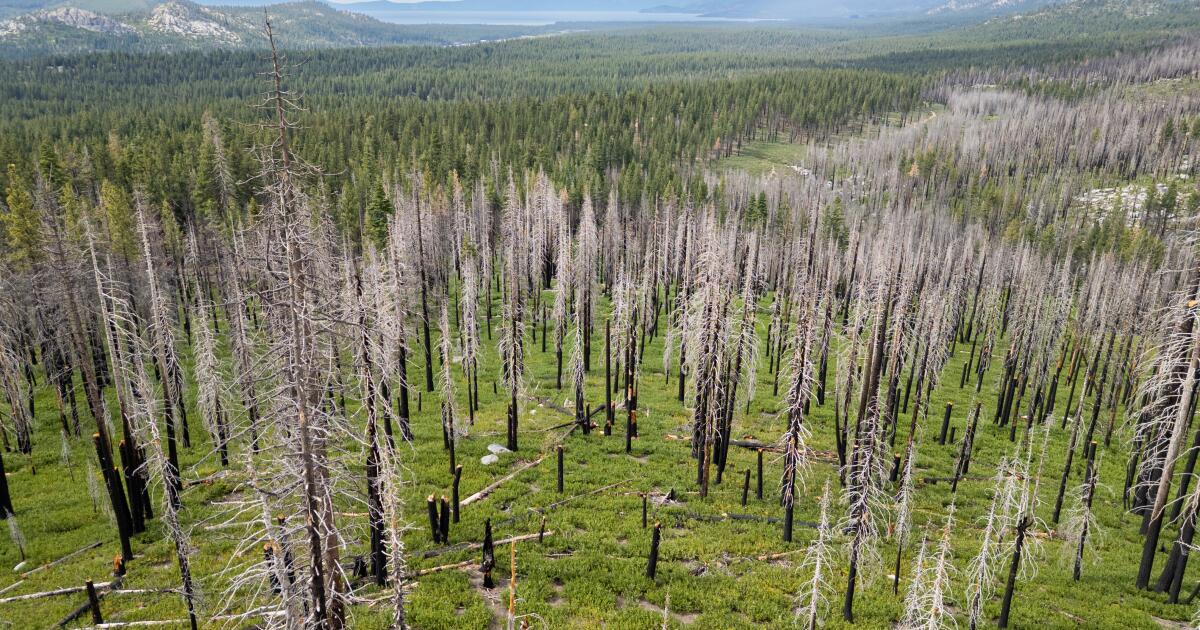
‘I’d rather my house burn down than get cancer’: Herbicide use upends California’s fight to save forests
-
 Sports32 minutes ago
Dodgers scheduled to visit White House in late July to celebrate 2025 World Series win
-

 World42 minutes ago
Former US Olympian pleads not guilty in DC reflecting pool vandalism case


