Northeast
On this day in history, February 24, 1914, Joshua L. Chamberlain dies, college professor turned Civil War hero

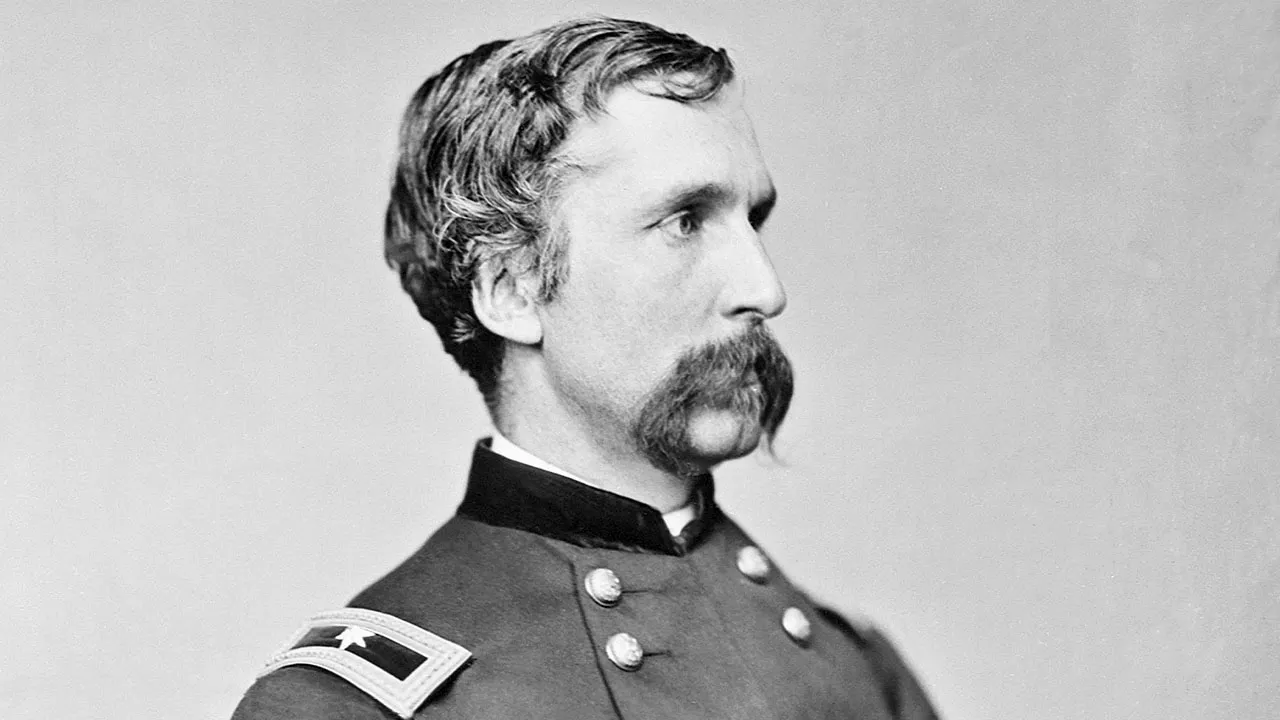
Joshua Lawrence Chamberlain, a bookish professor of rhetoric at Bowdoin College in Maine who became the Union’s most celebrated combat hero of the Civil War, died on this day in history, Feb. 24, 1914.
Brig. Gen. Chamberlain was 85 years old.
“A veritable icon of Civil War legend, Joshua Lawrence Chamberlain is best known for his heroic participation in the Battle of Gettysburg,” writes the American Battlefield Trust.
ON THIS DAY IN HISTORY, FEBRUARY 23, 1945, US MARINES RAISE AMERICAN FLAG OVER IWO JIMA, CAPTURED IN HEROIC PHOTO
“Prolific and prosaic throughout his life, Chamberlain spent his twilight years writing and speaking about the war.”
His death was attributed at least partly to some of the incredible six wounds he suffered and survived in battle 50 years earlier.
Studio portrait of General Joshua Chamberlain, a federal officer during the American Civil War. Chamberlain won the Medal of Honor for his heroism while commanding the 20th Maine Infantry during the defense of Little Round Top at the Battle of Gettysburg. (CORBIS/Corbis via Getty Images)
His ability to continue fighting despite numerous wounds, in an era in which whiskey and amputations were common treatments in battlefield medicine, was among his many remarkable successes as soldier.
Chamberlain is the last Civil War soldier to die of injuries suffered in combat, according to the Department of the Defense.
He was “a veritable icon of Civil War legend.” — American Battlefield Trust
Colonel Chamberlain earned the Medal of Honor for his heroic leadership of the 20th Maine Infantry at Gettysburg.
He later had the honor of accepting General Robert E. Lee’s surrender at Appomattox.
WWII LOVE LETTERS HIDDEN BEHIND WALL IN NEW YORK HOME DELIVERED TO FAMILY 80 YEARS LATER
He served four terms as governor of Maine, wrote a powerful chronicle of the last months of the war, “The Passing of the Armies,” and returned to academia, spending 12 years as president of Bowdoin.
Chamberlain’s legend was forged on Little Round Top, on the far left flank of the vast Union army at Gettysburg, Pennsylvania, on July 2, 1863.
An American flag that flew over a base in Iraq, and a portrait of Union Civil War General Joshua Chamberlain, are among the patriotic touches that line the walls of the Freedom General Store in Freedom on June 30, 2014. (Gabe Souza/Portland Portland Press Herald via Getty Images)
Chamberlain’s 20th Maine repelled numerous Confederate charges but ran out of ammunition.
He could not retreat and he could not surrender — or the rebels might roll up the entire Union line and possibly win the war with a stunning victory in the northern state.
Chamberlain responded with a dramatic bayonet charge down the hill, a turning point in American history that was immortalized in the Pulitzer Prize-winning 1974 historical novel “The Killer Angels” by Michael Shaara and again in the 1993 movie, “Gettysburg.”
“Chamberlain raised his saber, let loose the greatest sound he could make, boiling the sound up from his chest.” — Michael Shaara
“Chamberlain raised his saber, let loose the greatest sound he could make, boiling the sound up from his chest,” Shaara wrote in the dramatized account of the historically accurate encounter.
“Fix bayonets! Charge! Fix bayonets! Charge! Fix bayonets! Charge! He leaped down from the boulder, still screaming, his voice beginning to crack and give, and all around him his men were roaring animal screams,” wrote Shaara.
“He saw the whole regiment rising and pouring over the wall, and beginning to bound down through the dark bushes, over the dead and dying and wounded, hats coming off, hair flying, mouths making sounds, one man firing as he ran, the last bullet, the last round.”
General Robert Lee surrendering to General Ulysses Grant at Appomattox, on April 9, 1865, American Civil War, 19th century. General Joshua Lawrence Chamberlain ordered Union troops to salute the Confederate troops to begin the process of healing the nation. (Getty Images)
The frenzied charge swept away four Confederate regiments. About 2,000 men were killed, wounded, surrendered or retreated.
The rebel army lost the battle the following day, with the heroic but ill-fated disaster of Pickett’s Charge.
Chamberlain’s beautifully written work, “The Passing of the Armies,” published posthumously in 1915, serves as a foundation of scholarship of the final year of the Civil War and offers sobering insight into of the minds of men in combat.
MEET THE AMERICAN WHO WROTE ‘THE BATTLE HYMN OF THE REPUBLIC’
“The hammering business had been hard on the hammer,” he wrote of the tragic Union casualties suffered while trying to pound the Confederates into defeat at Petersburg in the final months of the war.
Chamberlain was later given the duty of accepting General Lee’s surrender at Appomattox, adding to his legend among Civil War soldiers.
“Grant wished the ceremony to be as simple as possible, and that nothing should be done to humiliate the manhood of the southern soldiers,” Chamberlain wrote in “The Passing of the Armies.”
Portrait of General Joshua L. Chamberlain, 1908, Joseph B. Kahill, pastel on paper/pastel board, 29 3/8 in. x 22 1/16 in. (74.61 cm x 56.04 cm). (Sepia Times/Universal Images Group via Getty Images)
He ordered his columns to salute the defeated Confederate troops — helping set the tone of the peace in Lincoln’s stated hope “with malice toward none and charity toward all.”
“It was not a ‘present arms,’ however … which then as now was the highest possible honor to be paid even to a president,” Chamberlain later said.
“It was the ‘carry arms,’ as it was then known, with musket held by the right hand and perpendicular to the shoulder.”
“Throughout the war, Chamberlain was wounded six times, most grievously at Petersburg in June 1864,” writes American Battlefield Trust.
“Believing this wound to be mortal, Congress promoted Chamberlain to the rank of brigadier general. Chamberlain, however, would survive the wound, and return to the front in time to play a pivotal role in the Appomattox Campaign.”
“Grant wished … that nothing should be done to humiliate the manhood of the Southern soldiers.” — Chamberlain on end of war
His achievements with both sword and quill make him one of the most remarkable soldiers in American history.
“Our place in human brotherhood, our responsibility not only in duty for country, but as part of its very being, came into view,” he wrote of serving the nation in wartime.
Pickett’s Charge, Battle of Gettysburg, Civil War, 1863. The ill-fated charge came the day after the Confederate failure to move the 20th Maine Infantry off Little Round Top at the far southern end of the battlefield. (Universal History Archive/Universal Images Group via Getty Images)
His legend was cemented in that decisive moment of action on July 2, 1863, for which he was awarded the nation’s highest honor for valor.
Some historians argue that the heroic Chamberlain not only saved the Union army at Little Round Top, but saved the cause of the Union itself.
“The regiment’s sudden, desperate bayonet charge blunted the Confederate assault on Little Round Top and has been credited with saving Major General George Gordon Meade’s Army of the Potomac, winning the Battle of Gettysburg and setting the South on a long, irreversible path to defeat,” reports American Battlefield Trust.
For more Lifestyle articles, visit www.foxnews.com/lifestyle.
Read the full article from Here


The Boston Celtics path to remaking the end of their bench and getting under the tax line without touching any of their regular rotation players (and actually giving one of them a promotion) is now complete, and with room to spare.
As you probably remember, the Celtics traded away Xavier Tillman, Josh Minott, and Chris Boucher at the trade deadline without getting a player in return. The Celtics then played a shell game with those three spots at the end of their bench, threading a needle many thought was impossible when the season started.
After a series of 10-day contracts, Charles Bassey among them, the Celtics upgraded two rookie contracts to fill two of those roster posts.
Max Shulga, drafted 57th overall and initially signed to a two-way contract, was upgraded to partially non-guaranteed standard contract. Amari Williams, drafted 46th overall, was also signed to a similar, partially non-guaranteed standard contract.
Charles Bassey then signed two 10-day contracts, the second of which expired today, leaving Boston under the mandatory 14-man roster limit. To fill that, the Celtics made the highly-anticipated move of upgrading Ron Harper Jr.’s deal. It’s a two-year deal that will be similarly structured.
Harper has had a breakout season with the Celtics. He’s only averaging 3.4 points per game this season, but he’s had several standout games. He scored 22 points against the San Antonio Spurs, helping make up for Jaylen Brown’s ejection and giving Boston a chance to win. He also had a tremendous performance against the OKC Thunder, where he was a +15 in a two-point loss.
So this is a fitting reward for a player who has earned his spot.
“Ron has worked,” Joe Mazzulla recently said about Harper Jr. “The way he plays in games against San Antonio and OKC is the way he plays in a state-ready game, it’s the way he plays in a G League games, it’s the way he plays in practice. So he cares about winning, he cares about competing. And he executes the details very well in all settings. And so his ability to think the game and compete is top notch. He’s getting better and better.”
The upgraded contract means Harper Jr. is now eligible to play in the playoffs, which two-way players are not.
The moves have now put Boston about $38,000 under the tax, a miniscule number that is the NBA equivalent of counting out pennies at the cash register (and maybe using the take a penny, leave a penny tray). They still have an open roster spot, and the the $38,000 is enough for them to sign someone on the last day of the season and also carry him into the playoffs in case of an emergency. So it’s possible there’s another move yet to come.


Once again, Connecticut Magazine has surveyed a panel of food experts to share their favorite places for it Top Restaurants for 2026 list. Experts have named restaurants in dozens of categories, from top cuisine (American, Mexican, Chinese, vegetarian, etc.) to outstanding apps and desserts, romantic ambiance, beer and wine selections and the top places to grab a burger or a slice of apizza.
266 S. Main St., Newtown, 203-304-9383
62 Main St., New Canaan, 475-256-5657
14 Danbury Road, Wilton, 203-210-7894 / 203-210-7895
929 Bank St., New London, 959-201-6913
65 Howe St., New Haven, 203-562-6226
385 Bank St., New London, 860-574-9414
150 State St., New London, 860-439-1809

Wisconsin basketball adds SEC opponent to 2026-27 schedule

Oklahoma vs. West Virginia odds, prediction: 2026 The Crown Tournament championship picks from proven model – SportsLine.com

Educators learn lessons of justice and memory at Heart Mountain workshop in Wyoming

What Is Risk Management in Crypto Trading? A 2026 Guide

Islanders encouraged to check car finance deals

Florida High School Football Rankings: Top 25 teams – Oct. 21

How old is Bo Nix? What to know about Oregon quarterback ahead of 2024 NFL Draft

Cleary's 21 help Le Moyne down Central Connecticut State 69-64 in OT

99th annual Pony Swim held in Virginia

Indiana Members Credit Union announced as new anchor tenant at Bottleworks District

DHS slams Democrat Sen Chris Van Hollen claim, says illegal alien caused crash while fleeing ICE

Zelenskyy warns US-Iran war could divert critical aid from Ukraine

After the Minnesota surge, ICE is moving to a quieter enforcement approach

FBI’s Patel delivers blunt warning to law enforcement attackers: ‘We’re going to put you down’

Indonesia receives bodies of peacekeepers killed in southern Lebanon
-

 South-Carolina1 week ago
South Carolina vs TCU predictions for Elite Eight game in March Madness
-

 Education1 week ago
Video: Transgender Athletes Barred From Women’s Olympic Events
-

 Miami, FL1 week ago
Jannik Sinner’s Girlfriend Laila Hasanovic Stuns in Ab-Revealing Post Amid Miami Open
-

 Minneapolis, MN1 week ago
Boy who shielded classmate during school shooting receives Medal of Honor
-

 Vermont1 week ago
Skier dies after fall at Sugarbush Resort
-

 Politics1 week ago
Trump’s Ballroom Design Has Barely Been Scrutinized
-

 Atlanta, GA7 days ago
Fetishist ‘No Kings’ protester in mask drags ‘Trump’ and ‘JD Vance’ behind her wheelchair
-

 Movie Reviews3 days ago
Vaazha 2 first half review: Hashir anchors a lively, chaos-filled teen tale