Entertainment
Jack Black joins ‘SNL’ Five-Timers Club with help from Jonah Hill and Melissa McCarthy

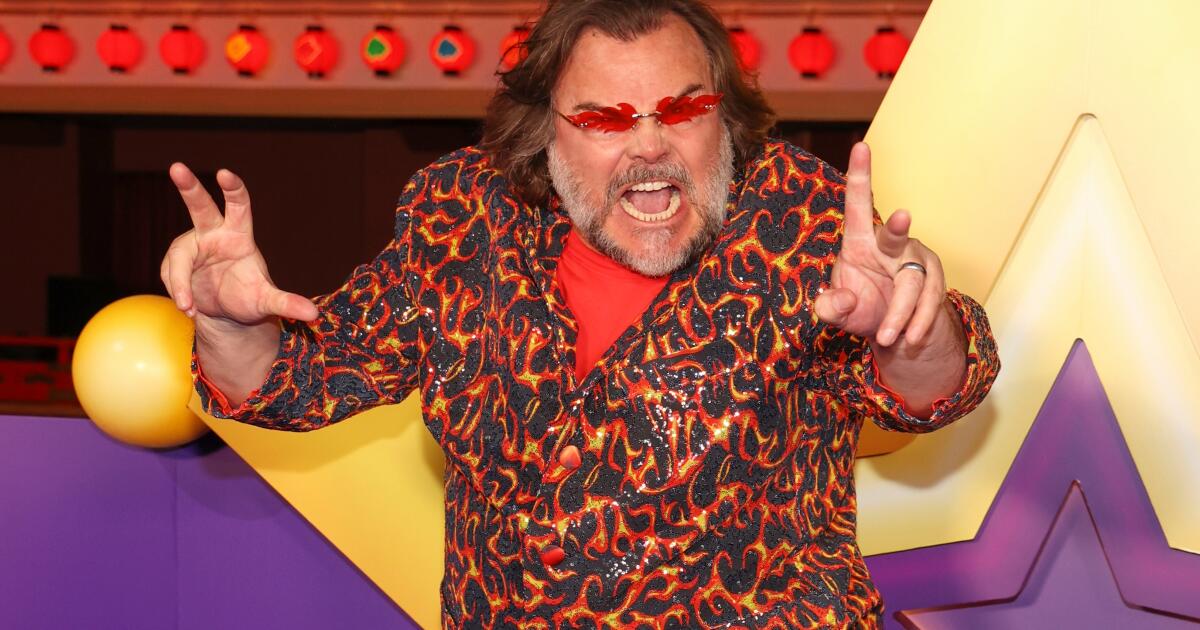
Almost a year ago to the day, Jack Black hosted “Saturday Night Live” for the first time in 20 years, fresh off the success of “A Minecraft Movie.” Now, the star of another freshly minted videogame-to-movie hit, “The Super Mario Galaxy Movie,” has returned after crushing it last time with a high-energy performance.
Having reached the Five-Timers Club, as addressed in an obligatory monologue sketch featuring Jonah Hill, Tina Fey, Candice Bergen and others, Black was a returning hero. He’s frequently cited as one of the favorite hosts among the cast. And while this time may not have reached the frenetic highs of last year’s manic and musical outing, it had some memorable moments.
Most notable was a video for a country-style song about gaining wisdom and then completely forgetting what that wisdom was. Black sang in that sketch along with musical guest Jack White. Black also appeared as a frustrated office worker trying to get a coworker (Ashley Padilla) to stop talking to him and others annoyed by the woman.
Black paired up with Marcello Hernández to play martial arts instructors who teach unorthodox self-defense methods. It played to Black’s physical comedy chops, but something felt off about the execution, especially because of the hard-to-understand dialogue. Black played the last Spartan to be considered for inclusion in the group of 300 Greek fighters against Persia (spoiler: he doesn’t make it in). He played an intrusive Airbnb host with Melissa McCarthy, who was also on board for the Five-Timers sketch.
And, finally, he played one of a set of awkward husbands who come to life singing “Carry On Wayward Son” together.
While the monologue was a blast of fresh chaos (or at least the sense of chaos) with Black jamming out with White, the rest of the show didn’t have the same kind of verve, falling back on familiar sketch formulas. That said, Black committed throughout and sang well when he had the opportunity.
Musical guest Jack White appeared in a few sketches and performed “Derecho Demonico” and “G.O.D. And The Broken Ribs.”
Breaking a streak of cold opens featuring President Trump and/or members of his cabinet, this week’s opening sketch featured instead a March Madness NCAA post-game roundup featuring Ernie Johnson (James Austin Johnson), Kenny Smith (Kam Patterson), Charles Barkley (Kenan Thompson) and coach Bruce Pearl (Jeremy Culhane). The joke here was that Barkley, already known for being outspoken, has been getting kudos for speaking out in favor of immigrants on a CBS broadcast. On the show, he jokes that it’s “the first time I went viral without a prescription for Valtrex.” Emboldened, this version of Barkley keeps saying he’s going to be careful with his words, before weighing in on the Iran war, the Artemis II space mission (“A waste of money. They just flying around the moon.”) and the firing of former U.S. Atty. Gen. Pam Bondi. Bondi (Padilla) appeared to refute the comments, referring to “The final four… years of this country.” Barkley said he was going to choose his words carefully one more time before delivering, “Live from New York… It’s Saturday Night!”

For his induction to the Five-Timers Club, Black was joined by a jacket-clad Hill who revealed that there’s something wrong with the lounge where the Five Timers hang out. The room, indeed, appeared spooky and abandoned with cobwebs and Fey wearing a robe made out of Paddington, which she said she got after hosting “SNL UK” last month. Fey revealed the lounge has fallen apart after literally being run into the ground by too many Five-Timers Club sketches. The suave Hernández character Domingo appeared briefly but was conked on the noggin by White, who also achieved Five-Timers status, but as a musical guest. He left early to move his hearse: apparently musical Five Timers only get their parking validated for 15 minutes. Black chose to rock out to revive the lounge, launching into a version of White’s “Seven Nation Army” with the guitarist accompanying him. After a brief musical rockening, Black told the audience, “Stick around, we’ll be White Black!”
Best sketch of the night: If only we could remember why this song was so good
Beyond his spot-on Trump impression, Johnson has proven to be adept at musical impressions, and here he does a nice job launching into a country song, “Words to Live By,” about a man who hears his father’s dying words … and then forgets what the wisdom was that was imparted. Black takes over as a man who climbed a mountain in Tibet and spent 20 hours with a guru, only to forget what he learned while walking down the mountain and getting a text from his wife. That would have been plenty, but a third section features Andrew Dismukes as an annoyed father refusing to listen to his 6-year-old son’s words. “You don’t even know how to wipe your own butt,” he sings, “you maybe only know the names of like 30 weird Pokemon guys.” The three singers at least remember the name of the “Men in Black” device that erases your memory: The Neuralyzer.
Also good: There’ll be peace when you are done (watching this sketch)
What looked at first to be a repeat of a recent sketch about wine-drinking wives chatting in the kitchen and playing truth or dare instead pivoted to a scene about husbands stuck together in a den with nothing to talk about. That might have been premise enough for a piece about men having trouble making friends, but instead, a mumbled lyric for the Kansas song “Carry On Wayward Son” turned into a full-blown sing-along that peaks when the men jam out with ribbon sticks and strip their outerwear to reveal colorful jumpsuits. When you have a guest who can sing as well as Black, you’ve got to lean into that talent.
‘Weekend Update’ winner: A scandal that keeps ballooning
Patterson had some funny moments as the new Black version of Professor Snape slated to appear in the new “Harry Potter” series, but Sarah Sherman was tough to ignore as Kristi Noem’s husband Bryon, currently embroiled in a scandal over online chats. Sherman as Bryon Noem wore two giant balloons under a shirt, challenging “Update” co-host Michael Che and others to make fun of his kink. “I dare you to find one thing that’s funny about this whole situation,” Bryon said. The segment got more and more absurd as Bryon challenged the cue-card master Wally Ferensten, Lorne Michaels (shown having already left, leaving a spinning desk chair), Kristi Noem (Padilla) and even the dog she shot, shown in heaven with a halo. It was as distasteful a segment as you’d expect from “Update,” yet also somehow straddled the line between wallowing in the scandal and mining some genuine laughs out of it.


In the modern entertainment age, franchising for the sake of it has become entirely commonplace. So long as intellectual properties are financially successful and capable of regularly turning a profit, no franchise is ever truly finished. Strangely enough, over the past decade, this has become especially true even in the medium of animation. Where sequels to animated films used to be predominantly relegated to straight-to-DVD releases and bargain bins at discount stores, they are now the bread and butter of the industry.
I say all of this to say that it’s easy to get jaded and uber-cynical when you see a title like “Toy Story 5” preparing for release. However, what’s so wonderful about Andrew Stanton and Kenna Harris’ long-gestating sequel is that it’s about as far from an easy cash grab as humanly possible. Instead, this fourth sequel to Pixar’s seminal original launching pad of a film overtly embraces several of the themes and subtextual threads that have emerged organically throughout the series, recontextualizing the three-decade-long-running franchise of cinematic bangers in a way I had never really thought about before: modern mythology.
TOP FIVE THINGS ABOUT “TOY STORY 5”
5. The Dynamic Duo of Andrew Stanton and Kenna Harris
Toy Story 5 is written and directed by the duo of Andrew Stanton and Kenna Harris. Stanton is a longtime Pixar veteran, a creative who has a writing credit on the first Toy Story and who also directed films like Finding Nemo and the masterpiece that is WALL-E. Harris, meanwhile, is a newer voice within Pixar, having made their directorial debut on the Luca-adjacent short film Ciao Alberto. In this combination of old and new, Toy Story 5 is able to strike a balance that is both traditional and innovative.
The film is both ruthlessly focused and astoundingly audacious. The first act spends time juggling multiple story threads, all of which inevitably collide in the latter half of the film. However, the fact that Stanton and Harris have crafted a structure that allows for these big, ambitious narrative swings while still remaining firmly rooted in the distinct perspective of Jessie as a character is nothing short of mesmerizing. Toy Story 5 is very much a film that could have simply played the hits and raked in the cash, but Stanton and Harris’ combined work, alongside their collaborators at Pixar, results in something far more nuanced, articulate, and affecting.
4. The Music
Randy Newman has long been the stalwart of the Toy Story franchise, writing original songs for all of the films and orchestrating the entire musical scores for them as well. That remains predominantly the case in this fifth entry, though he does receive a musical assist from Taylor Swift as well, with her bespoke end credits song, “I Knew It, I Knew You.”
The song is killer (and that is coming from someone who was kind of dreading new Swift music after the debacle that was The Life of a Showgirl), and Newman’s score is fantastic. The venerated musician finds inspiration anew in key elements of the plot, such as the legion of marooned high-tech Buzz Lightyear toys, who get their own operatic vocal arrangements to underscore their scenes. Elsewhere, Newman digs even deeper into the roots of his earlier inspirations, most notably with Jessie as a character, who receives a stronger twang in her theme music, along with numerous symphonic renditions of the iconic “When She Loved Me” from Toy Story 2. All in all, it’s phenomenal music across the board, worth hearing on the best sound system you can get.
3. The Playtime Setpieces
The masterpiece that is Lee Unkrich’s Toy Story 3 opens with one of my favorite sequences from any Toy Story film: a playtime sequence that sees the animators bringing young Andy’s imagination to cinematic life in thrilling fashion. It’s exciting, hysterical, and altogether enthralling. In Toy Story 5, with the toys and the films as a whole having shifted over to Bonnie, she gets numerous instances of her own playtime set pieces, and they are all just as fantastic.
Incorporating an entirely new animation style and aesthetic, these sequences bring the imaginations of these young girls (newcomer Blaze gets a playtime set piece as well) to life in the same way that the third film brought Andy’s to life. These sequences are full of innovation and bursting with creativity, while also gaining an immense amount of traction from contrasting themselves with the playtime sequences from earlier in the franchise. They are thrilling, insightful, and enlightening all at once, more than worth the price of admission.
2. The Performances
There are so many fantastic vocal performances throughout Toy Story 5. Tim Allen is as reliably broad as ever as Buzz, but it’s the other two-thirds of the main trio here that really get to shine in unexpected ways. First up is Joan Cusack as Jessie, who gets to be this film’s full-on protagonist and absolutely rises to the occasion. Jessie has long been a rich character, but seeing her get more room to breathe is a bona fide treat, and Cusack delivers her greatest vocal performance of the series as a result.
Then there is Tom Hanks as Woody, who absolutely soars as a result of the exact opposite approach: he’s unencumbered by the narrative and instead freed up to go kind of bonkers. In installments past, Woody has often been relegated to the role of the comedic straight man in one way or another. But here, Woody is unleashed, and Hanks subsequently goes completely off the rails. This is the most scenery he has ever chewed in one of these movies, hamming it up with several line deliveries in absolutely gut-busting ways.
Also, the scene-stealer of the movie is Conan O’Brien as Smarty Pants, a tech-based toilet aid. Conan goes full-blown gonzo in the ways that only Conan can, while also delving into some unanticipated nuance and pathos. All around, miraculous stuff.
1. What They Grow Beyond
The central narrative hook of Toy Story 5 is “tech versus toys.” There are about a million different ways this could have gone horribly wrong, and yet Stanton, Harris, and the team manage to pull it off with aplomb. The film is ultimately about the ways childhood has changed over the course of the franchise’s run: how technology has infiltrated this once-idyllic daydream of playtime and the implications of outsourcing childhood imagination to a series of devices.
On top of this, the franchise’s treatment of its characters remains consistent and earnestly authentic as ever. The way the Toy Story films continue to function as “yes, and” storytelling, building off each installment in ways that feel organic and deeply satisfying, is astounding. I don’t want to spoil some of this film’s greatest moments, but suffice it to say it engages meaningfully with its past while also charting a new course forward.
Where the previous two installments each brought things toward a sense of closure for the series as a whole, Toy Story 5 distinctly does not. Instead, it recontextualizes the franchise and redefines what a Toy Story film can be in the process.
GRADE
(A-)
Andrew Stanton and Kenna Harris’ Toy Story 5 is a Pixar film that more than lives up to the studio and franchise’s reputation. In an entertainment ecosystem full of seemingly unyielding franchises that keep proliferating for the sole sake of producing more monetizable content, Toy Story 5 stands in stark contrast as a passion-filled artistic statement. It is almost certainly not the sequel many Toy Story fans want, but it is instead the one they need: a film about the intrinsic beauty of growing, to infinity and beyond.

Discover more from RGM
Subscribe to get the latest posts sent to your email.
Entertainment
The hottest new rock star is the Vampire Lestat — with help from Bowie, Iggy and Freddie

In early June, hundreds of fans dressed to the nines were in attendance at a rock star’s sold-out show at New York’s Beacon Theatre. There was lace everywhere and leather too. Chains dangled from belt loops and wrists. Some attendees arrived with dyed crimson hair, others with orange or pink.
Sheer black outfits that looked pulled from the pages of a gothic romance novel were draped on bodies. If “The Rocky Horror Picture Show” had collided with a modern concert, it might have looked something like this.
Then a man took the stage. Was it Lestat de Lioncourt, the immortal vampire-cum-rock star, or was it actor Sam Reid?
Moments earlier, attendees had watched the first episode of AMC’s “The Vampire Lestat,” the rebranded third season of “Interview With the Vampire” that premiered earlier this month. This season adapts Anne Rice’s novel of the same name, which is told from the perspective of Lestat, played by Reid, and transforms him into a touring musician.
Now Reid, dressed in black with his chest partially exposed beneath an open jacket revealing a scar, stepped on stage and into the role of Lestat in front of the audience. As he moved across the stage, phones shot into the air. Fans screamed. People sang along to a slew of songs, and for a moment, the line between actor and character seemed to disappear.
At first glance, the assignment to turn Lestat into a rock star seemed straightforward. The vampire at the center of Rice’s beloved novels has flirted with music before. In 2002’s “Queen of the Damned,” he emerged as a leather-clad nu-metal frontman capable of commanding massive crowds. But bringing Lestat into the present introduced a different challenge. Rock music no longer occupies the same place in popular culture. Fame is fragmented. Audiences are skeptical of celebrity. Social media can build a star overnight and tear them down just as quickly.
Yet “The Vampire Lestat” asks viewers to believe something as audacious as a centuries-old vampire still being able to captivate people, launch a music career and inspire a movement. Reid thinks part of what drives the character is something surprisingly modern.
“Nobody cares that I exist, nobody cares that I’m not relevant,” Reid said of Lestat’s mindset entering the season. “It’s really fun to see him struggle with that and see him try to find his place in the world and not immediately get world domination.”
Making that fantasy feel believable required far more than putting Lestat in leather and handing him a microphone. To pull it off, the show’s creative team had to build a rock star from the ground up, crafting a visual identity, creating music that could stand on its own outside the series, and transforming Reid into a performer capable of owning a crowd rather than simply acting in front of one.
Sam Reid’s Lestat de Lioncourt crowd-surfs in “The Vampire Lestat.”
(Sophie Giraud / AMC)
“Dropping Lestat down into 2025 and making the decision for him to play rock ‘n’ roll was a really great dramatic switch because while there are many great rock bands that are alive and kicking right now, their hold of the cultural landscape is quite small,” showrunner Rolin Jones said. “You couldn’t think of a worse way to get your message out than going to be a rock star right now.”
That challenge became the foundation of the season.
Step 1: Making the music
A polished aesthetic, marketing and, in Lestat’s case, book buzz can only take a musician so far. It’s the music that had to make diehard fans believe he’s an artistic genius, or at least a star in the making.
That challenge landed with composer Daniel Hart long before a single script was finished. In an unusual twist, many of the songs that would eventually appear throughout the season were written before the writers’ room fully mapped out the story.
“There were so many unknowns when we started,” Hart said. To find a way in, Hart and Jones started with their familiar reference point: David Bowie.
“We settled, I think sort of obviously, on David Bowie as the launch pad for our Lestat,” Hart said. “The way that Bowie was so mercurial, and he was a chameleon. He reinvented himself throughout his career.”
Hart also looked to artists as varied as Kurt Cobain and Chappell Roan, while drawing inspiration from classical music, blues and the old-world sound Lestat would have absorbed over his long life. One early writers’ room exercise even involved breaking down the influences embedded within “Long Face,” the Bowie-coded first single released from Lestat’s fictional album.
“‘Long Face’ feels like a Bowie rip-off to Daniel Molloy [played by Eric Bogosian], and so then Lestat breaks the song down for him and goes into all the other influences that are in there,” Hart said. “ ‘Long Face,’ you could say, was in some way influenced by Bach, and then [he] talked about Willie Dixon, and how the blues had influenced Lestat when he was around the … 1920s and ‘30s.”
“He’s been alive for 250 years,” Hart continued. “He’s seen and heard a lot of music.”
The creative team never set out to replicate the hard-rock sound that defined “Queen of the Damned.” If anything, Jones felt trying to outdo that soundtrack would have been a losing battle.

In “The Vampire Lestat,” Sam Reid sings every song himself, including “Long Face,” “Butterscotch Bitch,” “Your Biggest Fan,” “All Fall Down” and “Black Licorice.”
(Sophie Giraud / AMC)
“I mean, that soundtrack is deservedly very famous,” Jones said. “And I think if we decided to out-Korn Korn, we were going to be in trouble.”
Instead, their Lestat was a musician still searching for his voice. Jones says the season begins in a more performative glam-rock space before gradually evolving into something more personal.
“We thought ‘70s Bowie is where we would start, and that we would musically make a journey with him as we went deeper and deeper,” he said. “He would put his band on one tour, what a normal band would do, over four albums. The music just keeps changing. And as he gets more and more vulnerable, the songs begin to change. They get more raw. They get more exposure, and the music style evolves.”
Reid sang every song himself, including “Long Face,” “Butterscotch Bitch,” “Your Biggest Fan,” “All Fall Down” and “Black Licorice.”
“The more bombastic, the more over-the-top songs — he doesn’t seem to like them by the end of this season,” Hart said. “The more introspective songs that come later on are more in his new wheelhouse.”
That journey also shaped how Reid approached the material. While audiences will ultimately see the songs unfold within the context of the show, Reid encountered many of them before he fully understood where Lestat’s story was heading.
“I think in the beginning, he’s coming from an artificial kind of construct,” Reid says. “As the show goes on, the music becomes more personal, and he becomes less interested in actually finding love through his audience and more about finding who he is as an individual and as an artist.”
When Jones first began adapting “The Vampire Lestat,” he briefly considered making the character the sort of arena-filling superstar audiences might expect, like a Beyoncé or Taylor Swift. But the more the writers discussed it, the less interesting that version felt.
“If we were gonna start chipping away at all the armor that Lestat had, one of the great repetitive ways of a tour is you just can’t seem to break a ceiling,” Jones said. “He’s a niche star. And I think that is part of the gas that fuels this little journey.”
Hart also had the impression that Lestat would be a massive star.
“But it became more apparent that [he might] not exactly have the kind of success that he wanted and desperately felt like he needed — that was a more interesting story to tell,” he said.
Step 2: Getting the rock star look
While the audience has to believe Lestat is a rock star, they also have to believe he’s someone with the look — and worth staring at.
Lex Wood, the show’s costume designer, said that the challenge began long before cameras rolled on Season 3. Jones first floated the idea of rock star Lestat while the team filmed Season 2 in Prague in 2023, giving Wood time to begin imagining what a nearly 300-year-old vampire might wear while reinventing himself as a singer. During a production trip to Paris, she started sourcing pieces and collecting references that would eventually make their way into this season years later.

“The main aim of building costumes for Lestat was to maintain an element of the unachievable,” says show costumer designer Lex Wood. “To emphasize that Lestat is untouchable.”
(Sophie Giraud / AMC)
Being fashionable wasn’t the only goal.
“The main aim of building costumes for Lestat was to maintain an element of the unachievable,” Wood said. “To emphasize that Lestat is untouchable. Hence, building specific costume build shapes and patterns that we adapted throughout the season.”
That idea guided nearly every aspect of the wardrobe. While the first two seasons often presented Lestat through structured tailoring and muted palettes, Season 3 arrives in a much louder world.
“A big thing really was that we wanted to push more color into the season in general,” Wood said.
Wood said the choice reflected where Lestat finds himself emotionally. No longer confined to drawing rooms and period silhouettes, he’s navigating celebrity, performance and self-reinvention. Leather remains. Black remains. But so do bursts of color, softer fabrics and strange patterns.
“We wanted to break Lestat free of the suiting,” Wood said. “Though we wanted to remain true to his roots in the 18th century, we also wanted Lestat’s pieces to feel slightly otherworldly at times.”
That meant weaving in elements of garments from the 18th century and making them feel contemporary. This could look like a very specific cut of a sleeve of a shirt that nods to that time.
Wood also studied the backstage photography of Mick Rock, pulling references of Bowie, Iggy Pop and Freddie Mercury. She blended that with punk-inspired designs from Vivienne Westwood and Jean Paul Gaultier. Goth icon Siouxsie Sioux also became an influence, particularly in the use of layering, texture and attitude.
Wood said the scattered references reflect a character actively trying to figure out who he wants to be.
“He’s investigating social media himself,” she said. “As he’s discovering his presence as a rock star. He’s investigating what it means to be a rock star.”
“He’s finding his persona,” she continued. “And trying on different personas.”
That idea extends all the way down to accessories, with Lestat’s jewelry blending old and new — a custom necklace created by a U.K. silversmith recalls one worn by Mercury during Queen’s early years, while rings featuring sculpted teeth serve as subtle reminders of his vampiric nature.
“We purposefully wanted some of his wardrobe to not be recognizable to any particular brand — at other times, we wanted to celebrate high-end fashion, to explore his playfulness and unpredictable character through his clothing,” Wood said.
Even the shoes became part of the transformation. One of Wood’s earliest conversations with Reid centered on abandoning the heeled footwear that helped define earlier versions of the character. This Lestat needed something heavier for a performer who could pace a stage.
“He wanted something that felt more grounded,” Wood said. “Something he could bounce around more in.”
Wood said the redesigned footwear altered Reid’s posture and movement, helping create a version of Lestat that she noted feels more volatile and more comfortable captivating a crowd than charming one.
Step 3: Becoming the rock star
For all the work that went into the costumes, music and scripts, none of it mattered unless the watchers believed the actor tying it all together.
Reid had already spent two seasons playing Lestat through other characters’ memories and perspectives. This time around required him to carry the character’s story through his own reflections. More importantly, he had to answer a deceptively difficult question: Why would anyone follow Lestat in the first place?

“It’s not fame that he’s after,” says Reid of his character in “The Vampire Lestat.” “Fame is totally temporary for a creature that lives forever.”
(Sophie Giraud / AMC)
The surface answer might be fame. The character launches a music career, records songs and steps into the spotlight. But Reid doesn’t think that’s what drives him.
“It’s not fame that he’s after,” Reid said. “Fame is totally temporary for a creature that lives forever.”
Reid sees Lestat as someone searching for validation.
“Not for the vampire that he is, but for the human being that he was,” he said. “He’s been pretty heavily rejected. From Louis through the book, and then his mother knows exactly how to string him along, when to give him love and when to take it away. So he’s really looking for validation and going into an audience space is where he first experienced that.”
While developing the season, Reid says he became increasingly interested in the gap between the public version of Lestat and the person underneath it.
“His whole life has been performance,” Reid said. “His whole life has been a lot of adversity, and the way that he kind of climbs out of that is to build a construct that he can perform and operate in. It makes a lot of sense for him to do this rock star persona. Through this season you start to see him realize that the music and the art can allow him to access himself as opposed to it just being a performance.”
“He’s trying to discover his sound as a musician,” Reid continued. “But he’s also trying to discover who he is.”
Throughout the season, viewers see a musician struggling to connect.
“Why can’t I sell out 5,000 seats?” Jones says, describing the character’s mindset. “I used to be able to walk into a room and everyone would love me.”
For Jones, that’s ultimately what makes Lestat feel like a contemporary artist. Sure, he may be an immortal vampire, but he’s navigating the same questions that confront plenty of artists: How much of yourself to reveal? How much should one perform? Can admiration ever substitute for genuine connection?
By the time the season reaches its conclusion, Lestat is still larger than life. But he’s also a more complicated performer forced to reckon with the distance between being seen and understood. Jones said none of this would be possible without Reid in the role.
“I think his performance in Season 3 is one of the 10 greatest American TV performances of all time,” Jones says. “I’d put him right next to Carroll O’Connor, Walter White [played by Bryan Cranston] and James Gandolfini.”
“And I’d look at all of them and say, ‘You guys didn’t sing.’ ”

Welcome to an exciting year-long project here at The Nerdy. 1986 was an exciting year for films giving us a lot of films that would go on to be beloved favorites and cult classics. It was also the start to a major shift in cultural and societal norms, and some of those still reverberate to this day.
We’re going to pick and choose which movies we hit, but right now the list stands at nearly four dozen.
Yes, we’re insane, but 1986 was that great of a year for film.
The articles will come out – in most cases – on the same day the films hit theaters in 1986 so that it is their true 40th anniversary. All films are also watched again for the purposes of these reviews and are not being done from memory. In some cases, it truly will be the first time we’ve seen them.
This time around, it’s June 13, 1986, and we’re off to see Karate Kid Part II and Legal Eagles.
Karate Kid Part II
Who knew this film would do so much work to make Cobra Kai the series it would become?
Six months following the events of the first film, Daniel finds himself at a crossroads as Ali has broken up with him and his mom is moving for work again and he doesn’t want to go. Mr. Miyagi (Pat Morita) Offers to take Daniel in, but as they work on what will become his room, he receives a letter asking him to come him to Okinawa as his father is dying. The two pack their bags and head to Japan where Mr. Miyagi’s past comes back to haunt him as Daniel looks forward to a potential new romance.
The film is fine, but it is definitely not the same quality as the first. Where the characters go story wise makes sense, but it still doesn’t feel that much like we needed to follow them any further in their lives.
As we all know in 2026, howver, their stories were far from over.
Where to watch: Available to stream.

Legal Eagles
There are some films where you wonder if anyone ever looked at a script and thought, “Could we maybe have one less plot?”
Tom Logan (Robert Redford) is an Assistant District Attorney who is possibly going to run for DA when his boss leaves the position. Laura Kelly (Debra Winger) is representing a performance artist, Chelsea Deardon (Daryl Hannah) who just can’t seem to get out of her own way. Everyone collides and starts making everything just that much more complicated for everyone involved.
I like every who stars in this movie, but the story is just so pointless. It has a weak foundation and instead of trying to build it up, they just keep piling one more thing on top of another and pretending that is how storytelling works.
Great cast. Horrible script.
Where to watch: Available to stream.
1986 Movie Reviews will continue on June 27, 2026, with American Anthem, Labyrinthm Running Scared, and Ruthless People.
-

 Hawaii46 seconds ago
Waianae encampment deadline extended amid pushback from lawmaker, community
-

 Idaho4 minutes ago
One dead, four injured in US 26 crash near Ririe – East Idaho News
-

 Illinois9 minutes ago
Illinois Prison Closure Deepens Small Town’s Fears
-

 Indiana16 minutes ago
Indiana Republicans nominate Max Engling for secretary of state at GOP Convention in Fort Wayne
-

 Iowa19 minutes ago
Why Iowa State Basketball Will Miss Star Potential of Milan Momcilovic
-

 Kansas24 minutes ago
Salvador Perez attended the Ecaudor-Curaçao match at Arrowhead. So did other royals — from the Netherlands
-

 Kentucky31 minutes ago
Kentucky Colonels executive to speak at Florence Rotary Club on Monday, public welcome to register
-
Louisiana34 minutes ago
Louisiana Lottery Powerball, Pick 3 results for June 20, 2026

