Lifestyle
How to have the best Sunday in L.A., according to Betye Saar

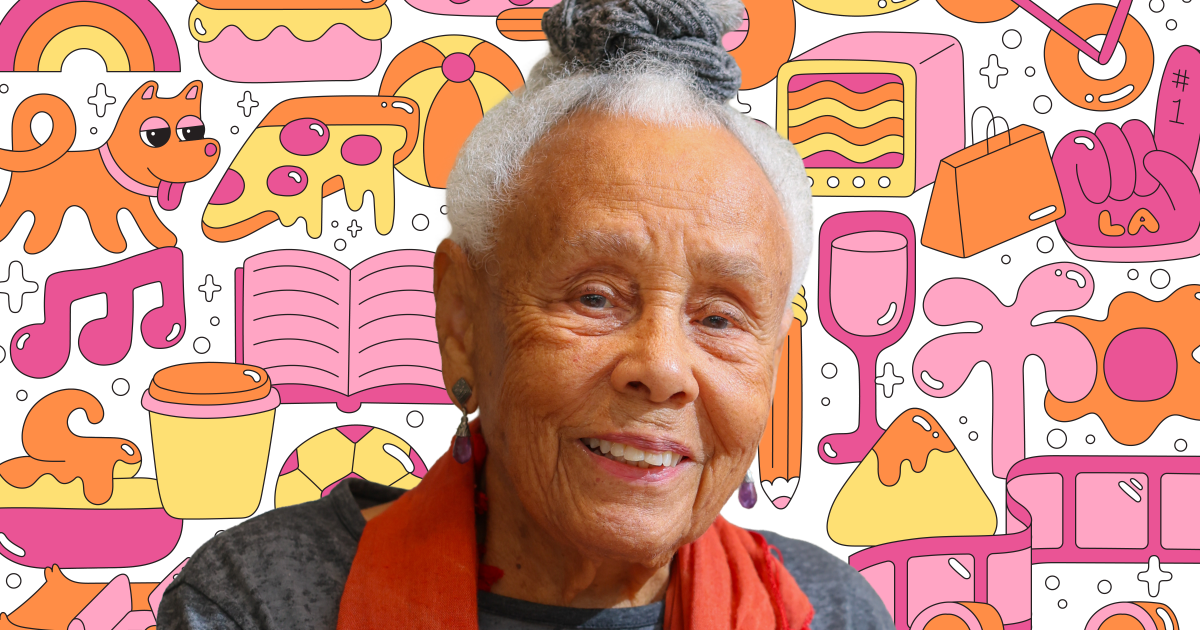
Not only is Betye Saar a living legend, but the prolific L.A. artist continues to add to her impressive oeuvre day by day.
She’s been creating powerful, thought-provoking artwork since the ’60s and her pieces have been shown at the Smithsonian, the Museum of Modern Art, the Art Institute of Chicago and LACMA, as well as museums and galleries around the world.
In Sunday Funday, L.A. people give us a play-by-play of their ideal Sunday around town. Find ideas and inspiration on where to go, what to eat and how to enjoy life on the weekends.
As her centennial birthday approaches this July, Saar shows no signs of slowing down. She still routinely creates art and continues to garner headlines and accolades. Last year, she was honored with the distinction of “Icon Artist” at the Art Basel Awards. During the upcoming Frieze Los Angeles art festival, which opens Feb. 26, she will be the subject of the photography installation “Betye Saar Altered Polaroids.” And this May, “Let’s Get It On: The Wearable Art of Betye Saar” will debut at Roberts Projects, the gallery that represents her. The exhibition will feature pieces from her early career as a costume and jewelry designer.
Though she’s skilled at painting and photography, she’s most widely known for assemblage, the art of juxtaposing miscellaneous items to form a single cohesive work. Her dioramas, sculptures and large-scale multimedia installations explore the legacy of American slavery, confront racial injustice and celebrate the strength and resiliency of African American women.
“I work with found objects that had another purpose before they came to my hands,” Saar says while seated at a patio table in her succulent-filled tiered garden. “The hardest part of it is going to a flea market, secondhand stores, an estate sale or even just going behind a store to see what people throw away.”
Over the years, she’s traveled by plane, train and automobile in search of usable materials. Meanwhile, admirers, colleagues and gallery workers have sent her curios from New Mexico, Tennessee, New England and beyond. Her daughters — artists Alison and Lezley, and writer Tracye, their mother’s studio director — also stay on the lookout for objects that might catch her eye.
“I’ve been doing this for a long time, so I have quite a collection,” she says.
Indeed, Saar’s multi-level home studio in Laurel Canyon is bursting with dozens of old empty picture frames, discarded window panes, wooden chests, antique chairs and vintage clocks. But there’s always room for more.
Her idea of a perfect Sunday includes foraging for new items (or old ones, as the case may be) to use in her daily art practice. And she’d return to her roots to do it.
“Pasadena is my hometown and I still have a few relatives that live there,” she says.
While visiting her old stomping grounds, she’d embark on a multi-stop shopping spree and wander through a longtime favorite San Gabriel Valley attraction (where her work just so happens to be on display).
This interview has been lightly edited and condensed for length and clarity.

10 a.m.: Search for hidden treasures
Pasadena Community College Flea Market is something that’s part of “the hunt.” Alison usually drives, sometimes Tracye. Some people are there early to get the deals; we’re not like that anymore. I like to look around and sometimes I find interesting fabrics, scarves to wear and strange-shaped succulents for my garden. I hardly ever find really good antiquing things there, because those are at antique stores and they’re usually pretty pricey. But I bought an old, rusty metal birdcage the seller said was from France. I like rusty stuff for my art. I also found an indigo blue kimono to wear at an art event later this year.
1 p.m.: Replenish with Thai food
I’d go down Fair Oaks Avenue — there’s some secondhand stores. Usually, it’s nothing I can use, but I still can’t say no. I have to go see for myself. Then, lunch at Saladang Garden. I always order chicken sate and the green papaya salad. Last time I went, we tried the Thai corn fritter which was really good and crispy. If food is too spicy, I can’t eat it. But somebody in my party would always have something spicy and I can have a spoonful to add to mine.

2:30 p.m.: More shopping
I am attracted to all the odd things at Gold Bug. Notepads and trinkets, curious vintage-y things with animals or interesting patterns, strange candles. Sometimes I surprise myself by buying something. They have a mixture of things that — whether it’s for the color, or the texture — I feel that I can recycle and fit into an art object that I’m making.

3:30 p.m.: Visit a childhood haunt (with a side of more shopping)
I really like the Huntington’s gardens. I remember the first time I went there was with my mother and a friend of hers, and we walked around. All the paths were dirt, you know, they hadn’t even gotten around to paving it yet. But I just fell in love with it. And I really like their gift shop.
6 p.m.: Head west for a culinary classic
If I go someplace to eat for lunch, I usually have leftovers to warm up. Nothing wrong with leftovers — if you liked it the first time, you’ll like it again! But if I had to go out to dinner, the Apple Pan. I would go there in the ’80s with my daughters. I like their sandwiches, or the hickory burger with cheese, and there’s good French fries.

8 p.m.: Tuck into some wind-down watching
Before bed, I like to watch the news because, otherwise, I don’t know what’s going on. I also like a lot of shows on PBS. “Finding Your Roots,” or dramas like “Sister Boniface Mysteries” and “Call the Midwife,” which has been going on forever!



NEW YORK, NEW YORK – APRIL 21: Laverne Cox attends the “Animal Farm” New York Premiere at Regal Theater on April 21, 2026 in New York City.
Jamie McCarthy/Getty Images
hide caption
toggle caption
Jamie McCarthy/Getty Images
In 2013, when the Netflix series Orange Is the New Black came out, the world met the character Sophia Burset — a Black trans woman serving as the resident hairstylist in prison.
For much of the audience, it was also the first time they met actress Laverne Cox — who landed the role of Sophia at the age 40, just when she was thinking of quitting acting altogether.
In her new memoir Transcendent, Cox talks about the challenges she faced long before Netflix came knocking: a mother who withheld love, a father who was never around and the brutal denigration she encountered growing up Black and trans in the deep South.
To unlock this and other bonus content — and listen to every episode sponsor-free — sign up for NPR+ at plus.npr.org. Regular episodes haven’t changed and remain available every weekday.
Email us at considerthis@npr.org.

Scott Simon talks with author Judy Blume at the Santa Fe International Literary Festival in May.
Tira Howard Photography./Courtesy Santa Fe International Literary Festival
hide caption
toggle caption
Tira Howard Photography./Courtesy Santa Fe International Literary Festival
Judy Blume is the legendary writer of books for young adults including Are You There God It’s Me Margaret, Deenie, Tiger Eyes, Tales of a Fourth Grade Nothing and Blubber.
Her last book, 2015’s In The Unlikely Event, was published more than a decade ago. Blume now spends her time reading children’s books behind the counter at her bookstore in Key West, Florida. Though she says she is done writing, her books remain beloved; her readers numerous and devoted.
Judy Blume spoke with NPR’s Scott Simon at the Santa Fe International Literary Festival in May. Here are excerpts from that conversation, edited in parts for clarity and length.
Scott Simon: How did you begin to write? What do you think made you a writer?
Judy Blume: I was a reader. And, you know, I meet so many kids and they say, “I want to be a writer when I grow up, but I don’t like to read.” And I say, “You know what? Forget being a writer.” Because I think every writer — that I know anyway — grew up a reader. And certainly that was true for me.
Simon: What was the spark that set it in motion from reading to writing, do you think?
Blume: I was married young. I had two kids young. And I was desperate for a creative outlet. I loved taking care of babies, but I needed something else and it could have been anything.
Simon: I have read that at one point in your life you made felt art pieces?

Scott Simon with Judy Blume in Santa Fe in May.
Tira Howard Photography/Courtesy Santa Fe International Literary Festival
hide caption
toggle caption
Tira Howard Photography/Courtesy Santa Fe International Literary Festival
Blume: Oh God, my first career. You know, I stopped because the Elmer’s glue — I’m an allergic person — started to give me funny things on the tips of my fingers. I made $300 selling those. And I bought myself a small electric typewriter. And the rest is history.
But I always had stories inside my head — when I was 9 years old. I bounced a rubber ball against the side of my house for hours. But really what was going on were stories. Fabulous stories, very melodramatic. I never told anybody. I never asked a friend, “Hey, do you have stories inside your head all the time?” Because I thought they’d think I was weird, which I might have been. So the stories were always there.
Simon: When you were writing, what was the process like for you?
Blume: Well, I kept a notebook for each book and I scribbled everything in it. Everything, everything, everything for a long time. For months.
And then on the day that I feel ready to start, well, that’s either the scariest part of writing or the best. Because, you know, when you have a good day — I mean, I had kids, and I would sit down at the dinner table and I would say, like, “You will never believe what Tony did today.” Because they’re real. They’re real to you. And you’re living with them for months, sometimes years. And you’re locked up in a little room all day with them. That’s why 50 years is enough. I was ready to come out into the world.
But I have found another career that I love dearly. I have a bookstore and I love that.

Tira Howard Photography/Courtesy Santa Fe International Literary Festival
Simon: I get the idea that you, at least for the moment, don’t miss writing right now.
Blume: I don’t miss writing but I’m very glad that I wrote. I mean, writing changed my life. But it was time to let it go. Could I have come up with more ideas and written more books? Yes. But I’m really happy that I found something else that I love to do.
Simon: Do characters ever come calling on you?
Blume: No. They know better. They’re quiet.
You know how many letters I get? “We need Judy to write a book — Margaret In Menopause.”
Margaret is always going to be 12. She’s not knocking, saying, “Let me out. I’m in menopause!”
They are what they are. They stay in the book. They stay in the book. They live for me in the book. And then I have to let them go.

Director James Burrows attends the “Will & Grace” start of production kick off event and ribbon cutting ceremony at Universal City Plaza on August 2, 2017 in Universal City, California.
Jason LaVeris/Getty Images
hide caption
toggle caption
Jason LaVeris/Getty Images
LOS ANGELES — James Burrows, who helped create volumes of laughter as director of more than a thousand episodes of such classic television comedies as “Cheers,” “Taxi,” “Friends” and “Will and Grace,” died Friday. He was 85.
His family confirmed his death in a statement to People, saying he “passed away peacefully today surrounded by his family.” No location or cause of death was provided.
Burrows spent his career behind the camera specializing in situation comedies. Few viewers recognized him or knew his name, other than to see it flash quickly on the screen in the opening credits. But they knew his work.
Burrows got his start in television relatively late at age 35 in 1974, directing episodes of “The Mary Tyler Moore Show,” “The Bob Newhart Show,” and “Laverne & Shirley.”
He co-created “Cheers,” directing 243 of the 273 episodes, as well as all 246 episodes of “Will and Grace.”
He also helmed multiple episodes of such hits as “Frasier,” “Friends” and “Mike & Molly,” and the pilots of “Two and a Half Men” and “The Big Bang Theory.”
“When I direct a television show, I try to reach that sweet spot where the best script meets the best performance and the best chemistry between performers,” Burrows wrote in his 2022 memoir “Directed by James Burrows.” “Hitting that exact moment, where these factors land in combination, results in the sweetest and most enduring laugh.”
His family said, “Burrows understood that great comedy was never simply about laughter. It was about humanity, connection, and truth. That understanding became the foundation of a career that forever changed television.
“But beyond his remarkable achievements, Burrows will be remembered for something even greater: his kindness, generosity, and unwavering belief in the people around him. He possessed a rare ability to make everyone better and was known for remembering every person he met by name, making colleagues at every level feel seen, valued, and appreciated,” the family statement said.
Born James Edward Burrows on Dec. 30, 1940, in Los Angeles, he moved to New York when he was 5 years old. He spent five years in the Metropolitan Opera Children’s Chorus until his voice started to change. He attended LaGuardia High School of Music & Art.
His father was writer, director and producer Abe Burrows, whose Broadway hits included “Guys and Dolls” and “Can-Can.” The elder Burrows also mentored Larry Gelbart, future creator and producer of the TV show “M(asterisk)A(asterisk)S(asterisk)H.”
The younger Burrows spent hours of his youth in theaters and studios watching his father work, dining with him at such famed New York haunts as Sardi’s and Gallagher’s and meeting celebrities who attended his father’s New Year’s Eve parties.
After earning a bachelor’s degree from Oberlin College, Burrows attended the graduate program of the Yale School of Drama, where his classmates included actor-comedian Robert Klein, playwright John Guare and film director John Badham.
At Yale, he was required to take directing classes and he got hooked.
Burrows’ first sitcom experience was as Burl Ives’ dialogue coach on “O.K. Crackerby!” which was directed by his father and ran for one season on ABC in 1965.
From there, he was an assistant on “The Patty Duke Show.” He moved back to New York and worked for Broadway producers Lee Guber, Frank Ford and Shelly Gross. He first met actor Moore while working on the Broadway production of “Holly Golightly,” an adaptation of “Breakfast at Tiffany’s” that was directed by his father.
Burrows eventually worked as a stage manager for various road productions, where he met such actors as Hugh O’Brien, Zsa Zsa Gabor and Julie Harris.
By 1974, after working in dinner theater and summer stock, he turned on his television and saw Moore’s eponymous TV show. He wrote her a letter asking if there was any opening “small or smaller” at her production company that he could fill, according to his memoir.
Moore’s husband and business partner, Grant Tinker, invited Burrows to Los Angeles to direct an episode of the comedy. He apprenticed for MTM Enterprises, which had four sitcoms on the air at the same time.
Burrows cited his theater background for learning how to give actors direction and block out scenes. He’s credited for being one of the first sitcom directors to increase the typical multi-camera television shoot from three to four cameras.
The common thread between Burrows’ shows were the bonds between friends and unrelated families, whether it was the motley crew of regulars meeting at the bar in “Cheers” or the drivers working toward a better life in “Taxi” or the 20-somethings sharing the same apartment building in “Friends.”
“The best sitcoms transcend the screen and reach out and grab the audience by the throat and by the heart,” Burrows wrote in his memoir.
He relished discovering new acting talent while directing more than 75 pilots that were picked up as series.
“Having directed over a thousand shows means that almost any night you can turn on your television or go online and find a show that I directed. I’m very proud of that,” he wrote in his memoir.
In 2019, Burrows was an executive producer on live productions of “All in the Family” and “The Jeffersons” with famous actors re-creating episodes of those 1970s comedies.
Burrows was married in 1997 to Debbie Easton, whom he met when she worked as a hairstylist on “Frasier.” Daughters Kat Schatzow, Ellie Gluck and Maggie Burrows, who followed her father into directing, are from his first marriage to Linda Solomon, who died in 2004. His stepdaughter Paris is from his wife’s previous marriage. He has a sister, Laurie Burrows Grad, and seven grandchildren.
-

 Oregon41 seconds ago
11 Best Small Towns In Oregon For A Crowd-Free Summer
-

 Pennsylvania6 minutes ago
Thousands flock downtown for Juneteenth parade celebrating racial progress and end of slavery
-

 Rhode Island13 minutes ago
Providence holds 50th Annual PrideFest
-

 South-Carolina16 minutes ago
South Carolina Lottery Powerball, Pick 3 results for June 20, 2026
-
South Dakota21 minutes ago
SD Lottery Powerball, Lotto America winning numbers for June 20, 2026
-

 Tennessee28 minutes ago
Strong storms possible Sunday night into Monday morning for Middle Tennessee
-

 Texas31 minutes ago
Video captures aftermath of a fatal stabbing at Texas track meet
-

 Utah36 minutes ago
Wildfire burns in Salt Lake City foothills behind University of Utah

