Sign up for the Today newsletter
Get everything you need to know to start your day, delivered right to your inbox every morning.

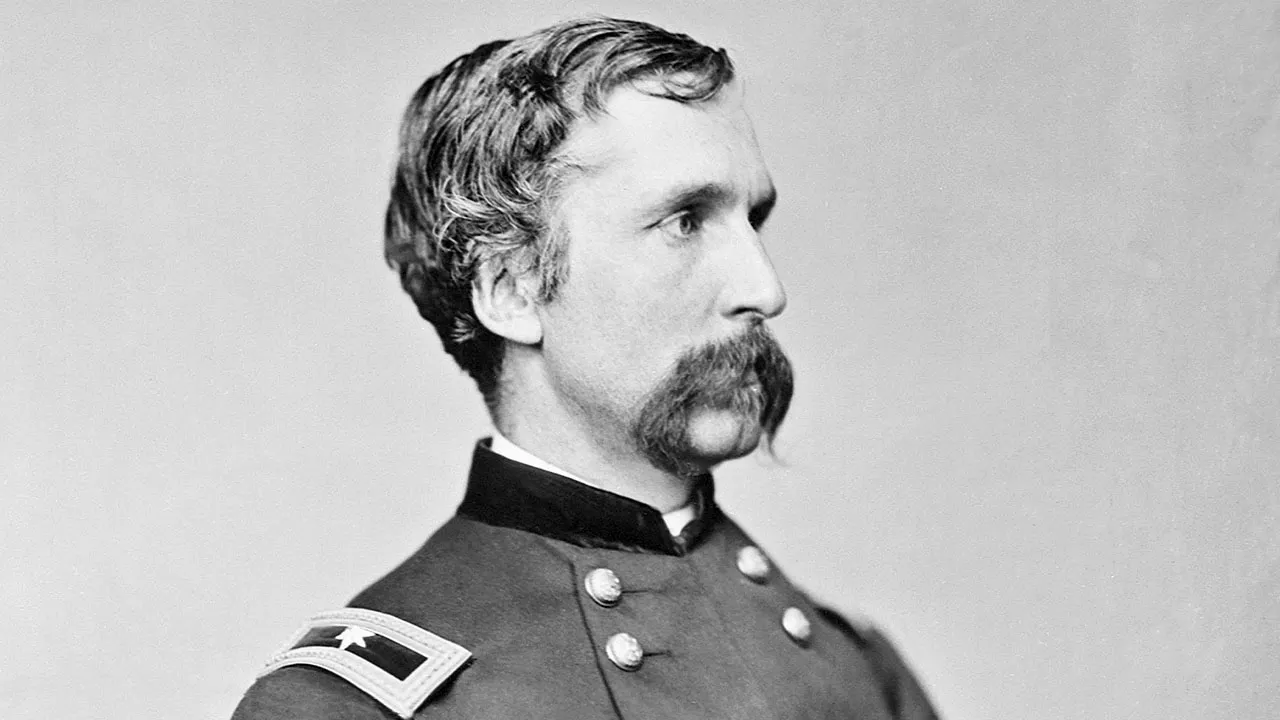
Joshua Lawrence Chamberlain, a bookish professor of rhetoric at Bowdoin College in Maine who became the Union’s most celebrated combat hero of the Civil War, died on this day in history, Feb. 24, 1914.
Brig. Gen. Chamberlain was 85 years old.
“A veritable icon of Civil War legend, Joshua Lawrence Chamberlain is best known for his heroic participation in the Battle of Gettysburg,” writes the American Battlefield Trust.
ON THIS DAY IN HISTORY, FEBRUARY 23, 1945, US MARINES RAISE AMERICAN FLAG OVER IWO JIMA, CAPTURED IN HEROIC PHOTO
“Prolific and prosaic throughout his life, Chamberlain spent his twilight years writing and speaking about the war.”
His death was attributed at least partly to some of the incredible six wounds he suffered and survived in battle 50 years earlier.
Studio portrait of General Joshua Chamberlain, a federal officer during the American Civil War. Chamberlain won the Medal of Honor for his heroism while commanding the 20th Maine Infantry during the defense of Little Round Top at the Battle of Gettysburg. (CORBIS/Corbis via Getty Images)
His ability to continue fighting despite numerous wounds, in an era in which whiskey and amputations were common treatments in battlefield medicine, was among his many remarkable successes as soldier.
Chamberlain is the last Civil War soldier to die of injuries suffered in combat, according to the Department of the Defense.
He was “a veritable icon of Civil War legend.” — American Battlefield Trust
Colonel Chamberlain earned the Medal of Honor for his heroic leadership of the 20th Maine Infantry at Gettysburg.
He later had the honor of accepting General Robert E. Lee’s surrender at Appomattox.
WWII LOVE LETTERS HIDDEN BEHIND WALL IN NEW YORK HOME DELIVERED TO FAMILY 80 YEARS LATER
He served four terms as governor of Maine, wrote a powerful chronicle of the last months of the war, “The Passing of the Armies,” and returned to academia, spending 12 years as president of Bowdoin.
Chamberlain’s legend was forged on Little Round Top, on the far left flank of the vast Union army at Gettysburg, Pennsylvania, on July 2, 1863.
An American flag that flew over a base in Iraq, and a portrait of Union Civil War General Joshua Chamberlain, are among the patriotic touches that line the walls of the Freedom General Store in Freedom on June 30, 2014. (Gabe Souza/Portland Portland Press Herald via Getty Images)
Chamberlain’s 20th Maine repelled numerous Confederate charges but ran out of ammunition.
He could not retreat and he could not surrender — or the rebels might roll up the entire Union line and possibly win the war with a stunning victory in the northern state.
Chamberlain responded with a dramatic bayonet charge down the hill, a turning point in American history that was immortalized in the Pulitzer Prize-winning 1974 historical novel “The Killer Angels” by Michael Shaara and again in the 1993 movie, “Gettysburg.”
“Chamberlain raised his saber, let loose the greatest sound he could make, boiling the sound up from his chest.” — Michael Shaara
“Chamberlain raised his saber, let loose the greatest sound he could make, boiling the sound up from his chest,” Shaara wrote in the dramatized account of the historically accurate encounter.
“Fix bayonets! Charge! Fix bayonets! Charge! Fix bayonets! Charge! He leaped down from the boulder, still screaming, his voice beginning to crack and give, and all around him his men were roaring animal screams,” wrote Shaara.
“He saw the whole regiment rising and pouring over the wall, and beginning to bound down through the dark bushes, over the dead and dying and wounded, hats coming off, hair flying, mouths making sounds, one man firing as he ran, the last bullet, the last round.”
General Robert Lee surrendering to General Ulysses Grant at Appomattox, on April 9, 1865, American Civil War, 19th century. General Joshua Lawrence Chamberlain ordered Union troops to salute the Confederate troops to begin the process of healing the nation. (Getty Images)
The frenzied charge swept away four Confederate regiments. About 2,000 men were killed, wounded, surrendered or retreated.
The rebel army lost the battle the following day, with the heroic but ill-fated disaster of Pickett’s Charge.
Chamberlain’s beautifully written work, “The Passing of the Armies,” published posthumously in 1915, serves as a foundation of scholarship of the final year of the Civil War and offers sobering insight into of the minds of men in combat.
MEET THE AMERICAN WHO WROTE ‘THE BATTLE HYMN OF THE REPUBLIC’
“The hammering business had been hard on the hammer,” he wrote of the tragic Union casualties suffered while trying to pound the Confederates into defeat at Petersburg in the final months of the war.
Chamberlain was later given the duty of accepting General Lee’s surrender at Appomattox, adding to his legend among Civil War soldiers.
“Grant wished the ceremony to be as simple as possible, and that nothing should be done to humiliate the manhood of the southern soldiers,” Chamberlain wrote in “The Passing of the Armies.”
Portrait of General Joshua L. Chamberlain, 1908, Joseph B. Kahill, pastel on paper/pastel board, 29 3/8 in. x 22 1/16 in. (74.61 cm x 56.04 cm). (Sepia Times/Universal Images Group via Getty Images)
He ordered his columns to salute the defeated Confederate troops — helping set the tone of the peace in Lincoln’s stated hope “with malice toward none and charity toward all.”
“It was not a ‘present arms,’ however … which then as now was the highest possible honor to be paid even to a president,” Chamberlain later said.
“It was the ‘carry arms,’ as it was then known, with musket held by the right hand and perpendicular to the shoulder.”
“Throughout the war, Chamberlain was wounded six times, most grievously at Petersburg in June 1864,” writes American Battlefield Trust.
“Believing this wound to be mortal, Congress promoted Chamberlain to the rank of brigadier general. Chamberlain, however, would survive the wound, and return to the front in time to play a pivotal role in the Appomattox Campaign.”
“Grant wished … that nothing should be done to humiliate the manhood of the Southern soldiers.” — Chamberlain on end of war
His achievements with both sword and quill make him one of the most remarkable soldiers in American history.
“Our place in human brotherhood, our responsibility not only in duty for country, but as part of its very being, came into view,” he wrote of serving the nation in wartime.
Pickett’s Charge, Battle of Gettysburg, Civil War, 1863. The ill-fated charge came the day after the Confederate failure to move the 20th Maine Infantry off Little Round Top at the far southern end of the battlefield. (Universal History Archive/Universal Images Group via Getty Images)
His legend was cemented in that decisive moment of action on July 2, 1863, for which he was awarded the nation’s highest honor for valor.
Some historians argue that the heroic Chamberlain not only saved the Union army at Little Round Top, but saved the cause of the Union itself.
“The regiment’s sudden, desperate bayonet charge blunted the Confederate assault on Little Round Top and has been credited with saving Major General George Gordon Meade’s Army of the Potomac, winning the Battle of Gettysburg and setting the South on a long, irreversible path to defeat,” reports American Battlefield Trust.
For more Lifestyle articles, visit www.foxnews.com/lifestyle.
Read the full article from Here


A historic 78,000-acre conservation project in the western Maine woods is nearing completion.
The Magalloway Conservation Project will ensure the land remains open for fishing, hunting, and other recreational activities for generations to come.
The project will also protect wildlife habitat and support the regional timber economy.
The effort began last March and is expected to be completed later this month.
BE THE FIRST TO COMMENT
Four conservation groups are leading the project.

NEWYou can now listen to Fox News articles!
A Massachusetts city with one of the nation’s largest Cape Verdean communities has imposed a temporary curfew ahead of Friday’s historic World Cup match between the West African nation and Argentina.
The curfew will be in effect in Brockton, just south of Boston, from 10 p.m. Friday until 5 a.m. Saturday.
City officials said the decision follows recent World Cup celebrations that led to dangerous and unlawful behavior.
“World Cup celebrations have resulted in incidents of reckless driving, illegal street gatherings, vandalism, assaults, fireworks violations, disorderly conduct and other criminal activities,” the city said.
WATCH THE WORLD CUP FINAL ON FOX ONE
A Cape Verde fan attends the 2026 FIFA World Cup Group H match between Uruguay and Cape Verde at Miami Stadium in Miami on June 21, 2026. (Craig Williamson/SNS Group)
Brockton is home to one of the largest Cape Verdean communities in the United States, with nearly one in four residents identifying as Cape Verdean, according to local outlet The Enterprise.
Friday’s match was expected to draw large celebrations, as the 2026 tournament marks the first time the African island nation has qualified for the FIFA World Cup.
Following previous World Cup matches, Brockton police said several people were injured in shootings that erupted during postgame celebrations, according to local outlet Boston 25 News — prompting city officials to impose the temporary curfew ahead of Friday’s matchup.
FOX ONE’S NEW WORLD CUP VIEWING EXPERIENCE
A mural on the side of the Mayor Bill Carpenter Garage in Brockton, Massachusetts, on Oct. 8, 2020. (Lane Turner/The Boston Globe via Getty Images)
Under the curfew order, no one will be permitted to enter establishments serving alcohol after 7 p.m.
Patrons already inside will be allowed to remain until 10 p.m., but “last calls” for alcoholic beverages must end by 9:30 p.m.
The city said only limited exceptions to the curfew will be permitted.
Such cases include law enforcement officers and other first responders, individuals traveling directly to or from lawful employment, those seeking medical care, and those responding to emergencies.
Cape Verde goalkeeper Vozinha celebrates at the end of the World Cup Group H match against Uruguay in Miami Gardens, Florida, on June 21, 2026. (Lynne Sladky/AP)
CLICK HERE TO DOWNLOAD THE FOX NEWS APP
Brockton officials described the measure as a public safety measure intended to preserve public order.
“The purpose of this curfew is to protect public safety, reduce criminal activity associated with post-match celebrations, and enable police, fire, and emergency personnel to effectively maintain order and respond to emergencies,” the city said.
“Residents and visitors are urged to celebrate responsibly, obey all laws, avoid unlawful gatherings, and cooperate with public safety officials to ensure that all World Cup celebrations remain peaceful and safe.”

Local News
A sergeant who served in the New Hampshire State Police for 19 years has died, authorities announced.
Sgt. Brian J. Ross, of Greenland, New Hampshire, died Monday at 41 years old, according to his obituary.
“Our hearts are broken by this loss,” State Police said in a Facebook post. “Sgt. Ross served the people of New Hampshire with courage and integrity, and all of us will miss him greatly.”
Ross began his career as a patrol trooper and later fulfilled other roles, including working with the Major Crime Unit, Special Events Response Team, and Motorcycle Unit. He recently served as the commander of the Collision Analysis and Reconstruction Unit, according to State Police.
“We ask everyone to join us in offering his family, including his wife and three children, the support and privacy they deserve at this time,” State Police said.
State Police added that a fund has been established for Ross’ family.
“Brian was a devoted husband, proud father of three beautiful children, dedicated Trooper, and beloved coach,” the fund states. “His family is now facing a future they never imagined.”
A walk-through for police officers and other public safety personnel is scheduled for 3 p.m. on July 6 at the Remick & Gendron Funeral Home-Crematory in Hampton, according to the obituary.
Public visiting hours are expected to take place from 4 p.m. to 7 p.m. in the funeral home. Services will be at 1 p.m. on July 7 at the United Church of Christ in North Hampton, the obituary states.
Authorities did not specify the cause of death, but said it was “unexpected.”
State Police noted that resources are available for anyone struggling with a mental health crisis.
“Anyone can call or text the Suicide and Crisis Lifeline at 9-8-8 for free and confidential support for themselves, a friend or a loved one,” State Police said.
Get everything you need to know to start your day, delivered right to your inbox every morning.


Kentucky Wildcats News: Tyler Herro helped UK get Milan Momcilovic


Supreme Court rules in indictment against Louisiana attorney general


Magalloway Conservation Project in western Maine nearing completion

Baltimore Gas and Electric seeks $8 monthly rate increase for Maryland customers


Michigan lawmakers work through the night on ‘compromise’ budget


Massachusetts city imposes curfew ahead of historic World Cup match
Where to watch Minnesota Lynx vs New York Liberty on July 3: TV channel, start time and streaming


List of Jackson area events to celebrate July 4th before firework shows

