Maine
What did Hallowell learn from the December 2023 flood?


Sam Joyall, co-owner of Rusticators Emporium on Water Street in downtown Hallowell, points out Thursday the high-water mark of last year’s December flood, the fifth-highest in the city’s history. Joyall says he noticed the water rising fast on the morning of Dec. 19, 2023, and he quickly called his wife. “I did a quick U-turn around, she booked it up there, and then we spent the rest of the day watching as that graph kept projecting it to go higher and higher for flooding.” Joe Phelan/Kennebec Journal
7:30 a.m., Tuesday, Dec. 19, 2023
Kennebec River at 17.3 feet: moderate flood stage
HALLOWELL — Power was out on Water Street, and Sam Joyall knew there was a cold spell coming. He drove from his home in Richmond to insulate his storefront, The Rusticators Emporium, from the dropping temperatures early Tuesday morning.
Joyall passed the boat launch on the southern end of downtown. It hadn’t rained for almost a day, but water encroached on the launch parking lot. Noted.
He continued on to his store, two blocks north of the launch, insulating supplies in hand.
“By the time I had stuffed the doors and was like, ‘OK, this is all I came here for,’ and was leaving, I noticed how — in that brief period — substantially higher the water was at the boat landing area,” he said.
A slow-moving storm had dropped 4-8 inches of rain across much of Maine over the previous two days, melting snowpack and quickly increasing river levels.
Joyall was seeing the beginning of what would become a historic flood. A year ago this week, riverside communities across central Maine suffered damage they will remember for decades — and as the climate changes, the storms that led to the flooding are expected to only increase in intensity.
It’s a time the communities can’t afford to forget. That December morning, experts say, will be repeated more frequently in the years ahead.
Front Street, which borders the river and lies much lower than the rest of downtown, had flooded the evening before. Hallowell’s bulkhead — where the famous colorful Adirondack chairs sit for much of the year — was already covered by several feet of water. The Kennebec River was rising by nearly a foot every hour.
Joyall called his wife, Lexi, who checked on the river’s flood gage predictions — and it did not look pretty. The duo, who co-own the store, scrambled to take action.
“I did a quick U-turn around, she booked it up there, and then we spent the rest of the day watching as that graph kept projecting it to go higher and higher for flooding,” Joyall said. “We were just in the shop, doing whatever it was we could — we took out some of our most expensive items, fearing that we were probably going to see some water come into the shop by that point.”
Floodwater soon lapped at the doorsteps of Water Street storefronts and completely inundated Front Street basement spaces.
And the river was still rising.
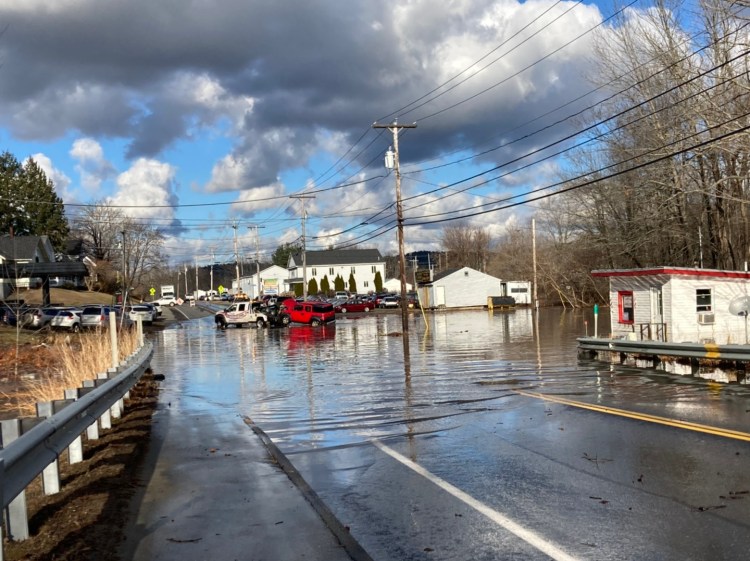
The town center of Hallowell was unreachable on the afternoon of Dec. 19, 2023, with both sides of Route 201 closed and cars coming from Gardiner being directed to turn around. Emily Duggan/Kennebec Journal file
10:30 a.m., Tuesday, Dec. 19, 2023
Kennebec River at 19.27 feet: major flood stage
Joyall spent the rest of the morning moving merchandise and watching the flood gage read higher and higher. Business owners up and down Water Street had the same idea — many scrambled to get their belongings to higher ground. Upstairs, up the hill — anything would do.
Down the street, Joyall saw volunteers, including Mayor George Lapointe, moving stock out of Vignettes of Maine — a gift shop near the corner of Water and Wharf streets — as the business took on water.
Chiseled into the building across Wharf Street, notches marking Hallowell’s biggest floods from the past 200 years loomed over Lapointe’s parked pickup truck. Nine months later, this flood’s high-water point would be marked on that building — the fifth-highest ever recorded in Hallowell and the highest since 1987.
Joyall called across Water Street to make sure Michel-Paul Cyr, who owns Michel Paul Artist Studio, had all the help he needed while water crept up to his gallery’s back deck. Lapointe jumped from business to business, asking owners how he could help.
On Front Street, the Quarry Tap Room’s back patio was submerged in 8 feet of water. Easy Street Lounge was filled with water “to the rafters,” and it took months for owner Bruce Mayo to rebuild and restock, Lapointe said.
Joyall said he stayed at The Rusticators Emporium for several more hours, watching the water slowly rise outside. He said the store’s lights and heat, which had been out since the day before, flickered back on, even before the water stopped climbing.
“Oh, this is a reverse Titanic situation here,” Joyall said to himself.
9:30 a.m., Wednesday, Dec. 20, 2023
Kennebec River at 17.97 feet: moderate flood stage
With power back on the western side of Water Street, City Manager Gary Lamb powered up the city’s computers and opened City Hall doors for business for the first time in two days.
The river had already noticeably dropped from its peak of 22.49 feet around 9 p.m. Tuesday, but roads were still impassable on the southern side of downtown until about midday, according to a memo Lamb wrote recapping the flood. Public works employees removed barricades and began cleanup, using the city’s snowblower’s power broom.

A swollen Kennebec River floods buildings on the back side of Water Street in Augusta after a severe rainstorm in December 2023. File photo courtesy of Dave Dostie
Much of downtown was covered in inches-thick silt that was “greasy as heck,” Lapointe said. Granite City Park, which had been underwater for about 36 hours, was caked in sediment. The building housing Vignettes of Maine and what was then Traverse Coffee Co. was lifted slightly off its foundation and required substantial structural work. The Quarry Tap Room’s outdoor stage had floated over a railing and onto Front Street. Several buildings in the southern part of downtown were evacuated due to a propane tank leak near Café de Bangkok. Floats from the boat launch had traveled downstream, despite being stored across the Water Street, away from the river. Merrill’s Bookshop lost eight tons of books.
Buildings on the western side of Water Street were mostly spared from the worst of the flooding, including Berry & Berry Floral, where Lapointe said he saw a “small puddle” inside during the worst of the flooding. The Rusticators Emporium, on the western side of the street, was kept mostly dry, too.
But on the eastern side of Water Street, closer to the river, flood waters were slow to recede, and power was still out through Wednesday night.
Lamb contacted Central Maine Power early Thursday morning, wondering when electricity would be restored and hoping businesses wouldn’t freeze up during the impending cold snap. He was told by customer service representatives that building owners and tenants would need to sign CMP’s post-flood power restoration form, signaling they understood the risks associated with turning power back on.
“Because so many of the services were inundated, they required this form to be filled out and signed by a master electrician who’d actually done an inspection,” Lamb said. “For obvious reasons, safety reasons; it could start a fire or hurt somebody.”
Lamb said he didn’t know about the form before the flood — buildings downtown hadn’t flooded this badly since he became city manager — but that city staff and other volunteers jumped in to contact relevant people as quickly as possible. Power was back on by Saturday morning.
“The critical part was people were going to have to drain their buildings,” Lamb said. “It was getting much colder after the waters receded and buildings were going to freeze up because they had gone for four or five days without power, and most of those places are relatively uninsulated. We were ecstatic that, right before Christmas, we got the power back on that Saturday.”
11 a.m., Thursday, Dec. 12, 2024
Kennebec River at 6.55 feet: well below flood stage
Almost exactly a year later, city officials’ fears about another river flood were growing. Conditions were similar to the December 2023 event: A powerful storm capable of dropping several inches of rain, rising temperatures, high winds that knocked out power to thousands and the potential for substantial snowmelt.
Lamb watched the flood gage predictions closely, and Lapointe mentioned in a City Council meeting earlier in the week that the city may have to deal with significant flooding again.
No such flood came.
But Maine State Climatologist Sean Birkel said events like last December’s will only get more severe with climate change.
“We’re much more uncertain about the frequency part,” Birkel, also a research assistant professor at UMaine’s Climate Change Institute, said. “However, as climate warms, we have seen an increase in the intensity of storms, and in particular with the amount of precipitation that these storms are producing.”
The Dec. 17-18, 2023, storm produced more than 3 inches of rain in most of the Kennebec River watershed. Warm, strong winds from the southeast created an “atmospheric river” event, which ushered massive amounts of rainfall, especially in central and western Maine.
When added to snowmelt, Birkel said, the conditions for widespread river flooding downstream were ideal.
“We have seen that a cold-season cyclone can produce this much flooding and damage, and in a warming world, there’s increased risk,” he said. “And so as we prepare in the future, we have to bear that in mind and incorporate that into our planning, especially at the state and municipal level.”
Lapointe said, while Hallowell does not plan on building a seawall to keep floodwaters out, city officials can take some steps to improve emergency response and prepare for future flooding events.
He said he and other city leaders should lean on the U.S. Geological Survey’s river gage — which Joyall watched intently during the flood and which Lamb said was “worth its weight in gold” — as a useful resource during floods. He said he would also like to standardize the city’s automatic emergency notification system for downtown businesses and residents and learn more about flood prediction, so the city is not scrambling to respond.
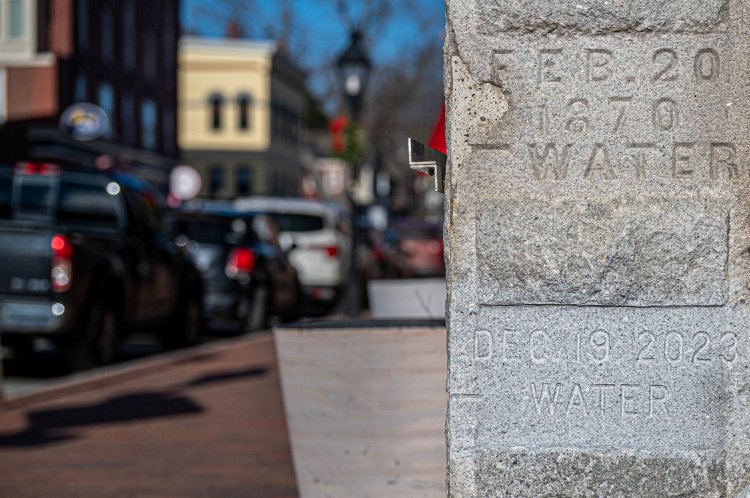
The water level from last year’s December flood is carved in a granite corner piece of the building at the intersection of Water and Central streets in downtown Hallowell. Joe Phelan/Kennebec Journal
Lapointe said it took two to three months for downtown Hallowell to feel normal after the December flood. Several businesses were closed for extended periods of time, and others never came back.
Some received aid from a City Council-approved relief fund, which directed $50,000 to businesses, with a cap of $2,000 per business. Others got help from private fundraising: One Quarry Tap Room employee’s husband raised more than $10,000 for the staff’s lost wages.
Vision Hallowell — a downtown support organization of which Joyall was recently appointed president — distributed more than $17,000 to downtown businesses following a monthslong fundraising campaign with other Hallowell community groups. The city matched that fundraising with another $17,000, which also went out to businesses impacted by the storm.
Lapointe said it would be easy for the city to beat itself up over its response to the flood. Not all business owners and tenants on Water and Front streets were on the city’s emergency contact list. Power restoration took longer than hoped. Lamb faced criticism for not invoking the city’s emergency management ordinance — which would have convened an eight-person committee of city leaders to coordinate response to the flood — but Lamb said the committee had never met, was not trained in emergency response and likely would not have been any more effective.
But above all the controversy and frustration, Lapointe said Hallowell should be proud of how it responded: The community came together to support its downtown, he said, in a relatively short amount of time.
“When there’s only so much you can do, people help out,” he said.



Maine
A hard lesson for Democrats in Maine. Plus, we have some news about Ed Markey. – The Boston Globe

Markey comes out and says it: One more and he’s done
By Abdallah Fayyad
Massachusetts Senator Ed Markey, who will turn 80 this week, is running for his third full term in the US Senate. His Democratic primary challenger, Rep. Seth Moulton, has tried to make age and generational change the issue in this campaign. But Markey is hoping that this year will be a repeat of 2020, when he handily beat another younger (and now former) member of Congress, Joe Kennedy III.
While Markey has been able to overcome concerns about his age in the past, the reality is that time waits for no one. So on Tuesday, Markey told the Globe Editorial Board that should he win again, his next term in the Senate will be his last.
In that interview, Markey initially dodged questions about his age, arguing that he is energized and perfectly capable of doing the job. But one question on many voters’ minds is whether people in positions of power know when to call it quits. After all, Joe Biden dropped out late in the 2024 presidential race after a disastrous debate performance against Donald Trump fueled speculation about cognitive decline. Dianne Feinstein, the late California senator, died while serving in office amid controversies surrounding her cognitive health and memory issues. And right now, Kentucky Senator Mitch McConnell is in the hospital after having been recently found unconscious, and there’s little to no public information about his current condition.
Addressing these concerns about aging elected officials, Markey eventually gave the right answer to the board — one that other politicians facing similar questions about their age or health should take note of. “I would hold myself to the same standard that every elected member should,” he told the editorial board. “If I cannot do the job, I would step down. I believe the commonwealth is more than one person. I would put the needs of the people of Massachusetts first.”
For now, though, he’s running because he believes he’s still capable of doing the job. And that’s the case he has to make to voters between now and Election Day. One last time.
Right, Left, and Center: A hard lesson for Democrats in Maine
Entries by Joan Vennochi, Noah Rothman, and Abdallah Fayyad
Yes, another shoe has dropped on Graham Platner’s insurgent campaign for US Senate in Maine, and this was the biggest one yet: allegations of rape by a former girlfriend.
He denies the allegation, but just about all his one-time Democratic supporters – including senators Bernie Sanders, Elizabeth Warren, and Ed Markey – have called on him to quit the race. If he does so by Monday, the Democrats can pick a replacement candidate to challenge the incumbent Republican, Senator Susan Collins.
Here’s how our three writers view the situation.
– Jim Dao, Globe Opinion editor
Democrats have some soul-searching to do
By Joan Vennochi
It’s over for Graham Platner, the Democratic Senate nominee from Maine. After a woman with whom he once had a romantic relationship accused him of rape, politically speaking, he sleeps with the fishes.
And so does much of the hope that Democrats had of defeating longtime Republican Senator Susan Collins. Because today’s politics feel especially volatile, I am not saying all hope is lost. It’s not impossible – if someone other than Platner is the nominee.
It’s clear now that Platner was an exciting candidate with serious character flaws, and conduct which now includes an allegation that he sexually assaulted a woman while intoxicated.
A May 10 column entitled “The Platner Trap,” by David French of The New York Times was right on target. French said, “I’m seeing Democrats engage in the same process of absurd accommodation and justification that Republicans use to excuse their deep love of Trump.” David Frum was also right when he wrote a month ago that Democrats “have to choose between character and power.”
The counter-argument – What about Trump? – is not the right rallying cry for Democrats. Riding the horse picked by the people rather than the party is a fine idea, unless the horse has a totenkopf tattoo. There was enough information from Platner’s past to suggest he could be hobbled by it, and he was.
Imperfection is human. People deserve second chances. But how a man treats the women in his life is ultimately more important than how much he supports abortion rights and I’m sorry I did not write that instead of this in a recent column.
The big political names that backed Platner, especially powerful women like Senator Elizabeth Warren of Massachusetts, have a lot of soul-searching to do. If they allow ideology to blind them to deep character flaws, they are no better than the MAGA ideologues whom they deplore.
From that perspective, it’s interesting to consider an influential and progressive politician who did not endorse Platner – Representative Alexandria Ocasio-Cortez of New York. Asked to respond to Platner-related controversies on June 9, the day of Maine’s Senate primary, Ocasio-Cortez told CNN: “Obviously, there’s a lot in that behavior that’s really challenging – it’s hard to stomach. But at the end of the day, I think it’s a choice.” She added, “If the choice is between that and a senator who’s voted to take healthcare away from millions of Americans, that’s the situation that we have to weigh.”

She did not explicitly say what her choice was, but instead staked out a middle ground that I recognize – neither support nor outright rejection.
At that point, the Platner controversies included a tattoo with Nazi implications that he had covered up; Reddit posts flagged as racist and sexist that had been deleted; and reports from The New York Times about sexual texts he sent to women who were not his wife, followed up by a report about his behavior from three of Platner’s previous romantic partners.
One of those previous romantic partners was Jenny Racicot, who told the Times about a 2021 incident in which Platner arrived at her house drunk after she asked him not to come over. While she said she found his behavior “reckless” and “unsettling,” she didn’t share further details until this week in Politico, when she accused Platner of rape.
He called the allegations false, but said he would “reflect” on what he would do next.
While he reflects, Democrats should also reflect on how embracing him before knowing more about him affects the battle for control of the Senate.
Platner’s legacy will haunt his party
By Noah Rothman
In a way, Democrats were well-served by their reflexive, stubborn refusal to entertain the implications of an early June story in The New York Times alleging that Graham Platner had engaged in “unsettling” behavior with women.
The “unsettling” behavior it uncovered included allegations of physical abuse. One of Platner’s named accusers, Lindsey Fifield, claimed that the Maine Senate candidate put his hands on her more than once, “sometimes hard enough to leave marks,” and even “shoved her into a bedroom and held the door closed from the other side so she couldn’t get out.”

But the Times also devoted several paragraphs to Fifield’s work as a conservative political operative, and that was all Platner’s supporters needed to rationalize their summary dismissal of her allegations.
Senator Sheldon Whitehouse said he was “unimpressed” by the charges, all of which struck him as “a lot of nothing.”
Congressman Ro Khanna said the charges didn’t amount to “evidence of violence,” and he deferred to the judgment of Maine’s Democratic primary voters, to whom the charges probably “didn’t come as a surprise.” After all, “he came back broken in a dark place” from his combat tours in Iraq – as if sexual assault were common among veterans.
“President Trump set a new standard,” Senator Mark Warner declared with mock resignation. “Whether that low standard is what we ought to proceed with is going to be, again, in the hands of the voters.”
Platner’s second accuser, Jenny Racicot, might not have told her Graham Platner story if Democrats had not taken the Times’s bait. She described in vague terms her ordeal to the Times’s reporters, but Racicot told Politico she “felt compelled to go public” because “the reaction to the Times story struck her as egregiously partisan. “My part of the story was just a read-over,” Racicot said. “And the story was Lyndsey, and the accusations of her being politically motivated.”
And Racicot’s story is harrowing. She alleges what she described as “rape” – a graphic episode in which Platner drunkenly forced himself on Racicot and had sex with her against her will. Suddenly, even Platner’s defenders – including even the morally compromised Hassan Piker – were willing to entertain the possibility that Platner’s accusers were telling the truth.
Their about-face was less a reaction to the details of Racicot’s assault than they were to her politics. “One of the reasons I didn’t come forward sooner was, the huge moral conflict that I had between supporting his politics, but not supporting him as a person,” Racicot confessed.
Democrats may get lucky. They have a week to figure out how to cajole Platner out of the race and replace his name on the ballot before the state’s deadline expires. But even if the party can salvage its fortunes in Maine, the party’s dalliance with Platner will leave a legacy that will haunt the party.
They don’t believe all women. They believe women with the right politics.
Democrats had Platner, but Republicans still have Trump
By Abdallah Fayyad
It’s the end of the road for Graham Platner’s campaign. The insurgent Democratic candidate for Senate in Maine has been in scandal after scandal. And though he had so far been able to overcome negative stories about him in the past — in part because of his anti-establishment cred that propelled him to win the Democratic primary against the incumbent Democratic governor, Janet Mills — the latest allegation is a bridge too far: A woman has now accused Platner of rape.
In a story in Politico, Jenny Racicot, a 41-year-old woman in Maine who had dated the Senate candidate years ago, says that in 2021, Platner came into her house and forced himself on her despite her objections. “I had been telling him these words, like: ‘No, don’t,’” she told Politico. “And, the look on his face and realizing what was happening, I just realized that, like, I am in a situation where there’s no consent here.” Platner’s campaign denied the allegation.
Since the story dropped, Platner’s supporters in Washington, including Massachusetts Sen. Elizabeth Warren, have rescinded their endorsements of him and called on him to drop out of the race. And that’s exactly what Platner should do. This is a disturbing and credible allegation, and even if his supporters believe that his policy positions are better suited for Maine and the country than Republican Senator Susan Collins’s, there is no excuse for this kind of behavior. He has until July 13 to withdraw his name from the ballot, and the Democratic Party can nominate a new candidate by July 27.
The question now is whether Platner has completely sabotaged Democrats’ potential to finally unseat Collins. If he stays on the ballot, he’s all but guaranteed to lose. And if he drops out, Democrats will need to find a candidate that can quickly build a grassroots campaign that voters can still get excited about.
I wouldn’t count out the possibility that Democrats can come back from this. There are potential candidates that are being recruited or have already expressed interest in replacing Platner. Some are also promising. Former state Senate president Troy Jackson and Maine Secretary of State Shenna Bellows both recently ran in the Democratic primaries for governor. And though they ultimately lost, they could quickly reignite their campaigns.
The reality is that Collins faces an unfriendly political environment. These midterms will be a referendum on President Trump and his policies, which have proven to be deeply unpopular. While the Democratic Party has its fair share of problems with voters across the country, Democratic voters are energized and want to see a check on Trump’s power.
If Democrats are able to pick the right candidate to replace Platner — ideally someone who has similar policy positions so that Democratic primary voters don’t feel entirely robbed of their choice — then they could still unseat Collins. But before any of that happens, Platner needs to drop out.
In case you missed it: Boston calls out Philly (and not just for stealing Jaylen Brown)
By Rami Abou-Sabe
Elsewhere in New England, this weekend was spent commemorating America’s 250th. As usual, the team at Globe Ideas took a unique approach, recontextualizing the anniversary through the lens of lesser-known stories and historical figures. In “America at 250: An unexpected history‚” seven writers explore the stories behind the Declaration of Independence, our Founding Fathers, and Boston’s role in all of it.

Abdallah Fayyad takes a look at James Wilson, “the Founding Father you’ve probably never heard of,” who hated the Senate and didn’t believe in the Electoral College. Harvard professor Danielle Allen shines a light on a British Duke whose role in the Revolution often goes unrecognized. And historian Ted Widmer pulls together a hilarious argument that Boston, not Philadelphia, should actually get credit for the Declaration of Independence.
By the way… if you’re not already following us on TikTok, be sure to check out Ted’s video, which, unsurprisingly, is really riling up our neighbors down in Philly.
In the mood for a podcast instead? On “Say More,” host Anna Kusmer talks to Yale historian Beverly Gage about liberals’ patriotism problem. “Whether or not people on the left like patriotism, it exists, and it’s a powerful, powerful force,” Gage tells Kusmer. What do you think? Do liberals have a patriotism problem? The transcript of the “Say More” episode has spurred a ton of debate in the comments. Take a look for yourself and join the conversation.
This is an excerpt from Globe Opinion’s weekly politics newsletter Right, Left, and Center. Sign up here to get it delivered to your inbox every Wednesday.
Abdallah Fayyad can be reached at abdallah.fayyad@globe.com. Follow him @abdallah_fayyad. Joan Vennochi is a Globe columnist. She can be reached at joan.vennochi@globe.com. Follow her @joan_vennochi. Noah Rothman is a senior writer at National Review and a regular contributor to Globe Opinion.

A nearly $7 million home on the coast of Kennebunk topped out as the most expensive home to sell in Maine last month.
We assembled a list of the top 10 most expensive residential properties in Maine that changed hands in June. The information comes from state transfer tax documents that are available to the public online.
While Maine’s most expensive residential property sales last month all surpassed $3 million and averaged nearly $5 million, they are not as pricey as some of the commercial real estate transactions from the same time frame.
The Press Hotel in downtown Portland, for example, sold for just under $58 million, making it the state’s most expansive property sale from last month.
— Scott Edmunds, Trustee of The Oyster Shell Real, bought 7 Shoreline Way in Kennebunk from Evergreen/Kennebunk Realty LLC for $6.9 million on June 30.
— Rebecca and Eric Deschambault bought 49 Rising Tide Lane in Freeport from Daniel and Lauren Mills for $6.7 million on June 1.
— Sea Rose Holdings LLC bought 488 Main St. in Ogunquit from John Brennan for $6.3 million on June 30.
— Set Family Investments LLC bought 9 Starboard Lane in York from The Richard Jackson Sr. 2023 Trust for $5.2 million on June 8.
— Suzanne and Christopher Hendriksen bought 904 Kings Highway in Kennebunkport from The Anchorage LLC for $4.5 million on June 15.
— The 149 Lighthouse Road Trust bought 149 Lighthouse Road in Bridgton from The William P. Boardman Irrevocable Trust for $4.2 million on June 30.
— Kevin Devaney and Melissa Croatti bought 7 Nubble Point in York from Jennifer and Andrew Amorosi for $3.5 million on June 18.
— Melanie and David Cox bought 909 Princes Point Road in Yarmouth from Thomas Harden for $3.4 million on June 18.
— The BH Family Trust bought 75 Scenic View Drive in Naples from the Denis R. Landrey and Cathleen Landry Revocable Trust for $3.4 million on June 26.
— April and Joshua Lafrance and Gail Marie Sasseville bought 93 Governors Point Road in Harpswell from Donna B. Barmore for $3.1 million on June 17.
Maine
Leslie Marshall urges Democrat Graham Plattner to exit Maine Senate race amid allegations | Fox News Video

Fox News contributor Leslie Marshall shares her personal experience as a rape survivor, stating her belief in women as Democratic Senate candidate Graham Platner faces allegations.
Fox News contributor Leslie Marshall expresses her belief in women as Democratic Senate candidate Graham Platner faces rape accusations. Marshall criticizes the Democratic Party for applying a ‘political litmus test’ to sexual assault allegations, emphasizing that physical abuse should not be overlooked based on political affiliation or timing.
-

 Los Angeles, Ca2 minutes ago
Waymo video could determine charges after teens’ bizarre California ride
-
Detroit, MI20 minutes ago
DPD investigating after human remains found in home on Detroit’s west side
-

 San Francisco, CA35 minutes ago
Bay Area Teen Waymo Riders Nabbed For Allegedly Shooting Projectiles From Robotaxi
-
Dallas, TX40 minutes ago
Role Call: Tyrus Wheat looking to make most of second stint with Cowboys
-

 Miami, FL47 minutes ago
2026 Miami Football Early Opponent Preview, Game 8: North Carolina
-

 Boston, MA50 minutes ago
Boston sues social media companies over ‘addictive’ features, joining nationwide litigation
-

 Denver, CO55 minutes ago
Peyton Watson landing spots: Could Nuggets star actually leave Denver?
-

 Seattle, WA1 hour ago
14-year-old dies in Seattle e-bike crash at Colonnade Park after losing control on steep stairs – MyNorthwest.com

