Politics
Commentary: Who won and who lost in Thursday night’s California gubernatorial debate? Our columnists weigh in

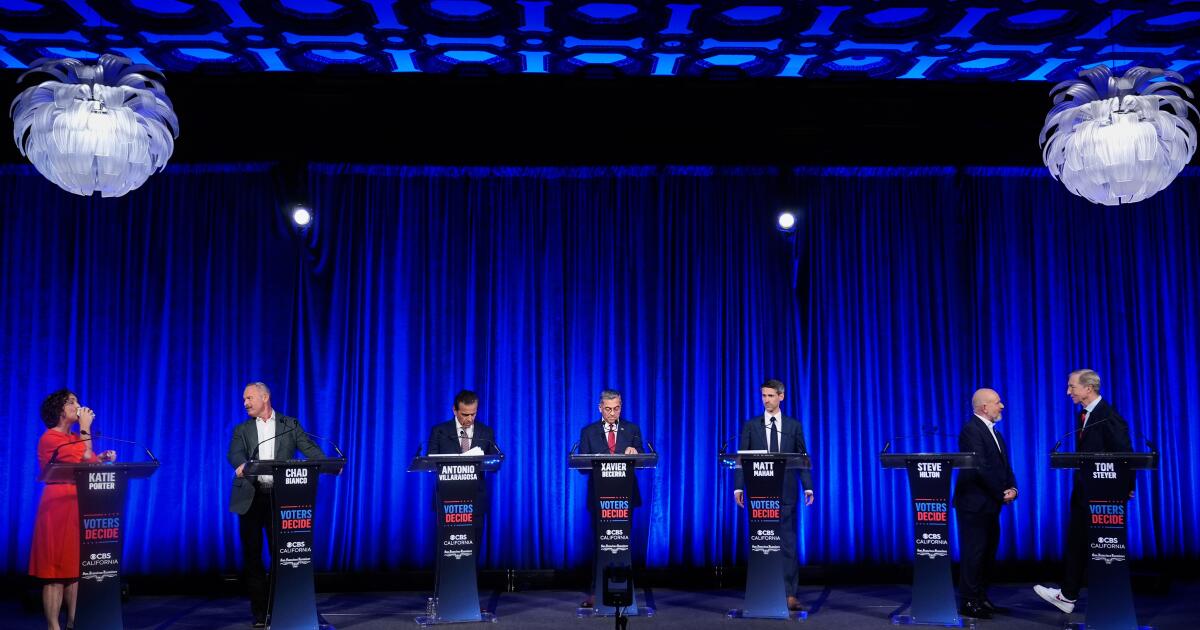
For the sixth and final time before votes are counted, the leading contenders for California governor gathered Thursday night for a televised debate, this one a 90-minute session in San Francisco.
Times columnists Gustavo Arellano, Mark Z. Barabak and Anita Chabria absorbed the rhetorical blows, followed the heated back-and-forths and took in each and every one of the candidates’ myriad policy prescriptions. Here’s their assessment:
Arellano: Near the end of the debate, co-moderator and San Francisco Examiner editor-in-chief Schuyler Hudak Prionas groaned as candidates talked over each other while trying to answer a question that was supposed to elicit a yes or no response.
That’s pretty much how California voters have reacted to this primary.
In an era where politics are far too often about choosing the least worst option, voters in this election are left with the political version of the Angels baseball team.
No candidate has polled higher than 20-some percent — a testament to how many are in the running, but also an indication that none of them has truly captured the zeitgeist of today’s California.
This year’s debates have done little to catapult anyone to the top, and tonight was more of the same. I still don’t know who I’m going to vote for, and no one inspired me to side with them. No one offered a clear vision of how they would pull Californians out of a spiritual malaise that has so many of us leaving the state, or thinking about leaving.
Instead, what I heard too many of the candidates evoke was the glories of the past — their past.
Antonio Villaraigosa’s closing remarks made a mantra out of “Dream with me,” a slogan he used back when he was L.A. mayor — that was 13 years ago.
Xavier Becerra bragged about how he stood up to President Trump as California attorney general — that was five years ago.
Katie Porter pulled out a white notebook with something written on it and directly challenged Becerra to answer a question — a callback to her time as a congressmember grilling people on Capitol Hill with a whiteboard and a marker, which she first made famous seven years ago.
The two Republicans, Riverside County Sheriff Chad Bianco and conservative commentator Steve Hilton, spoke of a halcyon California destroyed by feckless Democrats and vowed a return to those days.
The only candidates who didn’t live in the past were San José Mayor Matt Mahan and hedge fund billionaire Tom Steyer — but they seemed particularly out of their league, with Steyer too often looking down at notes instead of speaking off the cuff with his well-rehearsed populist pluck.
The word “nostalgia” first emerged to describe what doctors back then considered a malady, thinking it unwise to long for the past. It’s a concept historically antithetical to California, long boosted as the land of today and tomorrow by everyone from the Mission fathers to orange barons, developers to politicians. Indeed, nostalgia has sometimes been a dangerous factor in California politics, unleashing the Spanish fantasy heritage movement, Prop. 13, Prop. 187 and all sorts of other nonsense.
The two candidates who advance to the general election would be wise to offer Californians a hope for the future that doesn’t call back to our yesterdays. For now, the only real winners are the political consultants, and the only real losers are Californians, because we still don’t know for sure that any of the candidates can make things better.
All we can expect is that they’ll turn things for the worse.
Barabak: A popular expression — which Steyer mentioned — defines insanity as doing the same thing over and over and expecting a different result.
By that measure, was the audience for Thursday night’s throwdown insane? Masochistic? Or a group of high-minded, dutiful, quite-conscientious California voters?
The leading gubernatorial candidates have been at this so long that they’re like actors in a stage troupe, delivering well-rehearsed lines, or an old band getting together to play their greatest hits, though far less melodious.
Among those reprising familiar roles were Steyer as the boastful billionaire; Bianco as the angry white avenger; Hilton as the chipper doomsayer; Mahan as the kid brother insinuating his way into the conversation; Porter as the left-wing tribune promising a progressive Valhalla; and Villaraigosa as the old political war horse.
Once more, Becerra was the focal point of attacks, befitting his newfound status as the candidate to beat. “This is what happens when you take the lead in polls,” he rightly noted.
And so rivals again assailed Becerra’s performance as state attorney general and Health and Human Services secretary in the Biden administration. They accused of him being a shill for Big Oil. They tried, implying guilt-through-association, to rope Becerra into the scandal involving his former aides who embezzled from a dormant campaign account.
(Becerra, crisper and more lively than he’s previously been, noted that prosecutors in the case have described him as a victim and not a perpetrator or co-conspirator.)
It’s hard to see all the jostling and thrown elbows making a huge difference. The promises made and attacks scattered like buckshot on the San Francisco soundstage all seem much less important than the numbers that show up in opinion polls between now and Election Day.
Many Democrats, spooked by the prospect of their party being frozen out in June’s top-two primary, have been clinging to their ballots, intending to vote at the last moment for whichever Democrat appears likeliest to finish first.
In that way, the race seems to be shaping up as less a competition than a self-fulfilling prophecy. And Thursday night’s performance, while not wholly irrelevant, was just another television rerun broadcast to a less-than-mass audience.
Chabria: Here’s what I’ll say about Thursday night: It was a debate. The old-school kind where everybody is mostly well-behaved and polite, and the audience scrolls on their phones to stay awake.
The candidates themselves seemed low-energy, even with their jabs — which were largely directed at Becerra, as Mark said.
But no sparks also means we have more clarity. Barring an Eric Swalwell-style blow-up, the top three — Becerra, Steyer and Hilton — are really the only true contenders.
But I’ll give a shout-out to Porter, who had her best performance to date with answers that were clear and laid out policy with detail. Still, I fear it’s too little, too late.
Becerra, on the other hand, seemed subdued to the point of flat (sorry, Mark, he came off crisp like a week-old apple to me) often relying on the line that he sued Trump more than a hundred times as attorney general of California during Trump’s first term. I’m not sure that’s inspiring, though it did lead to some court victories.
Granted, Becerra has had a hard week, with a gaffe with a reporter that went viral and a plea deal by a former aide in that case of money misappropriated from his dormant campaign account. It’s not clear yet if voters care about either of those glitches — but if they stick in people’s minds, that could open a path for Steyer to scrape up the small margin he needs to get through the primary.
But Thursday night also did little to help Steyer’s cause — or hurt it. He made some clear, forceful points that positioned him as the changemaker progressive, especially around his policies on moving away from fossil fuels. He also had some convoluted answers that didn’t land. He didn’t give undecided voters much to work with.
I’ll end with one answer from Hilton that women should pay attention to: He said that if elected, he would allow California abortion providers to be extradited to states such as Louisiana to face criminal charges for mailing abortion medications.
Women across the U.S. now must rely on states such as California for any access to abortion care. Hilton’s position is not just bad for California but presents a risk to women everywhere.
For me, that answer should disqualify him for the highest office in our pro-choice state.


NEWYou can now listen to Fox News articles!
Rep. Diana DeGette, D-Colo., a 30-year incumbent, lost to a Democratic Socialists of America (DSA)-backed challenger in a high-profile primary on Tuesday evening.
Melat Kiros, a 29-year-old socialist, defeated DeGette in a Democratic primary for a deep-blue House seat anchored in Denver, according to The Associated Press, scoring a major victory for the socialist left on Tuesday evening.
The DSA had been aiming to cast DeGette’s loss as evidence of its growing momentum after a slate of socialist candidates won Democratic primaries in New York City last week.
“Today, the East Coast, next week the Mountain West,” the DSA wrote in a social media post last week.
Rep. Diana DeGette speaks during a press conference outside the U.S. Capitol building in Washington, D.C., on Jan. 10, 2024. (Samuel Corum/Getty Images)
SOCIALISTS CHEER ‘SHOCKWAVE’ PRIMARY NIGHT AS DSA-BACKED CANDIDATES WIN, ADVANCE ACROSS THE MAP
If elected in November, Kiros, who was born in Ethiopia, will likely join the ranks of the far-left group known as the Squad and become one of a handful of the House chamber’s outspoken socialists.
The millennial challenger was endorsed by Sen. Bernie Sanders, I-Vt., Rep. Alexandria Ocasio-Cortez, D-N.Y., and the anti-incumbent leftist organization Justice Democrats. Controversial socialist streamer Hasan Piker, who has said Hamas is “a thousand times better” than Israel and praised the Chinese Communist Party, also backed Kiros’ insurgent primary run.
DeGette, a member of the Congressional Progressive Caucus who supports abolishing Immigration and Customs Enforcement (ICE), sought to win a 16th House term by flexing her leftist bona fides. She argued her seniority on an influential House committee would allow her to push for Medicare-for-All legislation — a longtime priority of the party’s far-left flank.
DeGette, who was endorsed by former CPC Chairwoman Pramila Jayapal, D-Wash., also spotlighted her experience as an impeachment manager during Trump’s second impeachment trial in 2021.
Though DeGette and Kiros shared few policy disagreements, they diverged sharply over Israel and antisemitism. Kiros also sharply criticized DeGette for accepting corporate PAC contributions.
Kiros, a PhD student and lawyer, was fired from a New York firm in 2023 after publishing an open letter, arguing that pro-Palestinian student protesters calling for the elimination of Israel were not antisemitic and appearing to defend Hamas.
Melat Kiros participated in a League of Women Voters Congressional District 1 candidate forum at Montview Presbyterian Church in Denver on May 28, 2026. (RJ Sangosti/MediaNews Group/The Denver Post)
WATCH: HOUSE DEMS UNLOAD ON TEXAS DEMOCRAT OVER ‘DEMENTED’ ANTISEMITIC COMMENTS
She has also described the Oct. 7, 2023, attacks against the Jewish state as the “inevitable consequence of apartheid” and declined to characterize the deadly firebombing of protesters in Boulder last year who were urging the release of hostages held by Hamas in Gaza as antisemitic.
“I don’t know what was in the heart of the perpetrator,” Kiros told Colorado’s 9News in a recent television interview. “All I know is that he went and attacked innocent people because of what they might have believed.”
A June 2025 bipartisan resolution condemning the attack as part of a “rise in ideologically motivated attacks on Jewish individuals” won every present lawmaker’s support, except for Reps. Rashida Tlaib, D-Mich., and Thomas Massie, R-Ky., who voted present.
Kiros has also suggested the United States deserved 9/11.
“Inevitable in the sense that we destabilized a lot of the Middle East that forced people to believe that another act of violence was the only response,” Kiros told 9News when asked if she thought the terror attack was “the inevitable consequence of American foreign policy.”
“And again, just like I said before, our responsibility is to get rid of those conditions that lead to violence in the first place,” Kiros continued.
DeGette argued that Kiros’ embrace of Piker and her comments about antisemitism and 9/11 were disqualifying.
“I’m shocked and disgusted that Kiros is doubling down on excusing terrorism and the murder of innocent people,” the 30-year incumbent wrote on Facebook earlier this month.
Streamer and creator Hasan Piker speaks at a press conference during day two of Web Summit Vancouver at the Vancouver Convention Centre in Vancouver, Canada, on May 13, 2026. (Sam Barnes/Web Summit via Sportsfile via Getty Images)
CLICK HERE TO DOWNLOAD THE FOX NEWS APP
Colorado’s 1st Congressional District is the most liberal seat in the state and voted for former Vice President Kamala Harris by 56 points in 2024.
The primary fight was further scrambled by University of Colorado Regent Wanda James, also running for DeGette’s seat. Though James did not pose the same threat as Kiros, her vote share could ultimately have swayed the contest.

Gov. Gavin Newsom has signed off on a 100% state tax on money any Californians receive from Trump’s $1.8-billion “anti-weaponization” fund for his political allies.
Newsom unveiled his proposal in May, after Trump’s Justice Department said it would create a fund to compensate Trump’s allies who claim they have “suffered weaponization and lawfare” under Biden’s Justice Department.
The settlement fund was criticized by politicians on both sides of the aisle, including Sen. Mitch McConnell (R-Ky.), who described it as a “slush fund to pay people who assault cops.”
The fund remains in legal limbo. Earlier this month, a federal judge in Virginia extended a court-ordered block on the plan, which critics warned could be used to pay pardoned Jan. 6 rioters.
Fast-tracked into law as part of Senate Bill 122, Newsom’s plan imposes “a tax on any settlement fund payment from the federal Anti-Weaponization Fund, or any subsequent fund, settlement, or agreement, as provided, at a rate of 100%,” according to the bill text. The tax applies to all tax years between 2026 and 2030.
Newsom signed the bill Tuesday. In a statement, his office said the tax is meant to ensure that, should Trump’s fund proceed, California recipients won’t “receive favorable state treatment on those payments.”
“We believe democracy is worth defending, the rule of law matters, and public dollars should support victims—not those who attacked the very institutions that protect our freedoms,” Newsom said in the statement.
University of Southern California law professor Ariel Jurow Kleiman, an expert on tax law and policy, said that while Newsom’s tax is a “novel legal strategy,” she believes there is “no categorical legal restriction” preventing California from implementing it.
States have a “wide degree of discretion” to design their tax systems — including how they define income — so long as they do not violate their constitutions, Jurow Kleiman said.
If a California resident wanted to challenge the tax in court, they would need to show they were harmed by it to have standing to sue, according to Jurow Kleiman. That would mean receiving a payment from Trump’s settlement fund and then paying the 100% California tax. Unless the settlement fund is established and distributes payments, that scenario is unlikely.
While there have been proposals to levy a 100% tax on income above certain thresholds — Sen. Bernie Sanders (I-Vt.) in 2023 said he supports a 100% tax on income exceeding $1 billion — Jurow Kleiman said she is not aware of any governments that have adopted such a policy.

NEWYou can now listen to Fox News articles!
The House has officially shipped a colossal bipartisan housing package to President Donald Trump, and lawmakers are hoping that, at the very least, he doesn’t veto it.
Trump was supposed to sign the 21st Century ROAD to Housing Act last week, but his last-minute decision to ghost the signing ceremony with House Speaker Mike Johnson, R-La., and Senate Majority Leader John Thune, R-S.D., put into question whether the bill was dead.
His refusal to sign the bill, which passed with overwhelmingly bipartisan support in both chambers, was to leverage the Safeguarding American Voter Eligibility (SAVE) America Act, which doesn’t currently have the votes to succeed in the Senate.
WARREN TELLS TRUMP TO ‘SIGN THE DAMN BILL’ AS BIPARTISAN HOUSING PACKAGE REMAINS STALLED IN WASHINGTON
Trump has refused to sign the 21st Century ROAD to Housing Act. (Shawn Thew/EPA/Bloomberg via Getty Images)
Trump appears to be in no hurry to sign the bill, despite Republicans who are hungry for a win in the affordability fight ahead of the midterm elections.
“It’s so unimportant … compared to the SAVE America Act,” Trump told reporters in the Oval Office on Monday. “I think the SAVE America Act is exactly what it says. It’s saving America from crooked elections.”
“Here’s what I would like to sign, much more than a bill that — big deal, it’s a yawn,” he continued. “Some people say it’s wonderful. To me, compared to the SAVE America Act, just about everything is a big yawn.”
GOP INFIGHTING OVER TRUMP’S VOTER ID BILL ERUPTS AS TOP SENATOR CALLS STRATEGY ‘FANTASY’
It’s legislation that is loaded with nearly 60 provisions from both sides of the aisle in both chambers that’s designed to make it easier for homes to be built and for younger Americans to buy their first home. It also includes a ban on hedge funds buying up housing stock that Trump pushed Congress to include during the State of the Union earlier this year.
Sen. Elizabeth Warren, D-Mass., one of the architects behind the bill in the upper chamber alongside Sen. Tim Scott, R-S.C., charged that Congress handed the bill to Trump “on a silver platter.”
“When you ask me what happens next, if he cared about the American people, he’d have already signed the damned thing, and we’d be underway,” Warren said on WCVB’s “On the Record” on Sunday.
But Trump doesn’t have to put his signature on the bill for it to become law.
IRATE REPUBLICANS ACCUSE TRUMP OF HANDING DEMOCRATS A WIN AFTER BLOWING UP HOUSING PACKAGE
The Senate advanced a massive, Trump-backed housing package geared toward lowering the costs of homes and supercharging the housing supply. Sen. Elizabeth Warren, D-Mass., pitched it as legislation to prevent America from becoming a “nation of renters.” (Jemal Countess/Getty Images for Protect Borrowers; Anna Moneymaker/Getty Images)
The Constitution grants presidents the ability to veto a bill within 10 days of it being transferred over to the White House. In that scenario, Congress could override a veto of the housing package.
It’s happened before under the Trump administration. In early 2021, Congress overrode Trump’s veto of the annual National Defense Authorization Act — a massive Pentagon funding authorization package that some House Republicans are trying to use as a vehicle to pass the SAVE America Act.
But during that 10-day period, if Trump doesn’t sign the bill, it would automatically become law. That’s unless Congress completely adjourns, in which case a “pocket veto” could happen. The Senate is currently in recess and the House is scheduled to leave town by week’s end, but neither count as a full adjournment.
CLICK HERE TO DOWNLOAD THE FOX NEWS APP
Johnson, who spent the last few days meeting with Trump at the White House about the housing bill and the SAVE America Act, said: “I hope he does sign it.”
“If he doesn’t, it’s still law,” Johnson said. “We’ll still celebrate it, but he’s trying to make a point, and I think he’s making it very effectively. And the fact that you all ask me every three steps down the hallway illustrates that he has achieved the desired objective, and that is to make SAVE America the number one thing, because if we don’t get that right, everybody’s concerned about what happens next.”
-
 Lifestyle17 minutes ago
How does the Kennedy Center board make decisions? This legal filing sheds some light
-

 Technology27 minutes ago
Meta is adding ridiculous ‘rate limits’ and a soft paywall to its smart glasses
-

 World32 minutes ago
Boy, 2, pulled alive from rubble six days after Venezuela’s devastating twin earthquakes
-

 Politics34 minutes ago
Socialism goes west as DSA-backed challenger ousts longtime Democrat
-

 Health39 minutes ago
Americans are giving up multivitamins for a different daily health habit, study finds
-

 Sports42 minutes ago
2026 World Cup Quarterfinal Odds: Which Squads Will Make Final 8?
-

 Technology47 minutes ago
Warehouse robots move packages without human handoff
-
 Business54 minutes ago
Disneyland to offer $59 evening tickets next month

