Maine
A top issue in Maine and Oklahoma governors’ races? Tribal sovereignty. – ICT


This story is part one of a two-part story on gubernatorial races to watch in the 2026 midterm elections as part of the #NativeVote26.
Pauly Denetclaw
ICT
Two of the 39 states with gubernatorial races have tribal sovereignty at the top of their policy agendas: Oklahoma and Maine. The two states where tribal nations have had friction with their state governments. Now Native voters in both states will be electing a new governor, and the results will impact the relationship between tribal governments and the state for the next four years.
Wabanaki Nations in Maine had a challenging time getting state legislation signed into law by Gov. Janet Mills, Democrat, that would strengthen tribal sovereignty. The 38 tribes in Oklahoma had a tumultuous relationship with Republican Gov. Kevin Stitt.
Eighteen of the 39 governor races in 2026 will have incumbent candidates, according to the National Governors Association. Stitt is the 2025-2026 chair of the association.
What’s happening in Oklahoma?
Over the past seven years, tribal nations and the state of Oklahoma had a contentious relationship — especially after the McGirt decision. Current governor, Stitt, who is a Cherokee Nation citizen, has been outspoken against the McGirt decision, tribal compacts for tobacco and car tags, and tribal gaming compacts.
Tribal-state compacts are legal agreements between federally recognized tribes and state governments. It is most commonly used for class III gaming — slot machines and table games.
“There was a time and a day when we used to compact with the tribes. That is not a unique thing across the nation. It wasn’t a unique thing in Oklahoma,” Chip Keating said during an April 6 candidates forum. “We absolutely have to hit the full reset button with the tribes — work together, treat them with the respect that they should have been treated with, and we’ve got to get back to compacting.”
Tribal leaders are looking forward to new state leadership, said Michael Stopp, president and chief executive officer of SevenStar Holdings.
“It’s good for the tribes and the tribal leaders are happy about it,” said Stopp, a citizen of the Cherokee Nation. “It has very much been a sticking point with tribal leaders that Governor Stitt has a very different perspective on sovereignty and what role the tribes play in this state. Obviously, we’ve had some big changes with the reservation status here because of the McGirt decision in 2020, but Governor Stitt, who is a member of the Cherokee Nation, has been more of an antagonist when it comes to that, than trying to help with the transition. I can definitely say the tribal leaders are looking for leadership change.”
Cherokee Nation Principal Chief Chuck Hoskin called Stitt the most anti-Indian governor in the state’s history. Oklahoma Attorney General Gentner Drummond described Stitt as having a “penchant of racism against tribes,” during an April candidates forum. He added that it was unacceptable.
Tribal nations and state governments have to work together often. As seen in Oklahoma, Stitt vetoed several tribal compacts, despite overwhelming support by the state’s legislature, and this slowed the process for establishing the tobacco, car tag and gaming compacts between Oklahoma and tribal nations.
“Governor Stitt came in thinking that he could renegotiate this contract, and quite frankly, it just doesn’t work that way. Instead of listening and coming to the negotiating table, (Stitt) tried to come in with a really strong stance and ended up losing, honestly,” Stopp said. “I think that was unfortunate for him and for the tribes. Again, missing out on the chance of negotiating and I think the tribal leaders are definitely looking forward to having someone on the other side of the table to negotiate with.”
Oklahoma governor candidates
There are nine Republican candidates on the ballot for Oklahoma’s primary election set for June 16:
- Gentner Drummond: 20th Attorney General for Oklahoma
- Chip Keating: Former highway trooper and former Oklahoma Secretary of Public Safety
- Mike Mazzei: Former Oklahoma state Senator and former Secretary of Budget
- Charles McCall: Longest-serving Speaker of the House in Oklahoma history
- Jake Merrick: Local radio host and former Oklahoma state Senator
- Kenneth Sturgell: Local, small business owner
- Leisa Mitchell Haynes: Former marketing director and former city manager
- Calup Anthony Taylor
- Jennifer Domenico-Tillett
Three Democratic gubernatorial candidates are also running for the primary election:
- Cyndi Munson: Oklahoma House Minority leader
- Connie Johnson: Former Oklahoma state Senator
- Arya
Candidates will have to get more than 50 percent of the votes to avoid a runoff. If there is no outright winner, the top two candidates for each political party will head to a primary runoff election on August 25.
An additional three Independent candidates will automatically head to the general election this November.
Two important issues this election in Oklahoma are tribal sovereignty and a commitment to working with tribes.
During an April 6 Republican candidates forum, Gentner Drummond, Charles McCall, Chip Keating and Mike Mazzei, were asked to raise their hand if they shared Stitt’s perspective on the McGirt decision. Stitt was quoted as saying that the McGirt decision has torn Oklahoma apart and has created two justice systems based on race. None of the four candidates raised their hand.
“For three and a half years I’ve been working with every tribal leader in the state of Oklahoma, and I recognize them as unique among themselves, just like France is different from Germany,” Oklahoma Attorney General Gentner Drummond said during a candidates forum. “We have to honor and respect the culture of diversity that they bring to the table and the needs that they have. We have been working with tribal law enforcement each of the last three years to take the fight to organize crime in our rural communities. They are a great partner.”
All four candidates promised their administration would work with tribal nations and negotiate tribal compacts.
Mazzei said at two different candidate forums that he would be a strong negotiator with tribal nations.
In a recent interview with KOCO 5 News, local small business owner Kenneth Sturgell said tribal nations are their neighbors and should be treated as such. He also said that the state and tribal nations have to work together.
Jake Merrick, local radio host and former Oklahoma state Senator, was pleased that the state Supreme Court affirmed tribal nations’ right to hunt on their own lands, during a March 30 candidates forum.
Democratic candidate Cyndi Munson, Oklahoma House Minority leader, said in a recent press release that her caucus supports tribes.
“The Oklahoma House Democratic Caucus supports tribal sovereignty and acknowledges that our tribes fill important gaps in our education and healthcare systems, as well as other areas throughout our state,” Munson said. “I am extremely grateful for the work our tribes have done and continue to do despite vicious attacks on them by the Governor.”
A respectful working relationship between tribal nations and the state has shifted significantly since the last gubernatorial race in 2022.
“I think every one of them [Oklahoma governor candidates] has said something about it,” Stopp said. “[It’s] different than four years ago. It was an issue in the governor’s race, but it wasn’t a good issue. Here everyone’s saying yes, we want to change the tone and start the conversation differently. So I think as far as Indian voters go, that conversation is going to change regardless of who wins.”
Dawnland
In Maine, Gov. Mills repeatedly refused to sign a law that would strengthen tribal jurisdiction and recognize Wabanaki Nations right to access federal Indian laws. She vetoed the bill twice despite overwhelming support from state legislators.
“We’ve had multiple opportunities to send [legislation] to the governor’s desk and not just party line votes,” said Maulian Bryant, executive director of the Wabanaki Alliance and former Penobscot ambassador. “We generally have Democratic support, but we have gotten Republicans voting on these issues too. So, the governor has seen some great bipartisan work reach her desk and has still decided to veto some of these efforts.”

” data-large-file=”https://i0.wp.com/ictnews.org/wp-content/uploads/2026/05/AP26076552017637-scaled.jpg?fit=780%2C520&quality=89&ssl=1″ alt=”” class=”wp-image-329224″ srcset=”https://i0.wp.com/ictnews.org/wp-content/uploads/2026/05/AP26076552017637-scaled.jpg?resize=1024%2C683&quality=89&ssl=1 1024w, https://i0.wp.com/ictnews.org/wp-content/uploads/2026/05/AP26076552017637-scaled.jpg?resize=300%2C200&quality=89&ssl=1 300w, https://i0.wp.com/ictnews.org/wp-content/uploads/2026/05/AP26076552017637-scaled.jpg?resize=768%2C512&quality=89&ssl=1 768w, https://i0.wp.com/ictnews.org/wp-content/uploads/2026/05/AP26076552017637-scaled.jpg?resize=1536%2C1024&quality=89&ssl=1 1536w, https://i0.wp.com/ictnews.org/wp-content/uploads/2026/05/AP26076552017637-scaled.jpg?resize=2048%2C1365&quality=89&ssl=1 2048w, https://i0.wp.com/ictnews.org/wp-content/uploads/2026/05/AP26076552017637-scaled.jpg?resize=1200%2C800&quality=89&ssl=1 1200w, https://i0.wp.com/ictnews.org/wp-content/uploads/2026/05/AP26076552017637-scaled.jpg?resize=2000%2C1333&quality=89&ssl=1 2000w, https://i0.wp.com/ictnews.org/wp-content/uploads/2026/05/AP26076552017637-scaled.jpg?resize=780%2C520&quality=89&ssl=1 780w, https://i0.wp.com/ictnews.org/wp-content/uploads/2026/05/AP26076552017637-scaled.jpg?resize=400%2C267&quality=89&ssl=1 400w, https://i0.wp.com/ictnews.org/wp-content/uploads/2026/05/AP26076552017637-scaled.jpg?w=2340&quality=89&ssl=1 2340w, https://i0.wp.com/ictnews.org/wp-content/uploads/2026/05/AP26076552017637-1024×683.jpg?w=370&quality=89&ssl=1 370w” sizes=”(max-width: 780px) 100vw, 780px”/><figcaption class=) FILE – Democratic Gov. Janet Mills delivers her State of the State address, Jan. 30, 2024, at the State House in Augusta, Maine. (AP Photo/Robert F. Bukaty, File)
FILE – Democratic Gov. Janet Mills delivers her State of the State address, Jan. 30, 2024, at the State House in Augusta, Maine. (AP Photo/Robert F. Bukaty, File)
In order for tribes to access federal Indian laws, the state has to approve it. The Wabanaki Alliance, created to educate the people of Maine about tribal sovereignty, has been working diligently to amend the Maine Indian Claims Settlement Act of 1980.
Through the settlement, tribal nations ceded land in exchange for $81.5 million. However, it also drastically limited tribal sovereignty, and brought tribes under the jurisdiction of the state. Tribal nations that predate the state, are subjected to state jurisdiction and treated more like municipalities. The act was meant to be a living document but the state resisted changes for decades.
The Wabanaki Alliance has been able to increase tribal sovereignty and self-governance one legislation or amendment at a time. Throughout her two-terms, Mills has resisted a complete overhaul of the 1980 act and this created tension between the governor and tribal nations.
“If we had a governor that came in and fully embraced the inherent rights and inherent sovereignty of our people, and fully recognized that, it would strengthen our communities and it would also uplift the entire state of Maine,” said Bryant, who is Penobscot. “Our tribal communities are near rural places that could really use economic opportunities and could really use tribal businesses that are able to grow without all of these bureaucratic restrictions. We really are coming from a place of friendliness and we want to be good neighbors and we want to uplift the communities around us.”
The Wabanaki Alliance held a gubernatorial candidates forum in March where nine governor candidates participated:
- Shenna Bellows, Democrat
- Rick Bennett, Independent
- John Glowa, Independent
- Troy Jackson, Democrat
- Derek Levasseur, Independent
- Hannah Pingree, Democrat
- Nirav Shah, Democrat
- Angus King III, Democrat
None of the eight Republican candidates participated.
Most of the gubernatorial candidates generally supported increasing tribal sovereignty, recognizing inherent rights and working with tribal nations. Angus King III said he wasn’t educated on the topic enough to make any commitments and would have to look into it. This sentiment was shared by John Glowa and Derek Levasseur.
Hannah Pingree, Rick Bennett, Shenna Bellows and Troy Jackson firmly supported tribal sovereignty for Wabanaki Nations.
“If a governor comes in, and isn’t afraid of recognizing tribal sovereignty and sees it as an opportunity, I think we could see some real progress for everyone,” Bryant said.
Related



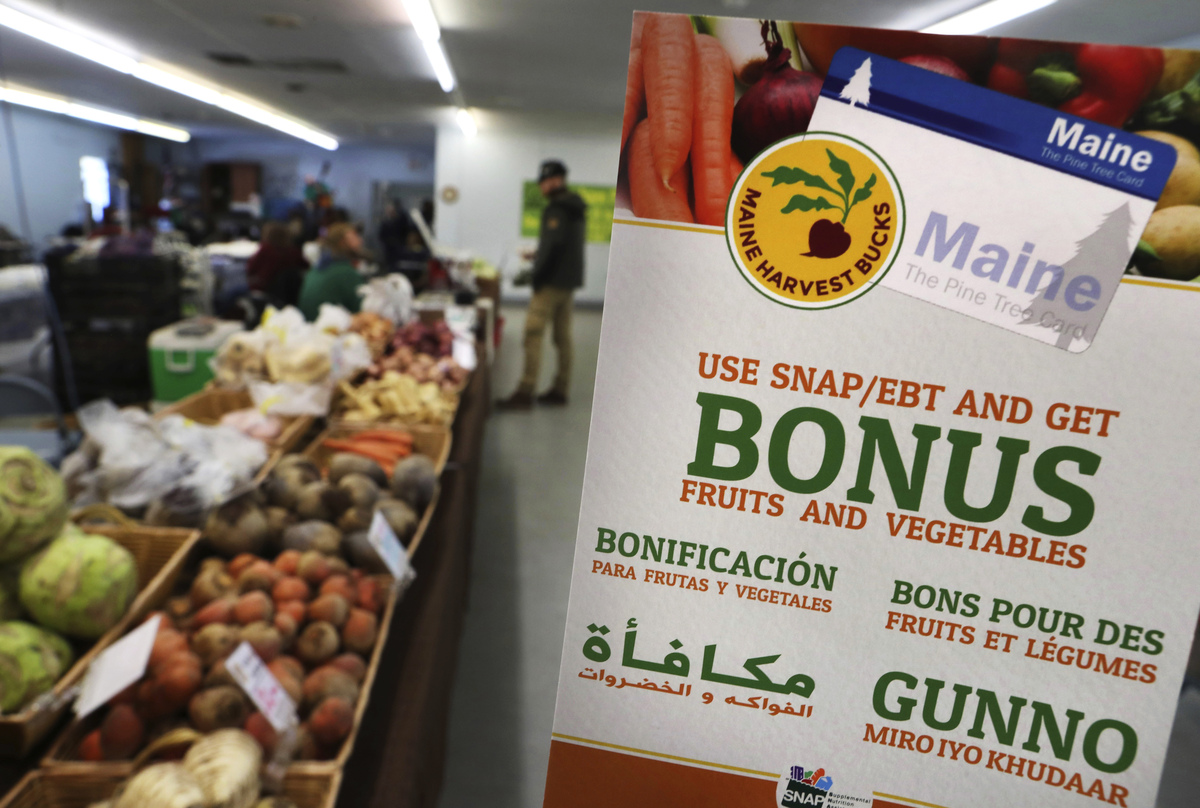
Maine could face up to $50 million in penalties next year due to errors in its payments for federal food benefits under the Supplemental Nutrition Assistance Program.
Newly released data from the U.S. Department of Agriculture find that Maine’s error rate last year was nearly 11%, the bulk of which were overpayments. That’s in line with the U.S. average. But starting in October of next year, states with error rates above 6% must cover a portion of the SNAP benefits.
Anna Korsen, executive director of Full Plates, Full Potential, said the overpayments aren’t fraud — they’re human error. She said this new cost-shifting policy enacted last year under the Trump administration further complicates the SNAP application process.
“Instead, we could make this program more accessible and more efficient,” Korsen said. “And that would reduce the number of errors and also ensure that Mainers who are eligible for SNAP have access to it.”
She’s urging Congress to delay or reverse the policy under the farm bill that’s currently under consideration.
Maine’s Department of Health and Human Services said it’s taking steps to reduce the error rate, including modernizing its systems and hiring an additional 40 eligibility specialists.
This story appears through a media partnership with Maine Public.

PORTLAND (WGME) — The third annual Celebration of America 300 is set for Thursday night at Oxford Plains Speedway.
This race was a favorite of NASCAR star Kyle Busch, who tragically passed away back in May. He was just 41.
Now, a Maine-born driver who worked on Busch’s team is ready to take the 8 car into victory lane.
For the past five years, Windham native Derek Kneeland was Busch’s eye in the sky, working as a spotter for the cup star. Kneeland says his relationship with Busch was like a brotherhood.
“I was fortunate enough where I got to have a personal relationship with him,” Kneeland said. “He came up, and he ran several races with me in late models and stuff at Oxford and Lee Speedway, and we got to do a lot of cool things together.”
Kneeland says dealing with the sudden loss has been both painful and difficult.
“It’s still hard,” Kneeland said. “I’m having a hard time with it. The weekdays are the hardest. At the track is where I’m most comfortable.”
Kneeland will be at the track and behind the wheel Thursday night, competing in the Celebration of America 300, driving the number 8 car.
“You know, a few days after everything went down, his dad called me, and his dad is a man of very few words, and I said, ‘You know, I’m thinking about running the 8 or 51 as long as I have your guys’ blessing, I would like to do that.’ And he said, ‘Short track world knows him as 51, but the world knows him as 8,’” Kneeland said.
Kneeland says it will be an emotional race, but he’s confident he’ll have a special co-pilot leading the way.
“Hoping he’s going to be on my shoulder and give me the guiding way and but to win it for Kyle, I think that would put the stamp on it,” Kneeland said.

FRIENDSHIP, Maine — A federal judge has ordered U.S. Immigration and Customs Enforcement not to relocate a Friendship man who ICE agents arrested Saturday.
Dhavalkumar Kalidas Patel was seized by four ICE agents at Wallace’s Market, which Patel and his wife operate on Harbor Road in Friendship.
His wife said the agents did not say why he was being taken away in handcuffs.
Attorney Audrey Richardson of Greater Boston Legal Services filed a motion for habeas corpus, meaning he is to be brought to a court in person.
U.S. District Court Judge Indira Talwani of Massachusetts issued an emergency order hours after Patel was seized that prohibits him from being moved elsewhere.
“To provide a fair opportunity for the judge who will be randomly assigned to this case to review the merits of the petition and to rule on any contested issues of jurisdiction, unless otherwise ordered by the assigned judge, respondents will not remove the petitioner from the jurisdiction of the United States or transfer petitioner to a judicial district outside that of Massachusetts for a period of at least 72 hours from the time this Order is docketed,” Talwani wrote.
Patel is being held at the Plymouth County Correctional Facility in Plymouth, Massachusetts.
The petition filed by the attorney representing Patel argues that he is being held unlawfully.
No further hearing dates have been scheduled, but the federal government has until July 6 to file a response.
Richardson issued a statement on the arrest.
“This is another example of ICE illegally and illegitimately taking someone who is working hard to support their family,” she said, including a child born in the United States. “The family is a critical part of the fabric of a small community.”
The Patels have operated the store since 2024. The attorney said ICE agents initially did not even identify themselves. They did not say where he was being taken but he was allowed to make a call when they stopped in Scarborough.
Rob Sample, a customer of the store, said he could not understand why such an action was taken.
“We appreciate them,” he said of the Patel family, adding that they work hard to provide a community service by operating the store.
Knox County Sheriff Patrick Polky said ICE notified his department after its action. He noted the agency is not required to notify the department.
Patel is a native of India.
This story appears through a media partnership with Midcoast Villager.
-

 Miami, FL4 minutes ago
Every Dolphins head coach’s start in Miami from worst to best
-

 Boston, MA11 minutes ago
Historian clears up one of the biggest myths about the Boston Tea Party
-
Denver, CO14 minutes ago
Nemanja Jokic, the older brother of\u00a0Denver …
-

 Seattle, WA19 minutes ago
3 Seahawks Rookies Who Must Step Up Right Away
-

 San Diego, CA26 minutes ago
Adobe Falls: The elusive waterfall that briefly returns after San Diego rains
-

 Milwaukee, WI29 minutes ago
Steve Czaban returns with new home in Milwaukee sports-talk radio
-

 Atlanta, GA34 minutes ago
Golestan brings a taste of Persian home cooking to Peachtree Corners – Atlanta Magazine
-

 Minneapolis, MN41 minutes ago
Minneapolis City Council abandons tax hike near George Floyd Square, revises development plan

