Science
A Physicist Who Thinks in Poetry from the Cosmic Edge


Much of the praise for Chanda Prescod-Weinstein’s debut book in 2021, “The Disordered Cosmos: A Journey Into Dark Matter, Spacetime, and Dreams Deferred,” lauded the way she used personal experiences in physics to discuss the social and political inequities that exist alongside scientific breakthroughs.
“It contains the narrative of dreams deferred,” Dr. Prescod-Weinstein, a physicist at the University of New Hampshire, explained in April at a bookstore in Chicago. But its very existence, she said, also “represented a dream deferred, because that was not the dream of what my first book was going to be.”
Her second book reclaims that dream. Released on April 7, “The Edge of Space-Time: Particles, Poetry, and the Cosmic Dream Boogie” is less pain and more play, a homage to the big questions that made Dr. Prescod-Weinstein want to become a physicist in the first place. She begins the book by asserting that it is humanity’s duty to uncover and share the story of our universe. Her latest offering toward that duty is a journey through physics that is tightly bound to her own cultural roots.
In the midst of a multicity book tour, Dr. Prescod-Weinstein spoke with The New York Times about guiding readers through the cosmos from her own point of view and about some of the art, poetry and literature she drew on to shape that journey. This conversation has been edited for brevity and clarity.
Why include so many references to poetry in a book about physics?
I knew poetry before I knew physics. It was part of my upbringing. I loved A.A. Milne’s “Now We Are Six” and Edward Lear’s “Nonsense Limericks.” Both of my books draw their subtitles from Langston Hughes’s “Montage of a Dream Deferred.”
Adrienne Rich’s poem “The Burning of Paper Instead of Children” became a guiding light for how my work would move in the world. It also opened up for me that I need language. That’s true among physicists. Even an equation is a sentence; even an equation is telling a story.
As physicists, we’re always working in language to connect what we learn with what we know. Poetry is one of the first places that my brain goes to draw those links. Language, as it moves in my brain, is often in Hughes and Rich and Shakespeare. Those are the lines that flicker up for me.
What if we got away from the argument that doing cosmology and particle physics is practical or materially valuable? Then we have to accept that we’re like the poets. What we do is important culturally in the same way poetry is. A piece of this book is me saying there is value in banding with the poets, and fighting for the value of being curious and trying to articulate the world with whatever tools are available to us. Not for the purposes of selling something, but for the purpose of fulfilling our humanity.
Another theme throughout the book is the story of Lewis Carroll’s Alice and her adventures in Wonderland.
Being a science adviser on future installments in The Legendborn Cycle, a fantasy series written by Tracy Deonn, is one reason Alice is in my book. It has allowed me to be open to the playful side that physics, as a Black queer person, can take from you. I wanted the book to be whimsical, because that’s who I was when I first arrived in physics, and that’s who I want to be when I die.
Part of the call of quantum physics is to change what our sense and sensibility are. When you look at the world through this framework — like the idea that particles have spin but don’t really spin — it sounds like nonsense. Except that’s literally how the universe works. Physics is our “through the looking glass.” It’s real.
Your first chapter invites readers to reflect on the metaphors used to describe the universe, like the “fabric” of space-time or electromagnetic “fields.” Why open in this way?
A lot of books about quantum physics start with its history. I wanted as much as possible not to just do that. I had actually planned to start it with the Stern-Gerlach experiment of 1922. But then I read an essay by the poet Natasha Trethewey about abiding metaphors and started to ask myself what the abiding metaphors of my physics training were.
We don’t ever take time in our classes to ask, “What do we mean when we say ‘space’? What do we mean when we say ‘space-time’?” There are these metaphysical questions that I often told myself were for the philosophers. This book was me letting myself think of them as physics.
One metaphor you invoke is the “edge” — not only the edge of the universe and of scientists’ understanding, but also existing at the edge of certain identities.
In “Disordered Cosmos,” I talked a lot about being at the margin and looking toward the center. With “The Edge of Space-Time,” I’m choosing to make the margin the center of the story. Part of that was me fully embracing what makes me the physicist I am. I’m an L.A. Dodgers fan. I love “Alice in Wonderland.” I love “Star Trek.” There’s lots of all of that in the book.
Picking a metaphor is a culturally situated decision. I wrote a line that says black holes are the best laid edges in the universe. I did, at some point, think that only some people were going to get this. But for people who don’t understand the reference to Black hairstyles, the sentence is still legible. And for those who do, it will feel like we just had an in-group moment. Anyone who thinks about laying their edges deserves to have an in-group moment in a physics book. Because we are physics, too.
Black students are often told that if you want to be a physicist, then you will make yourself as close to such-and-such mold as possible. At a young age, we have this understanding that whiteness and science are associated with each other, but we are also witnessing in ourselves that this can’t be entirely correct. There’s this narration of, “Well, sure, you can be Black in physics, but that means you have to acclimate to the ‘in physics’ part, and never that physics has to acclimate to the Black part.”
I use the example of rapper Big K.R.I.T.’s song “My Sub Pt. 3 (Big Bang),” in which someone tries to wire up subwoofers in his car but fries the wires because he doesn’t ground them properly. I don’t know if Big K.R.I.T. would think of this as a science story, but I think we should learn to read it as one. Not to contain it in science, but to say it overlaps there. This can be a rap song. It can be about the cultural significance of subwoofers and the Big Bang as a metaphor for the beat. And it can also be about cosmology and about how everybody who wires up cars or does this kind of work is a scientist, too.
How do you want readers to approach this book?
There is this feeling that you’re supposed to read a book like this and walk away an expert. That’s actually not the point of this book at all. The point is to wander through physics. Even if math terrifies you, you are entitled to spend some time with it.
And so here, I have made you a book with a bunch of tidbits on the oddities of the universe. The universe is stranger and more queer and more wonderful and more full of possibility than whatever limitations you might be experiencing right now. Physics challenges what we are told are social norms. For example, non-trinary neutrinos are fundamental to our standard model of physics.
“Non-trinary,” as in they shift between three different forms.
Non-trinary is natural. It’s such a challenge to the current anti-trans rhetoric that says people can only ever be one thing.
I don’t need my book to be the most important thing that someone reads. But I want it to be a source of hope. If it reminds you that, as my mom says, the universe is bigger than the bad things that are happening to us, then that’s all you need to remember. I’m good with that.



Scientists hoped for years to make a machine that could emulate the movements of diving birds, such as puffins, and offer an affordable, unobtrusive way to monitor fragile marine ecosystems. A team of researchers at M.I.T. has been able to create such a waterproof winged robot, according to a study published July 9 in the journal Science.
Nearly one month after a fire destroyed a massive cold-storage facility in Boyle Heights, the neighborhood has been overcome by the stomach-churning stench of rotting food.
As facility operator Lineage works to remove more than 85 million tons of weeks-old food from its 500,000-square-feet warehouse, the rancid odors have attracted throngs of rats and swarms of flies, as a foul-smelling brownish liquid pours from the seams of the building.
Now, with a heat wave descending over much of Southern California, residents worry the odor could get even worse and scores of residents have called air quality regulators to complain. At the same time, environmental groups are accusing Lineage representatives and emergency responders of downplaying the risks pose by chemicals released during the fire.
Boyle Heights, a neighborhood that has been subjected to decades of toxic pollution from rail yards and other industries, has again become the center of attention in another environmental disaster. Already, the official response to the Lineage fire has eroded trust in government agencies, residents say.
Remediation work continues at a Lineage facility in Boyle Heights, where residents and nearby businesses have complained of a rotting food odor for weeks.
(Allen J. Schaben / Los Angeles Times)
On Tuesday, Sen. Alex Padilla (D-Calif.) visited the gutted warehouse alongside L.A. Fire Chief Jaime Moore and representatives of the South Coast Air Quality Management District and a contingent of environmental organizations. Padilla, along with Sen. Adam Schiff (D-Calif.) and Rep. Jimmy Gomez (D-Los Angeles), wrote a letter to the U.S. Environmental Protection Agency, calling on the agency to return to the cleanup zone to monitor air and water quality.
“Given the materials present in the warehouse, we are concerned about the long-term health and environmental impacts from contaminated smoke and water runoff on communities surrounding the warehouse,” the letter read.
Joe Lyou, president of nonprofit Coalition for Clean Air, told Padilla that he has heard of people becoming sick in the weeks after the event.
“I think that pointed to a problem with the messaging while the event first happened,” Lyou said. “It wasn’t consistent [with] if you smell smoke, see ash to get out and protect yourself — make sure you’re not exposed to it. There were different messages coming from different people, and we need to fix that.”
“The whole community was completely overwhelmed … and concerned about the ammonia, concerned about burning plastic, concerned about all sorts of other [emissions] that are really hard, difficult, expensive to measure. But … we’ll just never know some of those things,” Lyou said.

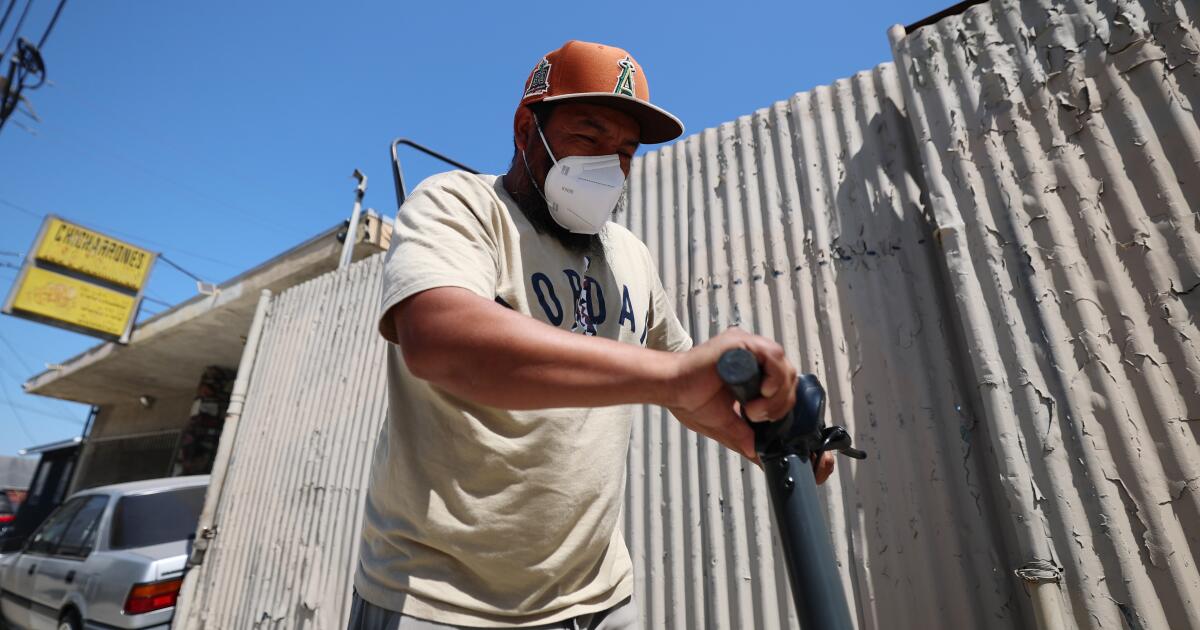
Street vendor Lupe Gonzalez pushes her cart away from a gutted warehouse in Boyle Heights.
(Allen J. Schaben / Los Angeles Times)
Chief Moore has faced criticism for his decision to advise residents to shelter indoors rather than to evacuate during the blaze. That stood in sharp contrast with Orange County fire officials, who evacuated tens of thousands of residents near an overheating chemical tank in Garden Grove in May.
On Tuesday, Moore told Padilla that the two incidents were very different. Moore said he had discussed the dilemma with TJ McGovern, the interim fire chief for the Orange County Fire Authority.
“He says everybody got mad at him because he evacuated everybody and nothing blew up,” Moore told Padilla. “But everybody’s mad at you because of the shelter-in-place [order] and it smells.”
Moore said that “there was nothing in the air that was hazardous” and that firefighters “never had a threat of an explosion.”
However, environmental experts said 14,000 pounds of flammable anhydrous ammonia were stored in tanks and used as refrigerant at the Lineage warehouse and posed a significant risk of explosion until it was removed days into the fire.
Environmental and community groups said L.A. fire officials also repeatedly emphasized the risks from ammonia in their radio communications. On the first day of the fire, a group of firefighters was hit by a plume of ammonia gas, and fire command quickly organized medical help.
“The majority of my division got exposed to ammonia gas. We’ll need to get them assessed.”
On Tuesday, Moore said no amount of ammonia was detected.
“When [firefighters] opened those doors, there was what looked like a big vapor cloud that came out,” Moore said. “That was the cold air mixing with the hot air that caused a vapor. It wasn’t ammonia.”
But residents remain skeptical.
Padilla’s visit follows a notice of violation that the South Coast Air Quality Management District issued to Lineage. The notice of violation was issued on July 12, after the agency received more than 40 public complaints of rotten, sour, garbage-type odors in the area. Inspectors confirmed the odors with community members and traced them back to cleanup operations at the facility, according to the air quality agency.
Boyle Heights residents are calling on Gov. Gavin Newsom to declare a mandatory evacuation of their community, saying the fire and the toxic aftermath are continuing to pose health risks. Without an evacuation order, they said, insurance companies won’t help residents who want to relocate with rent or mortgage relief.
“For nearly a month, a cold-storage warehouse fire has poisoned the air over the Eastside and Los Angeles County and City officials have refused to issue a mandatory evacuation,” read a statement from the community group Protect LA Now. “That refusal forces victims to pay their own way out, and leaves those who can’t afford to leave trapped in gases and toxins that no agency will name.”

Joe Lyou, president of the Coalition for Clean Air, explains how smell is affecting his health while talking to the media near a fire-gutted Lineage facility Tuesday.
(Allen J. Schaben / Los Angeles Times)
Tensions have been building in the community since the fire broke out on June 17 and burned for days.
At a contentious town meeting last week, Los Angeles Mayor Karen Bass struggled to open the meeting over the loud boos and yelling of community members, actions that were repeated as other elected officials took the microphone. The crowd grew even louder when Lineage Chief Operating Officer Jeff Rivera took to the stage and was met with shouts of “Liar!”
Air quality has been a constant concern for the community since the incident began. Beyond the health hazards of breathing in smoke from a building fire, there was a brief, temporary scare when an ammonia line that helped keep the building refrigerated was compromised, though Lineage has said the chemical was not detected in the air. Additionally, 85 million pounds of food thawed, burned and spoiled inside, creating a terrible smell that emanated from the property.
Nora Saenz, a resident of Bell, said she believed local leaders when they said there was no threat. During the fire, she took her niece and nephew to a community event in La Mirada, which was downwind of the fire.
Now Saenz fears what they might’ve breathed in.
“The day of the fire, we were told that the air was safe to breathe,” she recalled. “To this day, I don’t know what I exposed my niece and my nephew to.”
Times staff writers Salvador Hernandez, Clara Harter and Seamus Bozeman contributed to this report.
Video released by Chinese state media shows a state-owned aerospace company launching a rocket and recovering part of it on Friday. The successful launch of a reusable rocket was a major step for China toward challenging SpaceX’s satellite internet dominance.
-

 Pittsburg, PA5 minutes ago
Postponed: Waiting on Parkway East bridge to be demolished in explosion
-

 Augusta, GA11 minutes ago
Augusta youth program feels state budget cut heading into new school year
-

 Washington, D.C17 minutes ago
National Guard continuing DC deployment through Inauguration ’29
-

 Cleveland, OH23 minutes ago
Cleveland Advances Housing Manufacturing Strategy with MMY US Selection and Historic Tax Credit Award for Wellman-Seaver-Morgan Building
-

 Austin, TX29 minutes ago
Austin Pets Alive! activates emergency response to assist shelters affected by flooding
-

 Alabama35 minutes ago
Governor Ivey Taps Glenda Allred as New Tourism Director, Announces Lee Sentell’s Retirement –
-

 Alaska41 minutes ago
Alaska university gets funding for critical minerals center
-
 Arizona47 minutes ago
WATCH: Officers crack down on drivers running red lights in Arizona

