Movie Reviews
‘Parallel Tales’ Review: Isabelle Huppert Is a French Novelist Spying on the Apartment Across the Street in Asghar Farhadi’s Weirdly Muddled Voyeuristic Head Game


Sylvie (Isabelle Huppert), the pivotal figure in Asghar Farhadi’s “Parallel Tales,” is a French novelist whose better days are behind her. She lives in a stately old Paris apartment that’s starting to fray at the seams, and her whole vibe is that of an analog crank. When she goes into writing mode, she lights up a cigarette, puts on her stodgy spectacles and sits down at her ancient Olivetti electric typewriter, which is clearly the same machine she’s been using for decades.
As she starts the writing process, she pecks at the typewriter a few letters at a time. It’s doubtful, however, that a veteran writer would sound like that — instead, the keys would be flying. It’s a minor but telling detail, since Farhadi is generally a stickler for authenticity. But in “Parallel Tales,” Isabelle Huppert, putting on overdone grouchy airs, seems to be playing less a real-world novelist than a stylized cornball-movie version of a Venerable French Author. The character seems not so much drawn from experience as plucked from a vat of pulp cliché. And that’s mostly true of the rest of the movie as well.
“Parallel Tales” is a very different sort of Farhadi film. It’s not the first project the fabled Iranian director has shot in France — that would be “The Past” (2013), which he made on the heels of his international breakthrough with “A Separation.” But though he had already begun the painful process of parting ways with Iran (in 2024, Farhadi vowed not to shoot another movie there until the ban against depicting women without headscarves was lifted), “The Past” was every inch a Farhadi film. It had his domestic psychodramatic intensity, and his flowing ingenuity.
The new movie, by contrast, is an inflated meditation on fiction and reality. It’s all about people spying on each other, which can be a good jumping-off point for a movie. And no one is saying that Farhadi has to stick to his familiar and often starkly artful mode of neorealist drama. But “Parallel Tales,” it’s my grim duty to report, is a meandering and rather amorphous mess. It’s a far-out parable of voyeurism and imagination, loosely based on the sixth episode of Krzysztof Kieślowki’s “Dekalog,” which was about a young man spying on a woman across the street and falling in love with her. But “Dekalog: Six” had suspense; “Parallel Tales” has longueurs.
As Sylvie starts peering through her small telescope at the fifth-floor apartment directly across from her, what takes place behind those windows is not what we expect. The place is a sound-effects recording studio, with three sound designers creating and dubbing aural effects — footsteps on a sandy beach, flapping bird wings — onto pieces of film footage. But the three are also involved in a love triangle: the curly-brown-haired Anna (Virginie Efira), who is romantic partners with the older head of production (Vincent Cassel), is seeing her younger co-worker (Pierre Niney) on the sly. We watch this and think: Okay, so what? But it turns out that the triangle we’re observing is already Sylvie’s fictionalized version of what she saw through the telescope.
Since Sylvie hasn’t exactly been taking good care of herself, her niece, Céline (India Hair), who owns half the apartment, sets her up with a young drifter, Adam (Adam Bess), who rescued Céline from a subway pickpocket. The doleful, scruffy Adam cleans the apartment (though he also shepherds a family of mice), and he then takes Sylvie’s abandoned manuscript — the fictional scenario we’ve been watching — and palms it off as his own. He gives it to a woman named Nita (also played by Virginie Efira, now blonde), who he meets at a coffeeshop. He wants her to read the manuscript, even as the film now segues into showing us the real version of what’s been going on in that apartment. (It’s less racy, though it still involves a lurch toward adultery.) Are we having brain spasms yet?
The most baffling dimension of “Parallel Tales” is how little life there is to the characters outside of these fiction-vs.-reality gambits. It’s not that the actors are bad. Vincent Cassel invests Pierre with a no-longer-young sense of regret, and Virginie Efira, in her double role, makes you feel the sharpness of Nita’s pain in contrast to Anna’s more libertine ‘tude. Yet none of this comes to much. When Nita rebuffs the advances of the lightweight cad Christophe (who’s Pierre’s brother), that’s the one focused emotion in the movie — a woman rejecting workplace harassment. No problem there, but it feels like a different film.
In an abstract way, Farhadi is looking back to films like “Rear Window” and “Blow-Up” and “The Conversation,” as well as De Palma’s “Blow Out” and “Body Double.” But those movies, in different ways, were about trickery and deceit, about drawing the audience into a head game of perception. (“Blow-Up,” 60 years ago, was one of the movies that made art cinema fun, while “Body Double,” preposterous as it is, is vintage guilty-pleasure De Palma.) In “Parallel Tales,” Farhadi doesn’t play the audience so much as stymie it with the obliqueness of his storytelling. The movie manages to be rigorously muddled despite not being all that complicated. Maybe that’s because the tales it tells are parallel, all right. It feels like they’re competing to underwhelm you.



Heat Advisory
from THU 12:00 PM EDT until THU 8:00 PM EDT, Eastern Montgomery County, Lower Bucks County, Philadelphia County, Delaware County, Eastern Chester County, Gloucester County, Northwestern Burlington County, Camden County, Mercer County, New Castle County

By and large, the zombie subgenre has bitten off more than it can chew in modern times. Between George Romero survival films and camp comedies, the well has become pretty infected. But once in a while, along comes a movie like This Is Not A Test.
Let’s sink our teeth into this new release and see how it stacks up against the classics.
The tone and tenor of this film represent the classic survival movies like Night Of The Living Dead. But the thing that grabs the audience about This Is Not A Test is the trauma of the characters. Holt shines as a withdrawn survivor of an abusive home, trying to cut through the wreckage to reunite with her sister. Each of the main characters have standout traits, and they bathe in strongly acted moments as the stress of the situation changes who they are.
The gore in This Is Not A Test is pretty strong. The attacks spring quickly and when they do, the special effects team does a good job showcasing the battle scars. The camera work is also frenetic in a good way, because the chaos of the chase scenes puts the viewers in a first-person perspective. This film lets you feel like a part of the survivors, so their journeys are interactive.

Longtime fans may say that there’s nothing new in This Is Not A Test, and maybe they’re right. There’s no fresh take on the monsters here, no crazy origin, nothing that we haven’t seen in the past fifty-eight years. But the pacing nails a great balance between getting to know the characters and getting the zombie splatter fest. The mental meltdowns of the characters feel well earned, and the arc of Sloane and her sister brings a lot of heart and investment to the story. Even the most jaded zombie horror fans will find something to appreciate here, even as a background movie.
Adam MacDonald has made another intense hit here, and This Is Not A Test is currently available to stream on Shudder.

- THE ODYSSEY
- Starring: Matt Damon, Tom Holland and Anne Hathaway
- Directed by: Christopher Nolan
- Rated: R
- Running time: 2 hrs 45 mins
- Universal
Our score: 4.5 out of 5
EPIC. If I was asked to describe Christopher Nolan’s latest film, that is the word I would use. He has mounted a film that rivals the greatest achievements of filmmakers like Cecil B. DeMille or David Lean. And, like the films of those mentioned, it’s runs a tad too long.
I was shocked, but pleased, to see that my 12-year-old granddaughter recently did a school paper on King Agamemnon. Thank goodness they’re still teaching History in our schools. Based on Homer’s “The Odyssey,” the film tells the story of King Odysseus (Damon) and his adventures which, if you’ve read “The Odyssey,” include the Trojan Horse, the Cyclops and assorted angry Greek gods. The film covers each of these adventures in great detail, sparing nothing in the production design department. While Odysseus is away – and he’s gone for a l-o-n-g time, his wife Penelope (Hathaway) has to endure a never ending string of “suitors,” men lining up in the hopes of replacing the King should he not return. The men are nothing more then scavengers, taking advantage of the law of Zeus, which decrees no one should be turned away. This angers the Queen’s son, Telemachus (Holland), who must control his temper when the men try to bait him into a fight, the idea being if Telemachus is killed, the new husband would become the King. It’s all very interesting and complicated. And long.
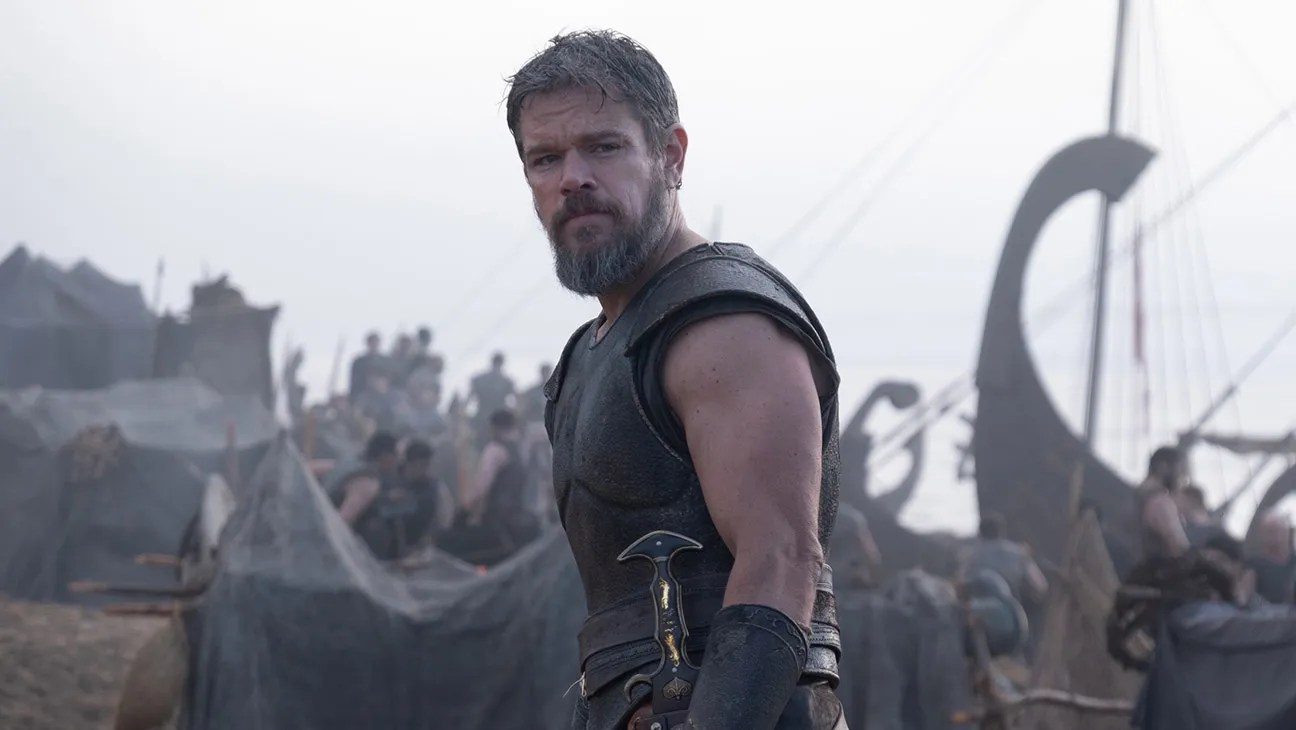
Director Nolan is one of the rare filmmakers who, in my opinion, has never made a bad film. From “Memento” to the “Dark Knight” trilogy to the Oscar-winning “Oppenheimer,” he has proven himself a true master of cinema. “The Odyssey” only adds to that distinguished resume’
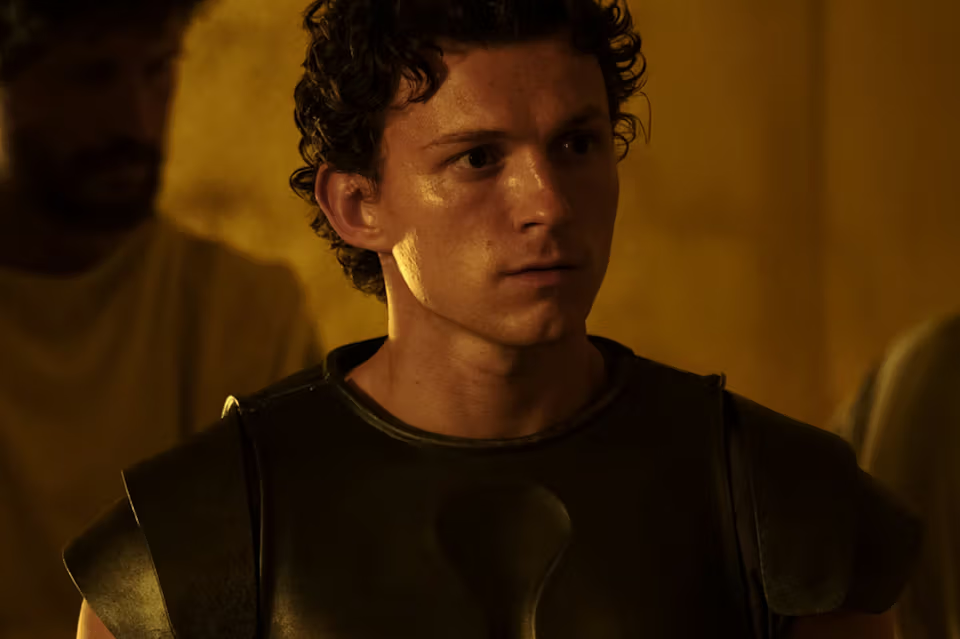
The cast is a tribute to Nolan himself who, like Woody Allen, can pretty much get anyone he wants for his films because, as an actor, why wouldn’t you want a credit in one of his films. Besides the three stars named above, the cast includes Robert Pattinson, John Leguizamo, Zendaya, James Remar, Jon Bernthal, Oscar nominees Samantha Morton and Elliot Page as well as Oscar winners Charlize Theron and Lupita Nyongo. As MGM used to advertise, “more stars than there are in heaven.”
The script and story are pretty faithful to the source material, though for some reason it bothered me whenever Telemacus referred to Odysseus as “dad.” Never father. The weird things you notice. Visual.y the film is stunning and the Trojan Horse and battle of Troy are worth the price of admission alone. I will add that I did see the film in 70 mm and, if that format is playing in your town, I urge you to see it in that format.
On a scale of zero to five, “The Odyssey” receives ★★★★ ½
-

 North Carolina39 seconds ago
Gunman killed after opening fire outside North Carolina gay bar
-

 North Dakota7 minutes ago
Vernon Krause
-

 Ohio13 minutes ago
Man pleads guilty to inappropriate conduct with minor in Howland
-

 Oklahoma19 minutes ago
Local Star Goose Hutchens Reclassifies, Will Join Oklahoma for 2027 Season
-

 Oregon25 minutes ago
Meet Miss Oregon at the Ross Ragland Theater Next Month – KOBI-TV NBC5 / KOTI-TV NBC2
-

 Pennsylvania31 minutes ago
Wildfire smoke puts Pittsburgh under Code Red air quality alert
-

 Rhode Island37 minutes ago
These 8 Towns In Rhode Island Were Ranked Among US Favorites In 2026
-

 South Dakota49 minutes ago
South Dakota confirms three cyclosporiasis cases as CDC investigates growing outbreak

