SACO, Maine — Duane Choquette hesitated when he discovered the property he wanted to buy to create a small homestead is a quarter mile from a Superfund site containing capped-over pits holding arsenic, chromium and other heavy metal waste dumped by a former tannery.
He researched how the site was cleaned up and found no contaminants when he tested the Saco property’s well water, which he would need for irrigation. Choquette bought the home on Hearn Road in 2014.
“Luckily, I happen to work as an ecologist for an environmental consulting company where a lot of other people do remediation work, so they deployed me to the right documents,” he said. “That helped, and the fact that we are uphill from the site.”
Now, 10 years later, a new potential threat is emerging at the location, known as the Saco Waste Pits Superfund Site. The U.S. Environmental Protection Agency notified Choquette and other neighbors by letter recently that it had discovered high levels of forever chemicals in some locations both on the site and in a few residential wells nearby. It will conduct additional testing over the next couple years to find the source of the PFAS and whether it might threaten nearby residences. That has renewed concern over the safety of that Superfund site and others across Maine and the country.
Advertisement
The federal agency has found forever chemicals at several Superfund sites in Maine and elsewhere in New England that could require new scrutiny, said spokesperson Vikram Lakshmanan. The EPA had not tested for the man-made forever chemicals, known as per- and polyfluoroalkyl substances, or PFAS, until the past five years, and regulations at the time did not mandate that the toxic chemicals be cleaned up.
That changed last July when a new federal regulation designated two of the most studied and commonly used PFAS as hazardous substances, requiring them to be remediated if they exceed federal standards They are PFOA, or perfluorooctanoic acid, and PFOS, or perfluorooctane sulfonic acid, both used in tanneries to hydrate and degrease hides and for leather finishing. Exposure to the chemicals may increase the risk of some cancers.
“They’re going to have to start this testing at current Superfund sites across the board,” said Jared Hayes, senior policy analyst at the nonprofit Environmental Working Group in Washington D.C. “This is kind of a new undertaking by the EPA, to have regular testing for PFOA and PFOS. Previously they were only doing it in select locations where there were already chances for concern.”
The EPA has tested Choquette’s well, which did not have PFAS. He expects it to conduct more testing.
Monitoring an emerging chemical
The EPA first tested for and discovered PFAS at the Saco pits Superfund site in June 2019. The nine groundwater monitoring wells at the dump site all showed PFAS levels higher than what was then the drinking water standard, according to the agency’s most recent safety review of the site released in January.
Advertisement
After those results, the Maine Department of Environmental Protection tested 38 residential wells near the Saco pits for several PFAS from 2019 to 2023. Four residential wells topped the drinking water standard at the time.
Last April, the EPA cut by fivefold the allowable limits for PFOA, PFOS and other PFAS in drinking water to 4 parts per trillion. That means more wells both on the Saco pits site and at neighboring residences could now top the new limit, meaning the water is not safe for consumption.
The recent report said the EPA has two years to investigate the PFAS source and whether it may be migrating to private, offsite wells. This year it will conduct soil borings, and test ground and surface water, soil and some residential wells, Lakshmanan said. Depending on results, PFAS might be added to its current list of contaminants that the EPA regularly monitors at the site, which includes arsenic, chromium and lead.
The Corinna Odd Fellows Hall sits on large dollies ready to be moved in this 2000 file photo. The hall was the only building to be salvaged in the Superfund cleanup of the former Eastland Woolen Mill.
“There could be potential that groundwater conditions have changed,” the report said. “The capped tannery waste may contain elevated concentrations of PFAS.”
Meantime, Choquette said he is watching for the results and will read them carefully. He said he will be satisfied “as long as the caps hold on the site.”
Advertisement
The EPA is requiring additional tests at several other Superfund sites where PFAS has been found, including Loring Air Force Base in Limestone and at Naval Air Station Brunswick. Some 1,400 gallons of toxic firefighting foam containing PFAS spilled at and around Brunswick Executive Airport last summer, worrying residents that their well water might be contaminated. PFAS also was found at the former Eastland Woolen Mill in Corinna, which is a Superfund site, during the last EPA review in 2020, but the levels were below the maximums allowed at the time. The EPA plans to review all three locations by the end of September.
Living near a Superfund site
The boundaries of the Superfund site where waste was dumped by the former Saco Tannery are highlighted in this February 2023 photo by the U.S. Environmental Protection Agency. Credit: United States Environmental Protection Agency
The Saco Tannery, which operated from 1959 until 1981, dumped 23 million gallons of its process waste at the site in two large lagoons, about two acres in size each, and 57 smaller waste pits, according to federal estimates. Located on 212 acres, the pits site is surrounded by the Maine Turnpike, Flag Pond Road and Hearn Road.
After the Saco Tannery shuttered, the EPA found three acidic pits posed immediate and significant human health risks. The pits became a Superfund site in 1983. The EPA extracted the liquids, neutralized the sludge and capped the pits with clean soil and a nonpermeable membrane.
The site is now a wildlife refuge owned by the quasi-state Finance Authority of Maine and is not open to the public. FAME has been working cooperatively with the EPA and Maine DEP on testing and remediation at the site, said Bill Norbert, a FAME spokesperson. He said it is unclear and premature to say which entity might need to pay for any possible additional cleanup.
The area looks the same now as it did when the trucks were dumping tannery waste there, said Anatole Brown, education manager at the Saco Museum. It is heavily wooded and not possible to see the covered pits and lagoons from the road. Still, the area developed a reputation from the dumping operation.
“Flag Pond Road was always considered a toxic zone, and not until recently did you see houses starting to get built along that road,” Brown said.
Advertisement
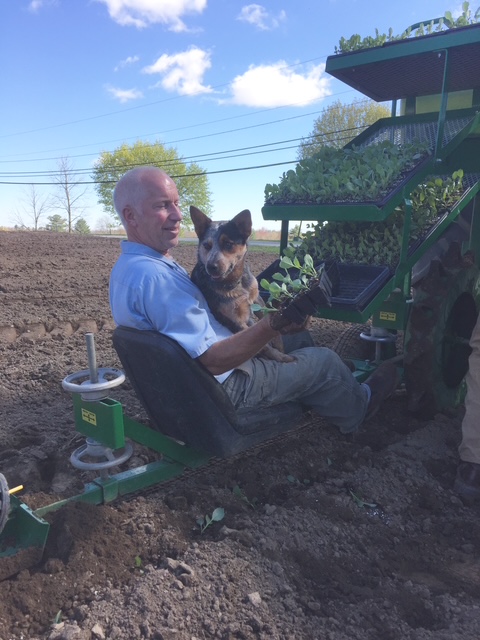
Tim Leary, owner of Leary Farm in Saco, transplants green cabbage with help from his cattle dog, Raymond. The farm sits near a Superfund site that has tested positive for certain forever chemicals. Credit: Courtesy of Tim Leary
In the past decade or so, homes and housing developments have sprung up around the Superfund site, with some neighbors barely aware it is there. So far, the city has not received any complaints about the discovery of the high levels of PFAS nor the two-year timetable for more tests, said Saco City Administrator John Bohenko. He said environmental regulators have been communicating about their review of the site and any necessary actions, and he will wait for their results.
But the PFAS news has some residents paying more attention. Kathleen Pierce, who lives on Hearn Road, said her family bought a house 11 years ago about a mile from the pits and didn’t hear too much about the Superfund site at the time.
“Now, hearing about the PFAS, it is an impetus for me, as a homeowner in the area, to take it seriously and get my water tested,” she said.
On the other road bordering the site, Tim Leary, the seventh-generation owner of Leary Farm, remembers when waste was still being dumped. He said many people at the time didn’t realize that the tannery, located about four miles away in Saco, was dumping acids and heavy metals into the pits.
“The primary concern at the time was the organic waste, because the smell was horrendous,” said Leary, 65, who has lived at the farm his entire life. “Before it was fenced off, we used to go skating on the ponds, on the lagoons. In retrospect, that probably was not a great idea.”
Leary tests the milk from his dairy cows and water to process his vegetables every year. So far, there have been no PFAS readings, and he would like it to stay that way.
Advertisement
“If I hear that the plume is moving, I might be concerned,” Leary said.
Lori Valigra is an investigative environment reporter for the BDN’s Maine Focus team. She may be reached at lvaligra@bangordailynews.com. Support for this reporting is provided by the Unity Foundation, a fund at the Maine Community Foundation, and donations by BDN readers.
University of Southern Maine biology professor Chris Maher sets four traps around a woodchuck burrow in Pond Meadow at Gilsland Farm Audubon Center in Falmouth on June 15. (Daryn Slover/Staff Photographer)
FALMOUTH — Standing in the apple orchard at Gilsland Farm, Chris Maher instantly recognized the woodchuck waddling across the grass 30 yards away.
“There’s Torch,” said Maher, needing neither her binoculars nor the telescope she had on hand to identify the tan marmot the size of a small cat. “And, oh, look, she’s got a pup with her.”
Trailing behind Torch was one of her several “pups” in her litter this year. Only 6 weeks old, the baby woodchuck was the size of a grapefruit, scurrying around under the watchful eye of its mother, who was nibbling clover flowers. Their burrow was just yards behind them, under the base of a tree stump.
Advertisement
Maher has been studying the woodchucks, also known as groundhogs, at Maine Audubon’s Gilsland Farm since 1998. A biology professor at the University of Southern Maine, her office is 10 minutes away in Portland.
Over the nearly 30 years of studying this population in Falmouth, she’s been answering longstanding questions about the species. Not whether they’ll see their shadow on Feb. 2, and not how much wood they could chuck if they could chuck wood, but how and why they behave the way they do.
“They’re basically a lot more social than people had thought they were,” she said.
Advertisement
” data-large-file=”https://www.pressherald.com/wp-content/uploads/sites/4/2026/06/43635806_20260615_Falmouth-Woodchucks_14.jpg?w=780″ height=”477″ width=”1024″ alt=”” class=”wp-image-7669138″ srcset=”https://www.pressherald.com/wp-content/uploads/sites/4/2026/06/43635806_20260615_Falmouth-Woodchucks_14.jpg 3000w, https://www.pressherald.com/wp-content/uploads/sites/4/2026/06/43635806_20260615_Falmouth-Woodchucks_14.jpg?resize=300,140 300w, https://www.pressherald.com/wp-content/uploads/sites/4/2026/06/43635806_20260615_Falmouth-Woodchucks_14.jpg?resize=768,358 768w, https://www.pressherald.com/wp-content/uploads/sites/4/2026/06/43635806_20260615_Falmouth-Woodchucks_14.jpg?resize=1024,477 1024w, https://www.pressherald.com/wp-content/uploads/sites/4/2026/06/43635806_20260615_Falmouth-Woodchucks_14.jpg?resize=1536,716 1536w, https://www.pressherald.com/wp-content/uploads/sites/4/2026/06/43635806_20260615_Falmouth-Woodchucks_14.jpg?resize=2048,954 2048w, https://www.pressherald.com/wp-content/uploads/sites/4/2026/06/43635806_20260615_Falmouth-Woodchucks_14.jpg?resize=1200,559 1200w, https://www.pressherald.com/wp-content/uploads/sites/4/2026/06/43635806_20260615_Falmouth-Woodchucks_14.jpg?resize=2000,932 2000w, https://www.pressherald.com/wp-content/uploads/sites/4/2026/06/43635806_20260615_Falmouth-Woodchucks_14.jpg?resize=780,363 780w, https://www.pressherald.com/wp-content/uploads/sites/4/2026/06/43635806_20260615_Falmouth-Woodchucks_14.jpg?resize=400,186 400w” sizes=”(max-width: 1024px) 100vw, 1024px”/>Tremont, right, and two of her pups spend time on the edge of Pond Meadow at Gilsland Farm Audubon Center in Falmouth on June 15. Tremont has at least two more, said University of Southern Maine biology professor Chris Maher. (Daryn Slover/Staff Photographer)
Purchase this image
Woodchucks are one of six native marmot species in North America and the least social of them all. When Maher first started reading the scientific literature on the species in the 1980s and 1990s, it said that woodchucks were solitary and territorial — but some anecdotal reports also shared they were perhaps more social than previously thought.
When Maher moved to Maine in 1997 to work at USM after years studying the behaviors of other species, she decided the social lives of woodchucks were worth examining. With the permission of Maine Audubon, she started trapping and tagging the woodchucks at Gilsland Farm. It became the longest study of woodchucks ever conducted.
While there were once three dozen woodchucks on the property, now only eight adults have multiple burrows each in the many fields, orchard, peony bushes, parking lot and underneath Maine Audubon’s outdoor classroom. Maher’s workforce has declined as well, as her busy schedule as an interim dean at USM means she has less time for student assistance.
One of the eight and Torch’s adult daughter, named Tremont, also wandered under the apple trees. After she left her mother’s burrow, she moved in next door, digging burrows under the outdoor classroom and in a field of goldenrod.
“Born in the orchard, and basically never left home. The parallels with people are amusing,” said Maher.
Advertisement
With her handheld computer, which resembles a PIN pad in the grocery store checkout, Maher took a 15-minute sample of Torch’s behavior, hitting buttons every time Torch switched what she was doing. There are codes for when the woodchucks eat, groom themselves, dig, recline or are on alert.
Female woodchucks have a territory of about three-quarters of an acre. Maher’s research found that related female woodchucks will overlap their territory, previously thought to never happen. Mother and daughter, aunts and nieces, grandmother and granddaughter are all more tolerant of sharing space than unrelated woodchucks.
But sometimes they still need to take a stand. That morning, Tremont and Torch got into a fight, squeaking at and batting each other. With their familiar relationship bringing higher tolerance, it wasn’t a “knock-down, drag-out” brawl, said Maher, just “Torch being Torch.”
For the fight, Maher hits the button to indicate “other.”
Advertisement
” data-large-file=”https://www.pressherald.com/wp-content/uploads/sites/4/2026/06/43635806_20260615_Falmouth-Woodchucks_5.jpg?w=780″ height=”683″ width=”1024″ alt=”” class=”wp-image-7669139″ srcset=”https://www.pressherald.com/wp-content/uploads/sites/4/2026/06/43635806_20260615_Falmouth-Woodchucks_5.jpg 3000w, https://www.pressherald.com/wp-content/uploads/sites/4/2026/06/43635806_20260615_Falmouth-Woodchucks_5.jpg?resize=300,200 300w, https://www.pressherald.com/wp-content/uploads/sites/4/2026/06/43635806_20260615_Falmouth-Woodchucks_5.jpg?resize=768,512 768w, https://www.pressherald.com/wp-content/uploads/sites/4/2026/06/43635806_20260615_Falmouth-Woodchucks_5.jpg?resize=1024,683 1024w, https://www.pressherald.com/wp-content/uploads/sites/4/2026/06/43635806_20260615_Falmouth-Woodchucks_5.jpg?resize=1536,1024 1536w, https://www.pressherald.com/wp-content/uploads/sites/4/2026/06/43635806_20260615_Falmouth-Woodchucks_5.jpg?resize=2048,1365 2048w, https://www.pressherald.com/wp-content/uploads/sites/4/2026/06/43635806_20260615_Falmouth-Woodchucks_5.jpg?resize=1200,800 1200w, https://www.pressherald.com/wp-content/uploads/sites/4/2026/06/43635806_20260615_Falmouth-Woodchucks_5.jpg?resize=2000,1333 2000w, https://www.pressherald.com/wp-content/uploads/sites/4/2026/06/43635806_20260615_Falmouth-Woodchucks_5.jpg?resize=780,520 780w, https://www.pressherald.com/wp-content/uploads/sites/4/2026/06/43635806_20260615_Falmouth-Woodchucks_5.jpg?resize=400,267 400w” sizes=”(max-width: 1024px) 100vw, 1024px”/>University of Southern Maine biology professor Chris Maher pauses after spotting Harp, a female woodchuck, at Gilsland Farm Audubon Center in Falmouth. Maher was surprised to see Harp with pups. (Daryn Slover/Staff Photographer)
Purchase this image
Maher knows that not everyone is a fan of woodchucks.
“People kind of run this gamut between ‘I hate woodchucks, because they eat my garden, or they dig under my shed.’ Or they love woodchucks — chances are, those people don’t have a garden,” she said.
Despite the woodchucks who keep eating the zucchini plant in her home garden, Maher maintains her affinity for the animals. Over the years, she’s trapped and tagged 630 Falmouth woodchucks.
In addition to the number on its metal ear tag, each woodchuck also gets a name, which helps her students remember them. Each year, there’s a theme: cars, cartoon characters, musical instruments and colleges. This year, she’s thinking it will be sports teams, in honor of the World Cup.
Now she’s attempting to trap and tag the pups born this year, including those of Tremont, who was born three years ago when the naming convention was Maine towns and had four pups this year.
Advertisement
Maher set four traps at right angles around the entrance of one of Tremont’s burrows, smearing a dab of Hannaford’s smooth peanut butter on the pressure plate that will trigger the trap to close if stepped on. Apple slices she dropped inside the metal grate increase the temptation.
Between the traps, Maher shoved wooden shingles to make a fence. Adult woodchucks will get creative trying to escape, as evidenced by tooth marks on the wood. Catching the pups is easier.
“They’re naive,” she said.
Purchase this image
Once a pup is caught, she’ll weigh it, take a hair sample, give it a numbered ear tag and paint a distinct mark on it with Revlon black hair dye, so she can recognize it from a distance.
Advertisement
Keeping track of which of these squirrely animals are related for 28 years, as well as what they’re doing and where they’re going, is no small feat. Maher’s logbook is filled with decades of notes on trappings and re-trappings of the hundreds of animals.
“Long-term studies are really valuable,” said Daniel Blumstein, a biology professor at University of California Los Angeles who studies yellow-bellied marmots. “Having decades of information gives us a whole different way of thinking about what’s going on.”
In addition to changing understandings of their social behavior, Maher has conducted numerous other studies across the course of the project, including the variation in woodchuck personalities, tracking their movement with radio transmitters, testing their paternity using DNA from hair samples and seeing if they pay attention to the alarm calls of other animals (turns out, woodchucks care what chipmunks have to say).
She’s also seen their lineages unfold across generations, such as with the woodchuck named Bonnie.
Maher first caught Bonnie in 1998. She lived for 12 years, twice the average woodchuck lifespan, until she disappeared. Her legacy living onwards, as having trapped and tagged her offspring, and her offspring’s offspring, Maher was able to track Bonnie’s bloodline for seven generations until it died out in 2018.
Advertisement
Maher wondered what exactly happened to Bonnie. The answer was unearthed in 2021, when Maine Audubon tore down the pavilion that her burrow had been under. Curled up underneath was the mummified body of Bonnie, identifiable by the tag still in her ear.
Purchase this image
Maher keeps Bonnie’s mummy in her office in a plastic tote, occasionally taking her out when she gives talks about her research at libraries, to Girl Scout troops and Maine Audubon camps.
“It’s a highlight of the summer for many campers,” said Molly Woodring, who oversees day camp and other educational programs at Maine Audubon.
With additional assistance from a woodchuck puppet, Maher presents her research and what it’s like to be a wildlife biologist to campers each year, also often explaining what she’s doing to other curious visitors of Gilsland Farm who typically come out to birdwatch.
Advertisement
“I do think, like in the context of the sanctuary, and in the context of her work, (woodchucks) do become really fascinating and lovable,” said Woodring.
As she starts this season’s pup tagging, Maher is also considering winding down her project. She turned 63 on Thursday — a day she wished she could have spent with the woodchucks, but was packed full of meetings.
In a year she’ll be on sabbatical, where she’ll write up more findings and is hoping to write a popular science book about woodchucks and her life studying them. Retirement is not too far off, and it doesn’t look like anyone else will be taking over the reins of the study.
“It will be hard to not keep coming out here,” she said. “By then, it will be 30 years of stories.”
While Maher may soon reduce her time observing Falmouth’s woodchucks, the woodchucks will remain — with evidence of their contribution to science still visible for at least another generation.
Advertisement
“Animals with tags will still be running around for a little while,” said Maher.
Yarmouth’s Ian Minnihan looks to shoot against Thornton Academy during a Class A boys lacrosse semifinal Wednesday in Saco. The Clippers face unbeaten Falmouth in Saturday’s state championship. (Shawn Patrick Ouellette/Staff Photographer)
The Maine high school spring sports season reaches its conclusion with two days of excitement, as 14 state champions will be crowned Friday and Saturday. Some teams are hoping to win their first state title, while others are trying to repeat, and a few are seeking revenge after losing to the same foes in last year’s state finals.
We asked Varsity Maine reporters for something important to know about each state championship game matchup.Here’s what they said about the three boys lacrosse finals.
Class A: Falmouth (16-0) vs. Yarmouth (13-3)
Yarmouth needs to start fast. The Clippers never trailed by more than two goals in their semifinal against Thornton Academy, which kept the task manageable and allowed them to prevail late. But they fell behind 4-0 to top-ranked Falmouth in an 11-7 loss in the regular season, and against a team with the Navigators’ firepower, that’s too deep a hole. Falmouth has scored 33 goals in two tournament games, so keeping pace early is vital as Yarmouth seeks the upset.
Advertisement
Class B: Marshwood (14-2) vs. York (11-5)
York intentionally played a brutally tough schedule with this state championship game in mind. Eight of the Wildcats’ 14 regular-season games were against Class A competition. Will the payoff be the team’s first state title since 2023, in its fourth straight state final?
Class C: North Yarmouth Academy (13-3) vs. Maranacook/Winthrop (10-6)
This is a rematch of last year’s final, which the Panthers won 9-7, but the scoreboard will probably be more active this time around. NYA bested Maranacook/Winthrop 17-10 on May 8, and has scored 39 goals this postseason, most coming from midfielders Stephen Connolly, Deagan Nadeau and Gavin Thomas. The Hawks have 32 playoff goals, paced by attackmen Ethan Chilton, Jacob Lyons and Caleb Morgan. With both offenses churning, possessions and defensive stops will be key.
Advertisement
Drew Bonifant covers sports for the Press Herald, with beats in high school football, basketball and baseball. He was previously part of the Kennebec Journal and Morning Sentinel sports team. A New Hampshire…
More by Drew Bonifant
Advertisement
Dave Dyer is in his second stint with the Kennebec Journal/Morning Sentinel. Dave was previously with the company from 2012-2015 and returned in late 2016. He spent most of 2016 doing freelance sports…
More by Dave Dyer
Advertisement
Jimmy covers sports for the Sun Journal, primarily contributing to the Varsity Maine team. He is from Hagerstown, Maryland, and graduated from the University of Richmond in May of 2025 with a B.A. in journalism…
More by Jimmy James
As I sit here, late at night, staring at a blinking cursor and listening to one of those sound wave channels on YouTube that are supposed to help you block out distractions (distractions like the 3- and 4-year-old upstairs who have come down thrice because they “aren’t tired”), I try to put my finger on what I’m feeling in this moment. In this exact moment, I am sitting on the precipice of a wonderful celebration. Precisely 24 hours from now, I will be coming down off the high of honoring eight truly talented business leaders who through their work or through the work of their organizations have made our region of the state a better place to live. That’s a very cool thing, and even though I haven’t experienced it yet, having done awards events like this for 20 years now, I know it will be special. I’ll recap these winners in the weeks to come and how the Community Leadership Awards event goes, but those stories are for another day, because …
My writing trance got broken … by a YouTube commercial. A YouTube commercial for a political candidate — which one, doesn’t matter. The commercial went something like this: “This political candidate running for office is terrible, they did this awful thing, and that gruesome thing, too. I’m a real Mainer, and I could never vote for the,” then the disclaimer of “paid for by people who want the other candidate.”
I’m so exhausted by it, and it’s only June.
I’m tired of the rage cycles. I’m tired of being bombarded by some twisted version of a fact that portends to be this universe-defining moment of a candidate’s life and definitely predicts who they will forever be going forward (“If she did that, you know she will do this next” or “He has that in is past, which means this is in his future”).
Advertisement
I don’t want my life, and the next five months, to be filled with that. I just read that $384 million dollars will be spent on the Platner-Collins race alone. What?! Will there literally be any commercials left on TV, radio, print or online? I mean $384 million has got to be pretty darn close to every minute of airtime for five months, right? Will there even be airtime left for the two to three gubernatorial candidates or are we just going to have to share memes for that race?
You see what happened there? I almost went back and erased it because I went down a stream of consciousness cycle of cynicism. I went down that cycle because when that is all that is around you — when it fills your airwaves, column inches and social media — it infects you. It was so easy for me to go from being thankful about being on the precipice of a joyous event to spiraling into cynicism.
Sadly, I think that is very relatable for all of us.
So, let’s choose not to do that.
Let’s intentionally decide, here and now, that when there is joy, we will recognize joy, and when there is not joy, we will manifest it for ourselves. Let’s challenge ourselves to engage in acts of celebration and thoughtfulness. Let’s applaud each other. Let’s actively tell people we appreciate them.
Advertisement
I’ll start. Here are four examples to lean into, that I hope you can top in the coming days and weeks, to find your joy and manifest it for others. Let’s get competitive — try and beat these.
Twice this year, in partnership with Main Street Bath, I have been blessed to be a part of a ribbon-cutting train where we celebrate multiple businesses back-to-back-to-back. I met an oyster sommelier (I didn’t know that was a thing) who has a four-seat oyster bar called The Parlor. I met a woman who moved here from overseas to make a career by beautifying others at Empire Nail Spa. I’ve met numerous young families and seen their proud spouses look at them as they cut the ribbon, symbolizing that this dream that they are building their family on is worth it. I’ve met subject matter experts who know so much about their specialty that it inspired me to do what I love again and write more.
Another set of joy along these lines was at Half Pint Giants — the new ice cream shop in Brunswick that took over the Frappe Shoppe by the Tontine Mall — and the couple launching that to bring joy to others. Who is sad at an ice cream shop? I saw the overwhelming joy from a huge turnout for the ribbon-cutting of Nest on Maine last week, as over 70 supporters turned out to celebrate their move into the former Cool As a Moose space. And I know I will see that joy again this Friday when Phil, Mattie, Angela and their staff cut the ribbon at the new Moderation Brewing location in the old fire station.
I heard that Hairspray at Main State Music Theatre was pure, incomparable joy, and I’ve also heard that after the tough days the pandemic brought, that MSMT is back to where they were with patrons. MSMT means so much to so many citizens in the region, but also, they are a catalyst for so many businesses in the region. “1776” opens on June 24, with the obvious intention of running through the Independence Day holiday, and that is expected to be a triumph as well.
And finally, for my last piece of joy, my 4-year-old will finish his first year of pre-K tomorrow, and although he doesn’t quite understand the milestone yet, it hasn’t been lost on me. I’ve seen him grow and change in ways I couldn’t have imagined without witnessing it myself, and I am truly excited to celebrate that milestone this weekend and to imagine what’s next for him.
Advertisement
So, that’s what I’m focusing on. In a world of cynicism, I choose joy. I hope you do, too.
Cory King is executive director of the Bath-Brunswick-Topsham Regional Chamber of Commerce.





” data-image-caption=”<p>University of Southern Maine biology professor Chris Maher sets four traps around a woodchuck burrow in the Pond Meadow at Gilsland Farm Audubon Center in Falmouth on Monday, June 15, 2026. (Daryn Slover/Staff Photographer)
” data-large-file=”https://www.pressherald.com/wp-content/uploads/sites/4/2026/06/43635806_20260615_Falmouth-Woodchucks_1.jpg?w=780″ height=”683″ width=”1024″ alt=”” class=”wp-image-7669140″ srcset=”https://www.pressherald.com/wp-content/uploads/sites/4/2026/06/43635806_20260615_Falmouth-Woodchucks_1.jpg 3000w, https://www.pressherald.com/wp-content/uploads/sites/4/2026/06/43635806_20260615_Falmouth-Woodchucks_1.jpg?resize=300,200 300w, https://www.pressherald.com/wp-content/uploads/sites/4/2026/06/43635806_20260615_Falmouth-Woodchucks_1.jpg?resize=768,512 768w, https://www.pressherald.com/wp-content/uploads/sites/4/2026/06/43635806_20260615_Falmouth-Woodchucks_1.jpg?resize=1024,683 1024w, https://www.pressherald.com/wp-content/uploads/sites/4/2026/06/43635806_20260615_Falmouth-Woodchucks_1.jpg?resize=1536,1024 1536w, https://www.pressherald.com/wp-content/uploads/sites/4/2026/06/43635806_20260615_Falmouth-Woodchucks_1.jpg?resize=2048,1365 2048w, https://www.pressherald.com/wp-content/uploads/sites/4/2026/06/43635806_20260615_Falmouth-Woodchucks_1.jpg?resize=1200,800 1200w, https://www.pressherald.com/wp-content/uploads/sites/4/2026/06/43635806_20260615_Falmouth-Woodchucks_1.jpg?resize=2000,1333 2000w, https://www.pressherald.com/wp-content/uploads/sites/4/2026/06/43635806_20260615_Falmouth-Woodchucks_1.jpg?resize=780,520 780w, https://www.pressherald.com/wp-content/uploads/sites/4/2026/06/43635806_20260615_Falmouth-Woodchucks_1.jpg?resize=400,267 400w” sizes=”auto, (max-width: 1024px) 100vw, 1024px”/><figcaption>University of Southern Maine biology professor Chris Maher sets four traps around a woodchuck burrow in the Pond Meadow at Gilsland Farm Audubon Center in Falmouth on Monday, June 15, 2026. (Daryn Slover/Staff Photographer)<span class=)

” data-image-caption=”<p>University of Southern Maine biology professor Chris Maher has recorded notes on each woodchuck that she has trapped at Gilsland Farm Audubon Center in Falmouth. The next woodchuck that Maher trapps will be No. 631. (Daryn Slover/Staff Photographer)
” data-large-file=”https://www.pressherald.com/wp-content/uploads/sites/4/2026/06/43635806_20260615_Falmouth-Woodchucks_3.jpg?w=780″ height=”683″ width=”1024″ alt=”” class=”wp-image-7669141″ srcset=”https://www.pressherald.com/wp-content/uploads/sites/4/2026/06/43635806_20260615_Falmouth-Woodchucks_3.jpg 3000w, https://www.pressherald.com/wp-content/uploads/sites/4/2026/06/43635806_20260615_Falmouth-Woodchucks_3.jpg?resize=300,200 300w, https://www.pressherald.com/wp-content/uploads/sites/4/2026/06/43635806_20260615_Falmouth-Woodchucks_3.jpg?resize=768,512 768w, https://www.pressherald.com/wp-content/uploads/sites/4/2026/06/43635806_20260615_Falmouth-Woodchucks_3.jpg?resize=1024,683 1024w, https://www.pressherald.com/wp-content/uploads/sites/4/2026/06/43635806_20260615_Falmouth-Woodchucks_3.jpg?resize=1536,1024 1536w, https://www.pressherald.com/wp-content/uploads/sites/4/2026/06/43635806_20260615_Falmouth-Woodchucks_3.jpg?resize=2048,1365 2048w, https://www.pressherald.com/wp-content/uploads/sites/4/2026/06/43635806_20260615_Falmouth-Woodchucks_3.jpg?resize=1200,800 1200w, https://www.pressherald.com/wp-content/uploads/sites/4/2026/06/43635806_20260615_Falmouth-Woodchucks_3.jpg?resize=2000,1333 2000w, https://www.pressherald.com/wp-content/uploads/sites/4/2026/06/43635806_20260615_Falmouth-Woodchucks_3.jpg?resize=780,520 780w, https://www.pressherald.com/wp-content/uploads/sites/4/2026/06/43635806_20260615_Falmouth-Woodchucks_3.jpg?resize=400,267 400w” sizes=”auto, (max-width: 1024px) 100vw, 1024px”/><figcaption>University of Southern Maine biology professor Chris Maher has recorded notes on each woodchuck that she has trapped at Gilsland Farm Audubon Center in Falmouth. The next woodchuck that Maher trapps will be No. 631. (Daryn Slover/Staff Photographer)<span class=)


