Northeast
Maine man shoots, kills mother, passing driver, wounds two others before taking own life

This story discusses suicide. If you or someone you know is having thoughts of suicide, please contact the Suicide & Crisis Lifeline at 988 or 1-800-273-TALK (8255).
A man in Maine shot and killed his mother as they were in a vehicle together, before he randomly shot at passing motorists, killing another woman and wounding two other drivers before taking his own life, on Wednesday, authorities said.
James Davis III, 29, was a passenger in a car being driven by his mother, Christine Smith, 47, on State Route 9 in Sabattus when he opened fire on her with a revolver around 4:15 p.m., the Maine State Police said.
Smith died at the scene.
MAINE GIRL INVOLVED IN TRANS ATHLETE BATTLE REVEALS HOW STATE’S POLICIES HURT HER CHILDHOOD AND SPORTS CAREER
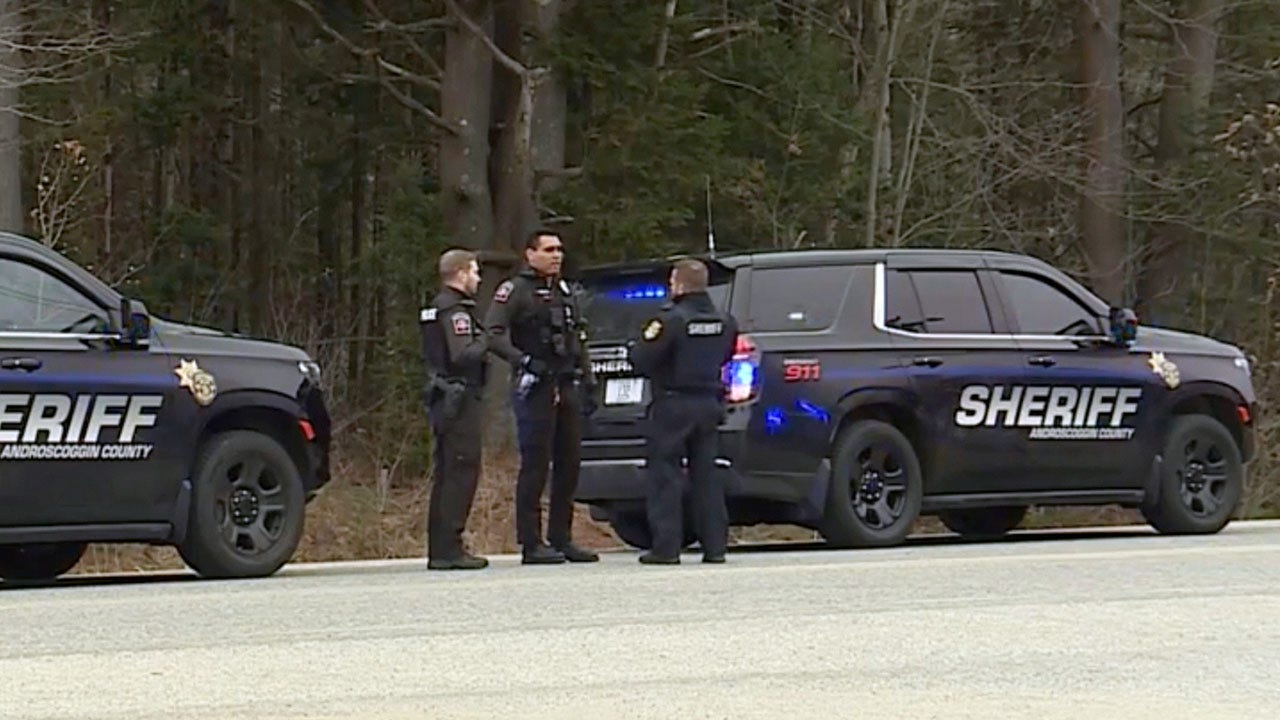
In this image taken from WMTW video, police stand by their vehicles at the site of a shooting along a road, Thursday, April 3, 2025, in Sabattus, Maine. James Davis III killed his mother, another woman and wounded two other people along the road, police said. ((WMTW via AP)
The vehicle traveled across a road before coming to a stop, at which point Davis got out of the car and began shooting at passing vehicles with an AK-47-style rifle, authorities said.
Katherine Williams, 53, who was the sole occupant in her SUV, was shot.
Williams’ vehicle kept in motion before crashing into a home. She was found and transported to the Central Maine Medical Center in Lewiston where she was pronounced dead.
TRUMP ADMIN FREEZES FUNDING TO MAINE FOR LETTING TRANS ATHLETES IN GIRLS SPORTS
Two other drivers in separate pickup trucks – Tyson Turner, 19, and David Wilson, 35 – were also shot, police said.
Both men called 911 to report the shootings, police said. Both Turner and Wilson were taken by ambulance to Central Maine Medical Center and were expected to survive, state police said.
Davis III killed himself after the shootings and died at the scene. Autopsies will be performed on Davis, Smith, and Williams, state police said.
Lisbon Police Chief Ryan McGee speaks at a news conference in Gray, Maine, on Thursday (AP Photo/Patrick Whittle)
Aside from Smith, none of the victims knew Davis, police said.
Williams, who went by Kay, was the kitchen manager at two schools in Litchfield, where she had a remarkable ability to build strong connections with students and staff, Superintendent Katherine Grondin said in an email to the Associated Press.
“Her kindness and dedication made a lasting impact on our school community, and she will be deeply missed,” Grondin said. “Our hearts go out to her family as they navigate this loss. It has been a difficult day for all of us as we mourn the passing of a valued and beloved member of our school family.”
Read the full article from Here

Connecticut
New Haven asks for retrial after jury awards Connecticut man $38M in wrongful conviction lawsuit

NEW HAVEN, Conn. — The City of New Haven is asking for a retrial after a jury awarded a Connecticut man $38 million in May for being wrongfully convicted of murder and imprisoned for 21 years.
Stefon Morant was allegedly wrongfully convicted of a double homicide in 1994. According to the New York-based law firm of Neufeld Scheck Brustin Hoffmann & Freudenberger, LLP, the jury ruled New Haven police officers and the City of New Haven were liable for his wrongful imprisonment.
The jury found that New Haven police detectives made up false evidence to frame Morant and that the city was liable for suppressing evidence favorable to criminal defendants.
A judge has issued a temporary stay, pausing any payments until the motion is resolved.

PORTLAND (WGME) — The third annual Celebration of America 300 is set for Thursday night at Oxford Plains Speedway.
This race was a favorite of NASCAR star Kyle Busch, who tragically passed away back in May. He was just 41.
Now, a Maine-born driver who worked on Busch’s team is ready to take the 8 car into victory lane.
For the past five years, Windham native Derek Kneeland was Busch’s eye in the sky, working as a spotter for the cup star. Kneeland says his relationship with Busch was like a brotherhood.
“I was fortunate enough where I got to have a personal relationship with him,” Kneeland said. “He came up, and he ran several races with me in late models and stuff at Oxford and Lee Speedway, and we got to do a lot of cool things together.”
Kneeland says dealing with the sudden loss has been both painful and difficult.
“It’s still hard,” Kneeland said. “I’m having a hard time with it. The weekdays are the hardest. At the track is where I’m most comfortable.”
Kneeland will be at the track and behind the wheel Thursday night, competing in the Celebration of America 300, driving the number 8 car.
“You know, a few days after everything went down, his dad called me, and his dad is a man of very few words, and I said, ‘You know, I’m thinking about running the 8 or 51 as long as I have your guys’ blessing, I would like to do that.’ And he said, ‘Short track world knows him as 51, but the world knows him as 8,’” Kneeland said.
Kneeland says it will be an emotional race, but he’s confident he’ll have a special co-pilot leading the way.
“Hoping he’s going to be on my shoulder and give me the guiding way and but to win it for Kyle, I think that would put the stamp on it,” Kneeland said.

Approximately eight million gallons of wastewater are currently being discharged into the river per day.
HAVERHILL, Mass. (WWLP) – Those traveling for the Fourth of July weekend are being advised of a wastewater pipe break on the Merrimack River.
The Massachusetts Environmental Police stated that over the weekend, a major wastewater pipe in Haverhill broke, releasing millions of gallons of sewage into the river. The broken pipe was carrying wastewater from the main pumping station to the treatment plant.
Police estimate that approximately eight million gallons of wastewater are currently being discharged into the river per day.
At this time, fishing in the river is not prohibited, and the estuaries and beaches remain open. However, the information is being released to the public to help community members be aware of current conditions and use caution.
To access more information on water quality testing results, you can visit the official DPH website. Updates will be provided as more information becomes available.
Local News Headlines
WWLP-22News, an NBC affiliate, began broadcasting in March 1953 to provide local news, network, syndicated, and local programming to western Massachusetts. Download the 22News Plus app on your TV to watch live-streaming newscasts and video on demand.
-
Colorado14 seconds ago
Colorado Democrats choose between insurgent progressives and veteran incumbents
-

 Connecticut3 minutes ago
New Haven asks for retrial after jury awards Connecticut man $38M in wrongful conviction lawsuit
-

 Delaware8 minutes ago
Rutgers Basketball Adds St. Peter’s and Delaware State to 2026-27 Non-Conference Schedule
-

 Florida15 minutes ago
50 tons of South Florida aid headed to Venezuela following earthquakes
-

 Georgia18 minutes ago
MLB's No. 39 Draft prospect Daniel Jackson of Georgia wins 2026 Golden Spikes Award
-

 Hawaii23 minutes ago
Historic Hawaiian Kukui Tree Cut Down After Nearly 30 Years at Disney’s Polynesian Village Resort – WDWNT
-

 Idaho30 minutes ago
Distemper found in raccoon population in Pocatello and Chubbuck – East Idaho News
-

 Illinois33 minutes ago
HSHS St. John’s, RMHC open Ronald McDonald House Family Room


