Midwest
Wife of Harris' VP pick sets social media ablaze with 'bizarre' admission about 2020 riots

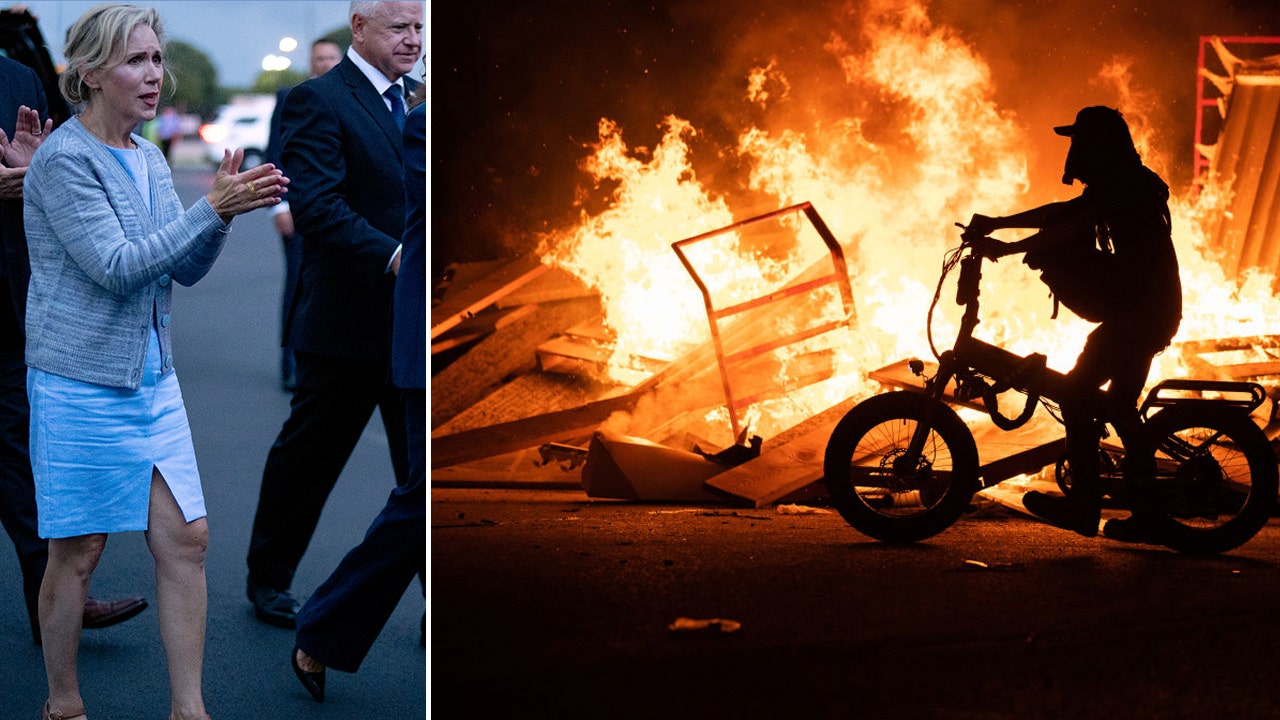
The wife of Democratic presidential nominee Kamala Harris’ running mate set social media ablaze Tuesday after an unearthed clip of her describing her actions during the 2020 Minneapolis riots went viral.
Gwen Walz is Minnesota’s first lady and the wife of Democratic Minnesota Gov. Tim Walz, who was picked by Vice President Harris to be her running mate on the 2024 Democratic presidential ticket.
A pivotal part of Walz’s gubernatorial record was his handling of the death of George Floyd in the state in 2020. Floyd’s death sparked nationwide protests about race and police brutality.
TIM WALZ, KAMALA HARRIS’ NEW RIGHT-HAND MAN, ECHOES LEFT-WING CRIME POLICIES
Minnesota first lady Gwen Walz and an image of the 2020 riots in Minnesota. (Getty Images)
“Again we had more sleepless nights during the riots,” Walz’s wife told KSTP in July 2020. “I could smell the burning tires, and that was a very real thing. And I kept the windows open as long as I could because I felt like that was such a touchstone of what was happening.”
Conservative commentators expressed astonishment at Gwen Walz’s remarks after the clip started going viral on social media.
“What might you call this? Bizarre? Abnormal? Peculiar? Eccentric? Offbeat? Quirky?” Noah Rothman, a senior writer at the National Review Online, said. “Gotta be a word that describes reveling in the catharsis represented by the torching of other people’s property.”
Turning Point USA founder Charlie Kirk described the comments as “weird.”
“Profoundly disturbing,” journalist Abigail Shrier said. “We’re going to need to learn a lot more about the Walzes.”
Dustin Grage, the president of a conservative Minnesota-based consulting firm, said the comments were “bizarre,” adding, “Her [Walz’s] daughter also coordinated with rioters to let them know that the National Guard would not be activated one night.”
“Everything you need to know about leftist elites can be found in this short clip,” Daily Wire host Matt Walsh said on X. “Tim Walz’s wife sat by the window enjoying the smell of poor neighborhoods burning during the Floyd riots. She did everything but pull out a fiddle.”
Gov. Walz was criticized for his handling of the riots. Conservatives accused him of sitting on his hands as the state was engulfed by riots.
Vice President Kamala Harris, the 2024 Democratic presidential candidate, applauds her running mate, Minnesota Gov. Tim Walz, as he speaks at Temple University’s Liacouras Center in Philadelphia on Tuesday, the first day of their Battleground State Tour. (Matthew Hatcher/AFP via Getty Images)
As a result of the delayed action, hundreds of businesses across Minneapolis and St. Paul were devastated by the destruction and had to ask their local government for help recovering on top of what they lost during pandemic-related closures.
First lady Walz said she was aware Minnesota was under national scrutiny at the time.
“With COVID-19, the entire state was watching what Tim did,” Ms. Walz said. “But with Mr. Floyd’s death, it was the entire country and the whole world looking at and watching what we did here in Minnesota in response to that.”
RIOTING, LOOTING LINKED TO GEORGE FLOYD PROTESTS LEAVES TRAIL OF DESTRUCTION ACROSS AMERICAN CITIES
That record is now again under scrutiny as Walz is catapulted into the national spotlight, with Republican critics taking aim at how both Walz and Harris handled the 2020 crisis.
“Minnesota was ground zero for the BLM riots of 2020,” Florida Republican Gov. Ron DeSantis said. “Harris egged it on, and Walz sat by and let Minneapolis burn.”
Ohio Sen. JD Vance, the Republican vice presidential candidate and running mate of former President Trump, poked at Walz’s 2020 record on Tuesday, calling his addition to the Democratic ticket “an interesting tag team.”
“If we remember the rioting in the summer of 2020, Tim Walz was the guy who let rioters burn down Minneapolis,” he said of the riots that began in Minnesota in response to the death of Floyd while being arrested in Minneapolis. “And then Kamala Harris was the one who bailed the rioters out of jail.”
Read the full article from Here


Former Detroit Lions cornerback Terrion Arnold is already planning for his future, after being released by the team that invested a first-round pick to select him back in 2024.
According to his attorney Harvey Steinberg, the former Alabama Crimson Tide defensive back has already been contacted by three NFL team’s in the last 48 hours.
Arnold has now hit the league’s waiver wire, as his release has become official.
Steinberg explained, in reply to a recent motion by Florida prosecutors to have Arnold fitted with a GPS tether, “Mr. Arnold is not a flight risk, nor is he a danger to the community. He is confined to his home by both court conditions and media scrutiny and anticipates that he will have employment with another NFL team within 30 days.”
Additional Insider Analysis: How Detroit Lions Depth Chart Changes Without Terrion Arnold
Here are five team’s that could take a chance and sign Arnold, should he clear waivers.
Jets
Aaron Glenn is now the head coach of the AFC East squad. Detroit’s former defensive coordinator may want to reunite with a player he worked very closely with for a season. Because of Glenn’s nature as a strong relationship builder with players, there could be a bond between the two parties that could be beneficial for Arnold.
The former NFL defensive back may be the only coach who can instantly reach the 23-year-old and keep him focused on improving his craft.
Commanders
Washington is in an interesting spot at the cornerback position. Mike Sainristil’s production dipped in 2025 after a strong rookie campaign, while 2025 second-round pick Trey Amos is expected to start opposite of him.
The Commanders signed former Lion Amik Robertson to be their nickel cornerback, but could benefit from adding some competition to the room. They could view Arnold as a player who would bring just that.
Cowboys
After Trevon Diggs was waived, the Cowboys were in the market for a second cornerback opposite of DaRon Bland. They signed Cobie Durant from the Los Angeles Rams, and drafted Caleb Downs to be their nickel.
However, Arnold has starting experience and could be a player the Cowboys view as competition for Durant and Bland. He could also be injury insurance, as Bland has been limited to 19 games over the last two seasons.
Chiefs
The Chiefs made a big change to their secondary this offseason, as Trent McDuffie was traded to the Los Angeles Rams. They drafted Mansoor DeLane in the first-round, and reunited with veteran L’Jarius Sneed.
However, their depth remains questionable, and currently their backups include Kristian Fulton and 2025 third-round pick Nohl Williams. Arnold would give them some experienced depth.
Buccaneers
The cornerback position may be the biggest question mark on the Buccaneers’ defense. There are a lot of talented options within the group, but there’s uncertainty in the secondary. Right now, the starters are expected to be Zyon McCollum and Benjamin Morrison.
Behind those two, Josh Hayes and Damarion Williams are both backups but neither played a defensive snap last season. As a result, a player like Arnold could be the ideal find for them who could compete for a starting spot on the outside.
For more comprehensive Detroit Lions coverage and NFL insider analysis, follow us on X, @detroitpodcast, head on over to our Facebook page and give it a like, follow us on TikTok, subscribe to the Detroit Lions On SI Lone Wolves YouTube Channel for daily videos, news, member-exclusive content.
Follow


MILWAUKEE – Milwaukee leaders accuse U.S. Immigration and Customs Enforcement of breaking a city ordinance, while an agency spokesperson stands by officers’ decision to “protect themselves” on the job.
ICE in Milwaukee
Big picture view:
ICE said it arrested 39 people over the weekend. The federal agency said those people were in the country illegally and that many had criminal histories, including for sexual assault and DUI.
FREE DOWNLOAD: Get breaking news alerts in the FOX LOCAL Mobile app for iOS or Android
Voces de la Frontera denied that and shared recent images at a news conference of federal immigration agents masked in Milwaukee. And on Wednesday, a fight erupted over what ICE agents are wearing during the arrests.
“For ICE to be doing this, which is again, against our ordinance, it drives me insane,” said Milwaukee Mayor Cavalier Johnson.
Masked agents
The backstory:
In April, Milwaukee’s Common Council and mayor approved a new ordinance. It bans all law enforcement from wearing masks in public when on duty. It provides exemptions if wearing it for health or safety reasons.
“There’s no need to do that, have masked police in the United States of America,” said Johnson. “We don’t have a Gestapo police in the United States. We shouldn’t have a secret police in the United States. If you engage with a law enforcement officer, you should be able to clearly identify who they are, their badge, their name, and they should identify themselves as such,” Johnson said.
Milwaukee’s ordinance also requires all law enforcement to either wear their name on their uniform and their agency – or when asked – to share that information. It also requires cars be labeled – except for undercover assignments.
“It isn’t that it is not working, it is that it is not being respected,” said Milwaukee Ald. Marina Dimitrijevic. “We will hold people accountable.”
Fines for feds?
What they’re saying:
Breaking the masking and ID ordinance could lead to a fine up to $10,000.
“Who’s going to fine them? It’s not going to be MPD. How do you the fine the federal government? An officer is not going to write a ticket and then give it to an ICE officer,” said Alexander Ayala, Milwaukee Police Association president.
MPD said in a statement that it has requested a formal written legal opinion from the city attorney’s office about the mask ordinance. The city attorney already signed off on the ordinance as legal and enforceable.
Milwaukee County action
The backstory:
Milwaukee County also recently passed an ordinance to ban law enforcement from staging in county parks without prior authorization. The county’s attorney said the legislation couldn’t just target ICE because that would violate constitutional principles, so it said all law enforcement.
SIGN UP TODAY: Get daily headlines, breaking news emails from FOX6 News
Milwaukee County Supervisor Juan Miguel Martinez shared images of what he said were federal agents at the Mitchell Domes.
“Right now the idea is to document and know as much as possible and make sure everybody has eyes on the park…and are looking and documenting to see when and what parks that they are staging at, so later on we can sue them for staging without a permit,” he said. “These are kind of small things that we are trying to get done, but, now allowing them in our parks is the idea here, to slow them down or stop what they are doing, from terrorizing our community as much as possible.”
ICE responds
The other side:
In a statement, a U.S. Department of Homeland Security spokesperson said:
“ICE is targeting criminal illegal aliens including murderers, rapists, criminals, gang members and more. In 2025, nearly 70% of ICE arrests are of illegal aliens charged or convicted of a crime in the U.S.
“Enforcing federal immigration laws is a clear federal responsibility under Article I, Article II and the Supremacy Clause.
“While Milwaukee sanctuary politicians continue to release pedophiles, rapists, gang members, and murderers onto their streets, our brave law enforcement will continue to risk their lives to arrest these heinous criminals and make Milwaukee safe again.
“Sanctuary politicians attempting to ban our federal law enforcement from wearing masks is despicable and a flagrant attempt to endanger our officers. To be crystal clear: we will not abide by unconstitutional bans. The Supremacy Clause makes it clear that Milwaukee’s sanctuary politicians do not control federal law enforcement.
“ICE officers wear face coverings for one reason: to protect themselves and their families from real-world threats including agitators. The danger is not hypothetical. Public databases and online “lists” have been created to expose officers’ identities. Today, our ICE law enforcement officers face a more than 1,300% increase in assaults, 3,300% increase in vehicular attacks, and an 8,000% increase in death threats against them.”
The Source: Information in this story is from FOX6 News interviews, prior coverage of the city and county ordinances and a statement from an ICE spokesperson.
Minneapolis, MN
Minneapolis closes three beaches ahead of 4th of July weekend due to high e. coli levels

-
 News5 minutes ago
What the SCOTUS campaign finance ruling means, according to an expert
-

 Los Angeles, Ca1 hour ago
Knife-wielding man rushes at LAPD officers in tense body cam video
-

 Detroit, MI2 hours ago
5 Potential Landing Spots For Former Detroit Lions CB Terrion Arnold
-

 San Francisco, CA2 hours ago
May 17 officially declared
-

 Dallas, TX2 hours ago
Dallas City Hall named to World Monuments Fund’s ‘Irreplaceable America’ list – Lake Highlands
-

 Miami, FL2 hours ago
Ex-con lists $138M in luxury penthouses, including Miami trophy condo
-

 Boston, MA2 hours ago
Celtics reportedly trading Jaylen Brown to 76ers for Paul George, picks
-

 Denver, CO2 hours ago
LeBron James to the Nuggets? Latest reports and betting odds

