Connect with us

Midwest

Universities take measures to protect graduation ceremonies from anti-Israel protesters

Published

on

Universities take measures to protect graduation ceremonies from anti-Israel protesters

With student protests over the Israel-Hamas war disrupting campuses nationwide, several major universities are intent on ensuring that commencement ceremonies — joyous milestones for graduates, their families and friends — go off without a hitch this weekend.

It won’t be easy. Colleges are hiring extra security, screening attendees at venues and emphasizing that significant disruptions by anti-Israel protesters won’t be tolerated. At the same time, they’re pledging to honor free-speech rights by designating protest zones.

Students booed and yelled “free Palestine” while the University of Utah president spoke Thursday night at commencement. He paused his speech to ask those who were protesting to leave or be removed. Outside the ceremony in Salt Lake City, a group of about 50 people were rallying. There was one arrest.

HOUTHIS WOULD WELCOME STUDENTS SUSPENDED FOR ANTI-ISRAEL PROTESTS TO THE MILITIA’S OWN UNIVERSITY

“Milestone is a perfect word,” said Ken Burdick of Tampa, Florida, describing his daughter’s graduation Saturday at the University of Michigan. He hopes the big day goes untarnished.

Advertisement

“People can exercise their First Amendment rights without disrupting or creating fear,” Burdick said of protesters.

Here’s how some schools are planning to balance things:

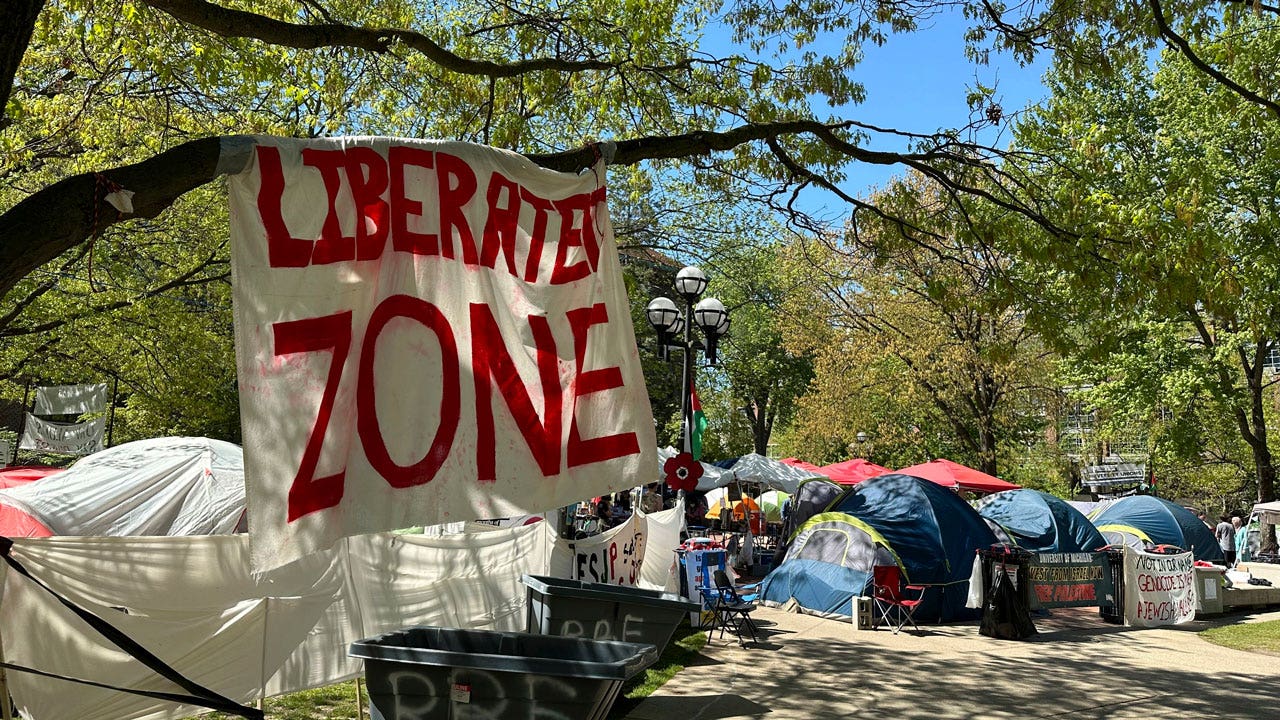
Tents at an anti-Israel protest are seen at the University of Michigan in Ann Arbor, Michigan, on May 2, 2024. The school said staff and volunteers have been trained to manage any disruptions that might occur at graduation at Michigan Stadium on May 4. (AP Photo/Ed White)

UNIVERSITY OF MICHIGAN

More than 8,000 graduates — and 63,000 spectators — are expected for Saturday’s festivities inside Michigan Stadium, known as The Big House. There will be security screening, and disruptive protesters could be subject to removal. Public safety officers and staff who commonly monitor major events, such as fall football games, will be present. Author and historian Brad Meltzer is the featured speaker.

In March, an annual event recognizing students with high academic achievement ended early when anti-Israel protesters raised provocative signs and drowned out remarks by President Santa Ono, yelling, “You are funding genocide!” The university subsequently drafted a policy that could lead to student expulsions and staff dismissals for event disruptions, though it hasn’t been finalized.

Advertisement

“It was painful for everyone who had gathered — and especially so for members of our Jewish community,” Ono said two days later.

Protesters have erected dozens of tents on the Diag, a historic space for campus activism more than a mile away from the stadium. They’re demanding that Michigan cut financial ties with companies connected to Israel. There has been no effort to break up the encampment and no arrests.

“We respect and uphold the principles of free expression, and also recognize that no one is entitled to disrupt university activities,” Laurie McCauley, Michigan’s chief academic officer, said in an email to students and staff about commencement.

Blake Richards, 25, is earning a bachelor’s degree in biochemistry. Richards plans to be at the football stadium Saturday after participating in a smaller ceremony Thursday for chemistry students.

“It could take away some great feelings, muddle them,” Richards said of any disruptions. “But truth be told, I’m not bothered. I know others have different opinions; I’m just happy to be here.”

Advertisement

INDIANA UNIVERSITY

The Bloomington, Indiana, campus is designating protest zones outside Skjodt Assembly Hall and Memorial Stadium, where ceremonies will be held Friday for graduate students and Saturday for undergraduates. Nearly 10,000 students are eligible to attend.

A social media post circulating on Instagram urged protesters to wear “your keffiyeh along with your cap and gown” and walk out during Saturday’s remarks by President Pamela Whitten.

Roughly 20 tents set up by protesters remained in place this week in an area known as Dunn Meadow, a mile from the stadium. Dozens of protesters have been arrested there recently, according to the Indiana Daily Student.

Maya Wasserman, a 22-year-old senior in management who is Jewish, said she and her family feel uncomfortable about the prospect of anti-Israel protests disrupting commencement. She expressed special concern for her mother and grandmother, who are Israeli.

“It’s unfortunate because we want this event to be about graduating, not politics,” Wasserman said.

Advertisement

At Dunn Meadow, students in lawn chairs or on blankets worked on their final assignments. Jessica Missey, a 20-year-old protester and senior, said she boycotted final exams; some professors, she said, simply canceled them. She has enjoyed the camaraderie at the encampment.

“Commencement is kind of just taking almost a little sidestep for me,” said Missey.

NORTHEASTERN UNIVERSITY

A week after police arrested nearly 100 protesters at Northeastern University, the school is holding its commencement exercises Sunday at Fenway Park, home of the Boston Red Sox, for the fourth consecutive year.

The venue will help security officials monitor the crowd and limit what people can bring. Signs, banners, balloons and full-size flags are prohibited in the stadium, along with most bags. Renata Nyul, vice president for communications, said public safety staffing will be strengthened.

Advertisement

All those entering Fenway will need to pass through metal detectors. About 50,000 graduates, family and friends are expected.

Northeastern is one of several universities in the Boston area that have had anti-Israel encampments. Some have let the protests continue, though Northeastern’s camp was broken up.

“While we realize that issues in the world prompt passionate viewpoints, the focus this weekend should be on our graduates and their remarkable achievements,” Nyul said.

Read the full article from Here

Advertisement
Continue Reading
Click to comment

Leave a Reply

Your email address will not be published. Required fields are marked *

This site uses Akismet to reduce spam. Learn how your comment data is processed.

South Dakota

605 Day at the Smoking Mule in Chamberlain returning in June

Published

on

605 Day at the Smoking Mule in Chamberlain returning in June


SIOUX FALLS, S.D. (Dakota News Now) – 605 Day at the Smoking Mule in Chamberlain is coming up on June 5.

Owner Erica Sperl and General Manager Dayre Evans joined Dakota News Now with the details.

“So, the Smoking Mule is in Chamberlain, right along the banks of the Missouri River. We got this idea a couple of years ago, where we wanted to have a ‘605 Day’ and celebrate South Dakota businesses,” said Sperl.

“Because we’re right in the center of the state, we get a ton of travelers coming through. So, we kind of feel like a little mini tourist spot. We’re always telling people where to go and what to check out. And so, that’s where the idea came from. Just inviting businesses to join us for the day. Little vendors, big vendors, food, clothes, whatever it is. Just to kind of celebrate the awesomeness of South Dakota.”

Advertisement

“Last year, we had about ten vendors on site. This year, we’re about, just almost to thirty, there’s some more rolling in,” said Evans.

There’s everything from tattoo artists from Winner, South Dakota, on site. There are hand-wrapped floral bouquets, home decor from some local Chamberlain businesses, Coffee Cantina, a coffee shop, on-site, doing drinks all day, and a slushie truck. We have kids face painting, we have family mini sessions right by the river, there’s a cigar shop, there’s breweries on site, including Palace City out of Mitchell.”

There will also be a minno race and a performance from the Rewind Band to end the night, along with much more!

The event will be at the Smoking Mule starting at 12:00 pm on June 5, 2026.

Watch the full interview above to learn more.

Advertisement

Copyright 2026 Dakota News Now. All rights reserved.


Source link

Continue Reading

Wisconsin

Nearly 50 guns stolen from Wisconsin sporting goods store, ATF offering $10K reward

Published

on

Nearly 50 guns stolen from Wisconsin sporting goods store, ATF offering K reward


Nearly 50 guns and lots of ammunition was stolen from a Wisconsin sporting goods store in February, and investigators are now offering $10,000 for information that leads to an arrest.

The St. Croix County Sheriff’s Office and the Bureau of Alcohol, Tobacco, Firearms and Explosives (ATF) are investigating the theft, which happened in the early hours of Feb. 12 at Russell’s Sport N’ Bike in Star Prairie.

Officials say that the suspect got into the federally licensed store through a window before stealing the firearms and ammunition.

Anyone with information can call the St. Croix County Sheriff’s Office at 715-386-4701 or email tipline@sccwi.gov to submit a tip.

Advertisement


Source link

Continue Reading

Detroit, MI

Inside Detroit’s Commercial Real Estate Comeback

Published

on

Inside Detroit’s Commercial Real Estate Comeback


The near-death and recovery of any great American city always starts with a story. 

The genesis of Detroit’s rebirth goes back 16 years to when an intern stepped into the office of Dan Gilbert, founder and chairman of Rocket Mortgage (neé Quicken Loans), owner of the NBA’s Cleveland Cavaliers, and native son of the Motor City. The intern told Gilbert he was leaving for Chicago. 

SEE ALSO: Sunday Summary: Revved Up for Power Finance

Gilbert was befuddled. Why would anyone leave? At the time, Quicken Loans employed more than 12,000 people and was the nation’s largest mortgage company, with its headquarters in a spacious suburban office in Livonia, Mich., about 20 miles west of Downtown Detroit. 

Advertisement

“The intern said, ‘I want to be in a dynamic urban environment,’” recalled Jared Fleisher, CEO of Bedrock Detroit, the Gilbert family’s commercial real estate firm, about the misguided intern. “And a light bulb went off in Dan’s head. He realized, ‘If this company is going to attract the talent it needs to thrive, I need to be in an urban center, so I’m going to move my headquarters to where I grew up in Downtown Detroit.’’’

Unlike Henry Ford, who famously created two different municipalities by moving Ford Motor Company’s headquarters and production out to the Michigan suburbs of Highland Park and Dearborn in the early 20th century, Gilbert embraced the challenge of planting his businesses flag in Detroit proper, three years before the city filed the largest municipal bankruptcy in history in 2013.

“Everyone was running for the hills, but that’s when Dan said, ‘I’m going to go in,’” added Fleisher. 

In the decade and a half since Gilbert made that decision to bring his firm into Downtown Detroit, the city itself has experienced nothing short of a cultural and economic renaissance, largely on the back of commercial real estate redevelopment and reinvestment, with no one deploying more capital and confidence back into the city than Gilbert and his different companies. Big questions like public safety have experienced a dramatic turnaround, with violent crime in 2024 reaching a low not seen since the 1960s, and 2025 numbers proving even better.

Through Bedrock Detroit (founded in 2011), Gilbert began purchasing and rehabilitating historic offices that had fallen into disrepair, like the Chrysler House, First National Building and the David Stott Building, all constructed before 1929. He then created a Blight Removal Task Force, seeded numerous local start-ups, and financed multiple grants that included gifting the city of Detroit $500 million to help low-income, underwater homeowners pay down property tax debt. 

Advertisement

“They’ve helped Detroit in dealing with high taxes on homes, home-care grants, and numerous projects that have impacted various policies and the quality of life,” Mayor Mary Sheffield, who took office in January 2026, told Commercial Observer. “They don’t get the credit they deserve in the city, but they do a lot for small business growth and overall quality of life.” 

All told, Bedrock Detroit has invested more than $7.5 billion across 140 different commercial real estate projects in Downtown Detroit, with a dogged focus on improving the central business district to attract companies and their workers.

Rock Ventures and Quicken Loans Chairman Dan Gilbert introduces Chrysler Group Chairman and CEO Sergio Marchionne before announcing that Chrysler will have an office presence in downtown Detroit in April 2012 named Chrysler House. PHOTO: Bill Pugliano/Getty Images

“It’s about talent retention, and for many years the state was losing talent,” said Kiana Wenzell, co-executive director of Design Core Detroit, a nonprofit. “We educate talent, we have the highest concentration of industrial designers, we have colleges and universities nearby, but we were seeing a brain drain. People would get their degree here, but they wouldn’t stay here.” 

To wit, on April 2, Bedrock Detroit, the Downtown Detroit Partnership, Move Detroit and more than 50 other partners announced the new “Make Detroit Home” initiative, a grant that will pay more than 300 residents up to $15,000 in stipends to support home down payments, renovations, rent or business expenses. 

Bedrock’s coup de grace, however, is Hudson Detroit, a $1.5 billion, 1.5 million-square-foot mixed-use development that opened last year on the site of the old flagship department store of the J.L. Hudson Company, and includes a 49-story hotel and condo and a 12-story office building that is now the global headquarters of General Motors — making it Detroit’s first new office tower in 50 years.

Advertisement

“The broader revitalization play was genuinely organic,” said Fleisher. “Dan never said, ‘I’m going into Downtown Detroit to make it my ultimate mission and life’s work to bring back the city,’ but then it truly became his passion and has snowballed into his legacy, an incomparable legacy of a single human being helping bring back a great American city.”  

While he was certainly the biggest catalyst, Gilbert has been far from alone in his conviction that Detroit — long considered the U.S. poster child for urban blight by the early 2010s — is not only worth saving, but is also an honest-to-God good and worthy investment. 

J.P. Morgan Chase, using the federal New Markets Tax Credit (NMTC) program, and working with local community development financial institutions, has invested $2 billion into the city since 2014, including $160 million to build more than 3,800 units of affordable housing.  

Through agreements with the city and numerous public private partnerships, J.P. Morgan’s community development arm has helped finance early childhood centers, charter schools, new housing, a three-mile light rail along the Q line that opened in 2017, and the modernization of Eastern Market, a marquee and historic commercial anchor, all within the last 12 years. 

“Given the significant economic need, we really felt that we had to be part of the rebirth of Detroit,” said En Jung Kim, managing director of community development banking at J.P. Morgan Chase. “[And now] we think Detroit is a really powerful example of what happens when businesses, government, public-private partnerships and community partners come together.” 

Advertisement

Another key ingredient in the recovery was the administration of Mayor Mike Duggan, who led Detroit from 2014 until 2026, and emphasized supporting the private sector on economic development while doing his part to clean up the city’s gloomy fiscal situation. 

“We had 12 years of a really strong mayoral administration, and 10 years ago, unlike so many cities, we cleared out our legacy debt, went through largest municipal bankruptcy, restructured, preserved our cultural assets and pensions, and put ourselves in a better financial position,” said Eric Larson, CEO of the Downtown Detroit Partnership.

Then there’s Mike Ilitch, founder of Little Caesar’s Pizza, a Detroit native, and owner of the MLB’s Detroit Tigers and NHL’s Detroit Redwings. After restoring the 5,000-seat Fox Theatre performing arts center, which opened in 1928 and fell into disrepair by the late 1980s, Ilitch helped finance a new downtown stadium for the Tigers, Comerica Park, which opened in 2000, and another stadium a few blocks away for the Red Wings and NBA’s Detroit Pistons, Little Caesar’s Arena, which opened in 2017 (Ilitch died that year).

Together with the 65,000-seat Ford Field, which houses the NFL’s Detroit Lions, these three stadiums have made Detroit the only city in the U.S. that hosts all four big league sports teams in the same downtown nexus. 

“Those were critical opportunities and investments that took place to not only house all four of our professional sports teams in a two-block radius, but to generate significant economic and entertainment activity,” said Larson. “Our ability to diversify hospitality, sports and entertainment has been a godsend to our downtown.’ 

Advertisement

The decisions by Gilbert, J.P. Morgan, Illich and numerous other local patrons have helped turn the city around. Over the last two years, Detroit experienced population growth for the first time since 1957 — an increase of 6,000 residents both years — outpacing not just all other localities in Michigan but the national average as well, according to the U.S. Census Bureau. 

But there’s still more work to be done, and the city continues to lick the wounds from one of the more dramatic declines to befall an American downtown in the last 100 years — one that nearly proved fatal. 

The decline

Detroit was once a crown jewel of the American Midwest. 

After half a century of economic growth driven largely by the automobile industry and its Big Three automakers — as well as the weapons manufacturing those same factories accommodated as the “Arsenal of Democracy” during World War II in the 1940s — the city’s population topped 1.8 million people by 1950, making Detroit the fourth-largest city in America, with residents boasting the highest per capita income in the U.S. and highest global rate of automobile ownership at the time. 

Advertisement

Only Chicago rivaled it as a Midwestern cultural hub. Detroit boasted of museums like the Detroit Institute of Arts and the Ford Institute, not to mention a wildly creative music scene, and some of the country’s greatest Mayan revival Art Deco architecture.

With a powerful and dependable manufacturing industry anchoring its economy, Detroit became a haven for Black migration from the 1920s to 1950s, and by midcentury the city had one of the strongest Black homeownership rates in the country.

General Motors' new headquarters in the Hudson's Detroit development.
General Motors’ new headquarters in the Hudson’s Detroit development. PHOTO: Jim West/UCG/Universal Images Group via Getty Images

But as suburban living exploded in the postwar years, and race relations worsened across the 1960s, Detroit began to suffer. Divisions reached their nadir following the 1967 “12th Street Riot,” among the deadliest and costliest riots the nation has ever seen. 

Moreover, from the 1970s into the 1990s, globalization changed the nature of manufacturing economics across the Rust Belt, free-trade agreements and automation incapacitated unions, and newer, more fuel-efficient cars from Asia cut into the profit margins of Detroit’s Big Three automakers. Such changes shrank the tax base and cut into the budgets of state and local governments.   

“There isn’t any one thing that caused [the decline], some of it was what happened nationally with race relations, but there were issues relative to the governance of the city, affordability, and there were issues with general reinvestment in the city, and the reduction of the overall job base,” explained Larson. “All those things contributed.”

The hits continued into the early 21st century. By 2010, Detroit’s population had declined 60 percent from its 1950 peak. Former Detroit Mayor Kwame Kilpatrick, who served from 2002 to 2008, was convicted of multiple felonies including mail fraud, wire fraud and racketeering and sentenced to 28 years in prison. (His sentence was commuted by President Trump in 2021.) And then came the Global Financial Crisis in 2008-9. 

Advertisement

“Between 2008 and 2010, Detroit lost 110,000 people,” said Hilary Doe, president and CEO of the nonprofit Move Detroit and formerly the state’s chief growth officer. “In those two years, the economic shock hit people harder in Detroit and Michigan than many other places, as we had less economic diversification than elsewhere. We had been dealing with out-migration for a long time, really since 1991.” 

In 2009, the city’s unemployment rate reached an appalling 29 percent, and the average price for a home in the city was a mere $7,500, with some going for only a few hundred dollars, according to The Guardian

The city hit rock bottom in 2013, when it filed what was then the largest municipal bankruptcy in U.S. history, carrying a debt estimated at $18 billion. At the time, 40 percent of the city’s streetlights were not functioning, according to the city’s Public Light Authority. 

Residents fled in droves. Detroit’s population declined roughly 28 percent between 2000 and 2015, according to Detroit Future City, a research nonprofit, and reached an all-time low of 639,000 in 2020. 

One of the reasons Detroit’s greater metropolitan area suffered disproportionately from the white-collar flight was the unfortunate fact that it is essentially without the mass transit systems found in Chicago, Boston, Los Angeles and New York.  

Advertisement

Moreover, rather than building dense multifamily apartments like those across New York, Detroit became a city filled with large single-family homes spread out on big tracts of land in a grid designed for automobiles rather than streetcars or subways.  

“From a Jane Jacobs urbanist perspective, it’s a disaster,” said Matthew Temkin, co-founder of Greatwater Opportunity Capital, the largest multifamily firm in Detroit with more than 2,200 units across 40 properties. “Detroit’s real estate saw very little investment from 1960 to 2010, maybe fits and starts, but even to the extent investment did happen, it was hard to feel, because Detroit is so geographically massive. There are a handful of old neighborhoods with some density, but the vast majority of Detroit’s built landscape is single-family homes and sprawl.”

Temkin emphasized that the population loss, and accompanying urban blight, was magnified by the prevalence of single-family family homes rather than apartments (as beautiful and historic as they might be.) 

“You have giant chunks of land where there’s only one house left on the block, and when it comes to emergency services, lighting, trash pickup, it’s an administrative nightmare,” he said.  

COVID-19 didn’t help, as the fragile office sector emptied out for two years beginning in 2020, setting back much of the progress that Gilbert and others had jump-started. 

Advertisement

“The challenge for Detroit is it got hit hard during COVID, as a big percentage of the economy was tied to office workers,” said Andrew Gibbs, managing director of real estate at Arctaris Impact Investors. “We didn’t see a lot of institutional capital come into the city across all asset classes. And property taxes are high, so it’s hard to pencil in new construction.” 

But rather than wallow in the dueling threats of bankruptcy and the pandemic, Detroit stayed in the game, kept chipping away at different development projects and public-private partnerships, and has slowly seen its fortunes turn in the second half of the 2020s. 

The comeback 

As state and local officials started rightsizing Detroit’s balance sheet after the 2013 bankruptcy, Dan Gilbert began pouring money into different commercial real estate projects, gradually moving from renovating older, derelict office buildings into financing retail and hospitality business through grants, and eventually repurposing entire structures and building from the ground up. 

“Dan said, ‘I need to create an ecosystem here if I’m really going to do this,’ and that led to investing in residential. If young folks are going to work downtown, they need to live downtown,” recalled Fleisher. “But people need somewhere to eat, and take their dry cleaning, so that started a focus on retail and the need for public spaces, so until 2017 it was all adaptive reuse.” 

Advertisement

Then Gilbert decided to go vertical. Aside from the development of Hudson Detroit, the tallest skyscraper built in nearly 50 years, Bedrock invested $30 million in renovating the historic Book Tower, a 38-story Art Deco office, into a mixed-use hotel, apartment and workspace asset. It was recently named one of Architectural Digest‘s “11 Most Beautiful Repurposed Buildings” in the world. 

“They made a really intentional decision to build a market in the downtown corridor, in particular,” said Doe. “But it required community leaders, neighborhoods and a real commitment from the city and folks who wanted to make this work. But Dan is one of those people who has had an enormous impact.” 

The Renaissance Center framed by a footbridge and the monorail infrastructure in Detroit.
The Renaissance Center framed by a footbridge and the monorail infrastructure in Detroit. PHOTO: Roberto Machado Noa/LightRocket via Getty Images

Bedrock’s next big project is an even heavier lift: a $1.6 billion transformation of the superannuated Renaissance Center, formerly GM’s global headquarters and today a seven-tower office and entertainment complex that includes a 73-story hotel, still in use, and four 39-story office towers, all virtually abandoned, with each building connected by a subterranean network of underground parking, retail corridors, and pedestrian walkways — essentially everything one imagines a 1970s Brutalist nightmare to be.

“It’s 5.5 million square feet, 90 percent empty, functionally obsolete, and needs to be radically overhauled, but it’s also iconic,” explained Bedrock’s Fleisher. “If you enter Michigan or Detroit into Google or ChatGPT, you’ll get a picture of the Renaissance Center.” 

While the project is still in the planning and financing phase, Bedrock’s end vision includes a total overhaul and redevelopment of the existing real estate and land to transform more than 30 acres of waterfront real estate into a link between the riverfront and central business district. 

“The vision is to create the best waterfront district in the country, modeled on Chelsea Piers in New York, Navy Pier in Chicago, Fisherman’s Wharf in San Francisco,” said Fleisher.  

Advertisement

But if Bedrock has been the main engine in powering Detroit’s real estate renaissance, the company is far from the only piston on the road to recovery, nor is Gilbert the only hometown hero who has put his money where his loyalty is.  

“Detroit is unique, as it has a number of legacy families and organizations that have continued to be connected and committed across generations,” said Larson. “But we also have a very deep and proactive foundation community, and those two things recognized the need for intervention.”

In the early 2000s, Peter Karmanos, co-founder of software giant Compuware, and Edsel B. Ford II (great-grandson of Henry Ford), both Detroit natives, were instrumental in financing the redevelopment of Campus Martius Park, a 1.6-acre public square that is Detroit’s own version of Rockefeller Center with ice-skating, live performances and an annual Christmas tree lighting. 

Billionaire sports team owners Steve Ballmer (L.A. Clippers), Bill Davidson (Detroit Pistons) and Ralph Wilson (Buffalo Bills), each Detroit natives, donated hundreds of millions of dollars to different causes across the city, with the latter two ensuring the city received generous contributions from their lucrative foundations following their deaths in 2009 and 2014. 

The Kresge Foundation, with a $5 billion endowment, has been headquartered in Detroit for 102 years and is a consistent investor into the city’s infrastructure and waterfront; the Knight Foundation, while headquartered in Miami, partnered with several other groups to pool $816 million together to preserve the Detroit Institute of Arts’ collection and protect city pensions following the 2013 bankruptcy; and the Hudson-Webber Foundation and Skillman Foundation are both based in Detroit, where they’ve donated money to fund education and the arts. 

Advertisement

Larson said the depth of relationships among its natives and wealthy sons is “almost a family-like atmosphere,” especially at levels of political and economic leadership.  

“There’s a grittiness to our community and the lack of interest in letting the city fail,” he said. “People took it as a personal mission to find ways to support Detroit’s rebirth.” 

Today, the foundation community is teaming with more than 50 other partners in the new “Make Detroit Home” initiative, announced this month, and aims to raise up to $10 million. 

The relocation incentive follows earlier grant programs led by the Downtown Detroit Partnership that saw the city’s population grow 27 percent over a five-year period prior to COVID, and will organize field trips in concert with University of Michigan, Michigan State University and Wayne State University to induce graduates to stay local. 

“It’s all really focused on doing what it takes to make sure we can retain residents who are already in the city and invite others to join us here in Detroit,” said Doe, who is leading the cause.  

Advertisement

While city leaders like Doe, Larson, and Fleisher recognize there is more work to be done on returning Detroit to its mid-20th century glory, there’s no denying the city is stronger from having gone through the fires of such a public decline and near-fatal fall. 

“I really do believe there’s something to a place that gets so far down that you can’t kick the can any further, and the DNA of Detroit is to rally,” said Larson. “And now we’ve found unbelievable pride and grit.”

Brian Pascus can be reached at bpascus@commercialobserver.com.


Source link

Advertisement
Continue Reading
Advertisement

Trending