Illinois
Actually, Illinois is a great place to do business right now. And Gov. Pritzker has helped


In the battle to attract the businesses of tomorrow, states around the country are using creative methods to differentiate themselves from others. And as we continue to build the best economic conditions our state has had in generations, it comes as no surprise that others count Illinois among their toughest competition.
While it’s true that the business community once turned its nose down at our state, the reality is that Illinois’ economic ecosystem today is hardly recognizable from years past. It’s time to reintroduce Illinois and set the record straight on why this is the place businesses want to be.
For one, Illinois is literally at the center of it all. We are the only state where all the Class I railroads meet in two locations. O’Hare airport is one of the most globally connected airports in the world. We have the third largest interstate highway system in the U.S., and inland waterways that connect to the Great Lakes, the Atlantic Ocean, and the Gulf of Mexico. Whether a business is shipping products via rail, roads, rivers, or runways, there is a big advantage to being in Illinois. How much of an advantage? PWC estimates that for many companies, logistics makes up around 10% of revenue. You won’t often see factors like these making headlines, but these are the things businesses care about.
Businesses also understand value, that you get what you pay for. Illinois offers a large, skilled workforce of over six million people, half of which have bachelor’s degrees or higher. Illinois’ astounding 244 higher education institutions are among the best in the world. The University of Illinois alone graduates more engineers each year than MIT, Stanford and Caltech combined. Beyond that, our community college system is the third largest in the nation. That means Illinois is providing customized training to students of all ages to ensure they gain the skills that are most in demand now. Put all of this together, and you have an extremely robust pipeline of talent at-the-ready to support business growth.
To fully understand why a new business relocated to or expanded in Illinois on average every day in 2023, we also have to acknowledge the strength of our state’s leadership. Businesses want to know that states are making intentional, coordinated and strategic efforts at the highest levels to constantly improve their business climate, as we are here in Illinois.
This hasn’t always been the case, but Gov. JB Pritzker is on the phone with CEOs daily to pitch our state and ask how we can better support their business. This active role may seem hard to quantify, but the results speak for themselves. For example, when Stellantis idled its Belvidere facility in the summer of 2022, the governor made it a priority to do whatever needed to be done for them to reopen and bring $4 billion worth of investments along with it.
More: $5B UAW, Stellantis deal could include construction of two more Belvidere plants
For all of these reasons and more, some states have attempted to discredit Illinois as a great place to do business. Take for example a Wyoming-based survey’s claims about that state versus ours. Wyoming may have the lowest tax rate in the U.S., but according to the Bureau of Labor Statistics, it also has the smallest economy. Not exactly a location where businesses can grow or dip into a skilled workforce or offer the kinds of infrastructure that multiple industries rely on to thrive. In fact, Wyoming can’t lay claim to even one Fortune 1,000 company that calls it home.
More: Study claims Illinois is worst place to start a business. Here’s why
On the other hand, Illinois is home to nearly 60 Fortune 1000 companies, like ADM, State Farm, John Deere, Walgreens, Motorola Solutions and United Airlines. Small businesses thrive here, too, with a recent JPMorgan Chase survey reporting that small and medium-sized businesses in our state are feeling more optimistic about business in the region than the nationwide average. It also has the fifth highest GDP in the U.S. and is ranked second in the nation by Site Selection Magazine for new and expanding companies.
It’s a great time to do business in Illinois − and to have the facts on our side.
John Atkinson is the chairman of Intersect Illinois, the state’s business attraction organization.



Name: Eric Godoy
Title: Associate Professor
Unit: Department of Philosophy
Years at Illinois State: 8 1/2 years
Tell us about your teaching and research in the College of Arts and Sciences.
“Renewable energy alone won’t make our energy systems more just. The production, distribution, and consumption of energy are connected to many ethical issues. For example, even renewable energy projects can pollute environments or displace people. My recent research examines these ethical challenges and asks what a just transition might look like. I’ve also published work on climate ethics, trophy hunting lions, urban park design, interdisciplinary research, and dinosaur films. My most popular course is PHI 236: Values and the Environment, but I also teach many topics in moral, social-political, and environmental philosophy. I’m also a proud affiliate of the Women’s, Gender, and Sexuality Studies Program (WGSS).”
What are your proudest accomplishments during your time at Illinois State?
“I was awarded an American Council of Learned Societies’ fellowship for my work on energy democracy this year. I was nominated by our university for a Carnegie Fellowship in 2024. I was also very honored to receive a College of Arts and Sciences (CAS) Excellence Award for Outstanding Teaching in 2021. But I’m always the proudest when I hear about the success of my former students. I love getting emails about their new careers or their graduate studies in all kinds of fields: law, environmental work, and, of course, philosophy.”
What’s your favorite thing about Illinois State or the College of Arts and Sciences?
“I do my best research in conversation with students and colleagues in different fields. Our students and faculty are so talented. They’re often working on amazing projects. I learn so much from them. They encourage me to explore new research questions I wouldn’t have thought of on my own. Environmental problems are inherently interdisciplinary. I’m very grateful that CAS supports interdisciplinary work and programs, such as WGSS, Environmental Systems Science and Sustainability, and Civic Engagement. Philosophy lends itself so well to interdisciplinary relationships since there are philosophical questions at the heart of every field.”
Department of Philosophy Chair Christopher Horvath on Godoy:
“Dr. Eric Godoy is an innovative, student‑centered educator whose inclusive and interdisciplinary pedagogy consistently elevates the department’s instructional standards. He is deeply committed to creating learning environments that empower students from diverse backgrounds to engage meaningfully with complex philosophical issues. His leadership in curriculum development has made him one of the department’s most forward‑thinking educators. Complementing his teaching excellence, his research provides practical, ethically grounded solutions to energy‑policy conflicts and will shape national conversations about democratic participation in a just transition away from fossil fuels.”
Read more stories from the College of Arts and Sciences at News.IllinoisState.edu/Unit/College-Arts-Sciences and follow the college on Facebook and Instagram.

Murals and memorials of César Chavez are continuing to come down across Chicago after allegations emerged last week that the Latino civil rights activist groomed and sexually assaulted girls and women.
The allegations were revealed in a New York Times investigation published March 18.
Some artworks are being repainted with murals of Dolores Huerta, the longtime ally of Chavez in the labor rights movement. Huerta, 95, told the New York Times that Chavez had sexually assaulted her.
The Illinois Senate adopted a resolution Wednesday honoring Huerta and declaring April 10 as “Dolores Huerta Day” in Illinois.
“In recent months, Dolores Huerta has shown profound resilience and courage in sharing her own experience of harm, doing so in order to uplift the stories of countless women whose voices were overlooked or silenced,” the resolution states.
One of the resolution’s sponsors, State Sen. Celina Villanueva, D-Chicago, said she is also working on a plan to rescind César Chavez Day, which is next week on March 31st.
At Cafe Tola in Lake View, a Chavez mural outside the restaurant’s building was replaced this week with a painting of Huerta, who coined the phrase, “Sí, se puede,” which loosely translates to, “Yes, we can.”
“We are deeply saddened by this news, yet we stand in unwavering support and admiration for Dolores Huerta and every woman who has found the courage to come forward,” Cafe Tola said in a social media post. “This moment is powerful — proof that truth cannot be silenced and that it is never too late to reclaim your voice. We honor that strength.”
A plaque dedicated to the 30th anniversary of the death of César Chavez, honoring him and Sister Dolores Huerta, before it was taped over at the Haymarket Memorial in the West Loop.
In the West Loop, a plaque honoring Chavez’s labor rights movement has been covered with black tape at the Haymarket Memorial. According to the Chicago Federation of Labor, the organization is planning to fully remove it.
“We will be discussing with all our partners on how to best honor both the survivors of Cesar Chavez’s horrific abuse and the workers that were betrayed by Chavez,” a spokesperson for the Chicago Federation of Labor said in a statement.
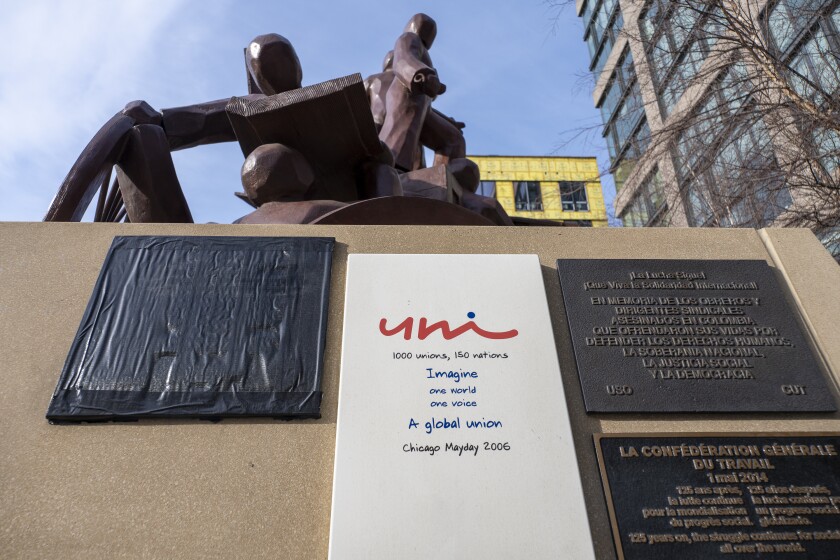
Black tape covers up a plaque (left) that commemorates the 30th anniversary of César Chavez’s death on the base of the Haymarket Memorial in the West Loop, Wednesday, March 25, 2026.
Tyler Pasciak LaRiviere/Sun-Times
Last week, Bob Reiter, president of the Chicago Federation of Labor, said the allegations that Chavez sexually assaulted children, women, workers and labor organizers “is a betrayal to our movement.”
Chavez, who died in 1993, has long been revered in Chicago’s Latino community. In addition to numerous murals of him across the city, a public elementary school in Back of the Yards and a post office in Pilsen are both named after him.
The school, César E. Chavez Multicultural Academic Center, has initiated the process that could lead to a new name. It is receiving community feedback about a possible new name, according to Chicago Public Schools officials. Any recommendation would need approval from the Local School Council and the school board.
Another school in Pilsen, Peter Cooper Dual Language Academy, has a mosaic of Chavez and Huerta side by side. It’s unclear if the school plans to remove the mosaic of Chavez.
The Sun-Times was the first to report that Chavez’s face had been painted over last week on the “Libertad” mural across a long wall at Barrett Park in Pilsen.
A splotch of green paint initially covered the portion where Chavez was depicted, but Park District officials have since painted over that with a continuation of the mural’s background design, a Park District spokesperson said.
Other historical figures on the mural, including Mexican artist Frida Kahlo, Malcolm X, Rosa Parks, and the Rev. Martin Luther King Jr. remain visible on the wall.

Paint covers Cesar Chavez’s face on a mural depicting civil rights figures that can be seen an exterior wall of Barrett Park in the Pilsen neighborhood, Friday, March 20, 2026.
Tyler Pasciak LaRiviere/Sun-Time
“The Chicago Park District takes recent allegations of misconduct by Cesar Chavez seriously … and are conducting a district-wide review of any other park features that may honor him,” a Park District spokesperson said previously. “Where appropriate, we will take further action consistent with our values and standards.”
The Park District has not identified any other murals or memorials of Chavez on any of its properties, the spokesperson said Wednesday.
Contributing: Isabela Nieto

Jogging 101: Benefits for Your Body and Mind
Movie reviews reveal A Poet and All That’s Left of You dominate March with perfect 100% scores – Art Threat

Phillies third baseman Alec Bohm sues his parents, accuses them of misusing his money

Video: Will ICE Change Under Its New Leader?

Video: Trump’s Signature to Appear on Dollar Bills

Florida High School Football Rankings: Top 25 teams – Oct. 21

How old is Bo Nix? What to know about Oregon quarterback ahead of 2024 NFL Draft

Cleary's 21 help Le Moyne down Central Connecticut State 69-64 in OT

99th annual Pony Swim held in Virginia

Indiana Members Credit Union announced as new anchor tenant at Bottleworks District
Video: Will ICE Change Under Its New Leader?

DHS shutdown breakthrough comes at cost for Republicans as funding fights nears end

Rubio joins crucial G7 talks as Iran war set to dominate second day

A surprise resignation could open the door for an independent to win a Montana Senate seat

Video: Savannah Guthrie Says She Believes Her Mother Was Taken for Ransom
-

 Detroit, MI1 week ago
Drummer Brian Pastoria, longtime Detroit music advocate, dies at 68
-

 Science1 week ago
How a Melting Glacier in Antarctica Could Affect Tens of Millions Around the Globe
-

 Movie Reviews1 week ago
‘Youth’ Twitter review: Ken Karunaas impresses audiences; Suraj Venjaramoodu adds charm; music wins praise | – The Times of India
-
 Science1 week ago
I had to man up and get a mammogram
-

 Sports6 days ago
IOC addresses execution of 19-year-old Iranian wrestler Saleh Mohammadi
-

 New Mexico4 days ago
Clovis shooting leaves one dead, four injured
-

 Texas1 week ago
How to buy Houston vs. Texas A&M 2026 March Madness tickets
-

 Tennessee3 days ago
Tennessee Police Investigating Alleged Assault Involving ‘Reacher’ Star Alan Ritchson