News
Missouri’s redistricting drama renews focus on direct democracy … and ‘Air Bud’


Buddy and Josh in the spotlight in the 1997 Walt Disney movie, Air Bud.
Walt Disney Pictures
hide caption
toggle caption
Walt Disney Pictures
When I first read about how Texas Republicans were preparing to engage in mid-decade redistricting, I sent a text message to a Republican aide in state government, jokingly wondering if Missouri would get in on the fun.
It’s no secret that my interest in Missouri redistricting borders on obsession. Some of my love for the subject stems from its importance. The lines and where they are drawn can determine which party has a better shot at winning any given district. But I also have a lifelong interest in cartography, including nearly winning my middle school geography bee and getting to talk to a National Geographic mapmaker while tagging along on a work trip with my dad.
Still, at the time I sent that text, I thought there was no way that Missouri Republicans would plunge back into congressional mapmaking in 2025 — especially after redistricting in 2022 sparked a bitter schism within the Missouri legislature.
I was wrong.
Very wrong.
Missouri ended up becoming the second GOP-led state behind Texas to redraw congressional lines at the behest of President Trump. And Missouri Republicans were upfront about their rationale: They wanted to oust Democratic Congressman Emanuel Cleaver of Kansas City to help prevent Republicans from losing control of the U.S. House in 2026.
And Missouri Republicans didn’t just pass a new map: They broke all sorts of legislative norms and precedents to push it to Gov. Mike Kehoe’s desk.
But in the rush to obtain a short-term victory for Republicans in Washington, D.C., Missouri Republicans may have ushered in the new map’s doom from at least two different directions.
EnterAir Bud
Redistricting detractors have filed a slew of lawsuits — including a particularly important one around whether it’s even allowed for Missouri lawmakers to redraw congressional boundaries in the middle of a decade. That case is still in its early stages, but the Missouri Supreme Court is expected to decide sometime next year.
On the surface, redistricting foes seem to have a solid case — a constitutional amendment that they say only allows for congressional redistricting after a census. But Missouri Republicans appear to have a secret weapon to counter that contention: The Air Bud Rule.
In the 1997 Walt Disney film, a referee allows Buddy the Dog to play basketball because, after searching frantically through a rule book, “there ain’t no rule that says a dog can’t play basketball.”
Flash forward to 2025: Defenders of the Missouri redistricting plan have rallied behind a similarly constructed argument: “There’s nothing in the Missouri Constitution that says lawmakers can’t redistrict mid-decade.”
Air Bud analogy is a slam dunk
When I first heard this argument, I started to ask Missouri lawmakers if they’d seen Air Bud.
Some, like Republican Secretary of State Denny Hoskins, had seen it — and acknowledged that the GOP defense of the map was basically the Air Bud Rule. (When he was a state senator, Hoskins successfully sponsored a bill designating two legendary canines, Old Drum and Jim the Wonder Dog, as Missouri’s official Historical Dog and the state’s official wonder dog.)
“Other states have different processes as far as when they can redistrict for congressional seats. But in Missouri, there’s nothing, in my opinion, that says that we cannot do this,” said GOP Secretary of State Denny Hoskins, who then joked that the new map should be named the “Air Bud Clause” if judges uphold it.
The analogy gained popularity among those entangled in redistricting.
Democratic state Rep. Mark Boyko mocked Republicans by citing the Air Bud Rule on the House floor. And during arguments earlier this month in Jefferson City, Chuck Hatfield, an attorney representing plaintiffs trying to strike down the new congressional lines, said in court this month, “we don’t do Air Bud rules in Missouri for very good reason, but that’s essentially what the argument is from the state.”
“It’s like if my children ask me: ‘Can we have ice cream tonight?’ And I say, we’re going for ice cream tomorrow,’” Boyko said. “And they say: ‘Well, you haven’t said we’re not having ice cream tonight, so we’re having ice cream tonight, too.’ No.”
Although Missouri Attorney General Catherine Hanaway had never seen the film, in an interview with me, she said the “ain’t no rule that says a dog can’t play basketball” principle is “not a bad analogy” in describing the state’s main argument.
“The Constitution says that redistricting shall happen after the decennial census. It doesn’t say that it shall happen immediately after; that it should happen only once per decade; that it can’t be revisited,” Hanaway said. “I don’t know what happened to Bud. I’m guessing he probably didn’t get to play basketball since you’re using that analogy. But I think our chances of prevailing are pretty good.”
When I informed her that Buddy not only got to play basketball, but he also played football in the classic film Air Bud: Golden Receiver, Hanaway said: “Man, I have missed a whole genre. I really got to catch up on that.”
A surprise referendum
But the biggest threat to the Missouri redistricting plan may not be the lawsuits.
One day, after the draining first week of the redistricting special session in September, I took a walk near my house in St. Louis. That’s when a question popped into my head: If lawmakers managed to pass the map, were there enough members in the Missouri House to make the map go into effect right away? If not, Republicans wouldn’t be able to avoid Missouri’s very robust referendum process.
While getting my kids ready for bed, I realized the answer was … no. The new map that Trump and Missouri Republicans wanted so badly could be subject to a statewide vote. If signature gatherers just got enough names collected before Dec. 11, the map couldn’t go into effect for the 2026 election cycle, defeating the entire purpose of the redistricting special session.
My story for St. Louis Public Radio was published before members of the House ended up giving first-round approval to the redistricting bill. Lawmakers ended up passing the map anyway, without much trouble — even though voters could end up wiping out their work.
After the special session ended, though, it was clear that a lot of lawmakers had no idea that the map could potentially be nullified through a statewide vote.
Opponents of the map have been scouring the state to collect signatures to put the plan up for a statewide vote. State Rep. Bryant Wolfin said he was unaware the map could go up for a statewide vote — adding “I guarantee the majority of the caucus did not as well.”
Whether the Trump White House realized that Missouri’s new map could be put up for a vote is unclear. Officials did not reply to a request for comment. But there’s no debate that the referendum generated a lot of excitement among despondent Missouri Democrats who suffered through yet another bad election cycle in 2024.
“I don’t even like politics, OK? I just know we need transparency,” Jefferson City resident Frida Tucker told me in September. “We need to stop the power grab. We don’t need to do it every three years, OK? Like, something’s not right here.”
So what did I learn from following along on this wild Missouri redistricting saga?
For one thing, it’s important to pay attention to seemingly insignificant details, like the vote count of a bill that was always expected to pass.
And other takeaway? Maybe revisit 1990s Disney films before a redistricting cycle, because you never know when a throwaway scene could inspire a legal theory that sinks or saves a nationally-watched proposal.
Jason Rosenbaum is a political correspondent for St. Louis Public Radio.


Lionel Messi #10 of Argentina celebrates scoring his team’s second goal during their World Cup match against Egypt in Atlanta on Tuesday.
Elsa/Getty Images
hide caption
toggle caption
Elsa/Getty Images
They looked beaten. And out. Argentina, the defending World Cup champion and No. 1-ranked team, was down 2-0 late against Egypt.

Then, in a span of 13 remarkable minutes, Argentina scored not once, not twice, but three times, capping a comeback for the ages and leaving Egypt stunned and shellshocked.
For much of the game in Atlanta, Egypt was in control, hobbling Argentina early. The Egyptian attack began almost immediately with a stunning header goal delivered by Yasser Ibrahim in the 15th minute. After that, Egypt’s defense closed ranks, making it practically impossible for Argentina to equalize.
It was downhill from there for the Argentines: team captain Lionel Messi failed to convert a penalty kick, and in the 67th minute, Egypt got a second goal from Mostafa Ziko (after an earlier Egyptian goal had been disallowed after a video review). It looked like Argentina was finished. On the brink of elimination.
But no one told the Argentine players that.
In the 79th minute, Lionel Messi began doing his thing. He fired a cross near the Egyptian goal, and Cristian Romero headed it in. Messi was not done. Four minutes later, he powered a shot past the Egyptian keeper. It was his eighth goal of this tournament, the most of any player. The score was 2-2.
Then, in stoppage time, yet another Argentina header and another goal, this time from Enzo Fernandez.
“This is the World Cup for you,” said Messi after the game. “It wasn’t easy to come back from two goals down. But as I always say, this group never gives up. We always try to fight until the end.”
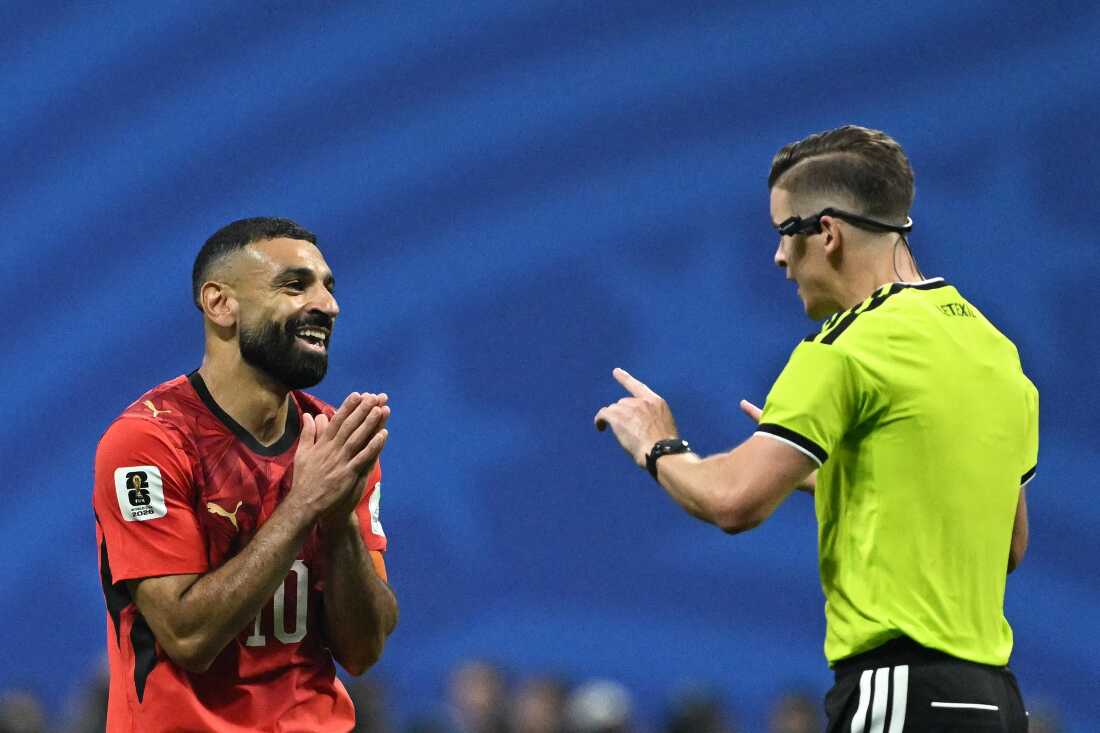
French referee François Letexier speaks with Egypt forward Mohamed Salah during the World Cup Round of 16 match between Argentina and Egypt in Atlanta.
Roberto Schmidt/AFP via Getty Images
hide caption
toggle caption
Roberto Schmidt/AFP via Getty Images
Afterward, Egypt coach Hossam Hassan complained about the French referee and the officiating. “I am not convinced. I am not convinced with this outcome. I’m not convinced with the way things unfolded during this match,” said Hassan in a post-match news conference. “We have been treated unfairly today. We have suffered injustice.”
“We would have deserved to earn this win, but we are leaving with honor, with pride, regardless of this defeat,” said Hossan.
African soccer teams have been the stars of this World Cup. Morocco has yet to lose a game. Cape Verde qualified for the first time in its history and stymied Spain, Uruguay and Saudi Arabia. Argentina barely beat them in a nail-biter of a match.
For Egypt, getting this far in the tournament is historic in itself: it’s the first time the team has made it this far. For Argentina, it was a terrifying yet relieving victory: several players, including Messi himself, cried after the game.
Next, they move to the quarterfinals and will play the winner of today’s Switzerland-Colombia match.

Top Senate Democrats are pushing for answers on whether a provision in a controversial settlement agreement between President Trump and his own administration applies to companies co-founded by or affiliated with the Trump family.
As part of a deal struck in May by the Justice Department to resolve a lawsuit brought by Mr. Trump, the Internal Revenue Service is permanently barred from pursuing claims against Mr. Trump, his oldest sons Don Jr. and Eric, and the Trump Organization based on prior tax returns.
In a one-page document signed by Acting Attorney General Todd Blanche and dated May 19, the Justice Department said the defendants in the president’s lawsuit — the IRS and the Treasury Department — are “FOREVER BARRED and PRECLUDED” from “prosecuting or pursuing, any and all claims” arising from tax returns filed before the settlement took effect. Blanche also wrote that the settlement applies to “parties including trusts, parent, sister, or related companies, affiliates, and subsidiaries.”
Now, Senators Elizabeth Warren of Massachusetts, Senate Minority Leader Chuck Schumer of New York, and Ranking Member of the Senate Finance Committee Ron Wyden of Oregon are pushing 11 businesses and organizations with ties to the Trump family to get answers for the “significant questions” the settlement raises relating to the tax audit provision, and whether the companies are included in the deal.
“Under the guise of a so-called legal settlement, the Trump administration has attempted to decree that the President, his family, and their entire business empire — potentially including entities with even the vaguest ‘affiliation’ to the family — are to face zero consequences if they have committed a range of financial crimes or misdeeds — regardless of the severity of the violation,” the senators wrote in letters transmitted to the companies Monday night.
The letters were sent to mining company Kaz Resources, defense firm Powerus, cryptocurrency companies World Liberty Financial and American Bitcoin, robotics startup Foundation Future Industries, investment firm 1789 Capital, private aviation company Tag Air, and prediction markets Polymarket and Kalshi.
All of the companies either were founded by Mr. Trump and his two adult sons, or list members of the Trump family as advisers, board members, or partial owners. Donald Trump Jr. sits on Polymarket’s advisory board and 1789 Capital, where he’s a partner, has invested in Polymarket. Days before Mr. Trump took office for his second term, Kalshi also announced Trump Jr. would be a strategic adviser.
The Democrats, who are in the minority, lack subpoena power, so Mr. Trump, his children and his companies can’t be forced to answer the questions posed by the senators.
According to recent financial disclosures, the president earned more than a billion dollars from cryptocurrency ventures alone last year, including from his meme coin business and World Liberty Financial, his family’s cryptocurrency firm.
Separately, the senators also asked the Trump Organization in a separate letter if it believes it has “immunity from all audits, civil penalties or federal prosecution” for any crimes that could have occurred before the settlement.
Trump Media and Technology Group, which is majority owned by a trust that lists Mr. Trump as the sole beneficiary and operates the Truth Social platform he uses daily, also received a letter from the Democratic senators.
“The public deserves transparency about the scope of this get-out-of-jail free card for Trump-aligned businesses, and about whether you intend to rely on this settlement as a free pass for any possible violations of the law,” the senators continued in their letter, which also seeks any communications that executives at the companies have had with the Justice Department and White House leading up to or after the settlement was signed.
The settlement was announced months after Mr. Trump and two of his sons and the Trump Organization accused the IRS and Treasury Department of unlawfully allowing a government contractor to leak tax returns to media outlets in 2020.
In a statement, a Justice Department spokesperson said “the IRS routinely provides releases as part of resolving taxpayer reviews and audits. This settlement follows that same standard practice.”
The spokesperson did not provide specific information about which companies are covered by the audit provision, or whether the Trump Organization and Trump family are the only entities covered by that addendum.

Charles De Ketelaere #17 of Belgium celebrates after scoring his team’s second goal during the World Cup Round of 16 match against the United States on Monday in Seattle.
Alex Grimm/Getty Images
hide caption
toggle caption
Alex Grimm/Getty Images
SEATTLE — This time was supposed to be different.
The U.S. men’s national team came into this FIFA World Cup with a lineup full of players with key roles in Europe’s top leagues. They had the name-brand coach — Mauricio Pochettino, of Tottenham, PSG and Chelsea fame. And they had homefield advantage, with every game on U.S. soil for the first time in three decades.

For weeks, the hype seemed like it might be real: The team’s three wins over Paraguay, Australia and Bosnia-Herzegovina were the most ever by a U.S. men’s squad in a World Cup. A new generation of American fans filled stadiums by the tens of thousands and tuned in on TV by the tens of millions.
But in the end, the Americans’ exit was the same as it ever was: Eliminated yet again in the Round of 16 at the hands of a European team — this time, Belgium, by a score of 4-1.
From the moment they stepped onto the Seattle field, the U.S. was outclassed by their opponent, No. 9-ranked Belgium. Countless turnovers and defensive lapses were seized on by the Belgians, who needed only nine minutes to take a 1-0 lead.
Then, once the Americans equalized on a free kick by midfielder Malik Tillman, Belgium scored yet again in barely a minute of play. Belgian forward Charles De Ketelaere scored both his team’s first-half goals.
After halftime, came an embarrassing nail in the coffin that silenced the Seattle sellout crowd for good — a 57th minute roll-in by Hans Vanaken after a slip-up by goalkeeper Matt Freese outside of the penalty area left the goal unguarded. Belgian forward Romelu Lukaku added a stoppage-time goal to seal the final score at 4-1.

Malik Tillman #17 of the United States celebrates scoring his team’s only goal during their World Cup match against Belgium. In what was one of the few bright spots of the game, the U.S. pulled even with Belgium at 1-1. The tie lasted less than two minutes before Belgium scored again.
Luke Hales/Getty Images
hide caption
toggle caption
Luke Hales/Getty Images
“It stinks,” said U.S. midfielder Tyler Adams. “Tonight was not a good performance overall. It’s not what we look to achieve. There [were] a lot of things that we could have done better.”
The U.S. had entered Monday’s game under a cloud of controversy around their striker Folarin Balogun, who was shown a red card in last week’s Round of 32 match against Bosnia-Herzegovina. An automatic one-game suspension was set to sideline Balogun, the Americans’ leading scorer at the World Cup, for Monday’s game.
Then, the day before the game, a FIFA disciplinary panel took the highly unusual step of delaying Balogun’s suspension by a year to allow him to participate. Then, news broke that President Trump had personally called FIFA president Gianni Infantino to encourage him to review the red card.
The Royal Belgian Football Association said it would protest Balogun’s inclusion in the lineup. But even at full strength, the U.S. were never real contenders in Monday’s game.
U.S. defender and team captain Tim Ream said the controversy swirling around the team had no impact. “We were fully focused on us as a group and as a team and fully focused on the game and not really worrying about what was being said or debated in the outside world.”
Belgium will advance to the quarterfinals for the third time in the past four World Cups, where it will face Spain on Friday in Los Angeles.

Mauricio Pochettino, Head Coach of the United States, walks down the touchline during the Round of 16 World Cup match between the USA and Belgium in Seattle on Monday.
Carl Recine/Getty Images
hide caption
toggle caption
Carl Recine/Getty Images
-

 Los Angeles, Ca6 minutes ago
Bicyclist killed by hit-and-run driver in Long Beach
-

 Detroit, MI24 minutes ago
Child shot while riding bike outside home on Detroit’s west side, police say
-

 San Francisco, CA36 minutes ago
Bay Area restaurant has strict policy on acceptable children behavior
-

 Dallas, TX39 minutes ago
Detroit Pistons trade Marcus Sasser to Dusty May’s Dallas Mavericks
-

 Miami, FL44 minutes ago
The offseason has been a massive success for the Miami Heat
-

 Boston, MA51 minutes ago
Can’t afford Boston’s priciest restaurants? Try these instead. – The Boston Globe
-

 Denver, CO54 minutes ago
City of Denver says images of piling waste a case of illegal dumping
-

 Seattle, WA59 minutes ago
14-year-old dies in electric motorcycle crash at Seattle bike park

