Science
The U.S. Is Funding Fewer Grants in Every Area of Science and Medicine


In the past decade, the National Institutes of Health awarded top scientists $9 billion in competitive grants each year, to find cures for diseases and improve public health.
This year, something unusual happened…
This year, something unusual happened… Starting in January, the Trump administration stalled that funding. By summer, funding lagged by over $2 billion, or 41 percent below average.
But in a surprising turn, the N.I.H. began to spend at a breakneck pace and narrow this gap.
There was a catch, however: That money went to fewer grants.
Which means less research was funded in areas such as aging, diabetes, strokes, cancer and mental health.
Which means less research was funded in areas such as aging, diabetes, strokes, cancer and mental health.
National Institutes of Health competitive grant funding
To spend its budget, the N.I.H. made an unusual number of large lump-sum payments for many years of research, instead of its usual policy of paying for research one year at a time.
As a result of this quiet policy shift, the average payment for competitive grants swelled from $472,000 in the first half of the fiscal year to over $830,000 in the last two months.
While this might sound like a boon for researchers, it’s actually a fundamental shift in how grants are funded — one that means more competition for funding, and less money and less time to do the research.
In the past, the N.I.H. typically awarded grants in five annual installments.
Researchers could request two more years to spend this money, at no cost.
Under the new system, the N.I.H. pays up front for four years of work.
And researchers can get one more year to spend this money.
Which means that they get less money on average, and less time to spend it.
And because these fully funded grants commit all of their money up front, it means the agency’s annual budget is divided into fewer projects, instead of being spread among a larger number of scientific bets.
The new policy directive came from the White House’s Office of Management and Budget, which in the summer instructed the N.I.H. to spend half of its remaining funds to fully fund research grants. In the past, the agency would do so only in special circumstances.
The White House has said this would “increase N.I.H. budget flexibility” by not encumbering its annual budget with payments to previously approved projects. It has said it plans to continue this policy in 2026, while proposing to shrink the agency’s budget by $18 billion, or nearly 40 percent. (The Senate and House rejected the White House’s proposed budget cuts, but have not yet agreed on the agency’s budget.)
“My sense of it was that the administration wanted to clear the decks,” said Sarah Kobrin, a branch chief at the N.I.H.’s National Cancer Institute, who said she was sharing her views, not those of the institute.
The new policy is being carried out as the Trump administration has tightened its hold over federal science funding. Earlier this year, it delayed reviewing grants in order to vet research by political appointees, culled projects that mentioned D.E.I. and fired thousands of employees or pressured them to retire early. (The N.I.H. lost nearly 3,000 employees this year, or about 14 percent of its work force, based on a New York Times review of the agency’s shutdown contingency plans.)
“They brought everything to a stop,” Dr. Kobrin said.
Nonetheless, the N.I.H. managed to spend most of its budget by the end of the fiscal year. “My colleagues did an outstanding job to work their butts off to approve things,” said Theresa Kim, a program officer at N.I.H.’s National Institute on Aging.
Something similar happened at the National Science Foundation, which is the second-largest federal funder of research at U.S. universities, after the N.I.H.
The N.S.F. started the year with funding delays caused by the Trump administration, and it lost about a third of its employees in layoffs or forced retirements. The agency ended the year awarding 25 percent fewer new grants.
New grants awarded by the National Science Foundation, 2015–25
Facing a proposed $5 billion cut to its $9 billion budget, the N.S.F. fully paid off many of the grants that were on its books, a strategy that employees called “paying down the mortgage.” It also paid for nearly all new awards upfront (though, unlike at the N.I.H., not necessarily for less time and money).
To draw these conclusions, The Times used public data to analyze nearly every competitive grant — over 300,000 in all — that the N.I.H. and the N.S.F. awarded since 2015, and interviewed many employees at these agencies.
Here’s what we found:
1. Fewer grants in every area of science and medicine
Together, the N.I.H. and the N.S.F. had a nearly $60 billion annual budget for funding future breakthroughs in science and medicine, about a quarter of which is typically spent on new grants or competitive renewals.
This year, both agencies made far fewer competitive awards:
Competitive grants at the …
National Institutes of Health
National Science Foundation
The White House has said it is streamlining scientific funding by eliminating wasteful spending and cutting “woke programs” that “poison the minds of Americans.”
But the more than 3,500 fewer competitive grants from the N.I.H. this year touched every area of biology and medicine:
Competitive grants awarded by the National Institutes of Health
In practice, this means thousands of very competitive projects in areas like cancer, diabetes, aging, neurological disorders and public health improvements probably went unfunded in 2025.
Similarly, at the National Science Foundation, the roughly 3,000 fewer new grants encompassed reductions to every area of science (and the social sciences):
New grants awarded by the National Science Foundation
| Directorate | 2015-24 avg. | 2025 | Change |
|---|---|---|---|
| Social, behavioral and economic sciences | 935 | 501 | -46% |
| Biology | 1,143 | 735 | -36% |
| Geosciences | 1,483 | 964 | -35% |
| STEM education | 1,087 | 758 | -30% |
| Computer science | 2,017 | 1,459 | -28% |
| Engineering | 1,755 | 1,461 | -17% |
| Math and physics | 2,512 | 2,094 | -17% |
| Technology and innovation | 757 | 657 | -13% |
| Office of the director | 132 | 205 | +55% |
| Total | 11,821 | 8,834 | -25% |
There were fewer new grants awarded in biology, geosciences, STEM education, computer science and engineering, math, physics, technology and innovation.
Only the office of the director awarded more new grants this year; it funds projects that don’t neatly fall into other categories. That growth was fueled by a previously established N.S.F. goal to expand fellowships at universities in regions that have historically received less federal funding.
The Trump administration has also taken the unusual step of canceling thousands of active health and science grants, citing a lack of overlap with its priorities.
The website Grant Witness has estimated that the administration canceled or froze 5,415 N.I.H. grants this year, of which roughly half have been reinstated through court cases or negotiations where universities have agreed to some of the administration’s demands. And it canceled or froze 1,996 N.S.F. grants, of which nearly a third have been reinstated, according to Grant Witness estimates.
2. More competition
It’s simple math: Fewer grants implies more competition for federal funding.
Take the category of research grants known as R01, the oldest and most prestigious grant that the N.I.H. awards. An acceptance or rejection can make or break a scientist’s career.
These grants fund topics such as studying the impact of e-cigarettes on brain health, modeling the movements of mice, or devising new methods to kill mosquitoes.
Last year, only one in six were funded. But this year, the agency awarded 24 percent fewer R01 grants.
R01 grants awarded by the National Institutes of Health
This means fewer scientists had their research funded. Last year, the N.I.H.’s National Cancer Institute funded R01 applications from new investigators that fell in the top 10 percent based on scoring by the agency. But by the end of fiscal year 2025, it funded only the top 4 percent.
“Nobody believes that a fourth-percentile and a fifth-percentile grant are clearly of different quality,” Dr. Kobrin said. “It’s just not that precise a measurement.”
3. A drop in grants mentioning diversity
The Trump administration has prioritized eliminating research that involves diversity, equity and inclusion, and has eliminated hundreds of keywords related to diversity on federal websites.
A Times analysis found a steep reduction in the share of competitive N.I.H. grants whose titles or abstracts included flagged D.E.I.-related keywords (such as “equity,” “racial minority” or “underserved patient”) on a list shared by N.I.H. employees.
Share of competitive N.I.H. grants that included flagged D.E.I.-related keywords
The data shows a big surge in these keywords after 2020, during the Biden administration.
While some of the decline in 2025 could be attributed to a change in the language that researchers use to describe their work, it also probably reflects a drop in research related to minority health. For example, the National Institute on Minority Health and Health Disparities awarded 61 percent fewer competitive grants this year, the steepest decline at any arm of the N.I.H.
N.I.H. employees said they did not receive clear guidance on how to determine if a project was D.E.I.-related. Instead, they were sent spreadsheets of grants that had been flagged for not complying with the Trump administration’s priorities.
“We’re constantly hearing that things have been flagged,” Dr. Kobrin said.
“Nobody wants to acknowledge what they were flagged for.”
4. Fewer fellowships for future scientists
The government provides critical funds for training new scientists through graduate student, postdoctoral and early-career fellowships and grants.
The N.S.F. has run a prestigious graduate research fellowship program since 1952. It funds three years of research for around 2,000 of the country’s top science graduate students.
Number of graduate research fellowships awarded by the National Science Foundation
This year, it awarded 536 fewer such fellowships. The government originally planned to eliminate 1,000 fellowships, but later added about 500 more after facing protests from scientists and academics.
The cut affected most fields, with fellowships in four areas — life sciences, psychology, STEM education and social sciences — being cut by more than half. Fellowships in computer science, an administration priority, grew by almost 50 percent.
National Science Foundation graduate research fellowships
| Field | 2015-24 avg. | 2025 | Change |
|---|---|---|---|
| Life sciences | 516 | 214 | -59% |
| Psychology | 117 | 56 | -52% |
| STEM education | 29 | 14 | -52% |
| Social sciences | 159 | 79 | -50% |
| Math | 90 | 56 | -38% |
| Geosciences | 122 | 84 | -31% |
| Engineering | 575 | 406 | -29% |
| Chemistry | 176 | 154 | -13% |
| Materials research | 58 | 63 | +9% |
| Physics | 139 | 166 | +19% |
| Computer science | 141 | 208 | +48% |
| Total | 2,121 | 1,500 | -29% |
There were also months of delays in publishing the fellowship application for next year, and new eligibility restrictions that exclude second-year Ph.D. students from applying, which may lower the numbers of fellowships in future years.
“This is an incredibly shortsighted and regressive change,” said Kevin Johnson, a former program director at N.S.F.’s geosciences directorate, because second-year graduate students are usually better prepared to conduct research.
“It sends a signal to future potential applicants that science is not supported and is not valued,” he said.
Early-career scientists are usually more reliant on federal funding because they have few alternatives to fund their research and training. Many go on to work in industry afterward, further fueling the economy.
In a 1945 report that led to the creation of the N.S.F., Vannevar Bush, who directed military research and development during World War II, argued that the government should invest in training the next generation of scientists to ensure American scientific progress.
But many experts worry that the recent funding cuts and budget reductions may threaten America’s role as a global scientific leader.
“I personally know many scientists in my field leaving the United States altogether,” Mr. Johnson said.
About the Data
For grants from the National Institutes of Health, we downloaded data from N.I.H. RePORTER from fiscal year 2015 onward, and filtered out intramural projects, R&D contracts, interagency agreements, subprojects and grants administered by other entities. We looked only at grants labeled as new (type 1) or competitive renewals (type 2, 4C and 9) that were awarded during the fiscal year. (We did not include noncompetitive renewal grants, which are ongoing annual payments to research awarded in past years.)
For grants from the National Science Foundation, we downloaded data from the N.S.F.’s award search website from fiscal year 2015 onward. We analyzed both standard grants, where all of the money is committed up front, and continuing grants, where the money is paid in annual increments. (We did not include annual payments made to grants that were awarded in prior years.) For grants that were awarded in past years, we used USASpending.gov to identify when each grant was awarded. Data for the graduate research fellowship program was retrieved from the program’s award listing.
All dollar figures are adjusted to August 2025 dollars, and the data is updated as of Nov. 25, 2025.



Video released by Chinese state media shows a state-owned aerospace company launching a rocket and recovering part of it on Friday. The successful launch of a reusable rocket was a major step for China toward challenging SpaceX’s satellite internet dominance.
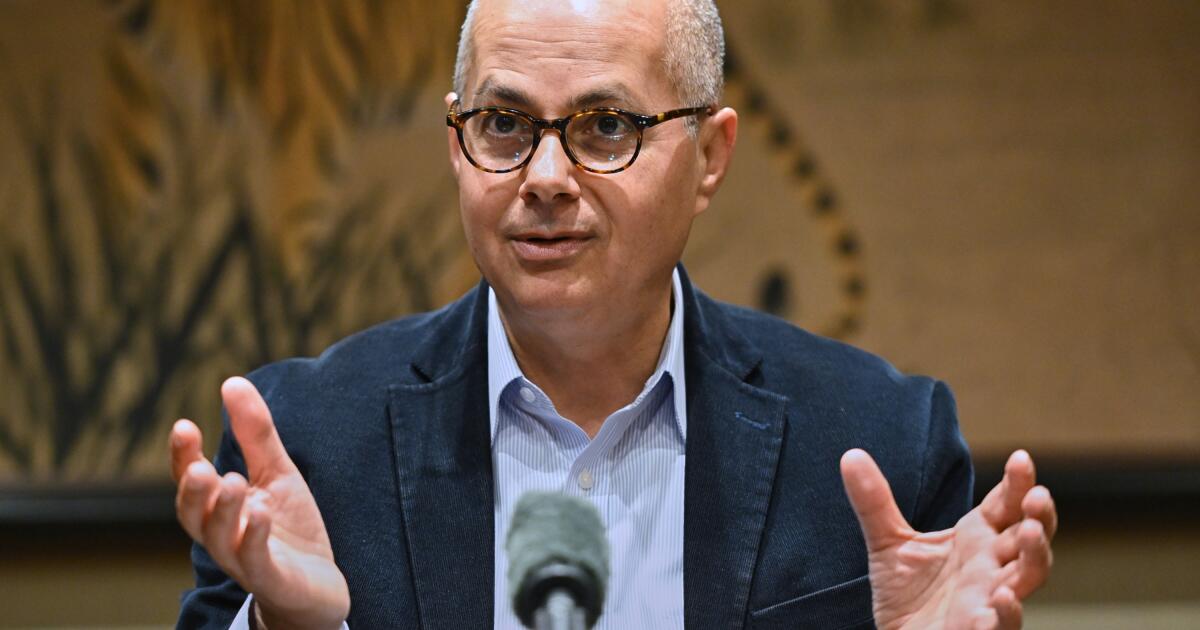
Nobel Prize recipient Omar Yaghi is leaving his role at UC Berkeley to lead the development of a new artificial intelligence institute at Tsinghua University in Beijing, the Chinese university announced.
Yaghi will head the AI Chemistry and Materials Research Institute at Tsinghua, where he was appointed an honorary professor in 2022. Known as AIMATRY (AI × Materials × Chemistry), the new center will focus on material design and synthesis through artificial intelligence, according to a statement from the university.
In 2025, Yaghi shared the Nobel Prize in chemistry with Susumu Kitagawa of Kyoto University and Richard Robson of the University of Melbourne for their development of metal-organic frameworks, a type of super-porous material in which metal ions and carbon-based molecules combine to form crystals with exceptionally large surface areas.
The material has the potential to combat climate change by capturing and storing carbon or other pollutants, and by extracting water from the atmosphere in water-scarce areas. Upon awarding the prize, a member of the Nobel committee likened the technology’s ability to store enormous amounts of stuff in seemingly compact spaces to Hermione Granger’s enchanted handbag in the Harry Potter series.
Yaghi’s Irvine-based company, Atoco, has said it will start taking orders later this year for its technology that harvests water from the air.
A representative for Yaghi said he was not yet available to respond to questions.
China is one of several countries that has been actively recruiting scientists from the U.S., where the Trump administration has slashed science funding, suspended research grants, fired science advisors and tightened immigration restrictions.
“For many, many years, our funding was very competitive; if you worked hard and you were doing good research, you would get funding,” Yaghi said of the U.S. in an interview with Scientific American earlier this year. “The current state is not so encouraging because of the cutting back on grants and support of science by the very agencies that many university researchers rely on.”
Yaghi was born in Jordan to Palestinian refugees, and immigrated to the U.S. when he was 15 to study.
“We’ve learned over and over in human civilization that scholars can move across borders,” Yaghi told the New York Times last year. “This is how knowledge spread and how vast regions of the world lifted themselves out of poverty.”
Science
Trump administration seeks to limit federal funding that doesn’t ‘advance’ presidential policies

A new rule proposed by the White House Office of Management and Budget would fundamentally overhaul the way federal grants are awarded and overseen — a sweeping change that one scientific society said “would all but end the use of scientific merit in the selection of grants and programs across the government.”
Proposed in late May, the rule would give political appointees unprecedented control over federal grants for research, education and infrastructure, and specifies that government funds can only be spent on projects “aligned with administration policies and priorities,” according to a copy of the proposed rule.
The rule would also restrict research topics, limit U.S. scientists’ ability to collaborate with colleagues in other countries and make it easier for the government to suspend or cancel grants at any time.
The changes are intended to improve “transparency, accountability, and oversight for Federal awards” while “ensuring that American tax dollars are not wasted or misused,” according to the White House office.
But critics say that if the rule is implemented, the final sign-off for grants will no longer be in the hands of subject-matter experts within individual agencies, but in those of political appointees.
“This touches all parts of American life,” said Dr. Eric Rafla-Yuan, a psychiatrist who practices at the Veterans Administration and San Diego County’s psychiatric hospital.
“Control of how all of the federal grants and programs are funded will fall under a small group of highly partisan individuals who would have very few limits on how they spend these billions of taxpayer dollars,” said Rafla-Yuan, who also chairs the Committee to Protect Public Mental Health advocacy group. “This touches everyone’s life, even if they don’t realize it.”
OMB published the proposed rule May 29, opening a 45-day comment period that closes July 13.
Opposition to the proposed rule has mobilized multiple sectors of society. Professional groups representing cancer researchers, civil engineers, county governments, medical schools, housing agencies, city and municipal governments, nonprofits and others have publicly expressed concerns about potential consequences.
By midday Thursday, the Federal Register logged nearly 100,000 comments about the proposal, many of them expressing concern.
“I understand the need for oversight, fiscal responsibility, and accountability. That is not the issue,” wrote Jack Feldman, a neuroscientist who holds the David Geffen School of Medicine Chair in Neuroscience at UCLA. “The issue is whether scientific research is to be judged by scientific merit, or whether it can be approved, denied, or terminated according to broad political criteria that may change from one administration to the next.”
Crucially, the rule converts policies governing federal grants from “guidance” into binding regulations that all agencies would be required to follow. It would give political appointees power to override federal agencies’ merit-based reviews and mandate that a political appointee review decisions to ensure that all awards “demonstrably advance the President’s policy priorities.”
The elevation of political appointees in what were previously merit-based decisions has alarmed many scientists.
“The proposed rule changes would all but end the use of scientific merit in the selection of grants and programs across the government,” read a statement from the Planetary Society, a nonprofit dedicated to space research.
Researchers and science groups have also expressed concern about a section of the rule prohibiting the promotion of “theories of disparate-impact liability” — a legal concept that refers to policies that appear neutral but cause disproportionate harm to certain groups.
The section’s vague language and many loopholes could have a chilling effect on any research that studies the effects of a disease, policy or public health intervention on any specific group of people, Rafla-Yuan said.
As an example, he said, “if there’s a specific age range that is at higher risk for suicide, and we want to figure out, well, what’s going on with people that are aged 14 to 19 … we can’t do that under the wording in this rule.”
New restrictions on collaborations with scientists in other countries would hinder opportunities for U.S. researchers and limit innovation, said Joanne Padrón Carney, chief government relations officer for the American Assn. for the Advancement of Science.
“Science is a global enterprise. Especially in biomedical and public health fields, diseases don’t care about borders or government policies,” she said.
California’s congressional delegation sent a letter Wednesday asking OMB to rescind the proposal, outlining concerns about its impact on scientific innovation, U.S. competitiveness and the fiscal stability of local governments, many of which rely on federal grants for local services.
The proposed rule grants the federal government broad powers to suspend or cancel grants for any reason, introducing “unprecedented unpredictability into local governance,” the lawmakers wrote, “leaving vital infrastructure projects unfinished and abandoning vulnerable populations who rely on these services.”
Republican Sen. Susan Collins has also asked the White House to withdraw certain parts of the letter and extend the public comment period, saying the proposed rule as written would “harm small and rural communities, undermine scientific and biomedical research, and conflict with Congress’ control over the federal funding process.”
-

 Missouri6 minutes ago
Missouri pushes for more nuclear energy to power the future
-
Montana9 minutes ago
Montana Lottery Mega Millions, Big Sky Bonus results for July 10, 2026
-

 Nebraska14 minutes ago
Nebraska has two players honored by the Big Ten Conference on Thursday
-

 Nevada21 minutes ago
Planetary parade this weekend — when to see it in Northern Nevada
-

 New Hampshire24 minutes ago
9 Most Hospitable Towns In New Hampshire
-

 New Jersey29 minutes ago
Husband of slain New Jersey mom begs for help in newly released 911 call | Fox News Video
-

 New Mexico35 minutes ago
NM Delegation Demands Answers On Reports Of DEA Declining To Seize Massive Fentanyl Shipments, Calls For Immediate Reforms
-
North Carolina36 minutes ago
Brunswick County wildfire grows to 300 acres


