Midwest
'Devasted farms': Bipartisan Senate letter calls for 'new urgency' to address crippling virus

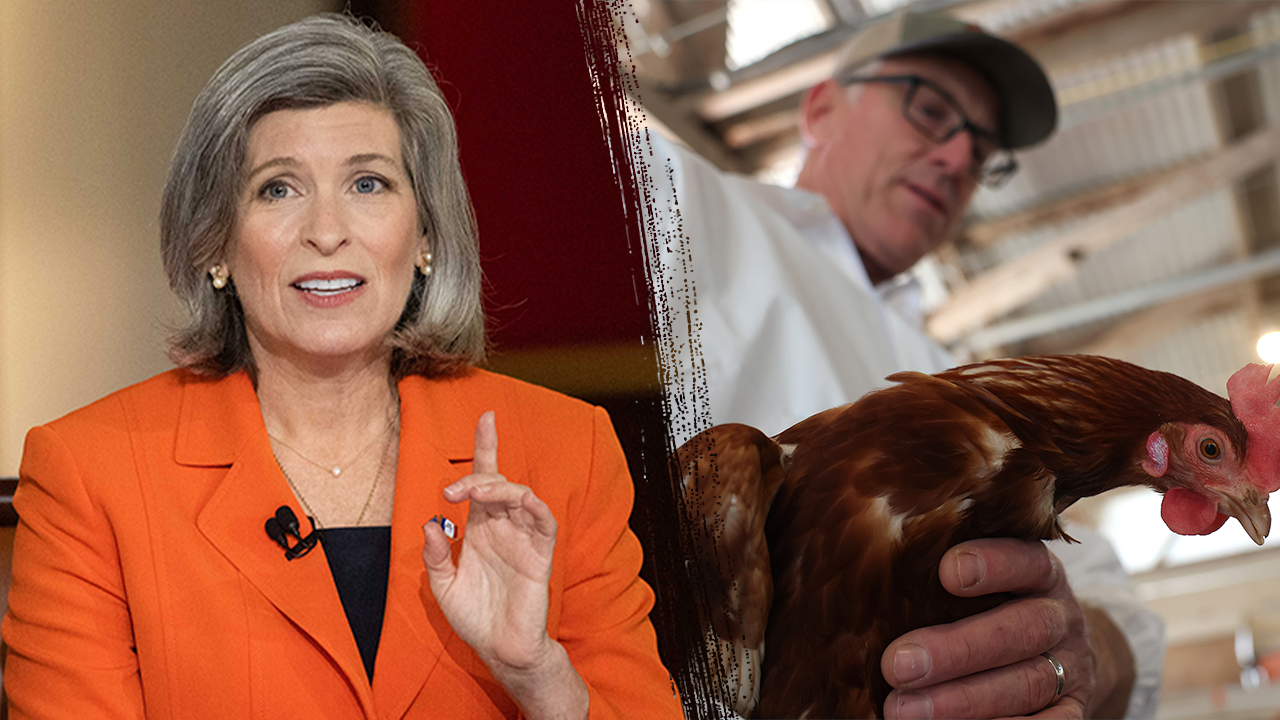
FIRST ON FOX: GOP Sen. Joni Ernst sent a letter to newly confirmed Agriculture Secretary Brooke Rollins calling for cooperation on key measures to address the bird flu epidemic ravaging farms across the country.
“We know many pressing concerns await you as you begin your new role. We write to ask that you enhance the U.S. Department of Agriculture’s (USDA) response to the ongoing outbreak of highly pathogenic avian influenza (HPAI) in our nation’s animal agriculture sector, which we greatly appreciate you announcing as a top priority in your testimony before the Senate Committee on Agriculture, Nutrition, and Forestry,” the letter from Ernst, a member of the Senate Agriculture Committee, states.
“The United States is now entering the fourth year of an outbreak of HPAI that has devastated farms, required the depopulation of more than 136 million birds on commercial poultry operations, and infected a small but growing number of farm workers. A new urgency is required from the USDA to address the evolving situation.”
The letter promotes ways to address the crisis that have been outlined by egg and turkey farmers, including an aggressive vaccination strategy for hens and turkeys, stockpiling vaccines, and outreach to trading partners to ensure that trade is not negatively impacted.
MINNESOTA DECLARES STATE OF EMERGENCY AS DISEASES CRIPPLE MIDWESTERN FARMS
Sen. Joni Ernst is calling on Trump’s USDA to take action on the bird flu crisis. (Getty)
The senators also called on the USDA to shift attention to a Biden order in 2024 that requires biosecurity audits on previously infected farms, or farms placed within a buffer zone of a control area, to be eligible for indemnities.
“In principle, this change would appear to enhance biosecurity measures and accountability for indemnity, but the rule was rushed,” the letter states. “As a result, nearly no auditors have been trained to complete these audits, and the audit itself was posted in draft form. USDA should provide adequate numbers of qualified auditors prior to enforcement of the rule.”
The letter explains that “current indemnity rates for laying hens and pullets are based on inaccurate data and are artificially low” and offers solutions on how to address that, including an egg industry proposal to revise the calculations relying on data from USDA and land grant institutions that would make the indemnities “fairer.”
BIRD FLU FOUND IN ARIZONA DAIRY CATTLE MILK AFTER BEING FIRST DETECTED IN NEIGHBORING NEVADA
“Even with revisions to indemnity formulas proposed by egg farmers, these payments will not come close to making producers whole for their losses. In reviewing indemnity activities, we would also urge you to ensure proper outreach to all farmers,” the letter says.
The bipartisan letter was signed by Democratic Sens. John Fetterman, Amy Klobuchar, Tina Smith, Raphael Warnock, Mark Warner and Jon Ossoff, and Republicans Sens. Bernie Moreno, Jerry Moran, Roger Marshall, Todd Young, Dave McCormick, Ted Budd, Thom Tillis and Chuck Grassley.
“I’m working to protect and preserve the livelihoods of our farmers, the stability of our local economies, and our food supply chain impacted by the spread of HPAI,” Ernst told Fox News Digital in a statement. “By partnering with the Trump administration to identify solutions, we can ensure our producers have the tools they need to stop avian flu.”
American farmers and those in the agricultural business continue to reel over the spread of H5N1 bird flu. (Lokman Vural Elibol/Anadolu via Getty Images)
American farmers and those in the agricultural business continue to reel over the spread of H5N1 bird flu, which apparently shows no sign of slowing to “disaster” status, FOX Business previously reported.
“The real crisis is that we’re going through the worst bird flu outbreak that we’ve had in the last 10 years since 2015, potentially the worst bird flu outbreak that we’ve ever had in the history of this country,” Eggs Unlimited Vice President Brian Moscogiuri said on “Fox & Friends” last week.
“We’ve lost 120 million birds since the beginning of 2022. In the last few months alone, since the middle of October, we’ve lost 45 million egg-laying hens,” he added. “We’ve lost a significant amount of production, more than 13%. So we’re just dealing with supply shortages. And it’s just a disaster right now because this virus is in three of the top egg-laying states in the country. It doesn’t seem like it’s stopping anytime soon.”
On the House side, GOP Congressman Randy Feenstra from Iowa sent an identical letter with 22 colleagues to Secretary Rollins.
“Representing the top egg-producing district in the country, it is a top priority for me to get the bird flu outbreak under control, support our producers as they work to repopulate their flocks, and bring egg prices down for our families,” Feenstra said in a statement. “That’s why I led a letter to Secretary of Agriculture Brooke Rollins asking that the USDA do everything possible to address this crisis, proactively prevent the spread of foreign animal disease, and help our farmers mitigate outbreaks when they occur.”
During her confirmation hearing, Rollins said she is “hyper focused” on finding the team to combat bird flu and other diseases.
“Secretary Rollins received the letter from Sen. Ernst and her colleagues yesterday,” a USDA spokesperson told Fox News Digital.
“She will respond in short order and is looking forward to working with Sen. Ernst and her colleagues to tackle this critical issue. The Biden administration failed to sufficiently address the avian flu, and his inflationary economic policies only made the problem worse. The American people deserve affordable eggs, and Secretary Rollins is fully committed to taking aggressive action to combat the avian flu and help lower the price of eggs. She is working with the White House to implement a comprehensive strategy that will be rolled out very soon.”
Fox News Digital’s Kristen Altus contributed to this report
Read the full article from Here


The Detroit Pistons have put Isaiah Stewart on the trade block with multiple offers swirling around the ever-changing rumor mill.
Several teams would benefit from having Stewart, who averaged 10 points, five rebounds and 1.6 blocks per game last season, on a solid 55% from the floor. However, despite linking up well with Jalen Duren, Stewart earning a total of $30 million over the next two years simply doesn’t fit with their future outlook.
Stewart has been linked to the blockbuster three-team trade involving Giannis Antetokounmpo; however, if we set that aside, who else could use his talents ahead of the upcoming season?
Stewart embracing the north?
A possible swap involving the Toronto Raptors could be on the cards. The Raptors have been desperate for frontcourt depth, and the Pistons could definitely use more playmaking and shooting options on their roster.
For Detroit, trading Stewart for youngsters Gradey Dick and Jamal Shead makes perfect sense, with the Pistons able to mould them into backups for Cade Cunningham and Ausar Thompson.
While Shead provided relief for Immanuel Quickley, Dick fell out of the rotation and will be eager for a second chance in the Motor City.
Bringing a much-needed wing player to Detroit, via Cleveland
The Cleveland Cavaliers could bring a talented wing player to Detroit in the shape of Max Strus, whose presence would really help the Pistons.
What they’re short on is two-way wings who can ease the pressure off their stars, and Strus can fit perfectly into that gaping hole.
Beyond his floor-spacing ability, he can also create offense by attacking closeouts, addressing another area where Detroit has struggled.
Look no further than their playoff meeting, which the Cavs won with Strus averaging around 10 points per game in the series, capped with a 20-point showing off the bench in Game 5 that helped swing momentum in the Cavaliers’ favor.
Stewart’s salary and defense helps Denver
One issue that plagued the Denver Nuggets this season was their rim protection, and defense in the paint.
With Stewart, who posted just under two blocks per game last season, his defensive style would really help the Nuggets, but he would be in a similar position to the one he is currently in Detroit: A backup to Nikola Jokic.
Why does this move make sense for both parties? Well, look no further than the money involved. If Denver shipped Cameron Johnson and Christian Braun, who are both on the trade block, it would save the Nuggets money and give Detroit two strong players with championship pedigree.
Stewart is under contract for $15 million in 2026-27, with a team option for the same amount in 2027-28, bringing his total value to $30 million. Johnson’s set to make $23 million, and Braun’s is on $21.5 million. This works better for Denver than it would for the Pistons, but having Johnson and Braun only boosts Detroit’s championship credentials.
Follow

MILWAUKEE – One person was killed in a two-vehicle crash in Milwaukee in the early morning hours of Sunday, June 21.
The driver of the other vehicle was arrested at the scene.
Crash and arrest
What we know:
According to the Milwaukee Police Department, the crash happened at about 1:15 a.m. near 11th and Greenfield.
A vehicle crossed the roadway then struck another vehicle, killing the driver. The victim, a 47-year-old, was being treated for life-threatening injuries but died from those injuries at the scene.
FREE DOWNLOAD: Get breaking news alerts in the FOX LOCAL Mobile app for iOS or Android
It is suspected that the driver of the striking vehicle was impaired. The 24-year-old suspect was arrested on scene in connection with the accident, and charges will be referred to the Milwaukee County District Attorney’s Office for review.
The Source: The Milwaukee Police Department sent FOX6 the information.

MINNEAPOLIS (WJON News) — A popular Broadway show will be hitting a Minnesota stage this fall. Mamma Mia! will jump-start the Broadway on Hennepin series at the Orpheum Theatre in Minneapolis from September 15th to the 20th.
Mamma Mia! has been seen in 50 productions in 16 different languages.
The 25th Anniversary production of Mamma Mia! made its return to Broadway last year for a limited run at the Winter Garden Theatre, where it got its start. The show also had a record-setting 14-year run on Broadway and toured from 2000 to 2017 with four different touring companies.
Mamma Mia! has grossed over $7 billion at the box office.
It inspired the blockbuster smash starring Meryl Streep, Pierce Brosnan, and Amanda Seyfried as well. The 2018 follow-up, Mamma Mia! Here We Go Again is the most successful live musical movie sequel of all time.
Mamma Mia! is written by Catherine Johnson and directed by Phyllida Lloyd with choreography by Anthony Van Laast. Tickets for the show go on sale at 10:00 a.m. on Friday.
QUIZ: Can You Identify These Awesome ’80s Movies From Just a Single Freeze-Frame?
From a stranded alien trying to phone home to a group of kids on a treasure hunt, see how many of these iconic ’80s blockbusters you can recognize from a single freeze frame.
Gallery Credit: Stephen Lenz
Glaring Continuity Errors From Popular TV Series
Gallery Credit: Stacker
LOOK: Iconic TV Shows With Only One Cast Member Surviving
From Diff’rent Strokes to Gilligan’s Island, several of the most iconic TV shows in history now have only one surviving main cast member.
Gallery Credit: Stephen Lenz
-

 Lifestyle50 seconds ago
Sunday Puzzle: B to the B to the B
-

 Technology9 minutes ago
Bose thinks it can be a media company for some reason
-

 World16 minutes ago
Meloni’s spat with Trump is calculated strategy to boost her approval ratings: expert
-

 Politics19 minutes ago
Trump’s Iran gamble divides GOP hawks and ‘America First’ conservatives over what victory looks like
-

 Health24 minutes ago
This one question may reveal whether your body is getting the rest it needs, study finds
-

 Sports31 minutes ago
Teenage golfer Miles Russell delivers his dad an all-time Father’s Day experience during US Open final round
-

 Technology34 minutes ago
Fake AAA email scam targets drivers
-
 Business39 minutes ago
This startup wants to bring driverless freight trucks to California’s roads, but drivers are pushing back

