Midwest
80% of Americans oppose gender craziness but the left still cling to it

NEWYou can now listen to Fox News articles!
What will it take for the left, and their representatives in blue state governments, to stop the gender insanity and admit defeat?
Despite President Donald Trump’s election and the promised return to normalcy on gender issues, some states are refusing to adapt to the obvious “vibe shift” that has happened across the country.
Wisconsin Democrat Gov. Tony Evers supports a budget proposal that would get rid of gendered terms in state laws. Father would be “natural parent.” “Mother” would be replaced by the atrocious “inseminated person.” Evers argues that changing the words for “mother” to something disgusting like “inseminated person” is just a way to have “legal certainty that moms will be able to get the care they need.”
MAINE HIGH SCHOOL SPORTS DEALS WITH NEW TRANS-ATHLETE CONTROVERSY AS STATE’S POLICY COMES UNDER FIRE
The Biden administration had previously changed the word for mother to “birthing person” and introduced it in their 2022 fiscal year budget. The added insult is that they featured it in a section about maternal mortality.
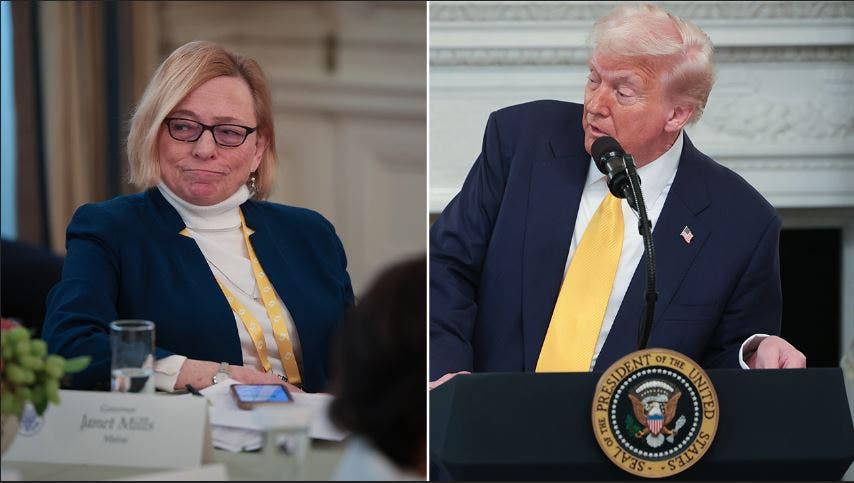
Maine Gov. Janet Mills and President Donald Trump disagreed at the White House on Friday, February 21, 2025, while debating about boys competing in girls’ sports. (Getty Images)
Everyone knows this is a political statement, not a medical or even a legal one. No doctor will encounter a pregnant woman and not understand how to give her care even if she chooses male pronouns for herself. Biology remains constant, no matter what the left pushes.
Meanwhile, Maine Democrat Gov. Janet Mills is ignoring a Trump Executive Order that prohibits boys from playing in girls’ sports. It’s not up for debate. Attorney General Pam Bondi sent a letter to Gov. Mills pointedly noting, “Where federal and state law conflict, states and state entities must follow federal law — not because we live in a dictatorship, but because the Constitution requires states to follow the supreme law of the land.” Bondi also sent letters to officials in California and Minnesota.
But even setting aside the actual law, allowing biological boys to participate in girls’ sports is a lopsided issue in American discourse, with a great majority, as much as 80% in some polls, saying that boys should not be allowed into girls’ sports. Governors still pushing the idea of biological boys competing against biological girls are representing a shrinking sliver of the American population. The rest of us know it’s wrong.
CLICK HERE FOR MORE FOX NEWS OPINION
The Maine House has also taken the extraordinary step of censuring Maine state Rep. Laurel Libby, who posted a picture of a biologically male athlete who won the state championship in women’s pole-vaulting. Libby is not allowed to speak on the House floor nor vote over the social media post. This kind of bullying has been standard to literally shut down any conversation on the topic so they don’t inflame that 80%.
Charlamagne tha God, the leftist talk show host of “The Breakfast Club,” wondered, “Why are folks still talking about trans athletes? Like that is a losing talking point. America’s not with it, and they keep making a micro a macro with that conversation. It impacts such a small, small group of people, but it makes a whole lot of people think folks lack common sense. So why are they even having that conversation?”
It’s because the activists won’t give up. They don’t care that the great majority of Americans don’t support their extremist views. They’ve gotten used to getting what they want through tantrums and name-calling over the last four years, and they think they can force their way into a win now.
However, the election has made it more likely that people will tell them, “No.” People are tired of being bullied into accepting increasingly unhinged terminology and behavior. They’re tired of having to accept lies and the erasure of women.
What the activists are going to find is that the Trump administration is ready to fight them, and that fight will be on behalf of most Americans. Blue state governors need to decide if calling women an “inseminated person” is worth it.
CLICK HERE TO READ MORE FROM KAROL MARKOWICZ
Read the full article from Here

Illinois
Lake County detectives rescue girl from man they say drove to Illinois from Georgia to meet her

Detectives from Lake County, Illinois, Sheriff’s office rescued a girl under 14 from a grown man who had traveled from Georgia to meet her this weekend, authorities said Sunday.
At 4:40 a.m. Saturday, Lake County sheriff’s deputies were called to unincorporated Gurnee for a report of a missing girl under the age of 14. Deputies learned the girl had never run away before, and it was especially concerning that she did so in the middle of the night, authorities said.
Sheriff’s detectives learned the girl’s cellphone was not functioning, and she could not be found through any of her electronic devices. Detectives also found that a 24-year-old man from Norcross, Georgia, named Jordy Alexis Fuerte Perez had been communicating with her, authorities said.
Detectives learned that Fuerte Perez had made plans to drive to Illinois from Georgia and pick up the girl, and evidence indicates he told the girl he wanted a “romantic relationship” with her, authorities said.
Detectives homed in on a vehicle that Fuerte Perez may have been driving, and found the vehicle at the Independence Grove Forest Preserve near Libertyville, authorities said. Both Fuerte Perez and the girl were in the car in a parking lot when detectives arrived at 6 p.m. Saturday, authorities said.
The girl did not appear to be injured, but was taken to the Lake County Children’s Advocacy Center for specialized advocacy and attention, authorities said.
Fuerte Perez was charged with two counts of solicitation of child pornography, and one count of unlawful possession of a controlled substance, namely cocaine. More charges ar likely, authorities said.
“This type of case is a parent’s worst nightmare. Our Criminal Investigations Division took this case seriously and worked tirelessly from the moment the girl was reported missing until she was safely located,” Lake County Sherif John Idleburg said in a news release. “While there will undoubtedly be a long road to recovery and healing, I am grateful the victim was found safe and is physically okay. I am proud of everyone who played a role in rescuing this young girl and bringing the offender to the first steps of justice.”
Fuerte Perez was due in court on Sunday morning. The Lake County State’s Attorney’s office is asking to have him held while awaiting trial.

U.S. Education Secretary Linda McMahon, left, joins Indiana Gov. Mike Braun and state Education Secretary Katie Jenner for a ceremonial signing of the state’s waiver from provisions of the Elementary and Secondary Education Act on Tuesday, June 16, 2026, at Plainfield High School. Photo by Mackenzi Klemann, Indiana Capital Chronicle.
By Mackenzi Klemann
Indiana Capital Chronicle
PLAINFIELD — Indiana K-12 educators will soon have less paperwork following the U.S. Department of Education’s approval of a waiver exempting the state from provisions of the federal Elementary and Secondary Education Act.
The state applied for the waiver in December to streamline education spending and align its new A-F accountability measures with federal law.
The waiver consolidates federal funding from portions of Titles I, II, III and IV – grants used to support things like low-income students, teacher training, English language learners and school safety – totaling $50 million over the next four years.
U.S. Education Secretary Linda McMahon, who visited Plainfield High School Tuesday for a ceremonial signing of the waiver, said the change frees $20 million in state and local funds from “bureaucratic red tape” so schools can reallocate money to the classroom.
The waiver also OKs the use of college and career readiness metrics like work-based learning and credentials toward high school accountability scores, a crucial component of Indiana’s new A-F system.
“President Trump told me I’d be successful in my job when I fired myself or worked myself out of a job,” McMahon said, “but his vision isn’t about me or one position. It’s about breaking up the education bureaucracy in Washington, D.C., a system that too often enriches adults while stifling progress for kids and empowering states to drive a new era of excellence for students across the country.”
She added, “We must breathe innovation into education, not suffocate it with top-down mandates, because we certainly know that one size does not fit all in education.”
Indiana is the third state approved for the waiver, nicknamed “Return Education to the States,” following Iowa and Louisiana.
States already control educational standards, curriculum and assessments. The waivers grant states greater control over how to spend federal K-12 funding too.
Indiana’s waiver consolidates funding for various education programs, which McMahon likened to a block grant, so schools no longer need to meet separate reporting requirements for each grant.
“At the heart of all this there is a simple, urgent belief: We must focus our time and energy on the work that propels us forward,” Indiana Secretary of Education Katie Jenner said. “We work to serve students, not to serve bureaucratic, outdated processes and paperwork.”
Less Paperwork, More Classroom Time

Indiana Education Secretary Katie Jenner leads a discussion about the state’s new federal education waiver. Photo by Mackenzi Klemann, Indiana Capital Chronicle.
Educators in attendance Tuesday praised what they see as a move away from bureaucracy.
“Too often these programs had differing goals and really specific requirements that might have been at odds with one another,” said Betsy Wiley, president and CEO of the Institute for Quality Education.
“There’s just no proof that, that extra bureaucracy is leading to higher standard achievements,” said Keeanna Warren, chief executive officer of Purdue Polytechnic High School.
Plainfield Community Schools Superintendent Andy Allen said he anticipates significant savings as the district will be able to redeploy office staff, many of whom are trained educators, to the classroom due to the reduction in compliance paperwork.
“Just because we have less compliance (paperwork) doesn’t mean we just do less,” he said. “Now we get back out in the buildings, we get back in front of kids, we get back in front of teachers, get connected with our community to make sure we have our best voices leading work for our kids and our community.”
The waiver could also benefit outside programs like the Boys and Girls Club’s summer learning labs.
Duane Wilson, chief executive officer of the Boys and Girls Club for the northern Indiana corridor, said the organization serves 5,800 Hoosier students throughout the state, but with additional funding the club could reach 10,000 Hoosier children next year.
The club is “moving the needle for kids,” Jenner said, but its rapid growth exceeded what the state could provide. “We’re seeing it in the short-term assessments. We’re seeing it in our state assessments.”
Iowa
Emmy-winning TV anchor gets choked up as he quits job and journalism — and slams his station live on air

An Iowa TV anchor choked up on air as he quit his job, and announced he was leaving journalism – before blasting his station for spewing “saturated” news that makes local viewers “uncomfortable.”
Dustin Nolan, morning anchor for NBC-affiliate KWQC-TV 6 in Davenport, delivered the dramatic on-air resignation Friday, repeatedly pausing while fighting back tears before issuing a stinging rebuke of the news station.
“I have chosen to step away from the news industry,” said Nolan, who has worked at KWQC since 2022.
“Before I say goodbye, I just want to say, I hope every one of you that’s allowed me to be a part of your mornings just how important that I have taken this job, how much it means to me that you’ve trusted me these past few years to bring you the news in the morning.”
The distraught broadcaster stressed that he has “given everything” to serving up transparent, fact-driven news coverage to the Quad Cities, calling it a “public service.”
Nolan said all he has ever wanted was to report on the “issues that really matter.”
“I’ve always believed that we as a local news station owe you, the viewers, the best that we can do, because without you, none of us would be able to do this job,” Nolan added.
“I also believe that we, as a local news station, have to be more than trends or sanitized news, because it makes people feel uncomfortable,” he continued.
“That’s why the facts matter, and that’s why we do what we do here. We have to take people out of their bubbles and comfort zones and make them think about the world we all live in.”
The tearful anchor went on to praise his co-anchor — his wife Jenna — as the “greatest co-anchor in life.”
Nolan has worked at the Gray Media-owned station since November 2022, according to his LinkedIn.
After graduating from Catholic St. Ambrose University in Iowa, he began his career reporting sports in Wyoming for seven months before moving to Illinois, where he worked as a sports reporter at WQAD for nearly two years.
He later rose to a morning news anchor role at WFBF in Illinois, where he spent three years before joining KWQC.
-

 Illinois6 minutes ago
Lake County detectives rescue girl from man they say drove to Illinois from Georgia to meet her
-

 Indiana13 minutes ago
US Education Department Oks Indiana Waiver To ‘Streamline’ Education Spending
-

 Iowa16 minutes ago
Emmy-winning TV anchor gets choked up as he quits job and journalism — and slams his station live on air
-
 Kansas21 minutes ago
Kansas City Symphony and Michelle Cann Perform Uplifting Concert Featuring a Variety of American Styles and Voices. – KC STUDIO
-

 Kentucky28 minutes ago
Top Kentucky Football transfer Lance Heard had minor spring procedure
-

 Louisiana31 minutes ago
Louisiana ranks next to last for working dads, according to WalletHub report
-

 Maine36 minutes ago
4-year-old girl flown to hospital after near drowning at hotel pool in Maine
-
Maryland43 minutes ago
Piper PA-28 crashes in Maryland, killing all three Israeli occupants | The Jerusalem Post


