Midwest
7 intriguing new foods at the 2024 Minnesota State Fair, including 'Grilled Purple Sticky Rice'

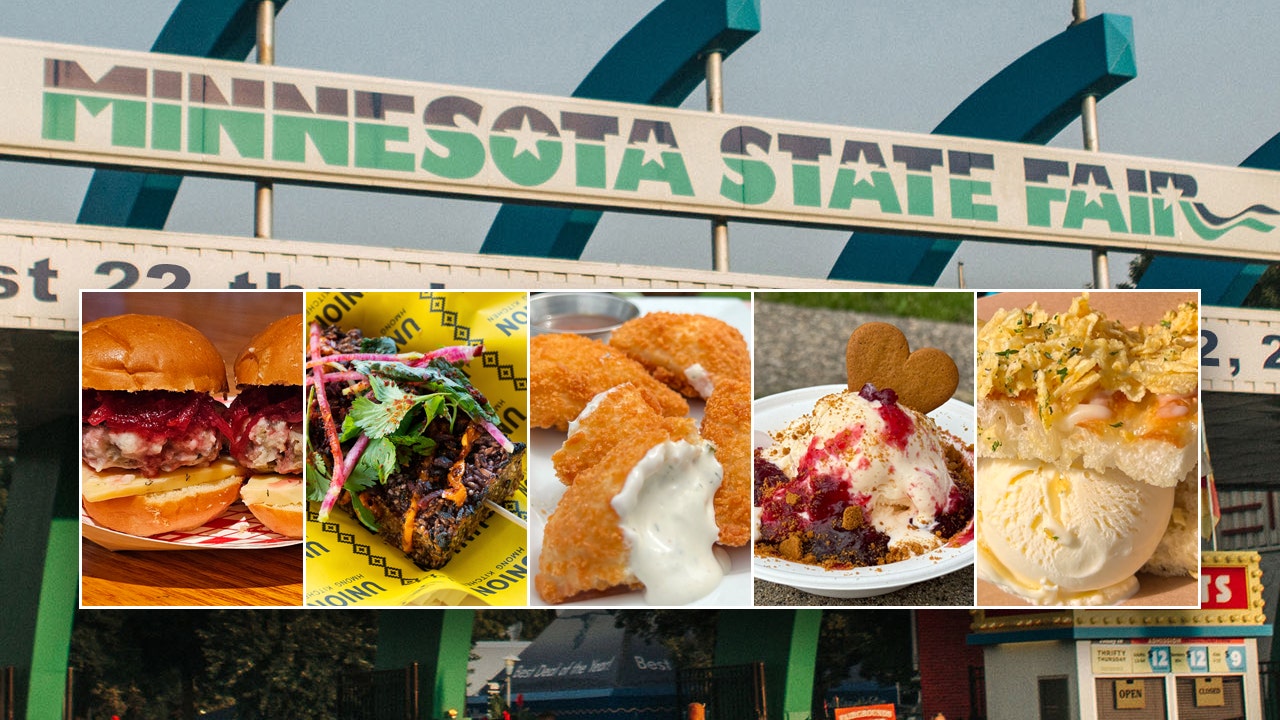
The Minnesota State Fair is known for its unique food offerings and the 2024 fair looks to be no exception.
Earlier this week, the Minnesota State Fair announced the 33 new food items that will be available this year when the fair opens on Aug. 22 (it runs until Labor Day, Sept. 2).
“We are so excited to announce our new foods for 2024. We work hard to present a diverse array of new foods each year and are excited to introduce several new vendors,” Maria Hayden, a spokesperson for the Minnesota State Fair, told Fox News Digital in an interview.
VIRAL ‘CRACKING LATTE’ LEAVES TIKTOK USERS DISAPPOINTED WHILE OTHERS ENJOY THE FUN
Some of the chefs who designed dishes for the fair are James Beard Award winners and semifinalists, she said.
“In addition, there are a lot of fun new foods that we think people will be talking about, such as Deep-Fried Ranch Dressing, Dill Pickle Tots, Chile Mango Whip and, to wash it all down, Cotton Candy Iced Tea,” she said.
The Minnesota State Fair announced that 33 new foods will be coming to the fair this year, including Grilled Purple Stick Rice and Deep-Fried Ranch Dressing. (Minnesota State Fair)
Minnesota State Fair foods to know about
Here are 7 items that are available this year.
1. Deep-Fried Ranch Dressing
Described by the Minnesota State Fair as “ranch dressing filling made with ranch seasoning, buttermilk and cream cheese in a panko shell, deep-fried and dusted with ranch powder,” this vegetarian treat comes with “a side of hot honey sauce crafted with Cry Baby Craig’s hot sauce.”
Deep-Fried Ranch Dressing is served with a side of hot honey sauce. (Minnesota State Fair)
It will be available at LuLu’s Public House.
“People in Minnesota love their ranch dressing,” Charlie Burrows, co-owner of Lulu’s, told Fox News Digital in an email, noting that “diners will ask for a side of ranch with almost everything.”
A deep-fried ranch offering has been in the works for more than a year-and-a-half, Burrows said.
CHICKEN THIGHS VS. CHICKEN BREASTS: WHICH ARE ‘BETTER’ FOR YOU? FOOD EXPERTS WEIGH IN
“We began by brainstorming popular flavors and figuring out ways we could deep-fry it,” he said.
Despite the unusual nature of the dish, Burrows said he thinks people will love it.
“I’m really excited about Deep-Fried Ranch. We think it’s a great product. We wouldn’t have done it if we didn’t think it tasted great,” he said.
2. Walking Shepherd’s Pie
A unique take on the hearty sit-down pub staple, this dish takes what’s normally a messy meal and compacts it into a handheld pastry.
The dish is “two handmade hot pastries filled with braised ground beef, mashed potatoes and a blend of onions, carrots and peas tossed in herb gravy,” according to the Minnesota State Fair.
The Walking Shepherd’s Pie features a handmade pastry shell. (Minnesota State Fair)
The Walking Shepherd’s Pie will be sold at O’Gara’s at the Fair.
3. Savory Éclairs in Two Varieties
For another twist on traditional pastry, there is no chocolate or pastry cream to be found on the savory éclairs offered at the Minnesota State Fair this year.
Instead, the choux pastry éclair shell will be available as lobster or bánh mì.
BEST AND WORST FOODS FOR PEOPLE WITH DIABETES TO MAINTAIN GOOD HEALTH
The Lobster Éclair is inspired by a New England-style lobster roll, according to the Minnesota State Fair.
The pastry will be stuffed with “lobster meat, celery, mayo, Cholula hot sauce, limes, chives and salt & pepper” and will be garnished with dried corn and micro cilantro, its description said.
The Savory Éclairs in Two Varieties offering takes the traditional fillings of a New England-style lobster roll and a bánh mì sandwich and serves them in a choux pastry shell. (Minnesota State Fair)
Conversely, the bánh mì éclair will contain “pork confit, chicken liver pâté, pickled carrot & daikon, cucumber and sriracha mayo” and will be garnished with micro cilantro.
The bánh mì is a sandwich that originated in Vietnam. It is traditionally served on a baguette.
HAMBURGER VS. HOT DOG: WHICH IS HEALTHIER FOR YOU? EXPERTS CHIME IN
The éclairs will be sold at Scenic 61 by New Scenic Café, according to the Minnesota State Fair.
4. Grilled Purple Sticky Rice
Move over, corn dogs. A new food on a stick is coming to the Minnesota State Fair this year.
The Grilled Purple Sticky Rice fish consists of purple sticky rice that is put on a stick and grilled on an open flame until crunchy, the Minnesota State Fair said.
The rice is then topped with either shredded Hmong beef jerky or a vegetarian option of pickled mushrooms.
Foods on a stick are an integral part of fair cuisine. This year, visitors to the Minnesota State Fair can try Grilled Purple Sticky Rice. (Minnesota State Fair)
The dish is then garnished with herbs and a chili aioli, according to the fair.
This unique offering will be sold at the Union Hmong Kitchen. It is a creation of James Beard Award semifinalist Yia Vang, who was inspired by his mom’s cooking, he told Fox News Digital in an email.
“Growing up, we would eat toasted/grilled sticky rice. It was an incredibly easy snack my mom would make for us,” Vang said.
The snack will be “crunchy, toasty and full of deep rich flavor,” he said, and is meant to be eaten “almost like” one would eat an ice pop.
STATE FAIR OF TEXAS IS CROWD-PACKED SCENE OF FLETCHER FAMILY’S DEEP-FRIED CORNY DOGS: ‘TASTES LIKE HOME’
“Instead, it’s a delicious crunchy grilled sticky rice with mom’s hot sauce and dad’s Hmong beef jerky,” he said.
About 90,000 people in Minnesota are of Hmong descent, an ethnic group originally from Southeast Asia, according to the St. Paul Hmong Cultural Center. The Twin Cities have the largest urban Hmong population in the world, the Twin Cities Pioneer Press reported.
5. Swedish ‘Sota Sliders
With a little more than 7% of the state reporting its Swedish ancestry, Minnesota has the highest number of Swedish Americans as well as the highest percentage of Swedish Americans for any U.S. state, according to the Census Bureau.
The Swedish ‘Sota Sliders, available at Hamline Church Dining Hall, combine the American burger slider with nods to Swedish foods.
The Swedish ‘Sota Sliders are inspired by some of Sweden’s traditional food items. (Minnesota State Fair)
The patty is a cranberry-wild rice meatball and is served with dill Havarti cheese and a relish of beets, red onions, red peppers, lingonberries and cranberries, according to the Minnesota State Fair.
Lingonberries are native to Sweden and are often served with Swedish meatballs, Food.com said.
6. Swedish Ice Cream Sundae
For dessert, the Salem Lutheran Church Dining Hall is debuting the Swedish Ice Cream Sundae this year.
The sundae features “vanilla ice cream covered in lingonberry jam, sprinkled with Swedish ginger cookie crumble and garnished with a ginger cookie heart.”
The Swedish Ice Cream Sundae contains lingonberries and ginger cookies. (Minnesota State Fair)
7. Patata Frita Focacciawich
Another interesting dessert item with a mouthful of a name to match, the Patata Frita Focacciawich combines savory flavors with sweet treats.
The name refers to the Spanish word for potato chips.
It features a special “‘Patata Frita’ kettle chip-flavored ice cream” that was created by the Minnesota Dairy Lab, according to the Minnesota State Fair.
This treat melds potato chips, ice cream and focaccia all in one dish. (Minnesota State Fair)
The potato chip-flavored ice cream is then sandwiched by focaccia bread and topped with honey butter, more kettle chips and herbs, the description said.
For more Lifestyle articles, visit www.foxnews.com/lifestyle
This unusual ice cream sandwich will be sold at the West End Creamery.
Other new items this year
These food items will also be offered, according to the fair, among others.
- 3 Piggy Pals on a Stick
- Ba’bacon Sour Cream + Onion
- Blazing Greek Bites
- Buffalo Cheese Curd & Chicken Tacos
- Chile Mango Whip
- Cookie Butter Crunch Mini Donuts
- Cotton Candy Iced Tea
- Crab Boil Wings
- Deep-Fried Halloumi Cheese
- Fried Bee-Nana Pie
- Ham and Pickle Roll Up on a Potato Skin
- Lady’s Slipper Marble Sundae
- Marco’s Garden
- Mocha Madness Shave Ice
- Nixtamal & Wild Rice Bowl with Wóžapi & Bison Meatballs or Sweet Potato Dumplings
- PB Bacon Cakes
- Raging Ball
- Shroomy “Calamari”
- Strawberries and Cream Waffle Stick
- Strawberry Lemonade Donut
- Sweet Corn Cola Float
- Sweet Heat Bacon Crunch
- Turkey Kristo
- Wrangler Waffle Burger
Read the full article from Here


Law: Lion. I had the Lion’s head on my back before I got here.
Law: Cornbread casserole, if it’s a meal, or a banana pudding.
What would your entrance music be?
Do you have any hidden talents?
Law: No, I need help on that. It’s hidden. I haven’t found it yet.
How would you describe your job to a five-year-old?
If you weren’t playing football, what would you be doing?
Law: I’d definitely be a blue-collar worker. I am a licensed welder.
If you could have any superpower, what would it be?
If you could play a different NFL position, what would it be?
Law: Safety. I am an athlete, so even at Bama and Kentucky, I literally played everywhere. I’ve played everywhere on the field besides O-line and D-line.
What is your proudest accomplishment?
What is your favorite thing about Detroit so far?
Law: The people in Detroit are nice.


We cover Wisconsin schools, help support the Journal Sentinel’s work
Milwaukee Journal Sentinel reporters cover education, schools, and issues that matter to parents, students and taxpayers. Help us sustain our coverage.
Maximus Bryant is a self-described gearhead, but he never knew what he wanted to do with his knack for cars and handiwork.
In the back of his mind, though, was his teacher’s voice nudging him to consider college. Ross Romenesko, a former Milwaukee Public Schools teacher, recognized Bryant’s interests and pushed him toward engineering.
Bryant graduated from the Milwaukee School of Engineering in 2025 and works for Harley-Davidson. Without Romenesko, he said he probably wouldn’t have even studied electrical engineering.
Hundreds of other Milwaukee students have also seen their life trajectories shift thanks to encouragement from Romenesko and Future Urban Leaders, the nonprofit organization he co-founded in 2015. Bryant was in the first class of 13 students.
The nonprofit’s tight-knit support system and STEM-based activities helped Bryant learn his interests and find the right pathway for him after high school.
“[Future Urban Leaders] is not just an organization, [it’s] a family,” Bryant said. “[Future Urban Leaders] is about improving you as an individual first.”
The nonprofit celebrated its 10-year anniversary in 2025, and staff has been reflecting on ways to expand and continue serving Milwaukee’s youth.
Future Urban Leaders serves K4 through high school students in Milwaukee
Founded by Romenesko and local business executive Brandon Vonck, the nonprofit serves young people in Milwaukee from ages 4 to 18.
Grade K4-8 students at Milwaukee College Prep Lloyd Street Campus can participate in the nonprofit’s programming. They focus on personal, emotional and creative skills.
“[We] start that early because you’re tapping into a young mind that’s very impressionable, very moldable,” said Darnell Hamilton, the nonprofit’s executive director.
High school programming is open to students citywide. They learn leadership skills and explore post-secondary and career opportunities.
“They gave us the resources to be able to expand ourselves,” said Trinitee Turner, a Future Urban Leaders alumna and incoming sophomore at the University of Wisconsin-Madison.
The ultimate goal is to mold students as people and provide tools and opportunities for students to ultimately find a path in college, trades or otherwise.
“It’s our job … that before you walk across the stage that we’ve done our part in this village mindset … to be a part of you figuring out what the next destination of your pathway is,” Hamilton said.
The program requires students to apply, though every eligible student has been accepted to date. The nonprofit serves about 150 students annually.
It’s been more than 10 years. Is the program successful?
To understand the past decade of program effectiveness, staff surveyed parents and students.
About 85% of parents said the nonprofit supported their children’s leadership skills, 90% of parents were satisfied with program quality and 90% of parents were pleased with staff engagement in the development of their children.
The nonprofit also monitors student retention, academic success, high school graduation and post-secondary plans. Staff keep in touch with students even after they graduate.
During the school year, staff meet regularly with students to hear how they are doing in school, take them on college and workplace visits, prepare for events and interviews, play golf and more.
What will the future of the program look like?
Hamilton hopes to help larger classes of students in the future if staffing can also increase.
The nonprofit currently has three part-time and three full-time employees on staff.
Hamilton also hopes to improve marketing and make more people aware of the organization.
Future Urban Leaders forms lifelong connections
Students can be in the program for up to 14 years but some alumni choose to stay connected even beyond that.
Bryant said staff are still invested in his day-to-day life, including some he now calls his friends. He helped Romenesko set up a play set for his daughters in his backyard in June.
Turner feels the same way. Her younger sister is now enrolled in the program. When Turner picks her up, she can’t help but stay and chat with staff that helped her during her own time in the program.

New analysis shows how misconduct allegations have been handled in the Minneapolis Police Department a week after an ACLU report found that concerns over policing tactics have continued. FOX 9’s Soyoung Kim has the latest.
-

 News21 minutes ago
Top Senate Democrats push Trump-affiliated companies for answers about IRS settlement
-

 Los Angeles, Ca2 hours ago
Missing 13-year-old with autism last seen at Los Angeles beach
-

 Videos2 hours ago
Charlie Kirk’s alleged killer appears in court
-
Detroit, MI2 hours ago
GET TO KNOW: Wide receiver Kendrick Law
-

 San Francisco, CA2 hours ago
Multiple people lose eyes, hands in illegal fireworks-related injuries in San Francisco
-
 Dallas, TX2 hours ago
Texas took this Dallas couple’s newborn baby for 3 weeks. A judge says their rights were violated
-

 Miami, FL2 hours ago
South Florida foundation empowering thousands of young girls through education, mentorship, community support
-

 Boston, MA3 hours ago
Where to watch Boston Red Sox vs Chicago White Sox: TV channel, start time, streaming for July 7


