Lifestyle
This painting is missing. Do you have it?

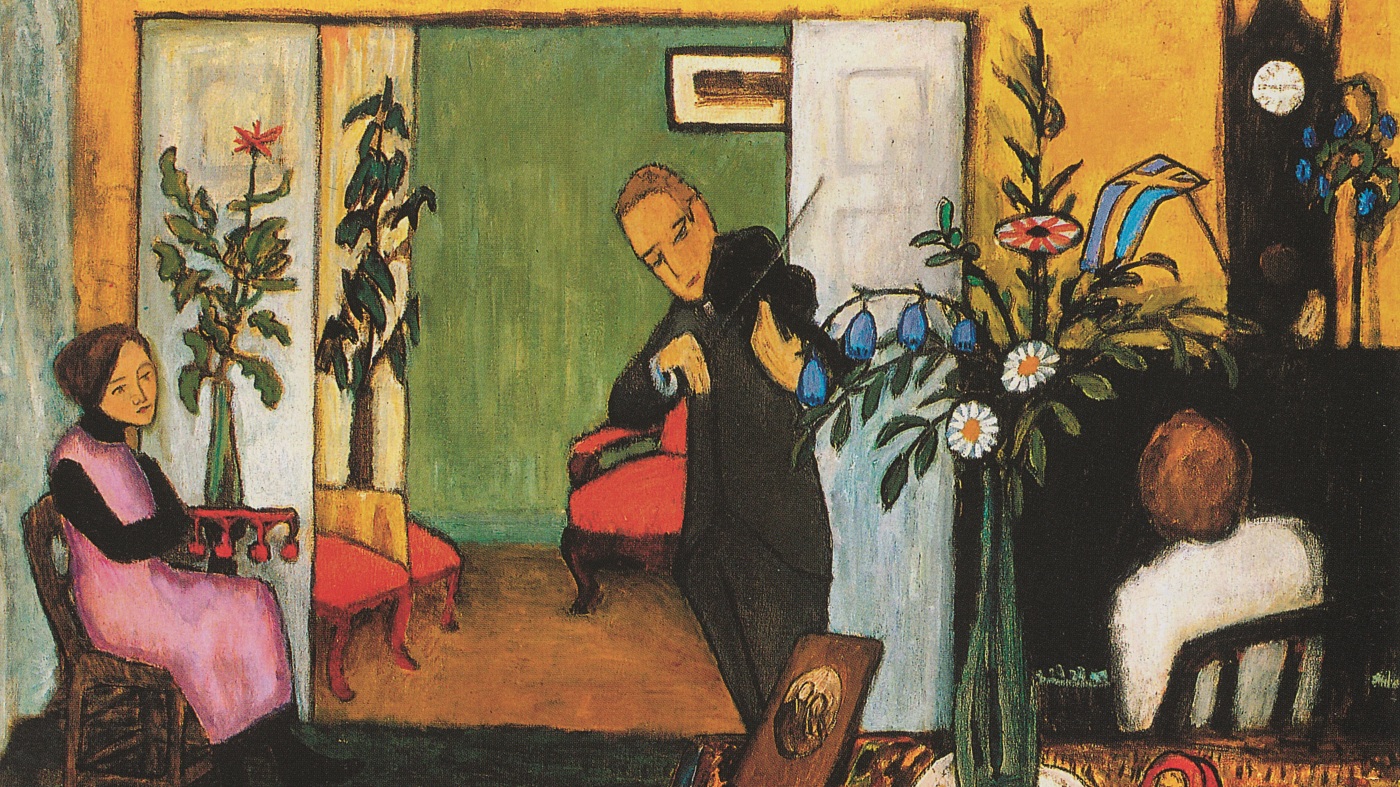
The missing 1916 painting Music, by Gabriele Münter. Its whereabouts have been unknown to the public since 1977. Oil on canvas. (Private collection. © 2025 Artists Rights Society (ARS), New York/VG Bild-Kunst, Bonn)
The Guggenheim, New York
hide caption
toggle caption
The Guggenheim, New York
This is a story about a missing painting, from an artist you may never have heard of. Though she helped shape European modern art, German artist Gabriele Münter’s work was quickly overshadowed in the public’s mind by her 12-year relationship with noted abstract artist Wassily Kandinsky.
She met Kandinsky in Munich in 1902, and with his tutoring, she “mastered color as well as the line,” she told a German public broadcaster in 1957. Together with other artists, they founded an avant-garde arts collective called Der Blaue Reiter (The Blue Rider) in 1911.
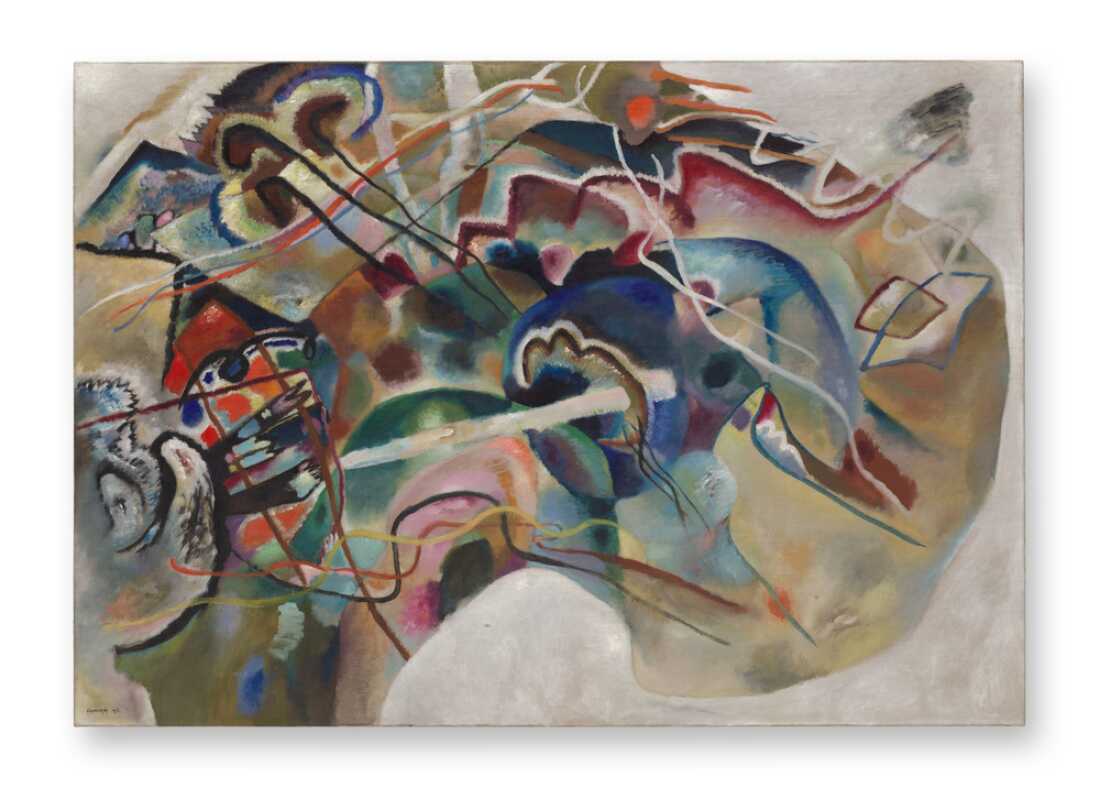
Wassily Kandinsky’s Painting With White Border (Bild mit weißem Rand), 1913. Oil on canvas, Guggenheim Museum, New York City.
Allison Chipak/The Guggenheim, New York
hide caption
toggle caption
Allison Chipak/The Guggenheim, New York
At the time, most modern artists, like Kandinsky, were moving toward more and more abstract work. Not Münter. In her paintings, people look like people and flowers look like flowers. But her dazzling colors, simplified forms and dramatic scenes are startlingly fresh; her domestic scenes are so immediate that they feel like you’ve interrupted a crucial, private moment.
“Gabriele Münter was so pioneering, so adventurous in her adherence to life,” said Megan Fontanella, curator of modern art and provenance at the Guggenheim Museum in New York City. “She is revitalizing the still life, the landscape, the portrait genres, and presenting them in these really fresh and dynamic ways.”
Yet, perhaps due to her relationship with Kandinsky, her work was rarely collected by important museums after her death in 1962 (she herself said she was seen as “an unnecessary side dish” to him), and so her paintings largely disappeared from the public eye.
Now Münter is having a moment, with exhibitions this year in Madrid and Paris, as well as one currently at the Guggenheim in New York. The New York show is an expansive one and includes American street photography in the late 1890s, alongside over 50 paintings, from her dazzlingly colored European landscapes to portraits capturing the expressive faces of people she knew.

Gabriele Münter’s Self-Portrait in Front of an Easel (Selbstbildnis vor der Staffelei), circa 1908-1909. Oil on canvas. (© 2025 Artists Rights Society (ARS), New York/VG Bild-Kunst, Bonn)
Bruce M. White/Princeton University Art Museum/Art Resource, N.Y.
hide caption
toggle caption
Bruce M. White/Princeton University Art Museum/Art Resource, N.Y.
Yet, when Fontanella was putting “Gabriele Münter: Contours of a World” together, there was one painting she couldn’t find: Music, from 1916.
In it, a violinist is playing in the center of a yellow room, with two people quietly listening. It’s set in a living room — but because it uses her wild colors and flattened figures, it feels vibrant and dramatic, not cozy or saccharine.
Fontanella said this painting is important because it provides a window into Münter’s life after she separated from Kandinsky, who had gone on to marry someone else. She was struggling financially, and she was no longer the promising young person she once was. But Fontanella said the painting shows she had found a new creative circle.
“There’s something really uplifting about that. You know, it speaks to her resilience, her sense of adaptation,” Fontanella said. Instead of showing those years as dark and challenging, it is serene and warm, joyful. “I think that’s really important because especially with a woman artist, it’s so easy to get tripped up in her biography and really see it colored by her romantic relationships when, in fact, the paintings tell a different story.”
Fontanella said she used every tool available to her to find Music. She worked with Münter’s foundation and contacted owners of collections in Europe and the United States, from institutions to private collectors. She read correspondence and catalogs from past exhibitions.

Gabriele Münter’s From the Griesbräu Window (Vom Griesbräu Fenster), 1908. Painting on board. (© 2025 Artists Rights Society (ARS), New York/VG Bild-Kunst, Bonn)
Städtische Galerie im Lenbachhaus und Kunstbau München, on permanent loan from the Gabriele Münter and Johannes Eichner Foundation, Munich
hide caption
toggle caption
Städtische Galerie im Lenbachhaus und Kunstbau München, on permanent loan from the Gabriele Münter and Johannes Eichner Foundation, Munich
It’s not unusual for art to vanish from public view if it’s not held at an institution. Private collectors often want to keep their holdings quiet. If they don’t sell a particular work at an auction or lend it to a museum, only a very small number of people might know that it still exists and where it is.
Fontanella was able to trace Music to its last known owner — a German collector named Eugen Eisenmann, who had the painting in 1977.
“There was a moment where the collection was starting to be broken apart and dispersed and no longer being held by subsequent relatives or family members,” she said.
Then the trail ended.
Not the end of the story
But just because the painting hasn’t surfaced yet doesn’t mean it never will. Take the story of a piece called There are combustibles in every State, which a spark might set fire to. —Washington, 26 December 1786, depicting Shays’ Rebellion, one of 30 works in the Struggle series by artist Jacob Lawrence. A 2020 traveling exhibition organized by the Peabody Essex Museum in Salem, Mass., had brought the works together for the first time in 60 years.

Five of the paintings couldn’t be located, and the curators put placeholders where those paintings should have been: black-and-white photographs of the canvases if they existed, blank spaces if they didn’t.
“We didn’t have any image of it. There really was no trace,” said Sylvia Yount, the curator in charge of the American Wing at the Metropolitan Museum of Art. She co-curated the Met’s presentation of the exhibition with curator Randall Griffey. “We had decided to leave the missing panels as kind of an absence, to really underline the absence. There was a blank on the wall.”
And, then, the miracle.
A visitor to the exhibition went home, contacted a friend “and said, ‘I think you might have one of these missing panels,’” Yount explained.
The friend did. When Yount, Griffey and art conservator Isabelle Duvernois went to see the painting — which was just across Central Park from the Met in an apartment on the Upper West Side — “we walked in and immediately knew it was right,” Yount said.
Within about two weeks, it was hanging in the exhibition. Incredibly, not long later, a second panel was found. Because that one needed some conservation work and a new frame, it didn’t join the series at the Met, but it did become part of the show later as it traveled across the United States.
That kind of thing “doesn’t happen every day,” Yount said, laughing.
Could it happen again?
But Fontanella hopes that it could happen for Münter’s painting. She included a photograph of it in the catalog so that people would know what to look for.
“What I always hope with stories like this is that the painting will resurface in its own time, you know, when it wants to be discovered,” Fontanella said. “But there’s been so much genuine interest in Gabriele Münter as an artist, as a person, that I feel it’s only just on the horizon that this painting will come to light.”
“Gabriele Münter: Contours of a World” is on view at the Guggenheim in New York through April 2026.
Ciera Crawford edited this story for broadcast and digital. Chloee Weiner mixed the audio.



Olivia Mathers
Hottest Shots for 29th Birthday!!!
Published
We keep tabs on a lot of models … but this weekend, all eyes are on Olivia Mathers, because the stunner just turned 29.
Olivia’s been blessing the Internet with plenty of jaw-dropping, skin-baring snaps, and her birthday feels like the perfect excuse for a little refresher 😉.
From sizzling selfies to full-on bombshell energy, Mathers knows exactly how to turn heads, and she’s clearly not slowing down as she kicks off another year.
Waiting for your permission to load the Instagram Media.
So soak it in while you can because this kind of birthday only comes once a year.
Happy Birthday, Olivia!!! 🎂🔥

The Wicked Witch ‘Adelphaba’ (played by Gigi Zahir) on stage at the Pleasance Theatre in North London
Ella Carmen Dale/Handout
hide caption
toggle caption
Ella Carmen Dale/Handout
LONDON — Foreboding music begins. A scary green witch announces her arrival with a cackle. It’s the opening of Wicked Witches, a British holiday-time play known as a “pantomime,” at a North London theater.
But soon after she walks on stage, it’s clear the witch isn’t happy with the audience.
She says the audience is being too quiet, and should boo her as loudly as they can, because she is the “villain” of the pantomime. She leaves the stage and comes back on — and this time, the audience does what it’s told, heckling with loud boos.
Throughout the two-hour play, the audience is expected to join in, shouting out classic lines that most people who attend already know, even if they haven’t seen this play. Pantomimes are famous for crowds calling out catch phrases e like “it’s behind you!” — to alert the actors to something, or someone, they can’t see on stage.
All across Britain during the festive period, families attend pantomimes — often shortened to “pantos” — which help get them into the Christmas spirit. Pantomimes are usually based on a well-known story, often a fairy tale, which is then given a bawdy twist. Traditionally, they feature female characters, or “dames,” played by a man in drag, and include lots of music, particularly pop parodies.
The show at the Pleasance Theatre is inspired by The Wizard of Oz and Wicked. Its storyline imagines a blizzard that brings Dorothy (whose name has changed to Dor) back to Oz, 20 years after that first visit. But in many ways, the plot comes second to the silly jokes, innuendos, and songs.
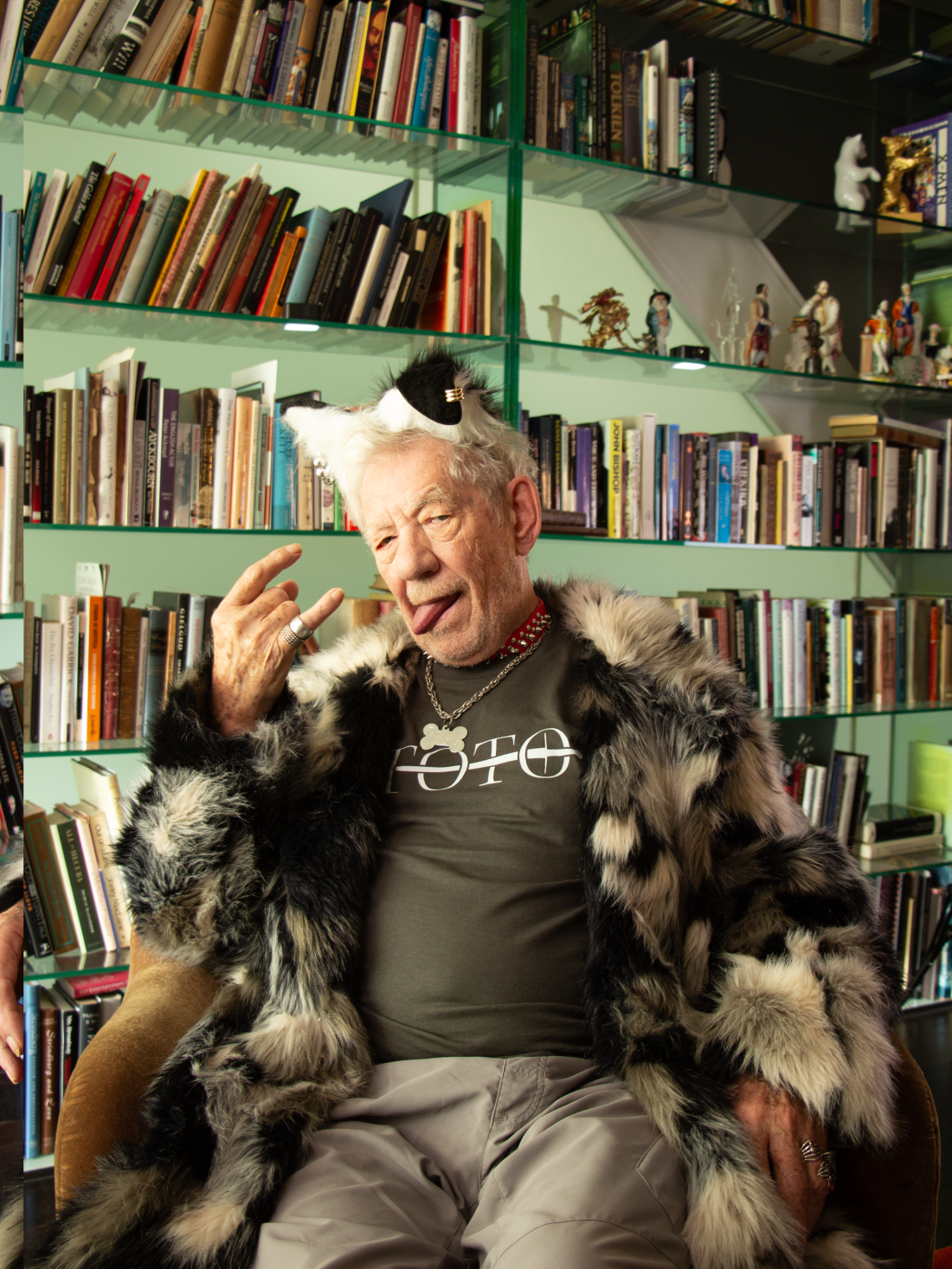
Actor Sir Ian McKellen playng Toto the Dog in a video clip for the Wicked Witches pantomime.
Pleasance Theatre
hide caption
toggle caption
Pleasance Theatre
Pantomimes are also known for featuring celebrities and public figures. This one features politician Jeremy Corbyn, who used to lead Britain’s Labour Party He appears on video as the Wizard of Oz-lington, a pun on Islington, the area of London he represents, now as an independent, in Parliament. Even more exciting is actor Ian McKellen — famous for playing Gandalf in the Lord of the Rings films — who is seen in a video clip as Toto the dog.
The Wicked Witches pantomime in North London was actually written by an American, Shane “ShayShay” Konno, who comes from California’s Bay Area but has lived in the United Kingdom for 12 years. “I didn’t grow up in the U.K., and when I moved here, starting to understand pantomime felt like a huge cultural hurdle,” Konno says.
Pantomime has its roots in Italian commedia dell’arte, a form of theater that dates back to the 16th century. In Britain, it has gradually developed over the years. “The actual history of pantomime is it started in East London, and it used to be this huge thing where the whole community would come together,” Konno explains.
Konno is nonbinary, and their pantomime is consciously inclusive of LGBTQ people, featuring a nonbinary character in the lead role of Dor, and a message that people should accept people who are different from them. “I wanted to make something that made an explicitly LGBT version of The Wizard of Oz and Wicked, because that’s such a beloved franchise for the queer community,” Konno says.
There are two versions: one for families with children, and one just for adults. But Konno says they aren’t as different as you might think. Many of the ruder jokes remain in the family-friendly show, but they are carefully disguised. “When a quite rude joke is said, but one that goes over the kids’ heads, it does tickle the adults in the room more than it would in an adult show because they’re like, ‘Oh my goodness, I can’t believe that they said that in front of the children,’” Konno says.

Characters perform on stage at the Wicked Witches pantomime in north London, on Dec. 6.
Robbie Griffiths/NPR
hide caption
toggle caption
Robbie Griffiths/NPR
Most theaters around Britain have an annual pantomime in the festive period — and it’s often their most popular production of the year. Johnny McKnight, from Paisley, a town near Glasgow, Scotland, has been performing and writing pantomimes in Scotland for 20 years, and says it’s a vital part of many British people’s Christmas celebrations.
“I’ve always said to everybody, when you do a pantomime, and you’re doing 12 shows a week, you’re giving people the gift of their Christmas ritual, their Christmas night out,” McKnight says. McKnight often plays the role of the dame, dressing up in drag.
McKnight has seen different generations of the same families grow up watching his shows, and explains that pantomime is often the first time that children in Britain ever visit the theater. “A lot of the time it’s a child’s first entry point,” McKnight says. “It was certainly mine — my first entry point into live theater.”
At the Wicked Witches show in North London, there are lots of children at the theater for the first time. Imogen Coackley is 8 years old, and attending with her father Alex and 5-year-old sister Emily. Imogen explains that she likes the pantomime because “they say very funny jokes and talk to the audience.”
McKnight says that seeing children enjoy his shows is one of the best parts of the job. “There’s something … magical in that, that you’re creating something accessible that talks to its audience rather than at them, that asks them to participate,” he says.

Driving through Southern California can feel like entering a different world. There are rules, yes, and you must learn them. The city, county, state and feds pass and enforce laws that govern our conduct on the road.
But within the confines of these rules, drivers take all sorts of liberties: They rush through at the tail end of a green light, prevent their peers from merging and snake through neighborhoods slow enough to read every street sign. The variations are endless and endlessly annoying.
Everywhere you turn, there’s another study ranking California drivers as among the worst. In fact, there’s just about only one thing California drivers all agree on: Everybody else on the roads has lost their minds.
As the holidays approach, we want to do our part to help eliminate the scourge of bad and selfish driving across the state. We asked Essential California readers to send in their complaints about other drivers on the road, and boy did they deliver.
Hundreds of emails later, we put together some tips for driving etiquette. We hope you’ll use them, and submit more of your own by emailing us at essentialcalifornia@latimes.com.
One surprising response wasn’t a complaint at all, but a compliment to L.A. drivers. “Every time we visit Los Angeles from Connecticut, we notice how well people drive in Los Angeles,” Wyn Lydecker wrote. “People are polite. They follow the rules of the road and it’s amazing to us.”
That’s great, Wyn, but we have no idea what you’re talking about.
We identified seven of the most frustrating things people do while driving, and we’re here, with the California Driver’s Handbook, to correct them. Please take note.
Turn signals were invented to be used

(Liam Eisenberg / For The Times)
Improper signaling or failure to use signals at all was the most common complaint we heard from readers.
“It seems obvious to me that when approaching a turn, you first signal, THEN BRAKE!,” Bill Pucciarelli wrote in. “So many drivers suddenly brake in front of you, for seemingly no reason. Then after we all come to a stop, turn on their signal. Why bother at this time?”
Bill is right. In fact, you are supposed to signal at least 100 feet before you turn; before every lane change; at least five seconds before you change lanes on a freeway; before pulling next to the curb or away from the curb; even when you do not see other vehicles around you; and when you are almost through the intersection if you plan to turn shortly after crossing the intersection.
Drivers, be more like Bill!
Please put your phone down. The light turned green and we’re all waiting behind you

(Liam Eisenberg / For The Times)
The second most complained about thing drivers are doing on the road? Looking at their phones.
“One of the most frustrating things is when there is only one car in front of me at a red light, then when the light turns green, the driver waits for several seconds to go, more than likely because they are looking at their cellphone, not hands-free,” Kim Sturmer wrote. “This happens at least once a day.”
Maybe these drivers were looking at their navigation app for directions. Or they were answering some non-crucial Instagram DM. Both are illegal in California. A state appeals court ruled in June that the state law prohibiting drivers from texting or talking on a cellphone while driving also makes it illegal to hold a phone to look at a map on the screen.
Whatever’s going on on your phone, it’s not worth the $158 fine for distracted driving (or worse).
Think before you merge

(Liam Eisenberg / For The Times)
Our readers also really don’t like when drivers improperly merge into lanes.
- “I strongly dislike drivers that commonly hit their brakes when attempting to merge into traffic rather than accelerating into an open spot,” Scott E. wrote. “After all, God gave them an accelerator pedal as well as a brake pedal.”
- “The things that frustrate me the MOST are: rude and inconsiderate drivers…drivers who drive on the shoulder of a freeway and create their own lane so they can CUT in front of you,” Lillian Bailey wrote. “Drivers who suddenly swerve across freeway lanes because they’re about to miss their exit, another pet peeve!”
- “Nothing annoys me more than drivers that cut in front of me on the freeway and then go slower than the speed limit,” Lorraine Lawrence wrote.
Improper merging is also one of the most common reasons California Highway Patrol officers stop drivers on the road. “We stop people mostly for speed or unsafe lane changes,” CHP Officer Katherine Hendry said. “In fact, probably both those reasons are also the No. 1 and No. 2 reasons why people get in accidents, which is why we focus on that so heavily.”
In case you need a refresher, don’t forget the SMOG method of changing lanes:
- S is for Signal: Tell the world of your plans, please!
- M is for Mirror: Check your mirrors to check traffic behind and besides you
- O is for Over the shoulder: Turn your beautiful head and use your eyes to check your blind spots as best as possible. Don’t drift while doing this. Make it a quick move.
- G is for Go. Merge. Do not stop or break or freak out. Move into your new lane.
(Scott, I hope you feel vindicated with this one!)
Say it with me: Red means stop (even if you are turning right)

(Liam Eisenberg / For The Times)
This should be common sense, but at red lights and stop signs, you’re supposed to stop. One of them even says STOP in large capitalized letters!
Disregarding both while on the road is frustrating for our readers.
- “Here in Fresno, there are many drivers for whom stopping at a red light is an option, not a requirement,” Reilly Rix wrote in. “I see cars blow through red lights at least once a week nowadays.” Us too, Reilly.
- “There is a new trend of speeding up when a signal turns yellow,” Cynthia Fletcher wrote to us. “Worse yet, I see people simply not stopping at stop signs.”
In case you don’t know the rules, let me break it down for you:
- When at a stop sign, drivers are supposed to make a full stop before entering the crosswalk or at the limit line.
- If there is no limit line or crosswalk, stop before entering the intersection and check traffic in all directions before proceeding.
A red traffic signal also means stop. Even if you can legally turn right on red, which is not always the case, you are still expected to stop and look before making your turn, and to yield for pedestrians.
All this tailgating will be the end of us

(Liam Eisenberg / For The Times)
Angelenos treat tailgating like an Olympic sport. You’d think you could win gold by getting as close as possible to the car in front of you.
Well, play stupid games, win stupid prizes. Tailgating is dangerous and crazy. What’s stopping the driver in front of you from making a mistake or doing something erratic? Keep your distance, so you have time to react.
Reader William J. McHale cited tailgaters as one of the driver types that annoys him the most.
I agree. Why are you following so closely in the middle lane? Get in the fast lane if you want to go faster!
In case you hate tailgaters too, or are a tailgater yourself, here’s what to do:
- If a vehicle merges in front of you too closely, take your foot off the accelerator. This creates space between you and the vehicle ahead.
- If a tailgater is behind you, maintain your course and speed.
- Then, when safe to do so, merge right to change into another lane and allow the tailgater to pass.
This brings us to the next one:
If you insist on driving slow, get out of the left lane

(Liam Eisenberg / For The Times)
No matter how much I’ve poked fun at my grandfather for driving like a snail my entire life, he continues to drive slowly on streets and freeways. He’s even gotten a ticket for driving too slow. I didn’t know that was possible, but it is in many states, including California.
Of course, you must drive slower through heavy traffic or bad weather.
But do not block the normal and reasonable flow of traffic by driving too slowly.
And please, if you’re going to drive slow, get out of the left lane. Let people use it for its purpose: Passing.
On that note: If you’re anywhere but the far right lane and a faster driver comes up on your tail, safely merge right so they can pass you. You are not being noble or righteous by slowing other people down, you’re creating danger.
Don’t blind us with your high-beams

(Liam Eisenberg / For The Times)
Most readers wrote a list of complaints or several paragraphs.
Michael West kept it short by simply writing, “High beams.” The rules for using high beams on the road are also pretty short.
Only use high-beam headlights when driving at night on open country roads or dark city streets (dim to avoid blinding the driver of an oncoming vehicle) and in areas where they are legally allowed.

McKenna Ross’ top Nevada politics stories of 2025

Firefighters battle large blaze at home near NH’s Loon Mountain

Deadly helicopter collision in New Jersey kills one, critically injures another
New Mexico Lottery Powerball, Pick 3 Day results for Dec. 27, 2025

How North Carolina’s Offense Looked in December

Florida High School Football Rankings: Top 25 teams – Oct. 21

Cleary's 21 help Le Moyne down Central Connecticut State 69-64 in OT

How old is Bo Nix? What to know about Oregon quarterback ahead of 2024 NFL Draft

99th annual Pony Swim held in Virginia

Video: ‘It Didn’t Have to Happen This Way:’ U.Va. Faculty Call for Review of Police Response to Protests

The biggest losers of 2025: Who fell flat as the year closed

Niger’s military rulers order ‘general mobilisation’ against armed groups

Disability rights advocate Bob Kafka dead at 79

‘Unlucky’ Honduran woman arrested after allegedly running red light and crashing into ICE vehicle

Podcast: The 2025 EU-US relationship explained simply
-

 Connecticut3 days ago
Snow Accumulation Estimates Increase For CT: Here Are The County-By-County Projections
-
 Entertainment3 days ago
How the Grinch went from a Yuletide bit player to a Christmas A-lister
-
 Entertainment4 days ago
Pat Finn, comedy actor known for roles in ‘The Middle’ and ‘Seinfeld,’ dies at 60
-

 Milwaukee, WI4 days ago
16 music and theater performances to see in Milwaukee in January 2026
-

 World1 week ago
Putin says Russia won’t launch new attacks on other countries ‘if you treat us with respect’
-

 Indianapolis, IN21 hours ago
Indianapolis Colts playoffs: Updated elimination scenario, AFC standings, playoff picture for Week 17
-

 Education1 week ago
How Trump’s Policies on Tariffs, Health Care, Immigration and More Impact You
-

 World3 days ago
Snoop Dogg, Lainey Wilson, Huntr/x and Andrea Bocelli Deliver Christmas-Themed Halftime Show for Netflix’s NFL Lions-Vikings Telecast