Entertainment
How the Grinch went from a Yuletide bit player to a Christmas A-lister


It takes a lot for sweet-tempered 28-year-old Nick Darnell to transform himself into Christmas’ most sought-after sourpuss.
There’s colored contacts and facial prosthetics, a protruding belly and at least an hour of makeup. But for the devout Christian and preternaturally cheerful young actor, the real metamorphosis is psychological.
“People today love to connect with the villain,” said the viral Grinch impersonator. “The world is just a darker world now.”
Darnell called the chartreuse baddie he portrays “the modern-day Santa.”
Dr. Seuss’ holiday parable “How the Grinch Stole Christmas!” has been a seasonal favorite since it was published in 1957, ranking among the most popular and profitable of the author’s iconic rhyming picture books.
The story’s sassy, brassy antihero has likewise adorned Christmas trees and school library shelves for generations. His hornlike fur forelocks and pathological refusal to assimilate have led some critics to call the Grinch ambiguously antisemitic, but those concerns have largely been glossed over by years of nostalgia.
Experts say 2025 heralds the Grinch’s ascent from Yuletide bit player to Christmas A-lister. He now crowds out Kris Kringle in store displays, social media feeds and holiday meet-and-greets.
Unlike Santa, who ho-ho-hos his way through the holiday season, Grinches twerk and pout and scream in kids’ faces. Compilations of their antics on YouTube and TikTok routinely rack up millions of views.
“I do the things that people think,” Darnell said of the role. “I’m not restrained.”
Despite the Grinch’s anti-consumerist zeal, the market for his visage has exploded in recent years.
Target touts its “Grinchmas,” while Walmart has “WhoKnewVille.” McDonald’s sells Grinch fries, Starbucks features a “secret menu” frappuccino. Hanna Andersson, a popular purveyor of holiday pajamas, boasts roughly a dozen different Grinch patterns, compared to three Hanukkah options and just one Santa design in two colorways.
“I’m not restrained,” Grinch impersonator Nick Darnell, 28, says of his role.
(Christina House/Los Angeles Times)
Ownership of the Grinch’s likeness is guarded as jealously as the villain protects his lair: Dr. Seuss Enterprises holds the rights to the children’s book, Warner Bros. Discovery the 1966 animated TV special, and Universal Studios the 2000 live-action Jim Carrey film, which ranks among the highest-grossing Christmas movies of all time.
But impersonators, academics and even working Santas agree: Americans’ embrace of the Grinch in 2025 goes far beyond consumerism.
“It’s definitely more popular,” said ‘Santa’ Ed Taylor, the famed Los Angeles Santa behind the Worldwide Santa Claus Network, a training camp for the art of Christmas cheer. “It’s a little yin and yang. Maybe we need a little bit of both.”
Costume companies across Los Angeles say they’ve seen a deluge of demand for the Grinch this year. At Etoile Costume & Party Center in Tarzana, nearly half of Christmas costume rentals are now furry green villains.
“It’s about equal to Santa,” one employee said. “Maybe 40% Grinch and the rest Santa.”

Ryan Ortiz, dressed in a Grinch costume, stands next to his 1969 Volkswagen Bus in San Diego on Dec. 21.
(K.C. Alfred / The San Diego Union-Tribune via Getty Images)
Fans of the hirsute sourpuss seek him out for his in-your-face edge — the opposite of Santa’s remote joviality. Santa enforces his regime of goodness through lists and surveillance. The Grinch will get in your face and yell at you to shut up.
“[Santa]’s supposed to be mysterious and unknown,” said Darnell’s fiancee JadaPaige. “He’s supposed to just come in the night and you’re never supposed to see him.”
“I grew up obsessed with Santa Claus — I did not grow up obsessed with the Grinch,” Darnell said. “I was the kid waiting up in the middle of the night, peeking, wondering if Santa’s down there. A lot of modern day kids aren’t having that journey.”
Instead, many Gen Alpha youths look to the Grinch for his views on “corruption or poverty or the oversaturation of commercialism,” Darnell said.
“Santa is looked at more like a godly figure, while the Grinch is a more everyday man,” the actor explained. “The world is so sinister and negative. [The Grinch] tells you how it is, rather than telling you everything is going to be fine.”
TikTok turbocharged that trend, with the infamous green meanie matching or beating his red rival in holiday clout.
“He has aura,” Darnell said.

Grinch impersonator Nick Darnell said the character he plays has become popular because, “He has aura.”
(Christina House/Los Angeles Times)
Today’s professional Santas are often retirees with a bit of a belly and some time on their hands. Grinches, by contrast, are more likely to be working actors like Darnell, who look reverently to Carrey’s performance as a blueprint for the character’s slapstick antics and snarky reads.
Still, experts say the Grinch’s 2025 glow-up likely owes as much to holiday exhaustion and broad consumer pessimism as it does vertical video virility.
“The Grinch is the opposite side of Christmas,” said Oscar Tellez, who owns Magic Dream Costumes and Party Rentals in East Los Angeles and says he’s seen a spike in Grinch requests even as overall holiday rentals have sagged.
“Especially with the Latino community, I don’t think they feel the enthusiasm to celebrate,” Tellez said. “They are more worried about what’s gonna happen next.”
Pop culture experts agreed.
“The economy is in big trouble, our political situation is chaotic, there’s a lot of hate — it’s no wonder that we would seek to express that through the embodiment of a monster like the Grinch,” said Michael M. Chemers, director of the Center for Monster Studies at UC Santa Cruz.
“You’ve seen these nativity displays popping up all over the country that have the Jesus figures removed and it says ‘ICE was here,’ ” he added. “I think there’s just a lot of Grinchy feeling right now in the world.”
Chemers and other scholars say the emergence of the Grinch as a foil to Santa is less a departure than a return to form: the Grinch is a “PG version” of the mythical Krampus, a shaggy, fork-tongued Germanic goat man who beats and even abducts naughty children, working as an enforcer for Father Christmas.
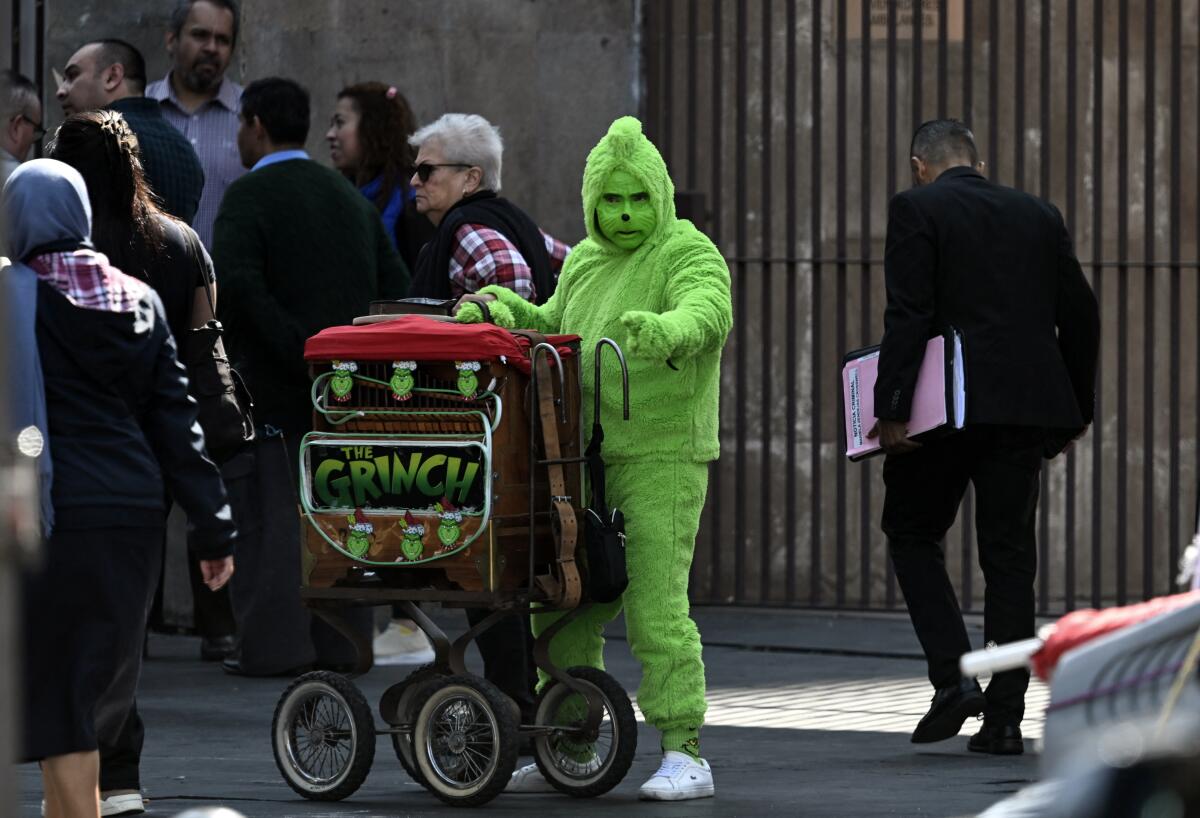
An “organillero,” or traditional street musician, dressed as the anti-Christmas character known as the Grinch plays on a central street in Mexico City on Dec. 9.
(Yuri Cortez/AFP via Getty Images)
“He’s been called the Christmas devil,” said Jeff Belanger, author of “The Fright Before Christmas,” a compendium of so-called “Yuletide monsters.”
“[Krampus] represented the consequence of bad behavior, while St. Nick rewards good behavior,” he said.
Krampus likely evolved from older, pre-Christian deities, just as Christmas absorbed solstice and midwinter customs, the author explained. The Christmas most Americans grew up with only emerged as a national holiday in the wake of the Civil War, he said, about a decade after the formal introduction of Thanksgiving in 1863. It was around this time that Christmas trees became popular in the United States.
“In 1867, Charles Dickens came over to Boston and that’s when he read his ‘Christmas Carol’ for the first time in America,” spurring President Ulysses S. Grant to declare Christmas a federal holiday, Belanger said. “It was truly on the back of that story.”
The holiday’s corpulent, white-bearded dandy arrived even later, his schmaltzy persona skimmed from bony St. Nicholas between Reconstruction and 1931, when Coca-Cola debuted its iconic, brandy-flushed Santa Claus.
“That’s when Christmas turned purely commercial, and there was no room for consequences anymore,” Belanger said.
Seuss’ Grinch sits somewhere in the middle — cuddlier than Krampus and pricklier than Santa — making him the perfect avatar for a moody, uncertain age.

Workers check Grinch inflatables ready for export at a factory in Suixi County in central China’s Anhui Province on March 19.
(Wan SC/Future Publishing via Getty Images)
Grinch boosters point out that the villain repents and reforms at the end of the story, shedding his pathological hatred of Christmas.
“I always tell people, ‘Don’t you just love how his heart grew three sizes?’ ” Taylor, the famous Santa, said of his increasingly popular crossover events.
Others note that it’s never the repentant Grinch who marauds through schools and holiday parades or blows up on social media.
“Once he’s rehabilitated, he’s no fun anymore,” Chemers said.
That makes it hard for the holiday villain to visit sick kids in the hospital, as legions of Santas do every year, or comfort children who confide in him about bullying.
“The message is one of encouragement and positivity and acknowledgment of accomplishments and encouragement to strive harder,” Taylor said. “It’s these beautiful personal development messages that Santa gets to be the conduit for.”
The Grinch, by contrast, can affirm where you are, without ever asking you to be better.
“He can hear you and know what you’re thinking, because he has the same thoughts,” Darnell said of his beloved version of the character. “People want to know his heart and his mind, and that’s something they wouldn’t be able to ask Santa.”


Right now in Los Angeles it’s Wes Week, with multiple tributes to the career of filmmaker Wes Anderson, known for his fastidious visual style, melancholy longing and nerd-chic aesthetic.
On Monday night there was a sold-out 30th anniversary screening of Anderson’s debut feature, “Bottle Rocket,” at the Academy Museum with the filmmaker making a rare in-person L.A. appearance. He sat for a warmly endearing Q&A with actor Luke Wilson and director James L. Brooks, an early champion who executive-produced.
Then on Friday, Saturday and Sunday, the Hollywood Bowl will have three nights celebrating the music of Anderson’s films, hosted by the director’s 10-time fixture, Bill Murray. Among those scheduled to perform are Beck, Jenny Lewis, Karen O, Rufus Wainwright and Devo, among many more. Other surprise guests may appear as well, performing songs familiar from Anderson’s music-stuffed movies.
“I was surprised how many things we did have to leave out,” Anderson, 57, tells The Times in a recent interview conducted via voice notes (his personal preference) recorded from Paris, where he has long lived. “There’s so much music over all these movies because I’ve been doing them for so long. We could do a whole other round of this, but let’s see how it goes on this first one.”
Because of his unique use of music, combining left-field vintage pop songs with classical pieces and original scores by favored composers Alexandre Desplat and Devo’s Mark Mothersbaugh, there have been frequent requests over the years for live performances, but Anderson and his longtime music supervisor Randall Poster have always declined — up until now and this ambitious three-night event at the Bowl.
“From the moment that he said yes we’ve been on the phone talking about his vision and how to execute it,” says Johanna Rees, vice president of programming and creative partnerships at the L.A. Phil, during a recent call from San Diego. “It’s about exploring and celebrating so many styles of music. It’s been such a fun adventure.”
Kara Hayward and Jared Gilman in Wes Anderson’s 2012 movie “Moonrise Kingdom.”
(Focus Features)
This will be more than a typical evening at the Bowl, with dedicated Anderson-branded merchandise and uniformed bicycle riders dispensing candy. “The plan is you walk into the Hollywood Bowl and you are immersed in the world of Wes Anderson,” Rees says.
Criterion, which has long put out high-end home video editions of Anderson’s work and recently issued a 20-disc box set, will also have a special presence at the Bowl. Alongside the popular Criterion Mobile Closet making another stop in L.A., there will also be a lounge, a listening booth and a screening room showing Anderson’s movies as well as ones curated by him, including “Yojimbo,” “Amarcord” and “Belle de Jour.”
“Wes is an amazing community-builder as a human being,” said Peter Becker, president of Criterion, in a video call from the Il Cinema Ritrovato Festival in Bologna, Italy. “If you look at his films and the people he’s been working with consistently, we’re not the only ones who’ve been part of the greater Wes Anderson family for the last 25-plus years. How could we not be a part of this?”

From left, Jason Schwartzman, Adrien Brody and Owen Wilson in the movie “The Darjeeling Limited.”
(Fox Searchlight Pictures)
Music supervisor Poster met Anderson in 1996 at L.A.’s Original Farmers Market shortly after “Bottle Rocket” was finished and immediately began to assist in pulling together the soundtrack release. Though the CD at the time could not include some of the key songs from the movie, these Bowl events will finally offer a flexi-disc of the Rolling Stones’ “2000 Man” as well as a limited-edition yellow vinyl 12-inch record with two songs by the band Love.
The two have worked together on all of Anderson’s films since, with a process that is constantly developing.
“Sometimes we’ve been talking about it even before the film takes shape,” says Poster on a recent phone call from New York. “We get to that point where I feel informed to a certain degree, that we’ve identified an element or two, whether it’s a composer, a specific song, a specific band that allows us to sort of start weaving it together. Sometimes we have more details, and sometimes we’re in a little bit more of a process of discovery.”
As impeccably detailed as his movies can be, Anderson acknowledges that his method can still be a bit vague. “I really couldn’t tell you what it’s all about, where it came from or why,” he says. “It’s just totally instinctive.”
One of the most indelible moments in Anderson’s repertoire is Gwyneth Paltrow’s slow-motion exit from a bus in “The Royal Tenenbaums” to the sounds of Nico’s 1967 recording of the song “These Days,” perfectly capturing a tender, delicate rush of emotions.
“That music was part of the inspiration for the entire movie,” Anderson recalls. “There’s a Ravel string quartet in F Major and this song — those two things together, for whatever reason, suggested something to me that slowly became the whole movie. With Gwyneth Paltrow coming off of the bus, we played the music on the set. It was all a bit choreographed to that.”
“Everybody wanted to do ‘These Days,’ ” says Poster of the artists lined up for this weekend’s shows. “But Jackson Brown wrote ‘These Days’ and Jackson Brown is going to perform ‘These Days.’ Nobody could really argue with that one.” (The rest of the song choices and performers are being kept under wraps.)

Ben Stiller, left, Gwyneth Paltrow and Gene Hackman in the 2001 movie “The Royal Tenenbaums.”
(James Hamilton / Touchstone Pictures)
In choosing music for the movies, inspiration can strike from just about anywhere, as with the Johnny Duncan and the Blue Grass Boys’ recording of “Last Train From San Fernando,” memorable from the opening credits of 2023’s “Asteroid City.”
“I knew that song because my daughter used to listen to it,” says Anderson. “She had a CD of western swing from the ’50s and ’40s that she was listening to again and again. So I stole it from her.”
Poster mentions Anderson’s affinity for woodwinds and novelty instruments along with his tremendous sense of rhythm, which is why the music often has a strong percussive feel, from Gene Krupa’s “Drum Boogie” in last year’s “The Phoenician Scheme” to Japanese taiko drums and the work of composer Peter Jarvis.
“I would say that I think the biggest change is that Wes has taught himself how to read music,” says Poster. “He just really gets into the score’s DNA and really has a great insight into how to arrange thematic pieces that I think help make the movies more wholesome, just being a whole thing.”
Poster playfully refers to Anderson as “The Maestro” and remains struck by how fresh the music cues feel in the context of the films.
“When those clips come on — ‘Here Comes My Baby,’ ‘A Quick One, While He’s Away,’ ‘These Days,’ ‘Needle in the Hay,’ ‘Ooh La La’ — I mean, countless, countless, I always get a kick out of it.”
All of which should add up to a special alchemy at the Bowl.
“They won’t happen again,” says Rees of the three nights curated by Anderson. “Not knowing what he’s going to do in the future, but certainly this is a special event, a one-of-a-kind weekend. It won’t be happening like this again.”
For Anderson, putting together the Hollywood Bowl shows has been a reminder of how far his work has evolved.
“When we made ‘Bottle Rocket,’ I didn’t intend to have an original score at all,” he remembers. “We had some Ennio Morricone music. We put Bob Dylan’s ‘Pat Garrett and Billy the Kid’ in the movie originally — and that’s a score from somebody else’s movie. At a certain point everything sort of changed, and Mark Mothersbaugh came and saw the movie and he liked everything we had in there. And so he brought his own voice in, but from the point of view of somebody who was very sympathetic to what was already in place, and that led to more movies together.”
Showing a bit of his own trademark wistfulness, he adds, “It is quite an amazing thing to have Mark and Devo coming up on the stage to do this music that reflects back on all these years — this whole gathering.”

Arts
Supergirl
Director: Craig Gillespie
DC Studios, Troll Court Entertainment, The Sagan Company
In theaters: 06.26.2026
I was a pretty big fan of James Gunn’s Superman. Building up to the release of the film, I relapsed into my comic book obsession, which I had laid to rest many years prior. I read whatever you get recommended when you look up “Superman comic recommendations:” For All Seasons, All Star, Birthright — whatever, you don’t care. David Corenswet’s portrayal of Big Blue was loving, thorough and unbelievably human, which is what Superman is (he’s not Jesus). He is the best of us. He is what we aspire to be.
Supergirl was announced, and I picked up the comic it was based on: Supergirl: Woman of Tomorrow. The questionable morals and talent of author Tom King aside, the book is good! The fantastic art by Bilquis Evely makes King’s (sometimes preachy) prose this beautiful and somber story about trauma and war. It appears that I’m ahead of director Craig Gillespie, who reportedly didn’t read the book and, boy, does it show.
During a bender, Superman’s cousin Kara (Milly Alcock, House of The Dragon) meets Ruthye (Eve Ridley), a child whose family is murdered by Krem (Matthias Schoenaerts, Amsterdam, The Old Guard), the leader of a raider group. She enlists Kara to hunt and kill him, and on their way, they confront their traumas.
Every change made from the original comic was for the worse. Most notably, this film simplifies the depth of the comic’s characters. Kara is reduced to a loud, charming alcoholic, which is fine, but in the comic, she’s somber and reflective, making an effort to teach Ruthye how the greater universe works. The antagonist, Krem, is sort of a loser in the comic. He’s a coward who spends his time running away, while in the film he’s a tattooed, pierced, menacing psychopath who appears in almost every major action sequence. He’s almost indistinguishable from The Joker — this all boils down to shame. While they’re becoming increasingly popular, comics are still for losers. Hinting at depth with characters who fly and shoot lasers from their eyes in brightly colored underpants isn’t something that a general audience will accept. They will accept a comic film so long as it constantly flogs itself for being comic-inspired.
Another bastardization is the look of this film. Everly’s amazing use of color in the comic makes the story so engaging. How is this translated? Brown. Just brown. When characters clash, it looks like someone’s wiping their finger across their dirt-covered lens, which is a total departure from Gunn’s fantastic color palette in Superman. The visual effects appear to be rushed and often look horrible — laughably horrible, as a matter of fact. How do you spot a bad action director? Look at the editing. If they have to hide poor action choreography and bad visual effects behind dizzying amounts of cuts, they’re bad. Gillespie is a bad action director. James Gunn promised that the DCU would prioritize artist voice over universal coherence, but if these are the artists he’s hiring, I’m not sure how long this could last.
Performances here are whatever. Alcock could have been good if the script and direction were right, but they’re not. I couldn’t get into Krem due to character assassination, but even if I wasn’t into the comic, I would find his performance as a crazy guy to be a standard for bad superhero movies. Ridley is good, especially for a debut in feature films, but the standout is Jason Momoa (Aquaman, A Minecraft Movie) as Lobo. He is loving the character, absolutely chewing up the scene with thick cigars. He’s a little cheesy-edgy, but that’s just what he is in the comics, so I won’t knock him for it.
While I was watching the film, I was suffering from a discrepancy. Supergirl is as powerful as Superman, but throughout this film, she doesn’t use her powers to their full potential. Something I actually loved about Superman is how much he got his ass kicked. Gunn was out to prove that Superman fights can have stakes — that he’s not just undefeatable and therefore boring as everyone says. Gunn’s ability to create ways to kill the Man of Steel without Kryptonite is amazing! Kara, in this film, is fighting space pirates and constantly forgets to finish the fight. It’s frustrating because the remedy to this in the comic is that they don’t see Krem until the last couple of issues, but in this film, Krem keeps showing up to menace Supergirl, and most of the time she has her powers.
I could ramble about how bad the dialogue can be, how derivative and uninspired it is or whatever lame comic thing I can talk about, but I’ll spare you. Here’s the moral of all this: Comic books are a valid storytelling medium. I recall recommending Alan Moore’s Watchmen to someone and being told that they have more important things to read. Watchmen is one of my favorite works of fiction. I did end up falling out of love with comics because I was told they were childish and I had grown bored of having costumes thrust into my peripherals all the time, but I’m back now, and I love them so much more than ever. I loved Superman because, above all else, it was earnest. There wasn’t a self-deprecatory tone toward its own plot. It didn’t try to bog its drama down with one-liners. It was just proud to be a comic book movie, and I think more movies should.
If you want to see Supergirl, go ahead, but I’d advise you to just read the comic, which is more dramatic, more meaningful and more impactful. —B. Allan Johnson
Read more reviews from B. Allan Johnson below:
Film Review: The Bride!
Film Review: Backrooms
Do you enjoy SLUG’s film reviews? Consider becoming one of our donors!

One Wednesday evening in May, at the boutique hotel Dream Hollywood — located just off the Walk of Fame — a young hotel staff member shuffled over to her co-worker to discuss a special guest on the top floor. Together they exchanged whispers about an artist’s unknown whereabouts and whether or not they would catch him on his descent to the first floor.
The name “Tito Double P” slipped out, referring to the Mexican corrido singer who happened to be in town promoting his latest album, “Acomodo.”
I met the 28-year-old on the top floor, where he opted for a warm, friendly hug in lieu of a firm business handshake. We were quickly rushed into a side room to conduct his last interview of the evening.
Those who’ve followed Tito Double P’s musical journey since 2023 would likely describe him as a chaotic force, with weathered vocals, off-the-cuff ad libs, riotous pelvic thrusts and suggestive tongue expressions.
Come Sunday, he’ll bring the ruckus when he headlines Belico Fest in L.A.’s BMO Stadium. But when we spoke about his second solo album, “Acomodo,” the Nayarit-born, Sinaloa-raised singer, whose real name is Jesús Roberto Laija García, arrived polished, perfumed and poised.
“After this LP, don’t be surprised if you see different things from me,” said Laija García.
Released on May 28, the LP contains 23 corridos, which see Laija García strike the commanding tone of brazen CEO. In its focus track, “Me Vale V,” the singer firmly declares he is manifesting his dreams and not paying anyone else mind. Its lyrics reveal it all: “Ya van tres días que no paro, pero bien trabado” (I’ve been going nonstop for three days now, but I’m totally locked in).
But listeners also get a more vulnerable side of the músicana mexicana singer, who agonizes over heartbreak in “La Fama” — while simultaneously voicing his vice for women and boozy escapades. Throughout the record, the singer sprinkles in the catchphrase, “Bélico pero no tanto, mija,” which translates to “warlike, but not too much, my dear” — striking a balance between his hard-shelled exterior and inner tenderness, namely in the yearning jazzy corrido “Pase y Pase,” in which he pleads for a late-night booty call.
Most notably, “Acomodo” boasts no features whatsoever, a rarity in an industry where artist collaborations play a key role in bringing in bigger audiences (and bigger payouts).
“Many people called me to ask why they weren’t going to be on [the record],” he said. But the solo move marked a milestone achievement for Laija García, who had no designs of becoming an international musical marvel.
“I was never the child who sang, who played the guitar in school festivities or at family parties,” said Laija García in a calm tone — occasionally referring to his stage name in the third person.
The singer still can’t fathom his own success. He cut his teeth by penning career-defining songs for his famous cousin, Peso Pluma — including anthemic corridos like “El Belicon,” “Siempre Pendientes” and “AMG.” These standout ballads touted a rugged lifestyle with elements of organized crime, which aided his primo’s ascent to the mainstream.

Tito Double P released his second solo album “Acomodo.”
(Adan Ornelas Anta)
In the process of composing his cousin’s Grammy-winning 2023 album, “Génesis,” Laija García asked him if he could also release his own material. “Let’s go!” he recalled Peso Pluma saying. “Your first song will be a duet with me.”
The plan was to debut Tito Double P with “La People,” a fiery narcocorrido that details the inner life of a cartel’s tactical security guard, who narrowly escapes a police raid.
But Laija García’s rollout plan took a detour when an unmastered version of his track was leaked to TikTok in spring 2023 — a bouncy tune he later renamed “Dembow Belico,” which is characterized by a Dominican-style boom-chi-boom-chick rhythm and raw, spitfire lyrics. This party track introduced audiences to a version of Tito Double P that radiated a lighthearted madness — fueled by Skyy vodka and Old Parr whiskey, as per the song’s lyrics.
“I liked it, it was something new,” said Luis R. Conriquez, who called up the new singer to be a collaborator. “What makes him special is his voice, his sound. He’s his own person.”
Together with Conriquez and Joel De La P, “Dembow Belico” was released on June 5, 2023, and became Tito Double P’s official debut in the music world — even giving life to one of the most viral clips of Mexican boxer Canelo Alvarez, who can be seen awkwardly dancing to it.
“From there on, Tito Double P was another persona,” said Laija García. Throughout his lively retelling of the story, he added a series of sound effects to move the story line — among them, wacha, pum, pum, pum, gol. “More than anything, Tito Double P came across as a character, because that guy was totally crazy, he didn’t give a damn.”

“More than anything, Tito Double P came across as a character, because that guy was totally crazy, he didn’t give a damn,” said Jesús Roberto Laija García, better known as Tito Double P.
(Adan Ornelas Anta)
In real life, Laija García considers himself a timid, camera-shy guy. That’s why he chose an illustration for the cover of his 2024 debut album “Incómodo,” rather than a real-life image of himself; the LP title directly translates to “discomfort.”
“I was going to be one of those artists that [only] releases songs, because [I thought,] ‘How embarrassing would it be if I got up on stage?’” he mused. “But now, I dominate the stage from head to toe. And I don’t want to come down.”
The debut record also served as an experimental project for Tito Double P, whose hard-won swagger elevated every sound he toyed with — whether it was on the brass-heavy banda song “La 701” with Luis R Conriquez, the techno thump of “La Bandolera,” the heavy-hitting urban track “Linda” with Neton Vega and the guitar-powered ballad “Los Cuadros” ft. Peso Pluma).
Featuring collaborations with established acts, such as Natanael Cano, Junior H and Grupo Frontera, the album peaked at No. 11 on the Billboard 200 chart and helped the rising star distinguish himself from his high-profile cousin — who he toppled from the No. 1 spot on the Top Latin Albums chart, five weeks after his debut release.
Although Laija García hasn’t shied away from embracing that familial tie either; in May, both Tito Double P and Peso Pluma concluded their “Dinastía” tour following their joint 2025 album of the same name.
“I still see comments on TikTok where people are surprised that we are cousins,” remarked Laija García.
Now with “Acomodo” — which debuted at the top of both Spotify Top Albums USA and Top Global Charts across all genres — Tito Double P affirmed his rightful place in música mexicana upper echelons.
“That’s why it’s called ‘Acomodo,’ because everything is aligning itself as it should be,” he said.
As Tito Double P made his way to the lobby, a member of the Dream Hollywood valet — who likely bore witness to Hollywood A-listers and other luminaries — asked if he could take a picture with the singer. “Tito, Tito, a photo please!” asked the employee.
Laija García flashed a friendly smile. Thankfully for the attendant, Tito Double P is always camera-ready.
-

 World1 minute ago
US urges donors to abandon UNRWA funding as UN defends agency’s mission
-

 Politics4 minutes ago
EXCLUSIVE: FBI adds alleged COVID fraudster accused of taking $5M from kids’ meal program to Most Wanted list
-

 Health10 minutes ago
One walking habit could signal a healthier brain after 80, scientists say
-

 Sports17 minutes ago
New Jersey pro wrestling promotion bringing the fight to the beach
-

 Technology19 minutes ago
Are airline miles still worth it?
-
 Business25 minutes ago
Walmart’s EV chargers are coming to California with discounts for members
-
Entertainment32 minutes ago
Still a Nico and Devo fan, Wes Anderson looks back on 30 years of musical moments
-
 Lifestyle34 minutes ago
Is it safe to eat from your garden after the Boyle Heights warehouse fire?

