Sports
How did curling become a Winter Olympics sensation? Inside the sports’ unique history

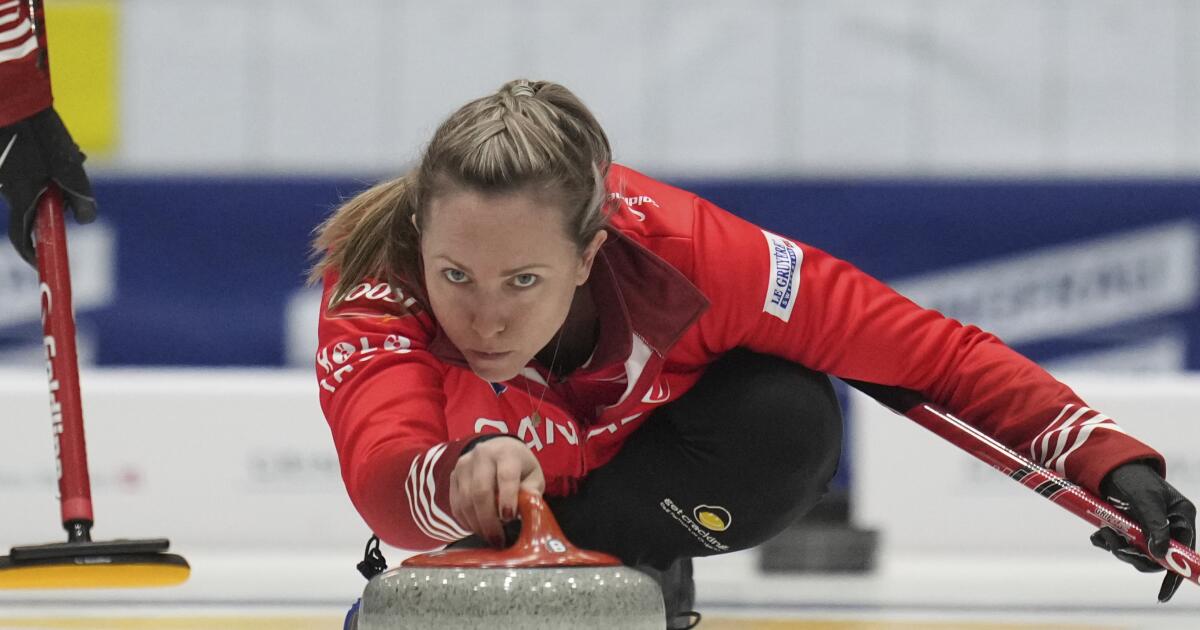
EDMONTON, Canada — Jason Hills grew up in a rural hamlet in southern Alberta so small there were no traffic lights. Which wasn’t a problem because there wasn’t any traffic either.
But there was a curling rink.
“There was nothing else really to do,” Hills said. “So if you weren’t curling you’d go hang out at the curling rink. It’s a community thing. It’s like everyone gets together.”
In much of the world curling is a curiosity, a sport which, like luge or the biathlon, surfaces every four years at the Winter Olympics — as it will do in February in Cortina D’Ampezzo, Italy — then quickly fades from view.
Canada’s Tracy Fleury (R) releases the stone during a gold medal match against Switzerland at the World Women’s Curling Championship in Uijeongbu on March 23.
(JUNG YEON-JE/AFP via Getty Images)
In Canada, however, it’s as much a part of the culture as poutine and maple syrup.
More than 2.3 million people — or one of every 18 Canadians — participate in the sport annually. That’s about 100 times the level of participation in the U.S. And more than 11 million Canadians watched the sport on TV in 2024, according to estimates from Curling Canada, the national governing body for the sport.
“It’s just embedded in the fabric of Canada,” said Elaine Dagg-Jackson, an Olympic bronze medalist and now one of Canada’s top curling coaches. “Canadians have a real identity with what curling is and what it stands for. It’s a gracious sport where people are being polite. They shake hands before and after the game.
“The curling rink was just a really good place to be in Canada. And still is. It just really suits the culture.”
The objectives of the sport are simple: Teams of two to four players slide 44-pound granite stones, also known as rocks, down a narrow 150-foot-long sheet of ice toward a target area called the house, aiming to get their stone closest to the center of the house. One or two players from the throwing team use carbon-fiber brooms to sweep the ice in front of the moving stone, influencing its path and speed.
A round of play ends when each team has thrown eight stones; in Olympic curling, a match consists of 10 ends, eight in mixed curling, with games typically lasting two to three hours.
The simplicity of the sport is both its charm and its curse. Because there is no running, jumping or lifting of heavy objects, everyone from young children to octogenarians can, and do, compete in amateur curling in Canada.
“It’s relatively inexpensive and it’s relatively accessible,” said Heather Mair, an associate professor at the University of Waterloo. “It’s not a hard sport to play and have fun at. It’s hugely entertaining. And you can really play your whole life.
“I don’t know too many sports you could go out with your grandfather and participate. It can be really family-oriented as a sport.”
But while it looks easy, to excel at the highest levels, where millimeters separate winners from losers in competitions that can stretch for as long as seven hours over multiple days, the sport requires surprising strength, stamina, precision and agility.

Canada’s Brett Gallant curls the stone during the 2022 Winter Olympics in Beijing on Feb. 17, 2022.
(LILLIAN SUWANRUMPHA/AFP via Getty Images)
“It definitely takes a toll on your body,” Rachel Homan, a three-time Canadian Olympian and three-time world champion, said during a break in training on a bright Edmonton morning. “That part of the game is maybe overlooked; the physical toll it takes. It’s definitely demanding.”
The curling events at February’s Winter Olympics will be held at the Cortina Olympic Stadium in Cortina D’Ampezzo, one of four event clusters in and around Milan. Canada, which has medaled in curling in every Olympics in the modern era, winning a record six golds, will send a dozen athletes — including Homan, the reigning world champion — to Italy to compete in the men’s, women’s and mixed doubles.
The U.S., which has won two Olympic curling medals, both in the men’s competition, will also have a dozen curlers in Italy competing in all three events. But if the sport is a national pastime in Canada, one that competes with hockey for fans and media attention, it remains something of an oddity in the U.S., where it draws huge TV audiences every four years during the Olympics, then fades from view until the next Winter Games.
“It’s so frustrating to see curling become the next best thing to sliced bread for a month and then it comes off the radar for four years,” said Korey Dropkin, a five-time U.S. champion and a 2023 world champion in mixed doubles. “I want to see something that’s on national television in the U.S. every week. I want to be able to expose our amazing sport to the U.S. audience day in, day out.
“I hope that in the near future we’ll be able to create more opportunities for exposure for curling.”
Curling was born in Scotland in the early 16th century but grew up centuries later on the Canadian prairies, where the severe weather, rural landscape and boredom provided fertile ground.
“In many parts of the country there’s long, long winters,” Dagg-Jackson said. “The farmers would be busy all summer, but in the winter they were looking for something to do. So the old adage in Canada is you could go to any town in rural Canada and find a grain elevator and a curling rink.”

Members of the Highland Curling Club, formed in 1898, play on flooded sheets of ice on Jan. 11 in Inverness, Scotland.
(Jeff J Mitchell / Getty Images)
The sport, which predates hockey by several decades, was brought to Montreal by Scottish emigrants during the colonial period, more than a half-century before Canada became a country. It then moved west as settlers pushed into what would become the central provinces, where the game was played on ponds and lakes before coming indoors.
In many ways the sport and the harsh conditions in which it thrived embodied the traditional values and traits — resilience, community, politeness, resourcefulness — that have come to define Canada’s unique “northern character.”
Mair, the Waterloo professor, has studied the role curling played in creating social and inter-generational connections and found the sport may have been more important from a mental perspective than from a physical one.
“I don’t know if you can appreciate what a Canadian winter is like, but anything that gets us out of our homes and talking to one another is really, really important,” she said. “We know how necessary it is that we spend time socializing with one another, especially in the dark winter days.”
As a result, it quickly became hugely popular, but for reasons that went beyond sport. Most curling rinks, Mair said, provide social spaces where players can visit with the people they’re competing against.
“So you’re sitting there for half an hour with people that you might never run into in any other part of your life and you start to build social relationships,” she said. “In really small rural communities, those are pretty essential. That’s kind of how it started.”

Aksarban Curling Club president Steve Taylor demonstrates how to push off the hack to deliver a stone in front of an all-ages group learning about the sport in Omaha, Neb., in 2018.
(Nati Harnik / Associated Press)
It’s also why the flat lands of Saskatchewan, Manitoba and Alberta became the earliest hotbeds of curling, which aligned well with the farming season. But the sport didn’t stay there. Curling clubs soon sprung up on Army bases and in fishing communities, in big cities and small towns, where it was taught in schools and played in retirement homes. (Curling has taken a different path in the U.S., where it has become popular in nontraditional winter-sports areas such as North Carolina, Florida, Texas and the San Francisco Bay area.)
“There were entire generations, for the most part, who really had a sense of the game,” Mair said. “The[re] were plumbers and carpenters and teachers, they had regular day jobs and yet they were these really talented athletes who would take the sport to these elite levels.
“So you could come from a teeny, tiny club and you might know someone who’s playing in the national championship.”
That romanticism inspired a radio play and novella by W.O. Mitchell, a writer and broadcaster who chronicled life on the Canadian prairies in the mid 20th century. In “The Black Bonspiel of Willie MacCrimmon,” which was also adapted for television, a cobbler from a small town in rural Alberta strikes a deal with the devil to trade his soul for curling success.

American John Shuster watches Matt Hamilton, center, and Colin Hufman, left, sweep his throw during a match against Canada at the Beijing Winter Olympics in 2022.
(Brynn Anderson / Associated Press)
But as curling moved from the prairies to the cities, the object lessons the sport taught changed as well. If Mitchell’s tale is a decades-old take on the timeless tug of war between good and evil, “The New Canadian Curling Club,” a 2018 comedy by playwright Mark Crawford in which four immigrants show up for a learn-to-curl class, is a modern exploration of multiculturalism and acceptance.
What the immigrants share, however, is a belief that understanding Canada starts with understanding curling.
“It’s weird and wonderful. And like all good things, it takes a little time to appreciate,” Mair, who teaches in the department of recreation and leisure studies at Waterloo, said of the sport. “At first glance you’re not totally sure what’s going on. And then as the layers start to kind of unfold, you realize just how interesting and complicated and engaging it can be.
“It’s fun. It really is. It’s quirky and fun. And I think we need more of that.”
But, she added, much of that has changed since curling entered the Olympics.
“We’re at a bit of a crossroads,” she said. “Elite sport is doing just fine in a lot of ways. [But] we need to have a different conversation about community sport. It’s not about a pathway to Olympic gold. It’s about rebuilding our communities and providing safe and accessible sports for everything. And curling is just so special in that way.”
Curling debuted in the Winter Games in 1924 with just three countries taking part; Great Britain, which fielded a team of Scottish curlers, won the gold medal. But the sport didn’t return to the official Olympic program for another 74 years and when it did, the exposure fueled interest in winter sports powerhouses such as China, Japan and South Korea, but also in Afghanistan, Andorra, Bolivia, the Virgin Islands, Kuwait and Mexico, which are all among the 67 members of the World Curling Assn.
“There’s a little bit of perception from America that curling is small potatoes. And it probably is compared to the big four sports,” said Marc Kennedy, a world and Olympic champion from Canada who will be competing in his fourth Olympics in Italy. “But it’s a big deal. Arguably one of the fastest-growing sports internationally. It’s massive in Asia. Some of our most popular athletes are from Japan.”
That added competitiveness — 30 countries attempted to qualify for this year’s Olympic tournament — has not only raised the stakes and professionalized the sport, it also threatens to crush curling’s gracious and polite traditions in a stampede for the top of the medal podium. In last spring’s world championship in Canada, for example, Chinese athletes were accused of touching a stone with a broom, kicking a stone and illegal sweeping — all forbidden acts.
In most other sports, that would have been considered gamesmanship. In curling, the accusations alone were an affront to the sport’s tradition and dignity.

Team Shuster’s Chris Plys throws the rock during the U.S. Olympic curling team trials in Omaha, Neb., on Nov. 20, 2021.
(Rebecca S. Gratz / Associated Press)
“In curling you always divulge that you broke a rule … and apologize,” said Dagg-Jackson, the former Olympian turned coach.
“It’s supposed to be a gentleman’s game. You’re supposed to call your own fouls,” added Chris Plys, a three-time U.S. Olympian. “Now we’re starting to see people doing questionable things.
“It’s sad because the best part of the game is just how honest everything is. And there’s people out there 1766935687 that are willing to do whatever it takes to win.”
Those athletes certainly aren’t cheating for the money since curlers, even at the highest level, have often had to work regular jobs to pay the bills. That could change this spring with the launch of the Rock League, the sport’s first professional competition, which will begin play shortly after the Milan-Cortina Olympics.
“The Rock League is going to be a huge new chapter to the sport,” said Dropkin, the Olympian who will captain the U.S. Rock League team. “That is going to present a whole lot of opportunities to curlers. Curlers now, curlers [in] the pipeline. They can actually make a living.”
The five-week circuit will feature six teams of five men and five women — one from the Asian-Pacific, two from Canada, two from Europe and one representing the U.S. — playing a variety of formats during stops in the U.S. and Canada. Competitors will not just earn money based on performance, but will receive salaries as well.
Historically the sport has relied heavily on prize money, which doesn’t go far. Kennedy’s winning five-man team at the 2025 Brier, the annual Canadian men’s championships, split $108,000 of the tournament’s $300,000 purse last March, which didn’t leave much after paying for travel and housing at the 10-day event.
The Dodgers will pay Shohei Ohtani more than that every time he comes to the plate over the next 10 seasons.
“I don’t think any of us get into curling with the idea of making millions of dollars,” said Kennedy, 43, a father of two who sold his frozen-food franchise 14 years ago to support his curling career. “You’ve got a lot of curlers out there that still play for the love of the game and for the opportunity to represent Canada at the Olympics or World Championships.
“If money was your motivation, then you’re probably in the wrong sport.”

Rachel Homan throws a rock during Canadian Olympic curling trials in Halifax, Nova Scotia, Canada, on Nov. 25.
(Darren Calabrese / Associated Press)
For Homan, 36, a mother of three young children who has traditionally relied on sponsorships, stipends from the national federation and winnings from underfunded tours such as the Grand Slam of Curling to make ends meet, the Rock League has the potential to change not only her life, but her legacy as well.
“In this league, being a part of it, might not mean anything for me financially right now. But it’s more about what you’re leaving behind and what you’re helping create,” said Homan, who will captain one of the league’s two Canadian teams.
Financing a professional league isn’t the only challenge curling will face coming out of the Milan-Cortina Games, though. Because while the Olympics may help the sport gather viewers, it has done little to reverse a steady decline in participation at the grassroots level, which is robbing the sport of its future athletes.
“It’s just hard to get young kids introduced to it and have access to it,” Kennedy said. “Back in the ‘50s, ‘60s, ‘70s and ‘80s it was the community center. Everybody kind of learned curling, especially out west. That’s what was driving a huge part of our sport for a long time.”
Not any more. Canada, like the U.S., has seen millions of people flee rural areas for big cities over the last several decades and as a result the local curling rink is no longer the civic hub it was when Jason Hills was growing up on the frigid plains of central Alberta. And what investment there is in the sport is now being directed to events such as the Olympics, the Grand Slam of Curling or the fledgling Rock League, not to building more community rinks.
“Curling had to pivot a bit,” said Dagg-Jackson, who takes her five grandchildren curling. “It used to be all about membership, about the thousands and thousands of curlers across the country. Now those few competitive curlers that shine in the spotlight are known to all Canadians because they’re on television all the time and they draw attention to the sport.
“Fifty years ago you just waited at the rink and people showed up because it was the place to be. Big events, Olympics, pro leagues, that’s the future of curling. But the culture and the lore, the history of curling, it’ll always be there.”


NEWYou can now listen to Fox News articles!
Pro wrestling is often known for its storyline-driven entertainment coupled with hard-hitting and high-flying action in the ring that leads to a crescendo that makes fans feel some kind of emotion. The major companies each try to drive to that moment.
Sometimes, a unique venue adds to the excitement of a show, especially for smaller independent pro wrestling companies who are trying to engage an audience for a few hours at a time. On July 14, Fight Factory Wrestling is going back to the beach for The War on the Shore 3.
COMPLETE PRO WRESTLING COVERAGE ON FOX NEWS DIGITAL
Fight Factory Wrestling hosted The War on the Shore 2 in Point Pleasant Beach, New Jersey, last year. (Provided to Fox News Digital)
The event will take place near Martell’s Tiki Bar in Point Pleasant Beach, New Jersey, bringing professional wrestling to the beach. Joey Janela, Ben Bishop, Jack Vaughn, Richard Holliday, Steve Maclin, Jay Lethal, Sent 2 Slauter, Lady Frost, Allie Katch, Steph De Lander and others are among those billed to be in matches for the event.
Dave Sturchio, one of the minds behind Fight Factory Wrestling with Chris Payne, talked to Fox News Digital about getting started in the sport. He said him and Payne initially got started wrestling in 2012 but as time went on, the two went their own way. The two came back together in 2024 to do the “Fight Factory Podcast.” He said Payne had aspirations to do a wrestling show on the beach – akin to World Championship Wrestling’s Bash at the Beach.
Sturchio said he called Payne to follow through on doing a beach show despite some apprehension about getting involved into the creative side of the sport. Sturchio said when he first approached the venue about the event, there was a little hesitation, but when he came back with a plan, the venue agreed.
“As the buzz started to develop and build over prepping for the show, I said to Payne, ‘I don’t know if this is a one off. I think that we have something here,’” Sturchio said. “And Payne and I, we’ve been in the industry since 2012, we’re life-long fans, I’m already an entrepreneur at heart, so how can I take my entrepreneurial stuff for the last three-four years of being my own boss, how do I spin this into becoming a pro wrestling promoter?”
Sturchio said that teaming with Payne allowed for the stars to align and to give each other a shot at building something great. He said the response from the first War on the Shore in 2024 was “overwhelming.”
Fight Factory Wrestling’s Dave Sturchio on the microphone at The War on the Shore 2. (Provided to Fox News Digital)
“We were like, this is actually kind of crazy. People are actually jones-ing for some wrestling in the summer. Typically, when you go to a VFW or your gymnasiums, independent wrestling kind of takes off and they don’t run as much in the summer because it’s hot. So, I said, if anything, nobody is going to run against us and unfortunately for us, we were put on a Tuesday night and we were like, ‘Jesus Christ, there’s no way anybody is going to show up on a Tuesday.’
“Turns out, nobody is really doing anything on a Tuesday. It was very easy to book the wrestlers in that regard because nobody else had anything going on. … First year was great. I think the best testament that we got was we booked Matt Cardona to be one of our featured guests on the first one and that’s when he tore his pec. So, he was out of action for a little while but he promised us that he would still show up.”
Sturchio said Cardona was blown away and thought he and Payne had been running shows for a while.
“If you’re going to blow away Matt Cardona, I think we got something. It was off to the races, man,” he added.
Now, Sturchio and Payne are set to put on their third War on the Shore in New Jersey and the card couldn’t be more interesting.
“This year, we really stacked the deck,” he told Fox News Digital. “Some professional wrestling shows you go to on the independents, there are those lulls. Matches where you’re like, ‘Oh, they’re giving this guy a chance over here and they’re gonna give this guy a chance over there.’
“This year, I told Payne, look, based off of everybody that we’ve booked so far, for me, and some independent wrestlers don’t want to hear this, we’re trying to build a roster, build a core roster. Meaning, if we used you before and you’ve done good work, we’re gonna use you again. Instead of saying, hey, random guy over here, who I don’t know who you are, but let’s give you a shot. So we’re trying to build stories and there are a lot of stories that are culminating.”
Sturchio pointed to a number of matches that fans should be eager to see. One specifically is the reformation of The Heavenly Bodies tag team with Justin and Mark Corino.
Pro wrestling fans back Point Pleasant, New Jersey, for The War on the Shore 2. (Provided to Fox News Digital)
“Those guys are reuniting for the first time in seven years,” he said. “They’re friends of mine, I came up with them. They were my first tag team opponents and I’ve known these guys forever and they’re near and dear to my heart.”
CLICK HERE TO DOWNLOAD THE FOX NEWS APP
Lady Frost will be in action against De Lander and Katch. Bishop defends the Fight Factory Premier Championship against Holliday and Vaughn. Janela will take on Jay Lethal for the first time ever and the event will feature a rumble and a tiki totem on a pole, which will act as Fight Factory Wrestling’s “Money in the Bank” type of gimmick.
“The card is stacked. I’m very excited about all of it. There’s not one lull,” Sturchio said. “We’re just going to roll right through and I think it’s going to be one of those nights that we remember for a very, very long time.”

Everyone knew going in that Lionel Messi would be the narrative centerpiece of the 2026 World Cup. Easily the most recognized name in the competition, Messi is considered by many to be the greatest soccer player of all time and, as the captain of 2022 winner Argentina, he is the reigning World Cup champ. At 18, he scored his first World Cup goal in 2006 and has competed in every World Cup since. He celebrated his 39th birthday before this year’s knockout rounds began, so it’s not unreasonable to assume that this will be his last.
No matter what Messi did, or failed to do, it would be News. Everyone with even a passing interest in the event knew this. Including me.
But I didn’t expect to completely fall for the guy. He’s a professional male athlete, for heaven’s sake, and I don’t emotionally invest in professional male athletes. Admire some of them, sure; watch with bated breath and then scream in astonishment when they pull off some amazing feat or another, absolutely. But the only athletes that have ever touched my heart have been women — Nadia Comăneci; Billie Jean King and the Title IX-sparking stars of women’s tennis; Dorothy Hamill; Brandi Chastain and 1999 Women’s World Cup winners; Venus and Serena Williams; Simone Biles; Caitlin Clark.
But here I am, at age 62, truly, madly, deeply in love with Lionel Messi.
I know, I know, me and half the world. Which normally would serve as an effective prophylactic. I am habitually wary of super-intense fandoms and the men who inspire them; stadiums filled with people chanting a single name inevitably set off internal alarm bells. As I have asked several times in columns throughout the years, how many “heroes” must we watch falter under pressure or be exposed for decidedly unheroic acts before we wise up and get out of the pedestal-placement business?
Yet here I am, stalking him on Instagram, up all hours flicking through interviews and career highlight clips. (I even watched the Apple TV docuseries “Messi Meets America”!) Here I am, literally praying to God, who clearly has more important things to do, for Argentina to advance and screaming Messi’s name every time he scores, assists or pretty much does anything at all.
In a matter of weeks, I have become addicted not just to watching the man play but seeing how he reacts when a shot is made or a game won.
Every World Cup player is happy when they or their team scores, but Messi is delighted. Like a kid seeing a puppy under the tree on Christmas morning. Like he cannot believe this wonderful thing that has just happened even if he was the one who sweat and ran and defied physics to make it happen.
His smile is infectious and even when he is running toward the stands, arms spread wide, after making some impossible shot or other, it never seems self-congratulatory. He is simply filled with joy and wants to spread it around. The field, the stadium, the world.
And his hugs. Long, deep, radiating emotion, utterly unself-conscious. Everyone needs to find someone who hugs them like Messi hugs people — teammates, coaches, opposing players, young fans. I could watch videos of him hugging his mentor and former teammate Ronaldinho or Argentina coach Lionel Scaloni all day long. (I’m not saying I have, nor am I saying I haven’t.)
Sometimes the hype gets a bit nauseating — former teammates who claim he never makes a mistake, commentators who refer to him as superhuman (despite the fact that he has missed as many penalty kicks as he has made in this World Cup). Whether Messi himself agrees that he is the GOAT is none of my business, but he doesn’t act like many sports stars who have received similar adulation. He doesn’t peacock, he doesn’t preen; he is visibly angry with himself when he doesn’t produce. He isn’t perfect — in various past games, he has gotten into heated disputes and shoving matches and famously (and many believe deservedly) taunted Netherlands coach Louis van Gaal during World Cup 2022. But for a man who has been such a star for so long, he presents himself as simply a player among players. The captain, certainly, but not the most important person on the field.
That is the most lovable, and superhuman, thing about him.
It feels pretty basic, not to mention embarrassing, to have a sudden summer crush on Messi, but I don’t care. He’s married to his childhood sweetheart, has three adorable sons and a picture of his mother tattooed on his back. He lets his teammates hoist him in the air and allows sports commentators to regularly (and lovingly) refer to him as “Little Messi.” He gets angry sometimes, but in this tournament he has yet to noticeably hector the refs or rumble with his opponents. He wants to win, obviously, but his joy comes from playing the game well rather than defeating another team.
That’s why, despite my newfound addiction to Messi delight, the moment I loved him best was when he didn’t celebrate at all. In the round of 32, Argentina (No. 2 in FIFA rankings) seemed guaranteed a win over Cape Verde (67). But even with Messi’s early goal, the game was a nail-biter, with Cape Verde scoring two brilliant goals while their goalie Vozinha made eight saves, including four shots (one of them a free kick) from Messi. After Argentina won in additional playing time, there was none of the usual jubilation. Instead, a subdued Messi walked to the midfield to shake hands with his opponents, a sign of exhaustion, no doubt, but also of respect. He hugged Vozinha and told him that his country should be proud of him.
The exuberance was back Tuesday, however, when, after trailing Egypt for most of the round of 16 game, Argentina managed to pull off the comeback of the tournament, going from a 0-2 deficit to a 3-2 win after the 79th minute, with Messi scoring the tying goal.
This time, the smiles, the hugs, the radiant joy filling Atlanta Stadium could have powered the entire state of Georgia. This time, Messi was so happy, he wept.
So did I. The World Cup is over in less than two weeks, and France and Spain are currently the 1-2 favorites to win the thing. My love for Messi is, after all, just a summer romance.
And as with any summer romance, I want it to last forever.
Sports
Donovan Mitchell signs massive $273M Cavaliers extension as LeBron James return speculation grows

NEWYou can now listen to Fox News articles!
Donovan Mitchell got quite a payday from the Cleveland Cavaliers Tuesday, agreeing to a four-year, $273 million maximum extension, which includes a full trade kicker and player option for the 2030-31 season.
While Mitchell could’ve waited one more year to get a potential five-year, $353 million deal, the 29-year-old wasted no time signing an extension on the first day he was eligible to do so this summer.
It’s hard for Cleveland not to want to build its team around Mitchell now and for the foreseeable future. He has been an All-Star seven straight seasons, which includes three with the Utah Jazz before he was traded to Cleveland during the 2022 offseason.
Donovan Mitchell (45) of the Cleveland Cavaliers looks to pass the ball during a game against the Memphis Grizzlies Feb. 2, 2023, at Rocket Mortgage FieldHouse in Cleveland. (David Liam Kyle/NBAE via Getty Images)
He has averaged 26.7 points in four seasons with the Cavaliers, including 27.9 last season, and has made an All-NBA team in three of his four years.
Mitchell also noted having “unfinished business” after the team got swept by the eventual NBA champion New York Knicks in the Eastern Conference finals.
Mitchell was heading into the 2026-27 season on the last guaranteed season of his previous contract before a 2027 player option kicked in.
CAVS NEED LEBRON JAMES ‘TO RETURN HOME TO SAVE THE DAY,’ ESPN STAR STEPHEN A SMITH SAYS
Now, the bigger question for the Cavaliers: Does Mitchell’s contract extension hurt or help their chances of yet another reunion with LeBron James?
The 41-year-old has made it clear he will be playing elsewhere for the 2026-27 NBA season, marking the end of his eight years with the Los Angeles Lakers.
James, the NBA’s all-time leading scorer, hasn’t indicated where he might be heading, but reports have indicated his agent, Rich Paul, is actively looking at specific teams.
LeBron James (6) of the Los Angeles Lakers reacts to a foul call during the second half of a game against Dallas Mavericks at Crypto.com Arena Jan. 12, 2023, in Los Angeles. (Kevork Djansezian/Getty Images)
Among them is the Cavaliers, as the man from Akron, Ohio, has played a significant role in the franchise’s history, including an NBA title in 2016. If this is James’ final NBA run, why not do it where it all began, where he returned after his successful stint with the Miami Heat and where he can close the book on a one-of-a-kind career?
However, other teams, including the Philadelphia 76ers, Miami Heat and Golden State Warriors have been rumored and debated about.
Of course, the salary cap and staying within its parameters is a big deal for NBA teams. While a Cavaliers fan could view Mitchell’s max extension as a bad thing for James to land back in Cleveland, it is not believed it will affect their chances at signing him.
As for James’ NBA title chances, the Cavaliers did reach the Eastern Conference finals, and the 41-year-old wouldn’t have to be the center of attention in terms of offensive playmaking. Mitchell and Evan Mobley can lead the way there, while Jarrett Allen protects the rim down low.
The Cavaliers and James Harden, whom they acquired before the trade deadline last season, are reportedly negotiating a team-friendly deal as well to keep their salary cap at bay.
Donovan Mitchell of the Cleveland Cavaliers reacts during the fourth quarter against the Detroit Pistons in Game 7 of the second round of the NBA Eastern Conference Playoffs at Little Caesars Arena on May 17, 2026 in Detroit. (Gregory Shamus/Getty Images)
CLICK HERE TO DOWNLOAD THE FOX NEWS APP
Whether the big fish will be landed, bringing “The Chosen One” back to his roots one last time remains to be seen.
Mitchell has left no doubt, though, where his future lies in the NBA, and he will look to get that unfinished business squared away in Cleveland.
Follow Fox News Digital’s sports coverage on X and subscribe to the Fox News Sports Huddle newsletter.
-

 Kentucky11 minutes ago
Kentuckians deserve honesty about McConnell’s health | Letters
-

 Louisiana14 minutes ago
Leadership Louisiana Health Fellows Welcomes Inaugural Class – Leaders for a Better Louisiana
-

 Maine19 minutes ago
A hard lesson for Democrats in Maine. Plus, we have some news about Ed Markey. – The Boston Globe
-

 Maryland26 minutes ago
Governor Moore Announces Awardees for $1.23 Million Investment to Help Maryland Workers Thrive in a Changing Economy
-

 Michigan29 minutes ago
‘Big Brother’ season 28 to premiere this week. One guest from Michigan
-

 Massachusetts29 minutes ago
Cool off this summer at these 10 splash pads in central Massachusetts
-

 Minnesota41 minutes ago
EF2 tornado injures two, damages homes near Detroit Lakes, Minnesota
-

 Mississippi44 minutes ago
Mississippi’s first Dutch Bros now open in Pearl

