Lifestyle
A museum's confession: why we have looted objects


A view of Moving Objects: Learning from Local and Global Communities on show at the Asian Art Museum in San Francisco.
Kevin Candland/Asian Art Museum San Francisco
hide caption
toggle caption
Kevin Candland/Asian Art Museum San Francisco
Last year, the Thai government sent a letter to the Asian Art Museum in San Francisco requesting the return of four ancient bronze statues depicting Buddhist spiritual figures — buddhas and bodhisattvas.
“ We did some initial research on these,” said Natasha Reichle, the museum’s associate curator of Southeast Asian art. “It was not too difficult to determine that they were looted.”
Stolen around 60 years ago in a massive art heist, the statues are soon heading home to Thailand. But before they leave, the museum is explaining how these artifacts wound up in its collection in the first place in the exhibition Moving Objects: Learning from Local and Global Communities. This effort is indicative of a growing trend: Museums opening up about dark truths.
“I would love audiences to think of the return of these objects not as in any way a loss,” Reichle said, noting that the exhibition explores complex questions to do with cultural heritage, ownership, and restitution. ”And it’s also, I hope, a way to form relationships with countries in Southeast Asia that’s based on equity and collaboration.”
Turning a blind eye to questionable provenance
Reichle said these statues were among the many stolen in the mid-1960s from the ruins of a temple in a remote part of northeast Thailand.
The looted statues were sold to private collectors and museums around the world by a London art dealer. Four of them were gifted to the Asian Art Museum by a major donor.

One of many panels on the gallery walls explaining what happened to the statues and what will happen next.
Kevin Candland/Asian Art Museum San Francisco
hide caption
toggle caption
Kevin Candland/Asian Art Museum San Francisco
Even back then, Reichle said, her institution had suspicions about their sketchy provenance. “You can see in the correspondence that they were concerned about the legality of this, but pretty much ignored it, put it to the side, and went ahead.”
Changing values
Until about a decade ago, most museums in the West didn’t think too deeply about questions of provenance when it came to acknowledging — let alone making amends for — looted works in their collections.
“The museum sector stance was much more, ‘We’re the authorities, we’re the experts, we’re going to talk about these things we’ve studied in other cultures,” said Elizabeth Merritt, the founding director of the Center for the Future of Museums at the American Alliance of Museums.
But a growing number of requests from overseas authorities for the return of stolen artifacts, along with prominent investigations in the U.S. media and government around a few of these cases has led to a shift in the public’s understanding of what museums do — and a shift in museums’ own values.
Many museums are now re-evaluating their traditional role as universal custodians of the world’s heritage and culture.

“There’s a larger public consciousness now about what museums are,” said Stephen Murphy, a senior lecturer in the Department of History of Art and Archaeology at the School of Oriental and African Studies (SOAS), University of London, who researches looted Southeast Asian art. “Like, ‘Why do you have all this material from different cultures around the world? And how did you get it?’ “
Murphy said that’s why museums are not only having more open conversations with the countries and communities whose artifacts were stolen, but also with the museum-going public.
“There’s such an appetite with the general public to understand how objects came into their collections,” Murphy said. “And I think if museums engage more openly with this, they will be able to develop a greater understanding among the museum-going public of the issues that museums face.”
The challenges facing museums
Those issues are substantial.
Many museums, including the Asian Art Museum, don’t have the money and staff to deeply research questions of provenance. And sometimes it can be difficult to identify what government or group has standing to receive these artifacts.
Figuring out the answers to these questions takes significant time. And museums may have thousands of objects, only some of which are on public display. Many are in storage, awaiting potential research.
Also, some museums still worry that the countries requesting these objects won’t be able to look after them.
As the American Alliance of Museums’ Merritt points out, caring for and researching significant cultural heritage is what museums do.
“I think it’s really important that the public understand that museums steward these vast collections for the benefit of the public, and what it takes to take care of those things,” Merritt said.

One of the statues on display in the Moving Objects exhibition: Standing Buddha, 750-850 CE, Thailand, likely from Prasat Hin Khao Plai Bat II, Buriram Province, Bronze.
Asian Art Museum of San Francisco
hide caption
toggle caption
Asian Art Museum of San Francisco
Talking to the public
The Asian Art Museum is just one institution confronting these competing forces out in the open.
There’s also an exhibition at the Smithsonian’s National Museum of African Art in Washington, D.C., which tells the story of sculptures stolen during a British raid on Benin City, Nigeria, in the late 1800s. The Smithsonian repatriated 29 of these co-called “Benin Bronzes” in its collection in 2022, and borrowed nine back from the Nigerian government for the exhibition.

An artifact on display in the Benin Bronzes exhibition at the Smithsonian Museum of African Art in Washington, D.C.
Chloe Veltman/NPR
hide caption
toggle caption
Chloe Veltman/NPR
And the Museum of Food and Drink in New York recently held a public event ahead of the repatriation of more than 50 antique Mesoamerican artifacts to Mexico and other countries.
“It’s really a celebration of the way that we are retelling history from the perspective of the people who made the history and not necessarily the people who came in and changed the history,” said Catherine Piccoli, the museum’s curatorial director.
The global museum community has been watching the evolution of American attitudes towards repatriation with interest. Udomluck Hoontrakul, the director of the Thammasat Museum of Anthropology at Thammasat University in Thailand, said she admires the Asian Art Museum of San Francisco’s efforts to engage its visitors around these issues.
“This helps audiences understand the broader situation in which these objects were taken,” Hoontrakul said. “And it highlights the violence and exploitation involved in the illicit trade of cultural property.”
Jennifer Vanasco edited the broadcast and digital versions of this story. Chloee Weiner produced the audio.



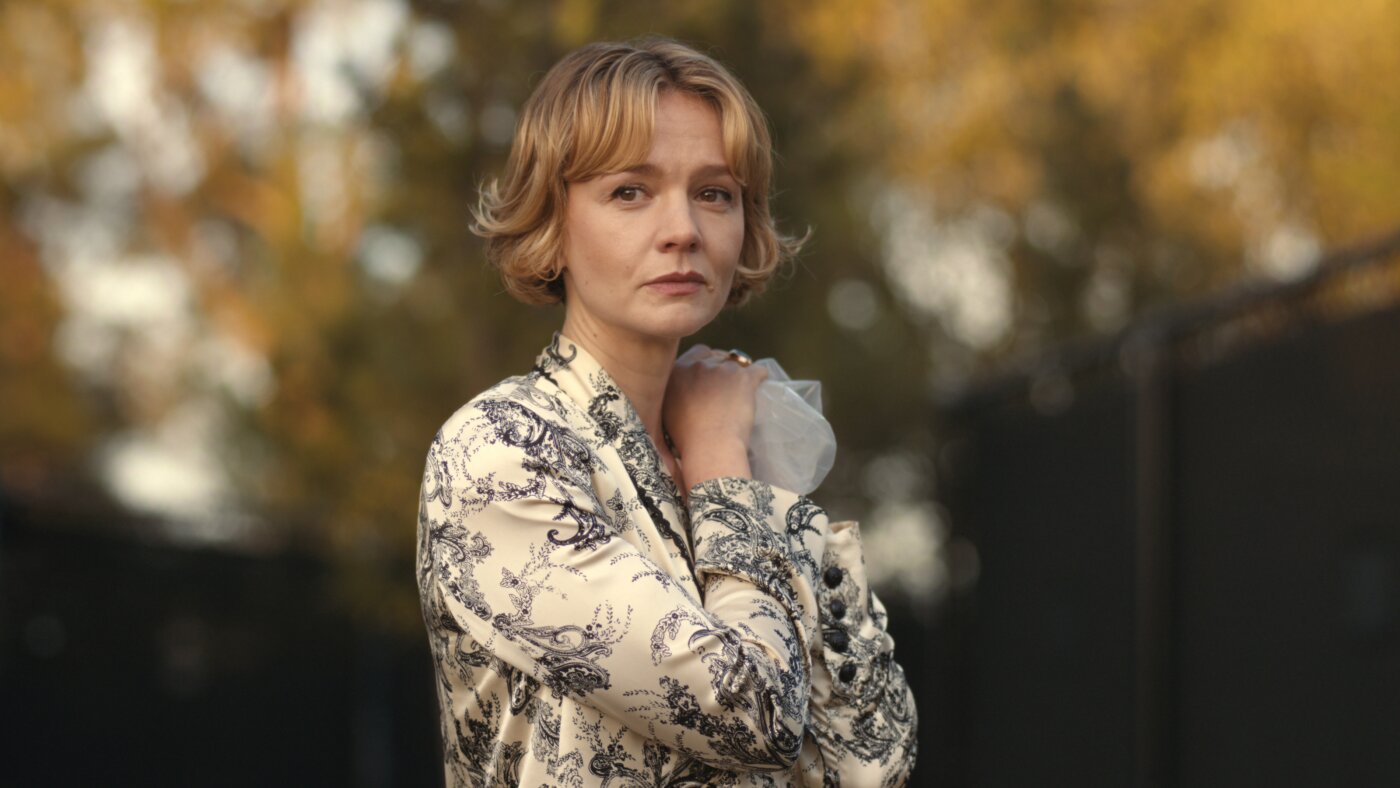
Carey Mulligan as Lindsay.
Netflix
hide caption
toggle caption
Netflix
There was something special about Lee Sung Jin’s Beef when it premiered on Netflix in 2023. The sometimes surreal but always emotionally grounded dramedy was premised upon how one minor, negative interaction between strangers — in that case, a road rage incident involving a struggling contractor (Steven Yeun) and a well-to-do business owner (Ali Wong) – can open the floodgates for misdirected anger and surface long unexamined disappointments and unrelated resentments. It tapped into something both mundane and potent, cleverly dramatizing a general sense of societal chaos via two richly-rendered Asian American leads.
Three years later, and Season 2 finds Lee swapping in an entirely new cast while pivoting the locus of ire. At its center are two couples: Josh (Oscar Isaac) and Lindsay (Carey Mulligan), the married general manager and interior designer of a Montecito, Calif. country club, and fiancés Ashley (Cailee Spaeny) and Austin (Charles Melton), low-level staff members at the club. In the opening episode, the latter couple accidentally happen upon Josh and Lindsay having a nasty drag-out fight that, from outside looking in, appears on the verge of turning violent.
As Beef reiterates many times in various ways, Austin and Ashley are Gen Z — so, naturally they capture the argument on video. The video’s existence is the first small cut of beef, which quickly ripples out to meatier and more consequential beefs, entanglements and manipulations. The younger pair, dissatisfied with their low wages and lack of health benefits, sees an opportunity to leverage what they’ve documented, and they do. But Josh and Lindsay have a lot more drama going on besides a sexless, unhappy marriage; despite their proximity to wealth and seemingly cushy lifestyle, they’re drowning in debt, and Josh’s employment at the club is in limbo as his contract nears its end. Predictably, both couples turn to extreme (and extremely illegal) measures to meet their wants and needs.
Season 1 was equally, if not more so, interested in the knotty personal lives of Yeun’s Danny and Wong’s Amy, apart from their beef with one another. Season 2 benefits from taking this same approach, though with far more primary characters to flesh out and intertwining storylines to serve, it can become unwieldy. To get across a heavily underlined message that “capitalism is soul-sucking,” an entirely separate and somewhat uninspired international plot dovetails with the quartet’s mess. Still, it’s fun to see Youn Yuh-jung leans into her role as Chairwoman Park, the shrewd and menacing billionaire owner of the club whose own dirty laundry drives much of the high-octane action in the back half of the season. (Ditto the great Song Kang-ho as Dr. Kim, the chairwoman’s much younger husband who has a poignant moment in a late episode.)
The digs at capitalism probably feel overdone because of how the media landscape looks now. It seems as if nearly every show or movie in recent memory throws in a corrupt wealthy person (or several) to comment on the disparities between the haves and have nots (The White Lotus, Triangle of Sadness, The Girlfriend) or presents middle-aged married couples wading through malaise and regret (DTF St. Louis, Fleishman Is In Trouble, plenty of Nicole Kidman projects). But it also seems like this iteration of Beef struggles with narrative substance on its own; while the exact details of how its story shakes out aren’t easily predictable, some of the emotional novelty has worn off by the time we arrive at any twists. (This is also true of some of its wry observations on cultural identity, which come off rote and obvious — a running gag is that Isaac’s Josh and Melton’s Austin are frequently perceived as ethnically ambiguous to white people. Isaac is Cuban and Guatemalan; Melton is white and Korean.)

Charles Melton as Austin, Cailee Spaeny as Ashley.
Netflix
hide caption
toggle caption
Netflix
Season 2 is compelling enough largely because its stars gamely tap into the spirit of the show’s M.O.; at any given moment, each character may reveal the worst of themselves, which looks different for everyone. Josh, for one, is an avoidant personality whose contempt simmers ominously for the demanding one percenter clientele he serves at the club, yet when he does explode, the limber and expressive Oscar Isaac lets him rip. In contrast, Carey Mulligan’s Lindsay is clearly exhausted from putting on airs as if everything between them is fine, and resentful of the sacrifices she feels she’s made for her increasingly distant husband at the expense of the dreams they once shared.
Lee Sung Jin and his writing team have added nice touches when it comes to Ashley and Austin, too – their relative youth reveals that media literacy and basic life skills are seriously lacking, all of which makes for silly comedic bits that Spaeny and Melton carry through handily. But even better is when the cracks in their “perfect,” non-confrontational relationship widen into a gaping abyss, reflecting and refracting that of their older counterparts.
“Couples fight. It’s normal,” Lindsay insists to Josh in the first episode, right after they realize Austin and Ashley were in the audience for their domestic row. Neither couple is as stable as they’ve convinced themselves they are. In its best moments, the show leans into this: depicting people who are actively avoiding reality until they’re forced to confront it by the skin of their teeth.
You’ve (finally) made an appointment with a therapist. Just getting the appointment took some legwork. This is an in-person appointment, so you walk from the nearest metro station, or step out of the ride share, or park your car. If you’re really fortunate, you were able to walk there. You arrive to the therapist’s office, perhaps anxious, flustered, maybe numb.
What do you see when you walk in?
You might enter a lobby. It might be windowless. Neutral carpeting, overhead lighting. There might be a bank of small buttons on the wall, and with one press, the button signals to the therapist in the room that you’ve arrived. That’s old school, though. You might enter an old apartment building that’s been rezoned for offices with no waiting room to speak of. Or you might enter directly from the street into an office, without the pacifying liminal space of a waiting room.
As a client of therapists in Los Angeles (one Jungian analyst in a big Westside office building, another in a home office in my neighborhood — and yes, I got to walk there), and as a therapist myself, I’m often thinking about The Room. The fantasy of the contemporary therapy room is often based on images planted by pop culture: The dark wood paneling and furniture of Dr. Melfi’s office in “The Sopranos” comes to mind, or the most recent season of the L.A.-based home office of “In Treatment,” with its distinctive view of the city and its well-appointed and colorful interior. Between just these two shows, one can see how the therapy space and how we perceive it is subtly changing.

I am not a “neutral” therapist, and so my self-designed therapy room is not a neutral, or beige, space.
The first office where I sought therapy was in a small town in the Pacific Northwest. I took an elevator and approached a door with frosted glass. The building was historical and aptly named the Security Building. I was in my early 20s. It was in that office where I began untangling some of my own history, much of which would later appear in my first book. My weekly processing of the past eventually migrated to another building when my therapist moved her practice to a house rezoned for offices in a residential neighborhood. Both locations served as a particular kind of refuge, places where I came to new understandings and occasional epiphanies. In each office, I sat across from my counselor on a couch, held in a space that she created.
“If the unconscious is structured like a language, the design of a therapist’s consulting room is also a language,” Deborah Levy writes in a recent Granta essay. As a writer/therapist, I can appreciate this — including when Levy later notes that therapy rooms are “often beige” and that even if the “room’s mood attempts to be entirely neutral, someone has art-directed its blandness.” When I think of the various therapy rooms I worked in as an associate therapist in a busy community clinic, I recall the attention to having a somewhat blank canvas across many rooms, that each could be outfitted with donated furniture, random books and an occasional piece of art. If you’ve been in therapy for as many years as I have, you probably recognize this blandness.
Up until the 1980s, there was not as much attention given to the decor of the room where patients/clients met. In the U.S. in the early ’90s, elements such as windows, plants and even aquariums were considered choices that might serve as symbolic material for the client. And with the easing of the concept of the therapist as “a blank slate,” shifts have continued to occur in therapy room decor. Where there was once an insistence on an impersonal space, there is now an acknowledgment that the therapist does not have to cloak their identity in a benign anonymity.
I am not a “neutral” therapist, and so my self-designed therapy room is not a neutral, or beige, space. In 2021, more than a year after I had stopped seeing clients in person in rented offices due to the pandemic, I had the opportunity to furnish and decorate my own home office. I thought about how best to create a container — a place where someone would cross the threshold and feel. Therapy can obviously generate loads of feelings, but the best container allows the client to feel it all, in a safe, comfortable environment.

In an episode of “Conan O’Brien Must Go,” O’Brien, dressed as Freud in a wig, fake beard and suit, visits the Freud Museum in Austria. O’Brien, gamely holding a cigar, introduces the museum director, who begins by noting that Freud’s office couch is actually housed in London. Upon hearing this, O’Brien abruptly leaves the room. Since The Couch is not in the Freud Museum, O’Brien returns to the room and does a whole bit using a blow-up mattress.
When I was buying a couch for my own therapy office, I did not think of The Couch. I did, however, think about the various therapy offices I’ve sat or reclined in. There was crying, complaining, dissociating and even laughing on those couches. No particular couch sticks in my memory, so perhaps these were neutral couches awaiting my emotions to spill out over them. When I try to remember sitting across from my therapists in their respective offices, I do remember whether there was carpet or wood floor under my feet, what the bookshelves in the room offered, and whether or not the lighting was natural, lamps or overhead.
Before I designed my own office space, I met my most recent therapist in a room of her home. The bookshelves in the room were a rich mix of cookbooks and psychology books. Occasionally my therapist would have a delicious-smelling soup on simmer in another part of the house — not a design choice, but a pleasant sensory experience in the background. When the pandemic forced us to meet outdoors, her back patio, with its tiled floor, pergola and garden became the room (albeit one with occasional mosquitoes).
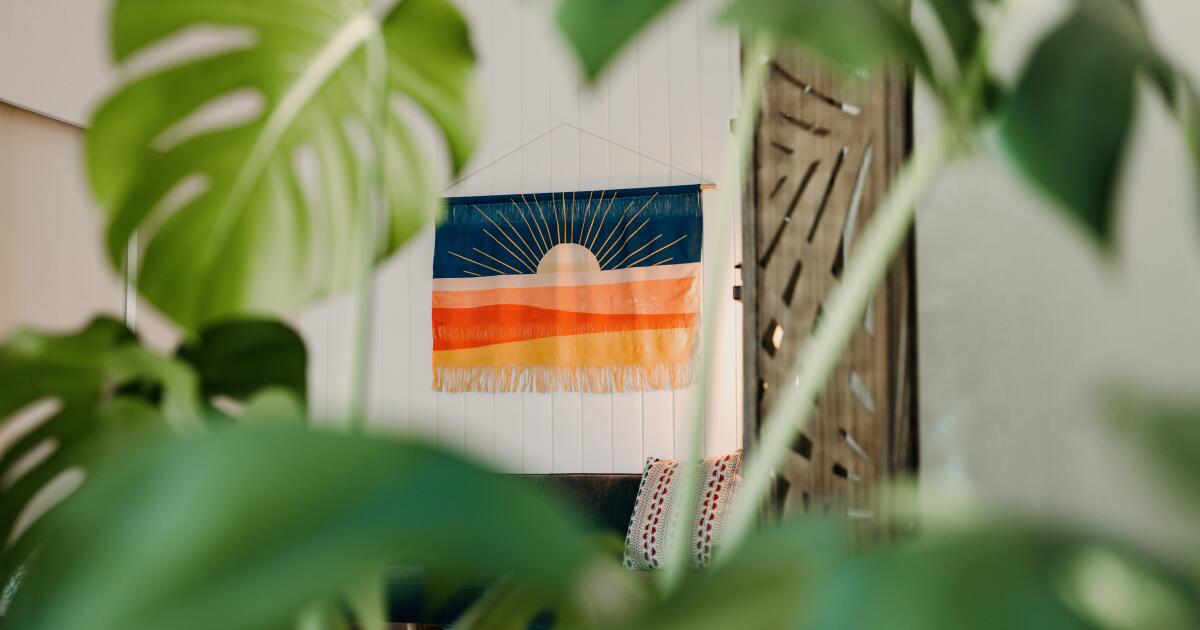
My therapy office is a 350-square-foot ADU behind my home. When a client enters, the first thing they see is a glass door with a bright yellow frame and behind it, a large monstera plant, which has grown along with them session by session. On the wall behind the couch where clients sit, I hung a tapestry that features a sun rising over an abstract landscape of pinks and yellows. Since the tapestry is in my eye line as I face clients, I think of it as a constant reminder that each person sitting in front of me has the potential to feel renewal and the possibility of change on a continual basis. The blinds on the east-facing window filter in natural light. From where my client sits on a slate blue couch, their eye might fall on the hanging bookshelves, where I’ve placed a few select volumes, such as the therapy-favorite “Waking the Tiger” by Peter Levine, as well as a few unexpected titles, like “Love in a F—Up World” by Dean Spade, and “Grapefruit” by Yoko Ono.


My therapy room is, quite literally, an extension of my home. Far from an institutional feel, the room’s colors, lighting and furnishings are meant to elicit a sense of warmth, connection and solace.
Above the book shelf is another shelf with more whimsical items: a container of various sea animal toys, for an imagined future where I offer clients sand play, as well as two varieties of cat tarot card decks. My desk, where I perch my phone atop a stack of old and new psychology tomes to see remote clients via Zoom, is its own sacred space: orange and blue dishes of honey and orange calcite, abalone shells, a stub of palo santo, and a deer figurine that reminds me of the animal images I conjured as a client doing the work of EMDR. A Himalayan salt lamp emits a soft orange light.
My therapy room is, quite literally, an extension of my home. Far from an institutional feel, the room’s colors, lighting and furnishings are meant to elicit a sense of warmth, connection and solace. And like my home, the language of this room wants to invite and beckon. It can hold the spectrum of emotions evoked in therapy, as well as the silences.
A common refrain we return to in therapy is that “everything is temporary.” Change is constant. In my ideal therapy room, plants live in the room when no one else is in it. Seasonal flowers are brought in, and when they die, composted. The scent of coffee or chai might linger. A client’s fingers might clutch a smooth black onyx, or a jagged rose quartz, or tissues. We are changed, both client and therapist, in the process. As my clients embark on the private journey that is therapy, in a room thoughtfully arranged to contain everything, the room itself is the reliable axis around which meaningful and deep changes can occur.

Wendy C. Ortiz is the author of three books and is a therapist in private practice in Los Angeles.

Winners of the 2026 Whiting Awards
The Whiting Foundation
hide caption
toggle caption
The Whiting Foundation
The Whiting Foundation announced the 10 winners of their 2026 Whiting Award for emerging writers on Wednesday night.
The esteemed early-career honor— which comes with a $50,000 prize — is given to writers “in recognition of their outstanding accomplishments and promise,” according to the foundation.
Since 1985, the foundation has awarded emerging authors with the prize in hopes of providing a launchpad for their literary success.
Past winners include now-renowned authors Colson Whitehead, Ocean Vuong, Tony Kushner, Catherine Lacey, Alice McDermott, and Ling Ma — who have gone on to win Pulitzer Prizes, National Book Awards, and Tony Awards for their writing.
Whiting Award winners generally aren’t household names yet, and that’s kind of the point. The $50,000 boost offers each 2026 recipient a chance to continue honing their craft, which the foundation says offers “a kaleidoscopic view of this moment — from the human cost of AI to the poetry of displacement, from Detroit to Kabul to the stage.”
This year’s 10 emerging authors also presented a kaleidoscope of genres to judges: nonfiction, fiction, poetry and drama.
Here are the winners of the 2026 Whiting Award:
(with commentary from the Whiting judging committee)
Negar Azimi (Nonfiction)
Azimi “explores how individuals inhabit history and how history lives through them” in her work, which includes projects like Bidoun. The judging committee says Azimi “weaves together memory, place, and exile to create a compelling story of heartbreak; a story of the lives we lead and the many more we do not.”
Elaine Castillo (Fiction)
Elaine Castillo, author of the 2025 book MODERATION and her 2018 debut novel America is Not the Heart, “deftly translates worlds into words.” The judging committee says “her work is brave and demanding, grounding our sense of present and future, while her sharp observations make us laugh, question and regret, and offer a delicious modern critique of unhinged times.”
Karen Hao (Nonfiction)
Hao is an award-winning journalist who authored the 2025 book Empire of AI. The judging committee says her work “offers a clarifying perspective amid the AI mania and lays bare the profit-seeking egos driving it.” They add that “her writing is lucid and tenacious, revealing the hubris and moral bankruptcy of those who seek to alter the fabric of human existence.”
Hajar Hussaini (Poetry)
The author of Disbound: Poems writes poetry that “propels readers to consider what war destroys and what remains.” The judging committee says her poems show how “fragments can contain the entirety of times, places, and people we thought lost.”
Hilary Leichter (Fiction)
The author of the 2020 debut novel Temporary and 2023’s Terrace Story, “traces post-pandemic loss to our upended present.” The judging committee says “her writing is assured and radiant with a fluid imagination that shapes lush worlds, at once uncanny and beautiful.”
Lara Mimosa Montes (Fiction)
The author of The Time of the Novel (2025), THRESHOLES (2020) and The Somnambulist (2016) “adeptly slows time to explore interiority and liminal territories.” The judging committee says her work is “formally innovative, playing with the possibilities of narration, while being fully tangible and present.”
Brittany Rodgers (Poetry)
Rodgers, whose poetry of place “glows with profound intimacy and care for the communities she calls kin,” writes with an unabashed celebration of place, a home for motherhood, matrilineal struggle, kink, and the pastoral.
Alison C. Rollins (Poetry)
The author of the 2019 collection Library of Small Catastrophes and 2024’s Black Bell writes poetry that “possesses a familiarity across literary traditions,” infusing it with depth and striking immediacy. The judging committee says “her painstaking research closes the gap between past and future, contributing to a new way of seeing.”
Celine Song (Drama)
The screenwriter and director of the 2025 film Materialists and the 2023 romantic drama Past Lives “pushes the bounds of theater with her moving excavation of humanity and love.” The judging committee says “she peels away historical narrative, challenging audiences to explore what stories remain below the surface, what art is staged, and who gets to tell the story on their own terms.”
Carvell Wallace (Nonfiction)
The author of the 2024 memoir Another Word for Love writes work that is at once “revelatory and discreet.” The judging committee says it is a testament to “radical care, practicing vulnerability to transform ache and memory into tenderness.” They add the book is about “coming to terms with the odds and surviving them with grace, radiance, generosity, and spirit.”

Who Will Be the Kentucky Derby 152 Favorite?

Parole committee for people convicted by nonunanimous juries advances

Meet the 2026 Outstanding Graduating Students – UMaine News

LDF Applauds Passage of Landmark Housing Legislation in Maryland

Michigan man didn’t turn right on red. So another driver hit him with ax, police say

Florida High School Football Rankings: Top 25 teams – Oct. 21

How old is Bo Nix? What to know about Oregon quarterback ahead of 2024 NFL Draft

Cleary's 21 help Le Moyne down Central Connecticut State 69-64 in OT

99th annual Pony Swim held in Virginia

Indiana Members Credit Union announced as new anchor tenant at Bottleworks District

Video: A Look at the Plans for Trump’s ‘Triumphal Arch’

First-ever moratorium on AI data centers passes Maine legislature

Flights hit by Iran war? Europe’s handiest rail networks revealed

3 things to know about naval blockades as U.S. begins patrols in the Strait of Hormuz

Video: What the Iran War Means for China
-

 Ohio2 days ago
‘Little Rascals’ star Bug Hall arrested in Ohio
-

 Georgia1 week ago
Georgia House Special Runoff Election 2026 Live Results
-

 Arkansas6 days ago
Arkansas TV meteorologist Melinda Mayo retires after nearly four decades on air
-

 Pennsylvania1 week ago
Parents charged after toddler injured by wolf at Pennsylvania zoo
-

 Culture1 week ago
Can You Name These Novels Based on Their Characters?
-
 Milwaukee, WI1 week ago
Potawatomi Casino Hotel evacuated after fire breaks out in rooftop HVAC system
-

 Austin, TX1 week ago
ABC Kite Fest Returns to Austin for Annual Celebration – Austin Today
-

 Pittsburg, PA1 week ago
Primanti Bros. closes Monroeville and North Versailles locations