Science
China’s Clean Energy Push is Powering Flying Taxis, Food Delivery Drones and Bullet Trains


As an American reporter living in Beijing, I’ve watched both China and the rest of the world flirt with cutting-edge technologies involving robots, drones and self-driving vehicles.
But China has now raced far beyond the flirtation stage. It’s rolling out fleets of autonomous delivery trucks, experimenting with flying cars and installing parking lot robots that can swap out your E.V.’s dying battery in just minutes. There are drones that deliver lunch by lowering it from the sky on a cable.
If all that sounds futuristic and perhaps bizarre, it also shows China’s ambition to dominate clean energy technologies of all kinds, not just solar panels or battery-powered cars, then sell them to the rest of the world. China has incurred huge debts to put trillions of dollars into efforts like these, along with the full force of its state-planned economy.
These ideas, while ambitious, don’t always work smoothly, as I learned after taking a bullet train to Hefei, a city the size of Chicago, to see what it’s like to live in this vision of tomorrow. Hefei is one of many cities where technologies like these are getting prototyped in real time.
I checked them all out. The battery-swapping robots, the self-driving delivery trucks, the lunches from the sky. Starting with flying taxis, no pilot on board.
Battery-swapping robots for cars
Of course, far more people get around by car. And navigating Hefei’s city streets shows how China has radically transformed the driving experience.
Electric vehicles (including models with a tiny gasoline engine for extra range) have accounted for more than half of new-car sales in China every month since March. A subcompact can cost as little as $9,000.
They are quite advanced. New models can charge in as little as five minutes. China has installed 18.6 million public charging stations, making them abundant even in rural areas and all but eliminating the range anxiety holding back E.V. sales in the United States.
Essentially, China has turned cars into sophisticated rolling smartphones. Some have built-in karaoke apps so you can entertain yourself while your car does the driving.
You still need to charge, though.
Lunch from the sky
China’s goal with ideas like these is to power more of its economy on clean electricity, instead of costly imported fossil fuels. Beijing has spent vast sums of money, much of it borrowed, on efforts to combine its prowess in manufacturing, artificial intelligence and clean energy to develop entirely new products to sell to the rest of the world.
Drone delivery has a serious side. Hospitals in Hefei now use drones to move emergency supplies, including blood, swiftly around the city. Retailers have visions of fewer packages stuck in traffic.
But does the world need drone-delivered fast food? And how fast would it really be? As afternoon approached, we decided to put flying lunches to the test.
We decided to eat in a city park where a billboard advertised drone delivery of pork cutlets, duck wings and milk tea from local restaurants, or hamburgers from Burger King. Someone had scrawled in Chinese characters on the sign, “Don’t order, it won’t deliver.” A park worker offered us free advice: Get someone to deliver it on a scooter.
Undeterred, we used a drone-delivery app to order a fried pork cutlet and a small omelet on fried rice. Then, rather than wait in the park, we went to the restaurant to see how the system worked.
Very rapid transit
China’s bullet trains are famous for a reason. Many can go nearly 220 miles per hour — so fast that when you blast past a highway in one of these trains, cars look like they’re barely moving.
In less than two decades China has built a high-speed rail network some 30,000 miles long, two-thirds the length of the U.S. Interstate highway system. As many as 100 trains a day connect China’s biggest cities.
Building anything this enormous creates pollution in its initial construction, of course, using lots of concrete and steel. Construction was expensive and the system has racked up nearly $900 billion in debt, partly because it’s politically hard to raise ticket prices.
But the trains themselves are far less polluting than cars, trucks or planes. And they make day trips fast and easy. So we decided to hop over to Wuhan, more than 200 miles away.
Taxis that drive themselves
We rolled into Wuhan looking forward to catching a robot taxi. While a few U.S. cities have experimented with driverless cars, China leads in the number on the road and where they can operate.
Wuhan is one of a dozen or more Chinese cities with driverless taxis. Hundreds now roam most of the city, serving the airport and other major sites.
But train stations are a special problem. In big cities, some stations are so popular that the streets nearby are gridlocked for blocks in every direction.
That was the case in Wuhan. Autonomous cars have not been approved in the chronically gridlocked streets next to the train stations, which meant that, to meet our robot taxi at its pickup spot, we either needed to walk 20 minutes or hop on a subway. (We walked.)
Of course if you want your own personal self-driving car, dozens of automakers in China sell models with some autonomous features. However, you are required to keep your hands on the wheel and eyes on the road. Just this month, regulators told automakers to do more testing before offering hands-free driving on mass production cars.
We wanted the full robot chauffeur experience.
Robot trucks don’t need windows
After a meal at one of Wuhan’s famous crawfish restaurants, we headed back to Hefei.
We had enjoyed Hefei’s airborne lunches, but there’s a lot more autonomous delivery in that city than just food. China still has many intercity truck drivers, but is starting to replace them with robot trucks for the last mile to stores and homes.
The trucks look strangely faceless. With no driver compartment in front, they resemble steel boxes on wheels.
The smaller ones in Hefei carry 300 to 500 packages. The trucks go to neighborhood street corners where packages are distributed to apartments by delivery people on electric scooters or a committee of local residents. Larger trucks serve stores.
Robot delivery trucks now operate even in rural areas. I recently spotted one deep in the countryside as it waited for 13 water buffalo to cross a road.
Subways get a makeover
Cities across the country are rapidly building subways. So many, in fact, that China has become the world’s main manufacturer of automated tunnel-boring machines.
It has also pioneered the manufacture of prefab subway stations. They’re lowered in sections into holes in the ground. Building a new station can take as little as two months.
Nearly 50 cities in China have subway networks, compared with about a dozen in the U.S., and they tend to be popular and heavily used.
As in many Chinese cities, people in Hefei live in clusters of high-rises, and many live or work close to stations. The trains cut down on traffic jams and air pollution.
And like so many things, new ones are usually driverless.
The changes are spreading across the country.
Many Chinese cities have not only replaced diesel buses with electric ones but are also experimenting with hydrogen-powered buses. And driverless buses. And driverless garbage trucks. And driverless vending machines.
One such vending machine was operating in the Hefei park where we ordered our drone lunches. According to a nearby hot dog vendor, the brightly lit four-wheeler drove into the park every morning, though always accompanied by a person on a bike who made sure nothing went wrong.
A robotic snack machine that needs a chaperone — how practical is that? But the fact that they are rolling around the streets of Hefei at all says something about China’s willingness to test the boundaries of transportation technologies.
Some ideas may not work out, and others might suit China but not travel well. For example, Beijing can essentially order arrow-straight rail lines to be built almost to the heart of urban areas with little concern for what’s in the way. Other countries can’t replicate that. Chinese-built bullet trains in Nigeria and Indonesia, which travel from one city’s suburbs to the next, haven’t proven nearly as popular.
Still, China shows a willingness to take risks that other countries may not. In San Francisco the death of a bodega cat, killed by a self-driving taxi, has hurt the industry’s image. But in China, fleets of similar cars are operating widely and censors delete reports of accidents. The cars are improving their software and gaining experience.
As for me, after several days putting Hefei’s idea of the future to the test, it was time to head for my next reporting assignment, in Nanjing. By bullet train, of course.



Scientists hoped for years to make a machine that could emulate the movements of diving birds, such as puffins, and offer an affordable, unobtrusive way to monitor fragile marine ecosystems. A team of researchers at M.I.T. has been able to create such a waterproof winged robot, according to a study published July 9 in the journal Science.
Nearly one month after a fire destroyed a massive cold-storage facility in Boyle Heights, the neighborhood has been overcome by the stomach-churning stench of rotting food.
As facility operator Lineage works to remove more than 85 million tons of weeks-old food from its 500,000-square-feet warehouse, the rancid odors have attracted throngs of rats and swarms of flies, as a foul-smelling brownish liquid pours from the seams of the building.
Now, with a heat wave descending over much of Southern California, residents worry the odor could get even worse and scores of residents have called air quality regulators to complain. At the same time, environmental groups are accusing Lineage representatives and emergency responders of downplaying the risks pose by chemicals released during the fire.
Boyle Heights, a neighborhood that has been subjected to decades of toxic pollution from rail yards and other industries, has again become the center of attention in another environmental disaster. Already, the official response to the Lineage fire has eroded trust in government agencies, residents say.
Remediation work continues at a Lineage facility in Boyle Heights, where residents and nearby businesses have complained of a rotting food odor for weeks.
(Allen J. Schaben / Los Angeles Times)
On Tuesday, Sen. Alex Padilla (D-Calif.) visited the gutted warehouse alongside L.A. Fire Chief Jaime Moore and representatives of the South Coast Air Quality Management District and a contingent of environmental organizations. Padilla, along with Sen. Adam Schiff (D-Calif.) and Rep. Jimmy Gomez (D-Los Angeles), wrote a letter to the U.S. Environmental Protection Agency, calling on the agency to return to the cleanup zone to monitor air and water quality.
“Given the materials present in the warehouse, we are concerned about the long-term health and environmental impacts from contaminated smoke and water runoff on communities surrounding the warehouse,” the letter read.
Joe Lyou, president of nonprofit Coalition for Clean Air, told Padilla that he has heard of people becoming sick in the weeks after the event.
“I think that pointed to a problem with the messaging while the event first happened,” Lyou said. “It wasn’t consistent [with] if you smell smoke, see ash to get out and protect yourself — make sure you’re not exposed to it. There were different messages coming from different people, and we need to fix that.”
“The whole community was completely overwhelmed … and concerned about the ammonia, concerned about burning plastic, concerned about all sorts of other [emissions] that are really hard, difficult, expensive to measure. But … we’ll just never know some of those things,” Lyou said.

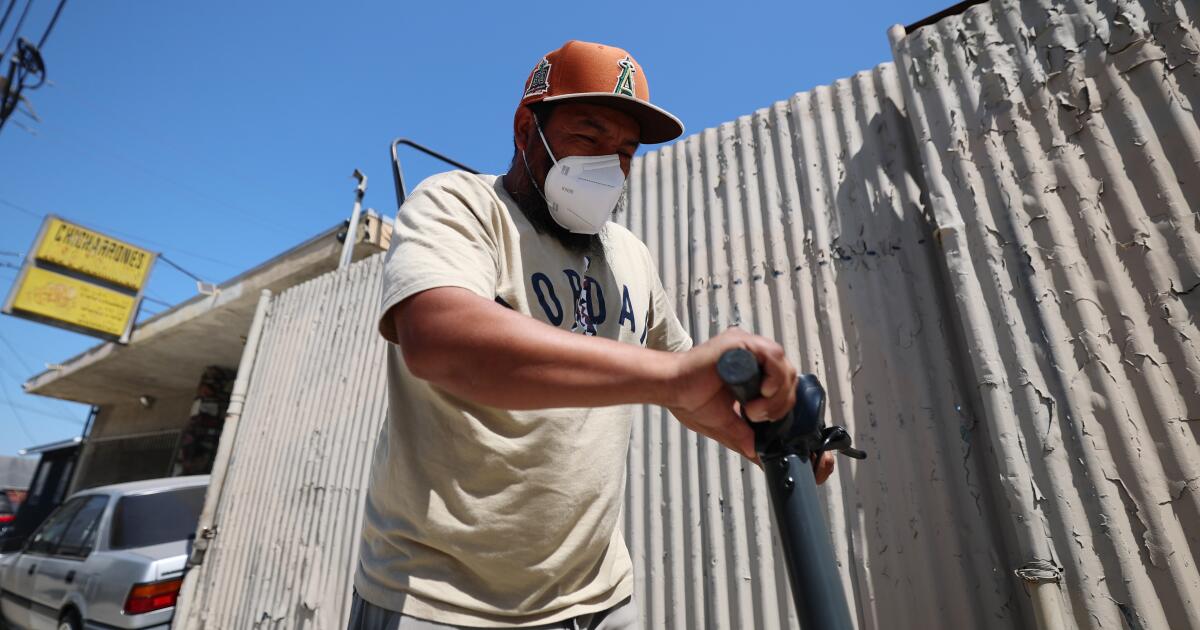
Street vendor Lupe Gonzalez pushes her cart away from a gutted warehouse in Boyle Heights.
(Allen J. Schaben / Los Angeles Times)
Chief Moore has faced criticism for his decision to advise residents to shelter indoors rather than to evacuate during the blaze. That stood in sharp contrast with Orange County fire officials, who evacuated tens of thousands of residents near an overheating chemical tank in Garden Grove in May.
On Tuesday, Moore told Padilla that the two incidents were very different. Moore said he had discussed the dilemma with TJ McGovern, the interim fire chief for the Orange County Fire Authority.
“He says everybody got mad at him because he evacuated everybody and nothing blew up,” Moore told Padilla. “But everybody’s mad at you because of the shelter-in-place [order] and it smells.”
Moore said that “there was nothing in the air that was hazardous” and that firefighters “never had a threat of an explosion.”
However, environmental experts said 14,000 pounds of flammable anhydrous ammonia were stored in tanks and used as refrigerant at the Lineage warehouse and posed a significant risk of explosion until it was removed days into the fire.
Environmental and community groups said L.A. fire officials also repeatedly emphasized the risks from ammonia in their radio communications. On the first day of the fire, a group of firefighters was hit by a plume of ammonia gas, and fire command quickly organized medical help.
“The majority of my division got exposed to ammonia gas. We’ll need to get them assessed.”
On Tuesday, Moore said no amount of ammonia was detected.
“When [firefighters] opened those doors, there was what looked like a big vapor cloud that came out,” Moore said. “That was the cold air mixing with the hot air that caused a vapor. It wasn’t ammonia.”
But residents remain skeptical.
Padilla’s visit follows a notice of violation that the South Coast Air Quality Management District issued to Lineage. The notice of violation was issued on July 12, after the agency received more than 40 public complaints of rotten, sour, garbage-type odors in the area. Inspectors confirmed the odors with community members and traced them back to cleanup operations at the facility, according to the air quality agency.
Boyle Heights residents are calling on Gov. Gavin Newsom to declare a mandatory evacuation of their community, saying the fire and the toxic aftermath are continuing to pose health risks. Without an evacuation order, they said, insurance companies won’t help residents who want to relocate with rent or mortgage relief.
“For nearly a month, a cold-storage warehouse fire has poisoned the air over the Eastside and Los Angeles County and City officials have refused to issue a mandatory evacuation,” read a statement from the community group Protect LA Now. “That refusal forces victims to pay their own way out, and leaves those who can’t afford to leave trapped in gases and toxins that no agency will name.”

Joe Lyou, president of the Coalition for Clean Air, explains how smell is affecting his health while talking to the media near a fire-gutted Lineage facility Tuesday.
(Allen J. Schaben / Los Angeles Times)
Tensions have been building in the community since the fire broke out on June 17 and burned for days.
At a contentious town meeting last week, Los Angeles Mayor Karen Bass struggled to open the meeting over the loud boos and yelling of community members, actions that were repeated as other elected officials took the microphone. The crowd grew even louder when Lineage Chief Operating Officer Jeff Rivera took to the stage and was met with shouts of “Liar!”
Air quality has been a constant concern for the community since the incident began. Beyond the health hazards of breathing in smoke from a building fire, there was a brief, temporary scare when an ammonia line that helped keep the building refrigerated was compromised, though Lineage has said the chemical was not detected in the air. Additionally, 85 million pounds of food thawed, burned and spoiled inside, creating a terrible smell that emanated from the property.
Nora Saenz, a resident of Bell, said she believed local leaders when they said there was no threat. During the fire, she took her niece and nephew to a community event in La Mirada, which was downwind of the fire.
Now Saenz fears what they might’ve breathed in.
“The day of the fire, we were told that the air was safe to breathe,” she recalled. “To this day, I don’t know what I exposed my niece and my nephew to.”
Times staff writers Salvador Hernandez, Clara Harter and Seamus Bozeman contributed to this report.
Video released by Chinese state media shows a state-owned aerospace company launching a rocket and recovering part of it on Friday. The successful launch of a reusable rocket was a major step for China toward challenging SpaceX’s satellite internet dominance.
-

 Iowa5 minutes ago
Iowa State Basketball Will Have Work To Do Following Recent Bracketology Update
-

 Kansas11 minutes ago
Kansas cases climb in ‘explosive diarrhea’ outbreak
-

 Kentucky17 minutes ago
Drafted by Reds, Matt Ponatoski enrolls at University of Kentucky
-

 Louisiana23 minutes ago
New Louisiana waterway cleanup initiative aims to start in September
-

 Maine29 minutes ago
“I’m Ashamed of My Country”: Biddeford, Maine Locals Grieve Neighbor Killed by ICE
-

 Maryland35 minutes ago
Maryland Fall Home & Garden + Craft Show returning in October
-

 Michigan41 minutes ago
University of Michigan’s David C. Miller chosen to succeed Jeff Balser as Vanderbilt Health’s President and CEO and Dean of Vanderbilt University School of Medicine
-

 Massachusetts47 minutes ago
Massachusetts Broadband Institute distributes devices to underserved communities

