Fitness
Busting 5 common wellness myths


During one of my recent doom-scroll sessions on the ‘Gram, I came across a fitness influencer who sticks “yoga teacher & nutritionist” against her name, has 236,000 followers, and in one of her videos was claiming to teach us how to ‘naturally’ increase our height.
The first exercise to increase your height, according to the influencer, is three sets of hanging from a bar for 30 seconds. I have been a monkey all my life and hanging from a bar is something I started doing as a kid and, firmly in my 40s now, I still do it. Since forty years of hanging from a bar failed to do anything for my height, it got me thinking how much of such ‘fitfleuncer’ content is actually factual and scientific.
While I shall save the question of whether one should follow fitness, health, wellbeing, and nutrition advice from someone with vague credentials on a social media platform for another day, for now let’s explore how much water some popular health myths hold.
A spoon of ghee/butter in coffee is good for health:This is a topic of debate in the health and wellness world, says Shalini Garwin Bliss, executive dietician at Manipal Hospital in Gurugram. She notes that proponents of this argue that the healthy fats in ghee or butter can provide a slow-release source of energy and promote satiety. However, Chandni Haldurai, the head nutritionist at Cult Fit, warns against doing this, no matter how delicious it sounds.
“Coffee with ghee or butter may sound delicious, but it’s not always a good idea. Although these fats can give you a brief energy boost, their high-calorie content quickly adds up. This tendency may not be helpful for people seeking to control their cholesterol or weight,” says Haldurai. It’s crucial to remember that this extra fat contributes to increased calorie intake, potentially hindering weight management efforts, adds Bliss.
Apple cider vinegar is good, helps burn fat:This idea is big these days as not only influencers but gym trainers and coaches also support the idea of having daily doses of apple cider vinegar. While there are several potential health advantages of apple cider vinegar, including improved digestion and prevention of increases in blood sugar, it is not a miracle cure for weight gain, says Haldurai.
“There is no magic bullet for weight loss. Simply consuming apple cider vinegar daily is unlikely to lead to significant weight loss without complementary lifestyle changes like a balanced diet and exercise,” says Bliss.
A comprehensive strategy for weight management that incorporates nutrition, exercise, and lifestyle modifications is the only efficient way to achieve and maintain weight loss. Alas, it’s common to exaggerate claims of miracle weight loss without making the necessary efforts, say coaches and nutritionists.
Jaggery and demerara sugar are safe:Sugar is the top enemy of anyone even mildly invested in health. But many simply replace refined sugar in their diet with jaggery and demerara sugar. Next time you put that second spoon of jaggery or demerara sugar in your tea or coffee, you should remember that despite being less processed than refined sugar, both are still sugars and can have an impact on blood sugar levels.
“Due to their low processing and trace nutrients, they might be marginally preferable solutions, but people with prediabetes or diabetes shouldn’t choose them. Anyone ingesting these alternatives needs to practice moderation and keep an eye on their blood sugar levels,” warns Haldurai. Moderation is all sugar and sugar substitute intake is the key, warns Bliss.
Freshly squeezed and cold-pressed juices are healthy:It is indeed true that fruit juices that have been freshly squeezed or cold-pressed retain more nutrients than packaged juices. But all such juices have little to no fibre. Due to their high fibre content, which helps slow down the absorption of sugar, whole fruits provide the most advantages, says Haldurai. However, if you must have your fruits in liquid form, smoothies that are made with whole fruits, yoghurt, or vegetables are preferable, since they retain fibre and offer a more well-balanced vitamin profile.
Hanging leads to height gain:Saved the best for last. If only hanging from bars actually led to height gain, many of us would have been giants. There is no good evidence or study to support these claims, says Dr. (Prof.) Amite Pankaj Aggarwal, directorand head of the department for orthopaedics, Fortis Hospital, Shalimar Bagh in New Delhi.
“It’s amyth that certain exercises or stretching techniques, such as pull-ups and hanging from a rod, can make you grow taller,” says Aggarwal, dismissing the tall claim.
Height gain depends on a lot of factors, from one’s genetics to diet to muscle strength, explains Dr. Poonam Sidana, neonatologist and paediatrician, CK Birla Hospital, NewDelhi.“Those who go out and play sports such as basketball are more likely to grow stronger because they are actually running around and are able to use all their bigger muscles. So, it really is a combination of things and cannot be attributed to a single activity,” adds Sidana.
Shrenik Avlani is a writer and editor and the co-author of The Shivfit Way, a book on functional fitness.



You don’t have to join a gym. Home workouts with resistance bands, body-weight movements, and other routines were just as effective as using gym equipment. The authors also found that you don’t have to work your muscles to the point of complete fatigue.

Chasing after your dog, catching yourself before you fall, jumping over a big puddle. These activities all have something in common, and it’s not just that they’re the makings of a very bad day. They rely on power: the ability to generate force quickly. It’s an often overlooked part of the fitness menu that experts think deserves more attention.
Mobility, cardio and strength all help us stay active and healthy as we get older. Strength training in particular has boomed in recent years, as the importance of building muscle mass to keep us strong, protect our bones and help us stay mobile as we age becomes more widely recognised. But when it comes to activities such as pushing yourself up from a chair or moving your arms quickly to break a fall, the size of your muscles will only get you so far. You also need power.
Imagine throwing a shot put, says Oly Perkin, a researcher at the University of Bath specialising in exercise to improve health at all stages of life. “You might have the strength to move the shot put from a start position to the top position. That’s largely down to your muscle mass. But to do that super quickly, to produce the force needed to propel the shot into the air, a different kind of strength is required.”
That explosive force depends on how quickly the nervous system can activate those muscles – the speed and efficiency of the brain-muscle connection.
For younger, active people, improving power can help prevent injuries. It can also help people who lift weights break through a training plateau. Where power training may matter most, though, is in reducing some of the effects of ageing.
“As you get older your muscles shrink and that is inescapable, irrespective of how active you are,” Perkin says. “If you make sure that the neural element is maintained alongside the muscle, your ability to maintain physical function across your life is much better. Even if you inevitably lose muscle mass, there’s good evidence that you can make better use of the muscle you have.”
The challenge is that power tends to decline faster than strength. After the age of 40 people typically lose about 1-2% of muscle mass each year. Alarmingly, muscle power can decline earlier and much more rapidly. The encouraging news is that power can be trained.
You build muscle by moving heavy weights a few times a week and increasing the load as it becomes manageable. The tension that the exercise places on the muscle fibres triggers a remodelling process that leaves the muscles better able to handle the stress next time.
Power is built differently. Instead of lifting heavy weights you move lighter weights, or your own body weight, but as quickly as possible. This could mean plyometric exercises such as box jumps. It could also include weighted movements such as throwing and catching a medicine ball, weighted jumps, snatches (where you grab a dumbbell from the ground and pull it towards the ceiling) and kettle bell swings. Weight-wise, you want something at about a six-out-of-10 difficulty level.
For older or less mobile people, power training can start with very simple movements. Try wall push-offs: lean diagonally with your hands against a wall, arms bent, and push yourself away at speed.
Perkin adds that, although everyone can benefit from training power, it may be especially valuable for older adults who have already experienced a significant decline in muscle mass. When muscle loss reaches the point of immobility, rebuilding it becomes very difficult. But improving the nervous system’s ability to activate the muscle that remains is still possible. “Growing muscle when you’re old is hard. There are physiological limits,” he says. “But for most older adults the capacity to improve neural function is still quite good. Within three or four weeks you can start to see improvements in key markers.”
If you’re thinking of stepping into your power, Perkin, alongside Alex Dinsdale, senior lecturer in sport and exercise biomechanics at Leeds Beckett University, and Leigh Breen, a leading expert in the field of skeletal muscle physiology and metabolism from the University of Leicester, share their tips.
Find your benchmark
A good way to test whether you could benefit from power training is if you can hold a squat but can’t squat jump more than a couple of inches off the ground, says Perkin. But jumps are also useful for measuring progress for those who have already built some power. Dinsdale says that when he works with athletes they regularly test power by incorporating jumps into sessions and measuring the heights or distances achieved. This may include static jumps on to boxes or broad jumps where you jump forward from a standing start.
For older or less active adults, the sit-to-stand test is useful. Sit in a chair with no armrests, cross your arms over your chest with your hands on your shoulders and keep your feet flat on the floor. How many times can you move from sitting to standing in 30 seconds? Over-65s should aim for at least 11 repetitions.
Perkin recommends using the same exercise to improve your power by doing three sets of 12 to 15 sit-to-stands while wearing a weighted vest.
Train with a goal in mind
“Obviously the main goal should be good general health and longevity,” says Breen. “But beyond that, everybody has something specific they want to achieve.” It’s useful to keep that end goal in mind as a motivator, as you’re less likely to see visible results than you are with strength training. It doesn’t have to involve training for a marathon or doing a Hyrox competition. It could simply mean restoring a functional ability that has been lost, such as being able to throw the bin bags into the outside bin or chasing the grandchildren around. “I think it’s always important to keep the purpose in mind when we undertake a training regime,” says Breen.
Get the timing right
All our experts say power training should come after you’ve warmed up, but early in your workout. It’s harder to develop neuromuscular speed when your muscles are fatigued; and it’s easier to injure yourself doing rapid movements when you’re exhausted.
Keep sessions short, adds Dinsdale. The focus is on how quickly you can move something, which means working at your maximum possible speed. You can only sustain that for short bursts. If you’re using weights, choose a light or moderate load and move it five or six times. Do three sets of three exercises, resting between them. You’ll want two to five minutes between sets so your systems can recover fully.
You don’t need a separate session
Doing a couple of power exercises a few times a week is more effective than doing many of them once a week. A simple approach is to add a 10-minute power block to the beginning of any regular strength workout. That could be three rounds of 10 kettlebell swings (which help with the posterior power chain), medicine ball throws and slams (to improve upper body speed) and weighted squat jumps (lower body).
Runs can also be tweaked to include power work. “You could do short periods of sprinting, maybe five or 10 strides as quickly as you can,” says Perkin. “Or stop briefly and do a few vertical jumps.”For those who aren’t confident with weights or jumping, Breen recommends doing medicine ball throws while seated (they’re still effective).
Take it steady
On first trying power training, it’s tempting to reach for heavier weights than necessary, says Dinsdale. Instead start lighter. “Use about 50 to 60% of whatever your maximum is for that movement [your maximum is the weight you can only lift once], and then build up,” he says. He adds that there’s very little benefit to going very heavy with these kinds of exercises if your focus is building mind-muscle connection.
Because you’re moving quickly, safety matters. As well as lighter weights, it’s important to focus on maintaining good form. If you’re unsure, Dinsdale recommends working with a trainer or taking gym classes while you build confidence.
Don’t be fooled by the name of workouts
Confusingly, powerlifting – lifting heavy weights without a time limit – doesn’t actually train power. Olympic weightlifting – with moves like the clean-and-jerk, where a barbell must be moved quickly off the floor and then into the air – does. For most people, power walking doesn’t train power either.
Use power to break through a plateau
Power training can also help people who feel stuck in their strength training. “When you lift weights you can reach a plateau where it becomes difficult to increase muscle size further,” says Perkin.
Adding lighter power work for a few weeks can sometimes unlock further gains. It forces your body to adapt by increasing the efficiency of the neuromuscular system. This enhances your ability to move heavy weights when you go back to them. “Then you have the opportunity to grow more muscle again. There’s a crossover effect,” adds Perkin.
Try a sport
If gyms feel intimidating and you’re right at the start of a power journey, playing sport can be another way to develop a beginner level of power. Activities such as tennis, padel, football or netball involve short bursts of acceleration that engage the mind-muscle connection, with the added social benefits. Contact sports, such as rugby and boxing, require explosive power too. The most important thing is finding a varied routine you enjoy.

The Artemis II crew — Christina Koch (left), Jeremy Hansen, Victor Glover and Reid Wiseman — have to share tight quarters aboard the Orion spacecraft on their way home. But even with limited space, they can still get a solid workout in — thanks to a very special piece of equipment.
NASA
hide caption
toggle caption
NASA
Even a few days away from Earth can significantly alter the human body. Without the constant pull of gravity on the skeleton, muscle and bone can quickly atrophy. To combat this immediate physical decline, the four astronauts aboard Orion on the Artemis II mission are using a specially designed machine known as the flywheel.

In a video blog posted before the crew launched, Canadian astronaut Jeremy Hansen compares the flywheel to a rowing machine. “Like a cardiovascular workout where you row at a lower resistance and a fast pace,” Hansen explains as he demonstrates the flywheel’s functionality. Astronauts strap their feet onto a small platform and pull on a handle connected to a cable. Pulling spins a flywheel. It works like a yo-yo, according to NASA — astronauts get as much resistance as they put into it.
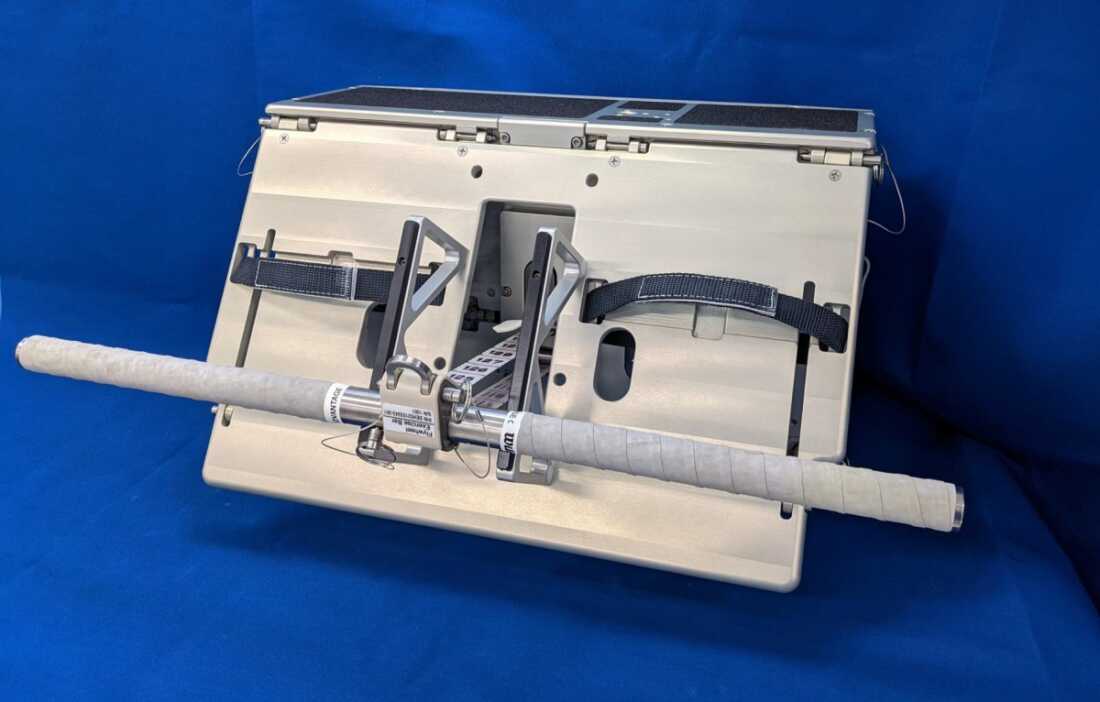
The Artemis II crew exercises on Orion using a flywheel, a simple cable-based device for aerobic and resistance workouts.
hide caption
toggle caption
The flywheel is small, not unlike an extra large shoebox. Working in Orion’s tight quarters — only 316 cubic feet , about the size of a smallish bedroom — engineers had to design this device to perform with utmost efficiency, so that it can both provide a cardiovascular workout and resistance exercises up to 400 pounds. Astronauts can use it to do weightlifting moves like squats, deadlifts and curls.
Before the astronauts, there were the pillownauts
The flywheel has been years in the making. Jessica Scott, an exercise physiologist at Memorial Sloan Kettering Cancer Center, worked on early prototypes for NASA, anticipating that astronauts would be vulnerable to rapid muscle atrophy without physical exertion.

Scott compares ten days in space to ten days in bed. Atrophying for that amount of time, says Scott, “You would feel very weak and your muscles start to lose size very quickly.” The heart, she stresses, is especially vulnerable with this decline in strength.
When recruiting people to study these early flywheel prototypes, says Scott, researchers looked for 30 subjects willing to lie in bed for 70 days. She and her colleagues weren’t sure they would be easy to recruit.
Turns out, people were eager to spend hours a day reclining in the name of science.

“We had over 10,000 people apply for 30 positions,” says Scott.
They called themselves the “pillownauts.”
Researchers divided these participants into different groups. Some stayed in bed all day. Some of them broke their bed rest in order to work out on a more traditional suite of exercise equipment, and some of them used the flywheel. The goal was not to improve fitness, but to prevent declines.
The flywheel, says Scott, delivered the results researchers were hoping.
“What was really exciting was that the small device could prevent the declines, the same amount that a full gym could do,” she says.
Other missions — like those aboard the International Space Station — have full suites of exercise equipment. The flywheel has not yet been tested for longer durations, but Scott says she’s hopeful it could also provide fitness for astronauts in longer periods of gravity deprivation.
Not everyone’s an astronaut, but everyone ages
Even for people who are not planning on orbiting the moon — this research has important implications, says Thomas Lang, a radiologist who studies bone and muscle loss and has worked with NASA on exercise science for previous missions.
“You start childhood and then as you grow your bone density and mass reach a peak,” says Lang, “in your late twenties or early thirties.”
Those who are lucky to live to old age, he says, will experience hormonal changes that lead to bone loss over time. For women, that escalates sharply in menopause. “That’s a big whopping decline,” says Lang.
Men’s decline may not be as dramatic, says Lang, but they are also vulnerable, especially as they live into their 70s and 80s.
NASA researcher Jessica Scott is also hopeful this work could have broader applications for the general public. Few of us will travel to space, but many of us can relate to dealing with time and space constraints when it comes to exercise, says Scott.
“One day we could all be having our own flywheel,” she says — something small enough to fit under a desk at work, or in the corner of an office.
After his first 30-minute aerobic session with the device, astronaut Reid Wiseman said he was happy to report that in addition to providing a good workout, he was pleased the flywheel didn’t drive his roommates too crazy. No one had to wear ear plugs to block out the sound.
“ It is a really good piece of gear and we can actually get a nice workout,” says Wiseman. “I look forward to the next time I get to try a resistance workout.”

Report: Wisconsin transfer John Blackwell down to six schools, not two

Trump promised to cut electric costs in half. In energy-rich West Virginia, bills now top mortgages

Keenan Morgan to run for House District 58 seat

OKX Invests in Vietnam Exchange CAEX Ahead of Crypto Pilot

Opinion: Teaching kids how to manage money is now a reality in New Hampshire – Concord Monitor

Florida High School Football Rankings: Top 25 teams – Oct. 21

How old is Bo Nix? What to know about Oregon quarterback ahead of 2024 NFL Draft

Cleary's 21 help Le Moyne down Central Connecticut State 69-64 in OT

99th annual Pony Swim held in Virginia

Indiana Members Credit Union announced as new anchor tenant at Bottleworks District

Trump adversary running for Senate borrows his filibuster playbook

Russian propaganda unit targets Hungary’s elections

WATCH: Artemis II astronauts splash down on Earth

Swalwell’s former female staffer drops bombshell allegations of sexual assault, exposing himself: report

NASA’s Artemis II prepares for splashdown on Earth
-

 Atlanta, GA6 days ago
1 teenage girl killed, another injured in shooting at Piedmont Park, police say
-

 Education1 week ago
Video: Toy Testing with a Discerning Bodega Cat
-

 Movie Reviews1 week ago
Vaazha 2 first half review: Hashir anchors a lively, chaos-filled teen tale
-

 Georgia4 days ago
Georgia House Special Runoff Election 2026 Live Results
-

 Pennsylvania5 days ago
Parents charged after toddler injured by wolf at Pennsylvania zoo
-

 Arkansas20 hours ago
Arkansas TV meteorologist Melinda Mayo retires after nearly four decades on air
-
 Milwaukee, WI5 days ago
Potawatomi Casino Hotel evacuated after fire breaks out in rooftop HVAC system
-
 Entertainment1 week ago
Inside Ye’s first comeback show at SoFi Stadium