
Connect with us

Entertainment

Opera gets slapped with the 'elitist' label. L.A. proves just how wrong that is

Published

on

Opera gets slapped with the 'elitist' label. L.A. proves just how wrong that is

The label of elitism sticks to opera like superglue. The label is a fake, but one for which no cultural chemical capable of removing it has yet proved effective. Still, opera populists are trying and appear to be making progress.

Los Angeles Opera last week unveiled two new productions of operas old or avant-garde: Verdi’s 19th century chestnut “La Traviata,” and Huang Ruo’s 2021 “Book of Mountains and Seas,” based on ancient Chinese myths. Both are literally worlds apart, they were given in theaters large (the Dorothy Chandler Pavilion downtown) and small (the Broad Stage in Santa Monica), and they were designed for different audiences. The performances I saw were well attended and enthusiastically received.

Both raised the question of what makes opera elite, as opposed to, say, a Lakers game. Wealth or privilege, say the lexographers at Oxford, a university where wealth and privilege have sway. As I write, tickets purchased on the L.A. Opera website for the Wednesday performance of “La Traviata” range from $89 to $329. The next night, the Lakers take on the Denver Nuggets at Crypto.com Arena. Cash in your crypto (if you still can) for nuggets of gold: Tickets on the Lakers website begin at $249, rising to five grand. Event parking at the Music Center is $10, a quarter of the price Crypto.com charges for a Lakers game.

Opera has been popular entertainment through much of its early history. Castrati were the pop stars of the Baroque era. At the time Verdi wrote “La Traviata,” he was so popular that his latest tunes were as closely guarded before a premiere as a Beyoncé track.

There were peanut galleries in all the great 19th century European opera houses, and there have been cheap seats ever since. As a student, I often attended San Francisco Opera several times a week, standing room being no more than the price of a movie. Tickets for L.A. Opera mainstage productions start around $35 or less, and they go fast.

Advertisement

The intimidation factor is often the main reason credited with keeping new audiences away from opera. What to wear? There is no dress code. Some people dress up, and hard-core fans can be found in jeans.

What to know? When I listen to a rap recording, I sometimes employ a guide to follow allusions in the lyrics that may escape me. If “La Traviata” is a mystery to you, arrive an hour early and the company’s music director, James Conlon, will explain it to you in his engaging pre-performance talk. A plot synopsis is in the program and English translations of the libretto are projected on screens during the performance.

That said, there is always the danger of a welcome turning into glad-handing. In the recent past, L.A. had been in the process of becoming a leader in taking bold theatrical chances, making our opera some of the most relevant theater anywhere and L.A. the hippest opera city in America. But we have entered a culturally risk-adverse period. Our present age of anxiety — which includes post-pandemic economic challenges to the arts, diminished attention spans and audiences seeking escape from all but virtual reality — has ushered in an atmosphere of caution in just about everything presented to the public.

A successful L.A. Opera strategy for building new audiences has, therefore, been precisely the opposite of challenge. Real old-fashioned opera, the more retro the better, has become the new cool.

Liparit Avetisyan as Alfredo, far right, Rachel Willis-Sorensen as Violetta (seated in blue) and the cast of L.A. Opera’s “La Traviata.”

Advertisement

(Cory Weaver / LA Opera)

The “Traviata” production the company imported from San Francisco Opera fits right in with period sets and costumes so formulaic as to feel ironically surreal, along with park-and-bark direction for the singers. There is a hint of wink-wink-nod-nod kink in a party scene (this is from San Francisco, after all), comic not erotic.

The performance sounds far better than it looks thanks in large part to Conlon’s commanding conducting that makes everything seem to matter despite appearances. The standout in the cast is the Violetta of Rachel Willis-Sorensen, her silvery and supple soprano making for a more brilliant than affectingly consumptive character. The starchy tenor, Liparit Avetisyan, as Violetta’s lover Alfredo, seems to like singing to the audience more than to her.

Ironically, the appeal may be that this is just outdated enough and nonthreatening enough to feel newly fashionable. The silly kink brings a smile. Any intimations of feminism dare seem threatening. By escaping modern theater, by not allowing “La Traviata” to be upsetting, we are offered a three-hour escape from reality.

Advertisement

In its attempts at opera for all, the Los Angeles company also has found ways to take opera out of the opera house. On May 3 and 4, Conlon brings back his warm, magnificent, family-friendly and free L.A. Opera production of Benjamin Britten’s “Noah’s Flood” at Our Lady of the Angels downtown. Expect to leave the cathedral feeling better than when you entered.

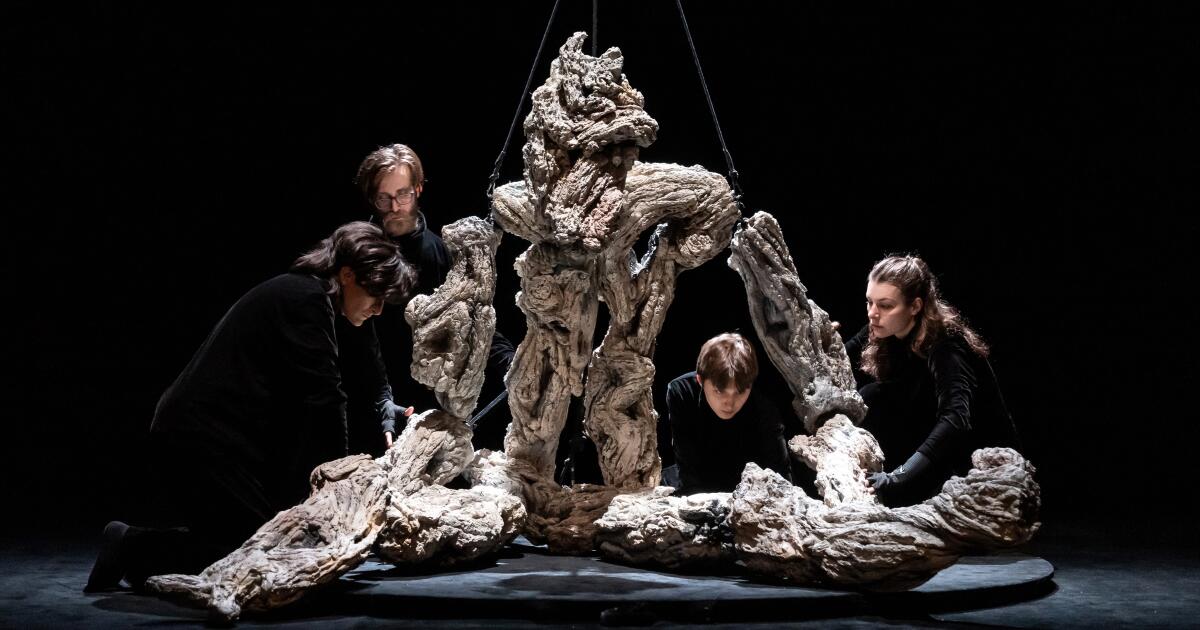
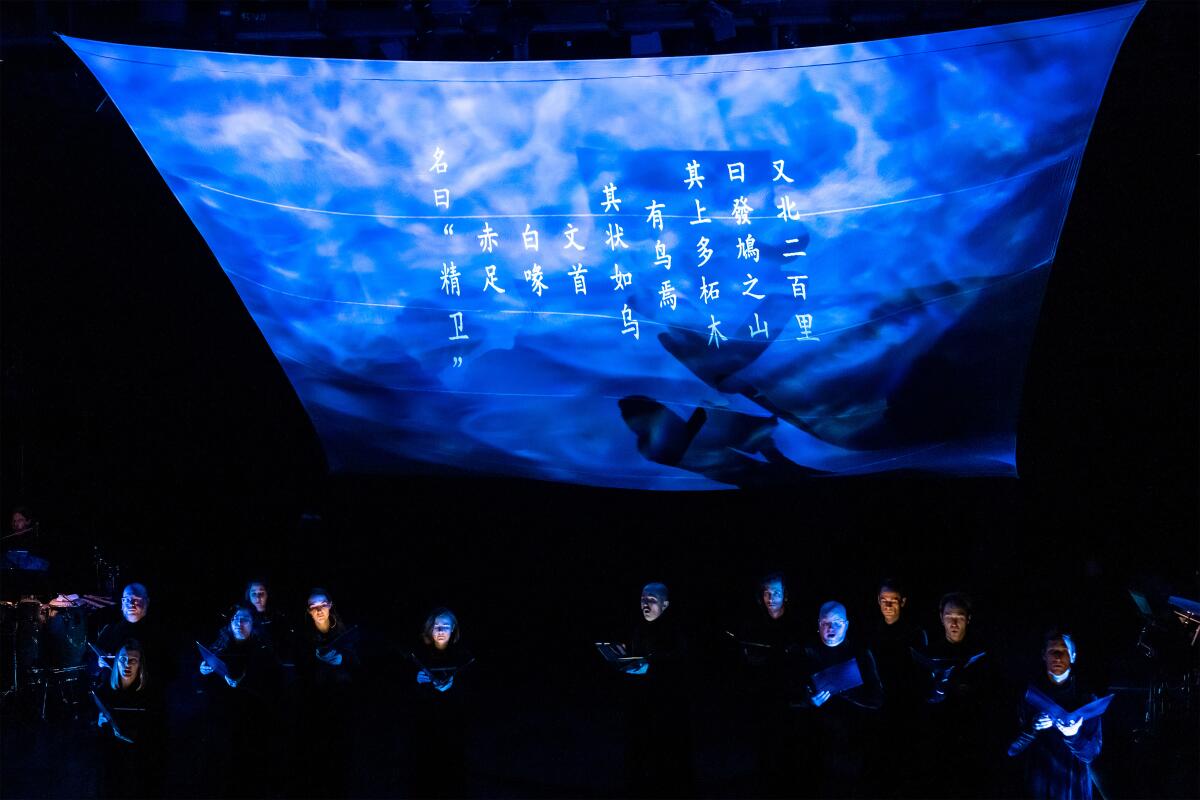
Experimental opera was also sent off Grand avenue. At the Broad Stage, “Book of Mountains and Seas” — part of L.A. Opera’s annual collaboration with Beth Morrison Projects, makers of new opera — was everything that “Traviata” was not. The imaginative production by puppeteer Basil Twist proved stunning. The cast contained a dozen equally ideal singers. What vague narrative there is comes across as barely explicable. Words and music didn’t matter all that much. The escape from reality, in this case, was of the go-with-the-flow variety.

A scene from 'The Book of Mountains and Seas'

A scene from “The Book of Mountains and Seas,” produced by Beth Morrison Projects.

(Steven Pisano)

Huang Ruo’s impetus is “The Classic of Mountains and Seas” from ancient China, which describes the mythic plants and creatures with odd powers. The four tales selected from “The Classic” for the opera — the birth of the hairy giant Pangu, a spirit bird who attacks water, the folly of 10 suns, and a giant who thinks he can capture the sun — are dramatized through the fuzzy ritual of a puppet being assembled.

Advertisement

The singers, the Ars Nova Copenhagen, are the real stars. Indeed for the West Coast appearances of “Mountains and Seas,” which is currently touring, this amazing Danish chamber choir might well have set the scene for the 75-minute opera with Lou Harrison’s “Mass for Saint Cecilia’s Day.” The group’s meditative yet exhilarating recording of this Californian mix Harrison’s gothic chant and ancient Asian tunings is a model for what Huang Ruo was after. Still the sounds were entrancing and the giant puppet impressive.

Atmosphere may not an opera make, but as escapes from reality go, there are far fewer appealing ones than this. And with luck L.A. Opera’s efforts at taking the elitism out of opera may make a difference. In the next two months, the town will be the site of an informal opera-for-all festival.

The Los Angeles Philharmonic is remounting “Fidelio” with Deaf West Theatre next month, Opera America and World Opera Forum host conferences in L.A. in June, and new work is coming from Long Beach Opera and the Industry — along with dozens of offerings from L.A. Opera, the happily populist Pacific Opera Project, Beth Morrison and others. Anyone with a stage, a costume, a voice and an idea is welcome. That is the L.A. opera ideal.

Advertisement

Movie Reviews

‘Ben’Imana’ Review: Rwandan Women Confront National Wounds and Family Secrets in a Searing Drama

Published

on

‘Ben’Imana’ Review: Rwandan Women Confront National Wounds and Family Secrets in a Searing Drama

“I forgive” are the first words uttered by Vénéranda in Ben’Imana, but her ferocious gaze and the clamp of her arms across her chest tell a different story. At the center of a fine cast of mostly nonprofessional actors, Clémentine U. Nyirinkindi brings Vénéranda’s resolve and all her painful contradictions to life in Ben’Imana, a searing and intimate portrait of a nation’s reckoning.

Writer-director Marie-Clémentine Dusabejambo’s drama is set in the Rwandan village Kibeho in 2012. It’s the final year of the Gacaca courts, community tribunals focused on addressing the genocidal crimes committed, neighbor against neighbor, in the previous decade. Through the character’s complex and often tense relationships with her teenage daughter, her sister and her mother, as well as with other women in her village, Dusabejambo has crafted a story that’s both emblematic and achingly specific.

Ben’Imana

The Bottom Line

Mother courage.

Advertisement

Venue: Cannes Film Festival (Un Certain Regard)
Cast: Clémentine U. Nyirinkindi, Kesia Kelly Nishimwe, Isabelle Kabano
Director: Marie-Clémentine Dusabejambo
Screenwriters: Marie-Clémentine Dusabejambo, Delphine Agut

1 hour 41 minutes

The person Vénéranda officially forgives in the opening scene is Karangwa (Aime Valens Tuyisenge), the man accused of murdering her siblings and other relatives. Of the eight children their mother (Arivere Kagoyire) raised, only Vénéranda and her sister Suzanne (a riveting Isabelle Kabano, who starred in Eric Barbier’s Small Country) survive. Suzanne’s fury is as explosive as her sister’s is contained. Contending to the judge (Adelite Mugabo) that Vénéranda “has no right to forgive on behalf of our family,” she’s determined to bring Karangwa to justice.

And she has no use for the community meetings that Vénéranda has begun leading, in her role as the district’s social affairs officer. Local women are invited to share still-raw memories, to grapple together with the kinds of things that would be immaterial to the courts. Their sessions are part of the country’s “Rwanditude” program, designed to reunite Rwandans after years of ethnic conflict and bloodshed.

Advertisement

Just as mentions of ethnicity are verboten in the courts, there’s no such identification in these gatherings, no way of knowing whether any of these women is Tutsi or Hutu, whether her husband was murdered or is in prison for murdering, until she stands to tell her harrowing story. (The film’s title is a Kinyarwanda word that emphasizes a collective identity, rather than the ethnic divisions of Tutsi and Hutu that Rwanda’s European colonizers encouraged and enforced.)

The younger generation, personified by Vénéranda’s spirited daughter, Tina (Kesia Kelly Nishimwe), and her boyfriend, a low-key photographer named Richard (Elvis Ngabo), has grown up without ethnic labels. But while Vénéranda holds herself as a model of forgiveness to women in the group, she can’t see past Richard’s Hutu heritage, and she turns a cold heart to Tina when she becomes pregnant and is kicked out of school. “Neither Richard or his family has harmed me,” Tina points out reasonably, while her mother fumes with shame and judgment, her inner turmoil finding expression in a baffling hypocrisy.

As harsh as she can be, Vénéranda is a devoted caretaker of her mother, who has lost her voice as well as her memory and is the regal, silent watcher of the unfolding family drama. Vénéranda also tends to her sister, whose health was taken from her, along with her husband and child, during the attacks. Suzanne is electric with anger even as her physical strength dwindles. “Can’t you stop your bullshit on forgiveness?” she hisses at Vénéranda, and urges her to reveal certain long-hidden truths to Tina.

What binds these two is the depth of what they’ve endured, the unspeakable brutality; what divides them is how they respond to it. Ben’Imana offers no simple definitions of courage, but rather a feverishly human group portrait of its possible expressions, with the exceptional triumvirate of Nyirinkindi, Kabano and the radiant Nishimwe forming the story’s broken but still hopeful heart.

Dusabejambo, working from a screenplay she wrote in collaboration with Delphine Agut, is attentive to her characters’ pain and their resolve, mirrored in the vibrancy of the setting. With strong contributions from cinematographer Mostafa El Kashef, production designer Ricardo Sankara and editor Nadia Ben Rachid, the movie is cinematic in an utterly unforced way, from the first images of gently rolling hills and the sound of birdsong to the bright interiors of Vénéranda’s home and the gentle, lilting score by Igor Mabano. Just as a brief piece of voiceover narration notes that a single word, ejo, means yesterday and tomorrow, Ben’Imana contains whole worlds in one very specific here-and-now.

Advertisement
Continue Reading

Entertainment

Review: ‘Star Wars’ wends its way back to theaters via an unlikely duo in ‘The Mandalorian and Grogu’

Published

on

Review: ‘Star Wars’ wends its way back to theaters via an unlikely duo in ‘The Mandalorian and Grogu’

Nearly 50 years on from “Star Wars” and the launch of a media empire (large or small “e”? You decide), the fandom has become its own galaxy of warring planets. But based on the success of the streaming series “The Mandalorian,” set around the title bounty hunter, we can all agree that his charge Grogu — green, wrinkled, big-eyed Baby You-Know-Who — is still adorable. Of the many “Star Wars” offshoots, this seems to be the sturdiest.

The brand is back together for “The Mandalorian and Grogu,” which is a movie, a hoped-for franchise revival, a fourth season of sorts and an affable throwback. But it’s never quite riveting enough as canon or fodder to supplant anyone’s memories of [insert favorite “Star Wars” film here].

The expectations game was never going to help series creator Jon Favreau’s big-screen version, written with Dave Filoni and Noah Kloor. Granted, this upscaled, agreeably rangy treatment of an adventure storyline that wouldn’t have been out of place on the show could have attempted more. Especially when it puts sci-fi icon Sigourney Weaver in an X-wing pilot uniform as a veteran of the Rebellion, but barely gives her anything to do besides secure Mando a job and keep tabs on his progress. (Gang, try harder. It’s Sigourney Weaver.)

Aimed squarely at kids of all sizes, “Star Wars” has become a glorified tour of a billionaire’s expanding playworld and “The Mandalorian and Grogu” wants the track well-oiled, not bumpy. The simple pleasures here of good vs evil, IMAX hugeness and composer Ludwig Göransson’s space-opera-hits-the-club score, go down easy enough to not be aggravating. It’s a lot.

But it’s not this reviewer’s position to tell you what “a lot” is — loose lips spoil scripts. When the moment comes at an appropriately dangerous time for our heroes, we sense the kind of thing that only movies can do well when they’re myths writ large: slow things down, shift momentum away from the tyranny of exposition and let emotion, humor, wonder and character co-exist. “The Mandalorian and Grogu” takes the series’ thematic underpinnings — what parenting looks like between a masked human loner and an otherworldly toddler — and deepens them.

Advertisement

The movie takes place in wonderfully detailed environments that evoke the earlier, beloved films. You’re not being pandered to, however; the payoff is a lovely echo. Elsewhere, the action set pieces are serviceably handled by Favreau. (One of them plays like, of all things, an homage to “The French Connection.”)

Otherwise, this is another hunt-and-retrieve narrative for the bounty hunter voiced by Pedro Pascal, physically embodied in armor by Brendan Wayne and, in combat, by fight choreographer Lateef Crowder. Still independent but New Republic-curious, Mando is tasked by Weaver’s Col. Ward to find a wayward scion of the slimy gangster Hutt clan, Rotta (voiced by Jeremy Allen White), whose return will unlock some important information. Of course, things don’t go as planned, which for a while is interesting — are the Hutts like the Corleones, perhaps? — until it’s not, because then the dialogue would need to rise above the level of a middle-school play.

That being said, one of the movie’s strong points, absent its story deficiencies, is that, across its many wordless scenes, it’s at heart a solidly rousing, delightfully icky creature feature, in the vein of a supercharged Ray Harryhausen-meets-Guillermo del Toro joint. “It’s a hard world for little things,” Lillian Gish famously says in “The Night of the Hunter,” a movie nobody will ever confuse with “The Mandalorian and Grogu.” But we all know summer fare like this is only ever as enjoyable as the monsters conjured up for conquering.

‘The Mandalorian and Grogu’

In English and Huttese, with subtitles

Advertisement

Rated: PG-13, for sci-fi violence and action

Running time: 2 hours, 12 minutes

Playing: Opens Friday, May 22 in wide release

Advertisement
Continue Reading

Movie Reviews

‘Her Private Hell’ Review: Nicolas Winding Refn’s Trippy Return To Cinema

Published

on

‘Her Private Hell’ Review: Nicolas Winding Refn’s Trippy Return To Cinema

Memories of cinema past and present come rushing at you like 2001’s Star Gate sequence in Nicolas Winding Refn’s Her Private Hell, his first return to cinema since 2016’s Neon Demon and his first project since dying for 20 minutes from a serious heart condition three years ago. Somehow, it was excluded from the Cannes Film Festival’s official competition in favor of films that look very much like 20th-century television, but so far Refn’s film is the only suggestion at this year’s event that one of its key directors is even remotely curious as to what the real future of film might look like — as opposed to a  mess of known IP and AI recreations of people who’ve been dead for 50 years. It seems the French, who once disdained le cinema du papa, have a little bit of catching-up to do.

The film it most closely corresponds to is last year’s Resurrection by China’s Bi Gan, another awake-dream that aims to haunt rather than entertain (although the two things are by no means mutually exclusive). In terms of art, it brings to mind ballet, since so much of what’s important in that medium is hardly what you’d call storytelling in the Hollywood narrative sense. To expand on that further, it would be impossible to discuss the power of this film without mentioning Pino Donaggio’s phenomenal score. Bringing much-needed context to Refn’s style-overload, Donaggio’s achingly emotional soundtrack guides the film in a way music hasn’t since the early silents, or the heyday of Powell & Pressburger, and even, at a push, the experimental films of Kenneth Anger.

What’s it about? Whatever you like. The setting is a surreal futuristic Japanese city of the most unrealistic high-rise kind, and at the story’s core is Elle (Sophie Thatcher), who is about to make a film with a younger influencer type named Hunter (Kristine Froseth). Hunter is obsessed with fame and obsessed with Elle, and the whole film draws quite heavily, in a similarly symbiotic way (whether knowingly or not), on Ingmar Bergman’s 1966 psychodrama Persona, which no genre director ever has ever not found endlessly fascinating. As they prepare for the shoot, Hunter meets Dominique (Havana Rose Liu), Elle’s former lover and now her father’s new wife. It’s a complication that obviously hurts, but Hunter is either slow on the uptake or, more likely, couldn’t really care less.

If we’re going to apply film-school formalism to a film that intends to live rent-free in your imagination whether you want it there or not, the “inciting incident” that the girls see a murder in a nearby tower block, and a young woman is defenestrated. It corresponds to the myth of The Leather Man, a tormented, Orpheus-like demon with piercing red eyes and razor-sharp diamond-studded gloves who stalks and kills young women in a bid to replace the daughter he lost to the underworld. We then jump-cut to a scene from a breathlessly exciting space movie, with Elle starring as the leader of an female sci-fi movie that looks like a fantastic space-opera version of Tarantino’s Fox Force Five and which serves as a reminder of Refn’s past interest in remaking Barbarella.

Things get more puzzling and more interesting — depending, of course, on your tolerance for ambiguity — with the arrival of Private K (Charles Melton), an American GI on the trail of The Leather Man, avenging mistreated women wherever he sees them, and drawn like a moth to the dress shop where he used to shop for his now-missing daughter. Private K isn’t at all connected to the main story, but as in Refn’s Thailand-set horror-thriller Only God Forgives, there is a sense that, somehow, justice can be willed into life in the east, and there is a sense that — perhaps — Elle has somehow summoned Private K into being, as the father she will never have.

Advertisement

How does it all fit together? Well, it does and it doesn’t, and Refn leaves you alone to figure out the true significance of The Leather Man and his two fabulously gnomic assistants (Ms. S and Ms. T). The genius of Her Private Hell is that, like a kind of visual ASMR, it offers nothing really concrete, just a lot of satisfying triggers and sensory associations. The actors feel that energy too, and the performances almost dare you to follow them, experimenting wildly with their characters in ways that make only the most subliminal kind of sense.

Is it pretentious? You bet! But it’s the kind of pretension that’s been missing for far too long in cinema; where once critics used to applaud Luis Bunuel for casting two actresses as the same character in 1977’s That Obscure Object of Desire, now they castigate Christopher Nolan for putting Elliott Page in The Odyssey.

Her Private Hell is either for you or it isn’t and you’re either for it or you aren’t. Either way, this is a film that demands you pick a side.

Title: Her Private Hell
Festival: Cannes (Out of Competition)
Director: Nicolas Winding Refn
Screenwriter: Nicolas Winding Refn, Esti Giordani
Cast: Sophie Thatcher, Havana Rose Liu, Kristine Froseth, Charles Melton
Distributor: Neon
Running time: 1 hrs 49 mins

Advertisement
Continue Reading
Advertisement

Trending
