Movie Reviews
Humane (2024) – Movie Review


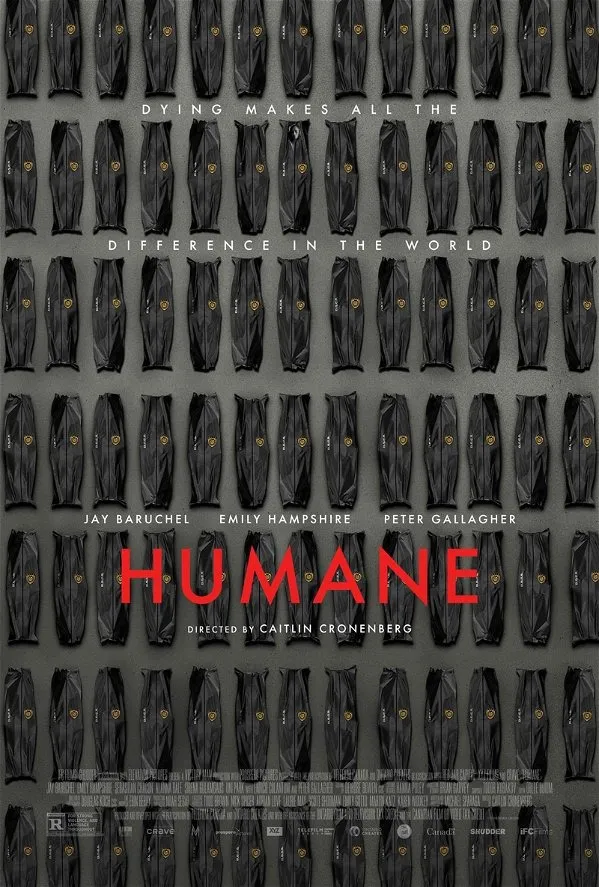
Humane, 2024.
Directed by Caitlin Cronenberg.
Starring Jay Baruchel, Emily Hampshire, Peter Gallagher, Enrico Colantoni, Sebastian Chacon, Alanna Bale, Sirena Gulamgaus, Uni Park, Martin Roach, Blessing Adedijo, Joel Gagne, and Franckie Francois.
SYNOPSIS:
In the wake of an environmental collapse that is forcing humanity to shed 20% of its population, a family dinner erupts into chaos when a father’s plan to enlist in the government’s new euthanasia program goes horribly awry.

Humane takes a darkly fascinating, timely concept regarding ecological collapse and overpopulation, competently establishes some of that world-building that’s not too far off from a potentially bleak future reality, and then devolves into an hour of filthy rich siblings, most of whom are unlikeable, shouting at each other in an attempt to decide who they are going to sacrifice as part of an ongoing government-funded euthanasia cleansing.
There is also nothing wrong with these characters being offputting and morally bankrupt when a sudden gathering organized by patriarch Charles York (Peter Gallagher) turns into an evening of survival, especially when there are military personnel and individuals even more psychotic overseeing the euthanasia process (a procedure with rewards that seemingly sets up the rest of one’s family financially for life), but the script from Michael Sparaga lacks characterization and complexity beyond one or two defining traits for each sibling. As a result, much of the backstabbing and betrayal between two particular siblings strains credibility and comes across as the screenplay looking to stretch the physical family feud long past its repetitive breaking point.

This is frustrating since, again, the hook grabs attention. Charles is a former celebrated news reporter who financially benefited from years of society ignoring climate change, among other pressing issues. Somewhat of a failure as a parent and husband, currently with a new partner named Dawn Kim (Uni Park), who has faced racism at extreme lengths of having her restaurant burned down (the script also mentions that for whatever reason, Asians, in general, have been made public enemy number one for the current disastrous state of the planet, without ever really expanding on that.) Charles cares deeply about his legacy. He is also looking for some form of redemption, so he signs himself and Dawn up for the euthanasia process while inviting his four adult children (one adopted son) over to say goodbye without explaining what the reunion is about.
The children are Jared’s (Jay Baruchel) government mouthpiece for the euthanasia program, Rachel’s (Emily Hampshire) sociopathic businesswoman who doesn’t realize or seem to care that her heartlessness gets her daughter Mia (Sirena Gulamgaus) endlessly bullied at school, recovering junkie and adopted son Noah (Sebastian Chacon) and aspiring actress Ashley (Alanna Bale.) Due to not knowing the nature of this reunion, Mia also ends up in the house. It is also established that Noah and Ashley are closer to one another than everyone else in this dysfunctional family.

Following dinner, Charles blurts out what is happening here; the euthanasia enforcements arrive, insisting that the family figure out a way to provide a second body since Dawn had run off before they arrived. Whether there is a deeper significance to that remains a mystery. There is no backing out, and the menacing ringleader, Bob (Enrico Colantoni), scrambles the Wi-Fi and is certain that these people are so selfish they will try to kill each other to ensure they are not the second death. He also makes clear that this group does not euthanize children (although the slimy Jared is seen on television early on promoting the idea, admitting that he would allow his teenage son to consider it), ordering his armed guards to bring Mia outside and into his van as insurance while the family decides what to do.
The euthanasia process is unsettlingly creepy, as fully seen during an opening prologue juxtaposed with an upbeat, cheerful song choice. The film consistently finds pockets to quickly drop tiny bits of information about this world and how the service is handled in the public eye, including gallows humor commercials thanking regular citizens for their suicide contributions.
That’s all one way of saying Humane has the ingredients to be a sharp and socially aware takedown of the rich and a reflection of a grim, possible reality if everyone on this planet doesn’t get on the same page to do something about devastating global concerns. However, the film takes that intrigue and squanders it all on a sibling match of who can yell the loudest and survive the most injuries. Characters repeatedly try to kill each other, form alliances, betray one another, and show their worst sides in ways that don’t always feel believable, even for these wealthy, self-centered assholes. It becomes exhausting, and at one point, we side with the gleeful euthanizing murderer for trying to convince Mia that her mom is an awful person. Hilariously, it also tries to give that character a dramatic backstory while dropping the psychopathic behavior for roughly two minutes.
What Humane does have going for it is that it is the debut from Caitlin Cronenberg, and while this is a different kind of horror from what her father and brother would craft (and sometimes a black comedy with Jay Baruchel eliciting some laughs), the violence still has some body horror that fits right in with the family portfolio. Fingers are forced inside stab wounds, and blood squirts so often that it becomes confounding no one is dead yet. As a director, there should be interest in what she does next, preferably something with a stronger screenplay and layered characters.
Flickering Myth Rating – Film: ★ ★ / Movie: ★ ★
Robert Kojder is a member of the Chicago Film Critics Association and the Critics Choice Association. He is also the Flickering Myth Reviews Editor. Check here for new reviews, follow my Twitter or Letterboxd, or email me at MetalGearSolid719@gmail.com
https://www.youtube.com/watch?v=embed/playlist



Unanswered//Butterfly is far from the first anime to be released as a video game extra—in this case the Echoes of Aincrad Ultimate Edition. However, rather than an extra episode or OVA, Unanswered//Butterfly is a full on feature film that clocks in at just under two hours in length.
At its core, Unanswered//Butterfly has a fantastic hook. The heretical-seeming idea of series hero Kirito massacring people in the early days of Sword Art Online is more than enough to get any fan invested. Moreover, the idea of having the story be told not from the viewpoint of Kirito but of two new characters—a pair out for revenge on the Black Swordsman—is likewise compelling. Unfortunately, the application of these ideas is a mixed bag at best.
On the positive side of things, Rex, the first of our characters out to kill Kirito, is an interesting character from top to bottom. Due to an error with how the NerveGear interacts with his brain, he is unable to attack—leaving him only able to use a shield for defence. This weakness weighs upon him—as does having to rely on Emirun, a 14-year-old that he tutored in the real world. He is serious and goal oriented—which clashes with Emirun’s immature and flighty personality. He also has more than a few layers of hidden depths that completely change how we view his character over the course of the film—making him the movie’s stand-out character.
Emirun, on the other hand, is completely unsuited for her role in the plot—i.e., as a young woman driven to get revenge on a man by killing him. Her flighty and impulsive nature are taken to insane extremes. In the span of just a few minutes, she goes from depressed and angry at the murder of her friends during their funeral, to throwing a childish tantrum in response to another players provocations. This is followed immediately by her enjoyably chowing down on food and fangirling out at a concert. Over the course of the film, her constantly jumping from one emotional extreme to another is exhausting at best, annoying at worst. And while her bouncing back easily is a main facet of her character—and one acknowledged by the plot—she is so rarely focused on revenge that it makes her main goal seem secondary.
Her personality also gives the film an uneven tone. While fun and silly things do happen in Sword Art Online, at this point in the story, things are relatively dire. The survivors are still figuring out the best way to clear floors, people continue to die in sizable numbers, and PKers have begun their murder sprees. But Emirun often treats Sword Art Online like the game it was supposed to be rather than the life-or-death struggle it actually is. The film itself plays along with this—with the music and direction emphasizing the fun to the point that I can’t help but wonder if this aspect of the movie is supposed to be a kind of commercial for the attached game.
As for the main pair of Sword Art Online heroes, Asuna plays the role of Emirun and Rex’s mentor—training them in the more advanced aspects of the game. However, little does she know that the person they are out to kill is Kirito. And, at the same time, she herself is hunting Kirito, trying to understand why the person she has gotten to know more than any other has become a murderer.
Meanwhile, the Kirito we catch glimpses of is not himself. He is always on edge, eyes wildly looking at those he meets as the orange criminal icon hovers above his head. It serves as a scarlet letter of sorts, leaving him isolated from society as other players flee from him while the system itself prevents him from entering towns. Viewing him from the outside, he’s legitimately intimidating and the mystery of his sudden fall keeps the film engaging throughout.
The other issue with the film is a visual one. Now, to be clear, this is not a dig at the animation team. While it’s odd at first glance that this film was done by Polygon Pictures rather than Sword Art Online‘s usual studio A-1 Pictures, the 3DCG animation fits this VR world well and the fight scenes range from adequate to absolutely awesome.
The actual problem comes in the form of the characters. Emirun’s character design (along with the Echoes of Aincrad characters) clashes with those of the returning and background characters. The two tone nature of her hair, the flower accessories she wears, and even the colors of her armor do not match the established visual aesthetic for the early days of Sword Art Online. It breaks the immersion of the world in an odd way as she clearly doesn’t seem to belong there.
On the music side of things, the general soundtrack is passable and the insert song, “Reach for the Rainbow” by Iori (Kato LEIA) and LaLa (Rina), is good enough to sell the idol characters as such.
All in all, I like what Unanswered//Butterfly i trying to do more than what it actually does. Emirun is so out of place both visually and in personality that it undercuts the story the film is attempting to tell. On the other hand, Rex is an interesting character to add into the chaos of Sword Art Online and the entire mystery surrounding Kirito’s murderous turn keeps viewer investment in the plot high—especially if you’re a long time fan.
And while I feel this film is certainly worth watching to anyone who loves Sword Art Online, the fact that the bar to entry is $110—a full $40 above buying the Echoes of Aincrad game on its own—feels ludicrous. If you have the money to burn—and you’re super interested in both the game and this film—then by all means, go for it. If not… well, maybe Crunchyroll or some other streaming service will get the rights to it sometime in the future.
Movie Reviews
‘Only Beautiful Things to Look At’ Review: A Handsome but Muffled Portrait of State-Sanctioned Cruelty

The fashions and furnishings of Czechoslovakia in the 1980s — the height of the state’s racist program of suppressing the Roma population through coerced sterilization — are painstakingly evoked in Slovakian filmmaker Ivan Ostrochovský’s “Only Beautiful Things to Look At.” But the film’s attractive yet oddly bloodless presentation gives the impression of a period drama set much farther back, as though we’re peering at the prettily mounted arrowheads and artifacts of a long-gone atrocity through museum glass. Alongside the decision to centralize the perspective of a white female doctor, this old-school, soft-focus approach robs an undeniably well-intentioned movie of a vital edge of urgency and discomfort, allowing viewers to consign the cruelties it outlines to some imaginary distant past, when in truth, the sterilization policy continued well into the 21st century in both the Czech and Slovak Republics.
The film begins with a montage of young Roma women, each shot as though for a studio portrait, impassively absorbing an offscreen voice lecturing them about family planning. “Sterilization,” the voice concludes disingenuously, “allows Gypsy women to improve their family’s quality of life.” The intention behind the portraiture is noble: to put faces to a crime more often recounted in impersonal statistics, when it is acknowledged at all. But although framed and lit with dignity by cinematographer Juraj Chlpík, none of these Roma women speak. The first words of argument or protest we hear are from Ingrid (Anna Geislerová), the film’s white protagonist, and she is not talking about reproductive rights at all. Instead, she is facing an all-male panel of her peers as she interviews for the role of head doctor at the hospital where she works. Ingrid knows the position will very likely go to one of her male colleagues, but that doesn’t stop her being angry and disappointed when it actually does.
Outside her work at the hospital, which in large part comprises assessing and performing the sterilizations in a procedure that leaves patients with a small scar beneath the navel nicknamed “the bow,” Ingrid has what can only be described as a beautiful life. With her music teacher husband Maros (Vlad Ivanov), she lives in a gorgeous house in the countryside, where her bedroom, glass-paned on two sides overlooking a lush forest, looks almost like a fairytale princess’ lair. In the warm-lit evenings she and Maros read and drink wine and listen to classical music; on her days off she goes for walks in the forest or, when it’s hot, visits the nearby river and looks on benignly as Roma children bob along playfully on tire tubes.
It is only through her burgeoning friendship with Agata (a radiant Simona Boledovičová), a sweet-natured orderly who is reticent about her Romani idenitity, that Ingrid eventually starts to become uncomfortable with the work she does helping the hospital meet its government-recommended quotas for sterilizations. Ostrochovský’s film, co-written with Marek Leščák, is not anything quite as crude as a white savior narrative, but it is certainly one that assumes the best conduit for a wide audience to understand the cruelty visited on Czechoslovakian Roma families, is the moral awakening of a white woman.
This faulty focus is particularly frustrating because Agata’s own story, and the manner in which she comes to reconcile herself with her Roma background, is by far the more intriguing narrative strand. As an orphan, Agata was separated from her sister Jula (an excellent Eva Mores), with each then going on to lead very different lives. Jula married within the Roma community, has had two children and is pregnant with an unwanted third. Agata, who at first barely acknowledges their connection, has been more independent, living with a roommate and working at the hospital, and recently getting serious with a boyfriend. “He’s white?” queries Jula in surprise when she hears that he’s a soldier. “Good for you.”
The tides of unspoken resentment and disapproval that flow between the sisters are fascinating, with Agata able to move between Jula’s world, in a cramped flat in a crumbling building where kids play in dirty stairwells, and Ingrid’s enviably refined domestic environment. Eventually, just like Chlpík’s limpid camera, Agata comes to see the beauty in both, when in the film’s most moving moment, the sisters tacitly reconcile while Jula’s kids splash about in the tub at bathtime. There would have been the opportunity here to probe the long-term consequences for the Roma women bearing “the bow,” many of whom had been conned into a procedure that was misrepresented to them, in a language they did not speak, or in documentation they could not read.
Instead, the film insistently returns us to Ingrid. As she’s kept awake by the first stirrings of her conscience, as she lazes in rumpled white bedsheets watching a beetle trundle across her pillow, as she’s depicted in macro close-ups that emphasize the blondeness of her hair, the fairness of her skin, the blueness of her eyes. Indeed, right up to a finale which resolves the remaining conflict with a rather glib miracle, the film’s loveliness practically becomes a liability, placing the real plight of the Roma several removes of perspective and aesthetic manipulation away, until you begin to wonder why we’re being given only beautiful things to look at, when there are so many ugly things that better warrant the attention.

Comedy is a matter of taste and preference — it’s a deeply personal thing. Which makes it hard for a critic to give a blanket assessment of a specific kind of comedy, especially if it didn’t work for them, but clearly worked for others (the laughter or lack thereof is the indication). “It’s not funny,” the critic says, “well I had fun,” someone else can reply, and then we’re at an impasse.
Which is the dilemma one finds oneself in with “Gail Daughtry and the Celebrity Sex Pass,” a very strange and shaggy Hollywood satire of sorts from David Wain and The State crew, still riding the goodwill of “Wet Hot American Summer” after all these years. If only this were as funny.
“Gail Daughtry” lives in the same world as that iconic summer camp spoof, as well as Wain’s 2014 rom-com parody, “They Came Together,” in that he’s playing with genre convention and expectation, taking well-known norms to the goofiest extremes. But those films hewed more closely to their respective genres, while “Gail Daughtry” is totally scattered, combining crime and spy movie tropes with a fish-out-of-water comedy and a Hollywood send-up. It has far too many ideas for its own good, and yet no ideas that are good enough to sustain this bizarre curio of a comedy.
What’s ironic is that one of the problems driving this wacky plot forward is the characters have to come up with a movie idea to pitch to star Jon Hamm (playing himself of course), leading them to do some pretty inane and shockingly violent things. It’s almost as if Wain and co-writer and co-star Ken Marino had no idea for a movie, then baked their search for an idea into their script, and then turned it into a madcap adventure about a woman on a quest to have sex with Jon Hamm. What an ouroboros!
OK, about the sex quest. Gail Daughtry (Zoey Deutch) is a chipper hairdresser from Kansas born without the part of the brain that recognizes sarcasm or irony. She’s a cheerful, Pollyanna-ish naïf whose literal-mindedness is almost as extreme as Amelia Bedelia. Her childhood sweetheart and fiancé Tom (Michael Cassidy) is the same. She tells him about the concept of the “celebrity sex pass” as a joke, and he promptly boinks Jennifer Aniston at local book reading.
(Nitpicky aside: why didn’t they use the common nomenclature “hall pass”? Is it copyrighted? “Celebrity sex pass” is clunky and sounds like an off-brand version of the well-known slang.)
That infidelity crisis is how Gail ends up in Los Angeles determined to bang Hamm, collecting a motley crew of similarly clueless helpers along the way. There’s her best friend Otto (Miles Guttierez-Riley), her salon bestie; Caleb (Ben Wang), an overly ambitious intern at Creative Artists Agency; Vince (Marino), a screenwriter turned paparazzo with a heart of gold; and John Slattery, as John Slattery, down on his luck. An accidental briefcase swap has a pair of thugs on their tail, in a forgettable and underdeveloped B-plot.
With a parade of celebrity cameos and collaborators in bit parts, “Gail Daughtry” at times feels like an excuse for Wain and co. to make something at home with all of their friends. Fair enough, it’s great to see all these people employed, but what about what we’re watching? Behold, the Los Angeles of the middle-aged working comedian: the CAA lobby, the Chateau Marmont, Griffith Park, etc. And the plot is as half-baked as the pitch they present to Hamm.
What’s actually interesting about this comedy is the distinct streak of despair and even resentment that reveals itself at the climax, a feeling of helplessness and uselessness. Everyone’s been striving to make it in this crazy town: the intern, the actor, the paparazzo. But not even Jon Hamm can help them get a movie made; even he feels inherently powerless. There’s an unexplored anxiety vibrating there that feels the most thematically fruitful, about what it means, some 25 years after bursting onto the scene with a generation-defining comedy, about maintaining the work, the drive, a sense of purpose, after years of strikes, and in the face of a constricting industry. Do they still have it? Is the dream still alive?
Maybe that’s why Wain and Marino need to invent a dreamer stand-in with Gail, a guileless eternal optimist who knows nothing of the craven Los Angeles and accepts everything at face value (though she is filled with a scary bit of rage too). She might behave like she has a head injury, but she’s going to achieve her goal, dammit. “Gail Daughtry and the Celebrity Sex Pass” might not be as funny as “Wet Hot American Summer” (for this critic), but reframed, it serves as a fascinating status update on life in La La Land for this troupe.
‘Gail Daughtry and the Celebrity Sex Pass’
2 stars (out of 4)
MPA rating: R (for sexual content, violence/bloody images and language)
Running time: 1:33
How to watch: In theaters July 10
-

 Michigan5 minutes ago
Michigan football lands four-star offensive lineman Lincoln Mageo
-

 Massachusetts12 minutes ago
Man arrested after injuring Massachusetts State trooper, K-9 in wrong-way crash in Chicopee
-

 Minnesota15 minutes ago
250 runners take to the Minnewashta Mud Run
-

 Mississippi20 minutes ago
4-star Kennedy Green commits to Mississippi State football again in 2027 class
-

 Missouri27 minutes ago
One dead, hundreds rescued in devastating Missouri flooding – UPI.com
-
 Montana30 minutes ago
Montana Folk Festival brings heat along with music, food, and art
-

 Nebraska35 minutes ago
Nebraska redshirt sophomore Carson Jasa picked by Chicago Cubs in third round of MLB Draft
-

 New Hampshire45 minutes ago
Gilmanton Iron Works Man Accused Of Possessing Guns, Hundreds Of Grams Of Fentanyl In Hooksett, Manchester

