Crypto
Cryptocurrency companies join Silicon Valley’s wave of layoffs! Coinbase lays off 14% of its workforce; CEO says AI is bringing profound change.


Written by: Dong Jing
Source: Wall Street News
Coinbase, the largest cryptocurrency exchange in the United States, announced layoffs of approximately 14% of its workforce, citing AI as a core driving factor in reshaping its operating model. This is the latest example of a new wave of AI-driven layoffs in Silicon Valley.
Coinbase disclosed in a regulatory filing on Tuesday (May 5) that the layoffs will affect approximately 700 employees, representing more than one-seventh of the company’s nearly 5,000-person team. The company expects to pay approximately $50 million to $60 million in severance pay, severance benefits, and related expenses.
CEO Brian Armstrong posted on social media, “AI is profoundly changing how businesses operate, and we are reshaping Coinbase to lead this new era.” He also cited the continued volatility of the cryptocurrency market as another important reason, stating that the company is “currently in a bear market and needs to adjust its cost structure immediately.”
This news of layoffs places Coinbase among the tech companies that have recently cut staff citing AI as a reason, further demonstrating the profound impact of AI on the employment structure of the tech industry—especially its direct impact on software engineers.
AI-driven restructuring: smaller teams, more “AI agents”
In his statement, Brian Armstrong outlined Coinbase’s future organizational structure: the company will form smaller teams whose members will be responsible for managing AI agents (digital bots) capable of handling programming tasks, while human managers will also need to “work hand-in-hand with the team.”
Armstrong characterized the current moment as a “turning point,” stating that the biggest risk is inaction. He said the company is “making proactive and conscious adjustments to rebuild Coinbase into a lean, fast, AI-native enterprise,” and that the future company structure will reduce management layers below the CEO and COO to improve decision-making efficiency.
This statement aligns closely with the logic of several tech giants recently—the rapid leap in AI tools’ capabilities in code generation is directly impacting software engineers, a core group in digital business.
Silicon Valley AI Layoff Wave: Coinbase is Not an Isolated Case
Coinbase’s layoffs are part of a recent wave of large-scale workforce reductions in the tech industry, citing AI as a reason.
In February of this year, fintech company Block laid off about 40% of its employees, affecting approximately 4,000 people, citing rapid AI iteration as the reason.
Last month, Meta announced plans to lay off about 10% of its employees (about 8,000 people) and close another 6,000 open positions, while the company is investing heavily in AI research and development.
Microsoft also offered early retirement plans to a large number of long-term employees last month to support its major investments in AI.
Analysis points out that although various industries are discussing how AI will change the way we work, the technology industry itself is undoubtedly undergoing profound disruption.
Double pressure: AI transformation coupled with a downturn in the crypto market
Coinbase’s restructuring reflects the dual pressures the company faces.
On the one hand, the rapid evolution of AI technology has prompted management to proactively seek change and accelerate the transformation towards an “AI-native” model; on the other hand, the cyclical fluctuations of the cryptocurrency market have a direct impact on the company’s revenue.
Coinbase has previously stated that its revenue is highly dependent on crypto asset prices and platform trading volume, and its profitability will be significantly pressured during market downturns.
In its statement, Armstrong characterized the layoffs as a proactive rather than reactive measure, emphasizing that the company is using the market downturn to streamline its organization and prepare for the next cycle.

Crypto
Hyperliquid Helps VALR Launch Over 200 Perpetual Markets as Decentralized Liquidity Gains Ground

Key Takeaways
- VALR and Hyperliquid debut 200+ markets as on‑chain perps volume tops hundreds of billions daily.
- Gianluca Sacco says VALR’s 24/7 access to FX, equities and crypto expands South Africa’s regulated perp trading.
- Hyperliquid’s rise and 2023–2026 perp growth push multi‑asset contracts like BTC, S&P 500 and WTI into mainstream.
Evolution of the Perpetuals Market
Cryptocurrency exchange VALR announced it is preparing to roll out a major expansion of its derivatives offering with the launch of “Perps,” a cross-asset perpetual futures product that will introduce more than 200 new markets.
The upgrade allows customers to take leveraged long or short positions across global equities, commodities, precious metals, stock indices, foreign exchange pairs and crypto assets within the VALR app.
According to a company announcement, the move builds on VALR’s initial perpetuals launch in 2023 and arrives during a period of rapid evolution in the global perpetuals market. Over the past several months, perpetual futures have surged in scale and diversity, with decentralized venues gaining ground and traditional-asset perpetuals accelerating in adoption.
Industry data shows that perpetual futures now dominate derivatives activity, regularly exceeding hundreds of billions of dollars in daily volume and expanding into tokenized equities, commodities and forex. Decentralized perpetual exchanges — led by Hyperliquid — have grown into sophisticated competitors, capturing rising market share as on-chain liquidity deepens.
VALR’s new product is powered by an integration with Hyperliquid. It allows users to open and manage positions directly on VALR while trades execute via Hyperliquid’s permissionless infrastructure. According to the company, this marks the first time a major regulated exchange has natively integrated an on-chain protocol to source liquidity for cross-asset perpetuals.
The expanded suite includes perpetual contracts on global equities such as SpaceX, NVIDIA, Tesla, Apple, SK Hynix, Samsung and Palantir Technologies, as well as benchmarks such as the S&P 500. Also included are Brent and WTI crude oil, natural gas, gold, silver, platinum and copper. Forex pairs such as EUR/USD, GBP/USD and USD/JPY, alongside digital currencies, round out the offerings.
VALR representatives said the breadth of markets will allow traders to express macro views and capitalize on volatility across sectors, ranging from energy shocks to equity earnings cycles and crypto-native catalysts.
The launch comes as perpetual futures undergo a structural shift. Centralized exchanges have historically dominated liquidity, but decentralized perpetuals have grown sharply, with Hyperliquid helping push decentralized exchange market share to new highs. At the same time, traditional-asset perpetuals — including commodities and equities — have expanded rapidly, moving from niche experiments to multibillion-dollar weekly markets as traders seek 24/7 access to real-world assets.
Gianluca Sacco, VALR’s chief operating officer, said the launch places “over 200 perpetuals markets directly inside the VALR app,” offering round-the-clock access to crypto, commodities, currencies and equities — including pre-IPO companies — through a regulated platform.
“Perps are how crypto traders take a view on price — a market now exceeding hundreds of billions of dollars in daily volume,” Sacco said. “We believe they will become how people trade every market. Our integration of Hyperliquid will give our users the deepest on-chain liquidity available anywhere.”

Key Takeaways
- Zcash targets July 21, 2026 for Ironwood mainnet activation after sealing the Orchard pool.
- ZEC trades at $462.33 on July 4, up 13.3% in seven days and over 1,000% in a year.
- Node operators must migrate to Zebra or updated clients before Ironwood’s mainnet launch.
The upgrade traces back to a discovery on May 29. Security researcher Taylor Hornby, working under contract for Shielded Labs, found a soundness flaw inside the Orchard shielded pool’s elliptic curve code. The bug lived in a piece of the halo2_gadgets crate handling point multiplication. A prover could swap in the wrong base point and still get the circuit to accept an invalid proof.
That flaw mattered because Orchard hides sender, receiver and amount by design. A counterfeit note created inside the pool would look identical to a real one. The bug had sat in the code since Orchard went live in May 2022 as part of the NU5 upgrade.
Rapid Patch, No Confirmed Losses
Zcash’s core engineers, including Daira-Emma Hopwood, Kris Nuttycombe and Jack Grigg, confirmed the issue within hours of Hornby’s report. A soft fork disabled new Orchard actions around June 1 to contain exposure. A hard fork, NU6.2, followed on June 3 with a corrected verifying key, restoring full Orchard functionality.
Orchard transactions paused for roughly a day during the rollout. Transparent and Sapling transfers kept running the whole time. Zcash Open Development Lab and Shielded Labs both say they found no evidence that the bug was ever exploited, and the network’s turnstile accounting, which tracks value entering and leaving each pool, showed no signs of unauthorized minting.
There’s a catch developers can’t patch away. Orchard’s privacy means nobody can prove a negative. No cryptographic method exists to confirm counterfeiting never happened, only that it probably didn’t.
Ironwood Closes the Gap
Announced June 6, Ironwood is the fix for that remaining uncertainty. It ships as NU6.3 and was built by ZODL alongside Tachyon, Valar Group, the Zcash Foundation and Shielded Labs.
The upgrade opens a new Ironwood shielded pool built on the patched Orchard circuit, now backed by ongoing formal verification and added independent audits. At the same time, the old Orchard pool gets sealed. Wallets will block new deposits into it, internal transfers between users inside the pool get disabled, and funds can only leave through the turnstile toward Ironwood or a transparent address.
That sealing is the actual fix. Once the legacy pool stops taking new value and stops circulating internally, any theoretical counterfeit notes get boxed in. Anyone running a full node can then add up balances across the active pools and confirm the total supply lines up with what the protocol allows, without waiting on developer assurances or a full migration.
Ironwood also carries ZIP 2005, a set of note format changes meant to support recovery in a future quantum computing scenario. It doesn’t make Zcash quantum-secure today, but it lays the groundwork for a smoother transition later.
Timeline and What Users Need to Do
Testnet activation for Ironwood landed around July 3 and 4. Zebra, the Rust client maintained by the Zcash Foundation, and Valar Group’s independent implementation are both running release candidates against it.
Mainnet activation is targeted for around July 21, tied to a zcashd end-of-support block. Developers say hashrate signaling looks ready, and existing testnet time gives wallets enough runway, so a delay isn’t currently on the table.
Node operators on older zcashd builds will need to move to Zebra or an updated client before that date. Wallets are expected to prompt users to migrate shielded funds out of the old Orchard pool with minimal friction, often a single approval.
Market Response
ZEC’s price tells its own story of the past six weeks. The token fell more than 50% from around $630 down to the $250 to $300 range once the vulnerability became public, then rebounded sharply once the patch and Ironwood plan landed.
As of July 4, ZEC trades at $462.33, up 13.3% over the past seven days, even after a flat 24-hour session. Zooming out, the coin is up more than 1,000% over the past year, a stretch that includes both a run to a 52-week high near $744 in November 2025 and the Orchard scare in late May.
Investor Chamath Palihapitiya has publicly flagged Ironwood’s supply verification model as a meaningful step for the coin, adding outside attention to what started as a bug fix.
For now, the work left is coordination. Formal verification results are due before mainnet, and wallet, exchange, and infrastructure providers still need to ship updated support in the next two and a half weeks.

US President Donald Trump has made $US1.4 billion ($2b) from cryptocurrency in the past 12 months.
$US635 million came from celebration coins royalties and $US236m came from cryptocurrency “token sales”, while the rest of his income came from assorted cryptocurrency wallets.
His celebration coin income is linked to meme coins he launched before returning to office, namely $TRUMP.
But what are meme coins and has anyone other than the Trump family profited?
Meme coins
Cryptocurrencies are a type of digital asset, not unlike a stock, which can be used as an exchangeable form of money online.
Much like paper currencies since the gold standard was ended, crypto has value because investors collectively agree it does, in part due to its security and scarcity.
Meme coins on the other hand are a bit harder to pin down.
“Meme coins are cryptocurrencies that leverage popular memes or internet trends to create a community-driven, often playful approach to digital currency,” according to crypto broker Blockchain.com.
Meme coins have no inherent value and, unlike Bitcoin, have varying limits of scarcity, rendering the price of any coin vulnerable to the rise and fall in popularity of whatever meme or trend inspired the item.
As an example Hailey Welch, an American woman, launched her own brand of meme coin after she rose to internet fame in June 2024.
The $HAWK coin released in December 2024 reached a market capitalisation of $500m before it crashed to $25m by late January.
Investors have since sued $HAWK.
The $TRUMP coin
The $TRUMP coin is valued at $US1.65 as of July 1, 2026. (Supplied: GetTrumpMemes.com)
Mr Trump’s own meme coin $TRUMP launched days before his second inauguration, also in January 2025.
At its peak it sold for almost $US75 a coin, but by the end of February its value had plummeted to about $US20 and as of July 1, 2026 its value sits at $US1.65.
This is where the bulk of Mr Trump’s $US635m in royalties and $US236m in token sales are believed to have come from.
In April 2026, Democratic Senator for California Adam Schiff said he and other senators would be investigating a Mar-a-Lago conference which invited the top 297 $TRUMP token holders to attend and offered VIP access to Mr Trump.
In a statement he said CIC Digital and Fight Fight Fight LLC, which controlled 80 per cent of $TRUMP supply, received trading revenue from all $TRUMP activity.
“The announcement of the conference ‘set off a quick but brief run-up in the price of the $TRUMP meme coin, which reached $3.08 before tumbling back down,’” the senators highlighted.
“President Trump financially benefits from the market value and activity of the $TRUMP cryptocurrency.“
Mr Schiff and his fellow senators asserted “not all” investors of $TRUMP and the similarly branded first ladies meme coin, $MELANIA, benefited from their investment.
“According to recent reports, $TRUMP, and the First Lady’s meme coin, $MELANIA, “erased an estimated $4.3 billion in retail wealth,” they said.
“Insiders, however, reportedly made a fortune: 45 ‘early-deployment wallets’ earned $1.2 billion off the meme coins, meaning that for every dollar insiders earned, retail investors lost $20.”
World Liberty Financial, another Trump family-linked business which distributed Mr Trump’s royalty and token sale revenue, provided him with an additional $65m in income.
Eric Trump and Donald Trump Jr are involved in its management and it was co-founded by Zach Witkoff, the son of Mr Trump’s special envoy to the Middle East Steve Witkoff.

Donald Trump Jr and Eric Trump with Zach Witkoff. (Reuters: Eduardo Munoz)
Mr Trump’s $236m in token sale revenue is a marked leap in profits collected compared to Mr Trump’s 2025 disclosure which only reported $US57m from token sales.
World Liberty Financial launched another cryptocurrency in May, 2025 called USD1.
USD1 rose to US$1.016 after launch and is now valued at $U0.99.
It was also used to pay bonuses to UFC fighters performing at the White House in June.
On July 1, after his disclosure came out, Mr Trump said his wealth was the result of the US stock market’s success.
“”You know why I’m profiting? Because the stock market’s going up, everybody’s profiting,” Mr Trump said, according to Reuters.
-
 News23 minutes ago
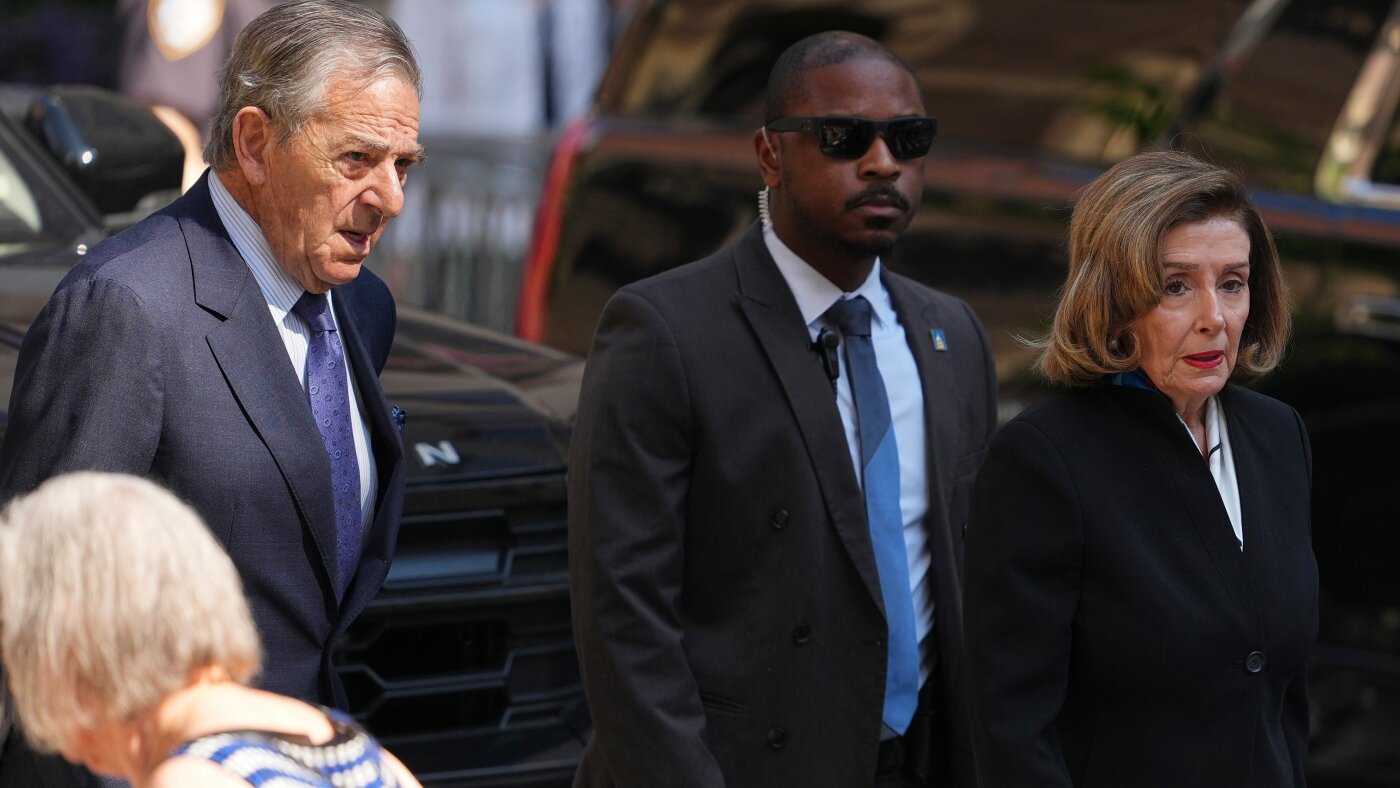
Paul Pelosi in hit-and-run in California, car left with major damage, authorities say
-

 Los Angeles, Ca2 hours ago
Firefighters battle Fourth of July blazes around Los Angeles
-

 Detroit, MI2 hours ago
Storm chances linger into the start of the week across Metro Detroit
-

 San Francisco, CA2 hours ago
Relay for America runs flag from San Francisco to D.C. in message of unity
-

 Dallas, TX2 hours ago
Cowboys newcomer already looks like a waste of money in Dallas
-

 Miami, FL2 hours ago
Police search for suspect after man is shot while on a boat near hotel in Fort Lauderdale on 4th of July
-

 Boston, MA2 hours ago
Sonny Gray shines again, and the Red Sox make it two straight wins at the Angels to start grinding road trip – The Boston Globe
-

 Denver, CO3 hours ago
Aldi expanding into Colorado, applies for permits at two Denver locations

