Business
Trump Administration Looks to Take Steps to Ease Pain From Car Tariffs


The Trump administration said it plans to announce measures as early as Tuesday to ease the effects of tariffs on imported cars and car parts to give automakers more time to relocate production to the United States.
Tariffs of 25 percent on imported vehicles and on auto parts will remain in place. But the tariffs will be modified so that they are not “stacked” with other tariffs, for example on steel and aluminum, a White House spokesman said. Automakers will not have to pay tariffs on those metals, widely used in automobiles, on top of the tariffs on cars and parts.
In addition, automakers will be reimbursed for some of the cost of tariffs on imported components. The reimbursement will amount to up to 3.75 percent of the value of a new car in the first year, but will be phased out over two years, the spokesman confirmed.
A 25 percent tariff on imported cars took effect April 3. On Saturday, the tariffs are set to be extended to include imported parts.
“President Trump is building an important partnership with both the domestic automakers and our great American workers,” Howard Lutnick, the commerce secretary, said in a statement. “This deal is a major victory for the president’s trade policy by rewarding companies who manufacture domestically, while providing runway to manufacturers who have expressed their commitment to invest in America and expand their domestic manufacturing.”
Karoline Leavitt, the White House press secretary, said at a news conference on Tuesday morning that Trump would sign an executive order related to auto tariffs later in the day. At the same briefing, Treasury Secretary Scott Bessent declined to share details of any relief that automakers might get from tariffs but said that the policy would be focused on encouraging them to bring more production back to the United States.
Even with the planned changes, there will still be substantial tariffs on imported cars and auto parts, which will raise prices for new and used cars by thousands of dollars and increase the cost of repairs and insurance premiums.
The modification to the tariffs was reported earlier by The Wall Street Journal. Mr. Lutnick helped automakers secure a major exemption from tariffs in March and has taken on a role advocating relief for some industries hit by the levies.
Automakers welcomed the change. “We believe the president’s leadership is helping level the playing field for companies like G.M. and allowing us to invest even more in the U.S. economy,” Mary T. Barra, the chief executive of General Motors, said in a statement on Monday. “We appreciate the productive conversations with the president and his administration and look forward to continuing to work together.”
Alan Rappeport contributed reporting.



Business
Commentary: It’s not just vaccines — from infancy to adolescence, Republicans are waging war on children’s health
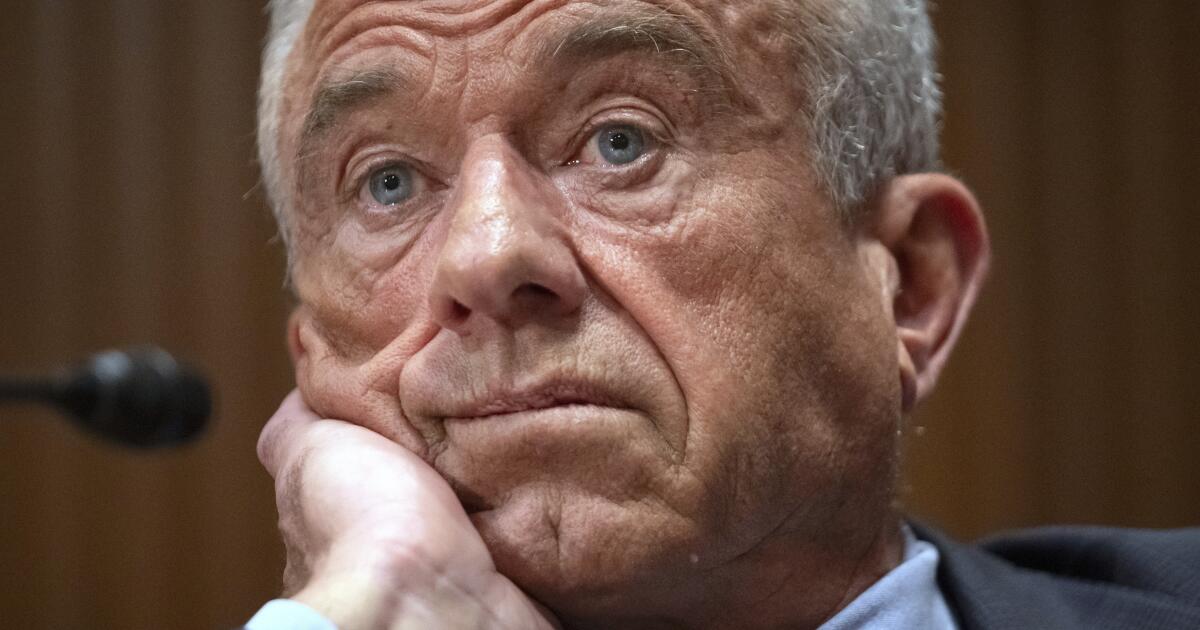
The conservative assault on child health starts with the anti-vaccine campaign and proceeds to cutbacks in nutrition assistance and narrowed access to healthcare.
In the old days, before accepted medical protocols came under partisan assault, infants typically received a vitamin K shot to enhance blood-clotting capability and a few drops of an antibiotic to stave off eye infections before leaving the hospital, followed by a thorough round of vaccines against life-threatening diseases.
Americans assumed that “whatever a family could afford, the country had already decided this child was worth protecting,” Robert B. Shpiner, a critical care expert at UCLA medical school, wrote recently. “I have seen children harmed by disease, poverty, by bad luck. I had not, until now, seen them harmed so methodically by their own government.”
Shpiner’s targets were the changes in healthcare policies instituted by the Trump administration generally and Health and Human Services Secretary Robert F. Kennedy Jr., as well as the mistrust in medical authority that Kennedy and his followers have helped to foment.
We’re going to be paying this bill for years to come, because the lack of proper nutrition has profound effects on learning and disability.
— Robert B. Shpiner, UCLA
As Shpiner wrote in the Guardian, the administration’s assault on child health begins with its anti-vaccination policies. In January, Kennedy’s agency reduced the list of recommended childhood immunizations to 11 from 17, removing shots for COVID-19, hepatitis and meningitis, among other diseases. The agency made the changes without the customary professional consultations, KFF has reported.
But that’s only the tip of the iceberg. “It’s just one thing after another,” Shpiner told me.
What triggered him into writing his Guardian essay, he says, was learning that congressional Republicans had advanced an agriculture appropriations bill that would cut the fruit and vegetable benefit for children in WIC, the supplemental nutritional program for women, infants and children to $10 a month from $26.
“That got me to looking at this as a sequence,” he says, starting with the reduction of child immunizations, followed by the proposed cuts in WIC and the cuts in food stamps enacted as part of the Republican budget bill that Trump signed one year ago Saturday (i.e., the Fourth of July, 2025).
“The image of us taking food away from kids and not giving them enough money to buy some apples and berries—the short-term response is outrage,” he says, “but the medium- and long-term effect is that we’re going to be paying this bill for years to come, because the lack of proper nutrition has profound effects on learning, and disability and anemia. A number of measures of health and success match with nutrition.”
At almost every stage of childhood development, he notes, programs aimed at preserving or enhancing children’s health have gone on the chopping block.
“A vaccine rule one week, a food program the next,” he wrote. “Each change arrives wrapped in a reasonable rationale: fiscal discipline, local control, parental choice. But arrange them in the order a child actually grows, and the rationales stop mattering.”
Judging from their rhetoric, one would think that Republicans would move heaven and earth to foster child immunizations, nutritional assistance and access to medical care.
In “Communion,” his recent book about his conversion to Catholicism, for example, Vice President JD Vance writes: “We want more children in our society because children are profoundly good — the greatest value add we can create.”
Yet the programmatic cutbacks advocated for and implemented by the Republican Congress and Trump give the lie to that sentiment. Let’s examine chapter and verse.
Measles is the canary in the coal mine for vaccination and public health, and at this moment, the canary is singing a doleful tune. The Centers for Disease Control and Prevention count 2,134 cases in the U.S. as of June 25. That’s poised to exceed the 2,288 cases in all of 2025, which was the worst outbreak since 1991.
There’s no question why this is happening. It’s because of a decline in measles vaccinations below the 95% generally considered to provide “herd immunity,” in which the disease is so rare that even unvaccinated individuals are protected from exposure.
Kennedy may not deserve all the blame for the immunization decline, but as pseudoscience debunker Steven Novella has pointed out, as secretary he has “done everything possible to undermine vaccine science and confidence in health institutions.”
Kennedy has paid lip service to the value of the MMR vaccine, which combines immunizations for measles, mumps and rubella. But he has claimed without evidence that the vaccine causes deaths “every year” and that the vaccine hasn’t been safety-tested, which isn’t so. He has asserted that it shouldn’t be subject to a government mandate. He also has promoted treatments for measles that aren’t known to be effective.
(The Department of Health and Human Services didn’t respond to my request for comment on the vaccine initiatives.)
As children grow, the crisis of malnutrition kicks in. The House GOP’s cuts to WIC are still only on the drawing board. But the Republican budget bill incorporated cuts to food stamps — the Supplemental Nutrition Assistance Program, or SNAP — that have driven some 4 million people off the program. In 13 states that have published data, according to the Center on Budget and Policy Priorities, child enrollment fell by more than 800,000, or 16%, between July 2025 and May of this year.
“This is where the nutrition cuts become a medical, not merely a moral, story,” Shpiner says. “Iron-deficiency anemia in infancy is associated with poorer cognitive, motor, and behavioral outcomes that persist more than 10 years after the deficiency itself has been corrected — the deficit does not fully reverse even with later treatment. Withdrawing produce and protein from WIC and SNAP at the peak window of brain growth is not a budget line that resets the following year; it is a developmental exposure with a long tail.”
The combination of reduced immunization and poor nutrition build on each other. “Unvaccinated kids are going to get sicker,” he told me. “If they’re malnourished, they’re going to get sicker. If their parents don’t get affordable care, they’re going to be strapped. It becomes a synergistic and multiplicative cascade.”
Indeed, the administration’s assault on Medicaid and the Affordable Care Act intensifies the damage. Enrollment in Medicaid and the Children’s Health Insurance Program, which is part of Medicaid, fell by 4.8 million people, or 6%, from March 2025 through March 2026, according to government data. The enrollment decline for children alone came to more than 1.9 million, or 5%.
White House spokesperson Kush Desai challenged the latter figure when I asked for comment. But it came from KFF, which sourced it to the government’s Centers for Medicare and Medicaid Services, or CMS.
“Nothing has been done to alter insurance or Medicaid coverage of any vaccination,” Desai told me by email, “and parents are encouraged to seek out the counsel of their pediatrician to make the best decisions for their children.”
The prospects are for further declines. That’s because new work requirements for enrollees in Medicaid expansion under the Affordable Care Act are almost certain to drive enrollment down, due to obstacles including paperwork burdens and administrative snafus, resulting in even some eligible enrollees losing their coverage.
(These problems became so pronounced in Arkansas, which implemented work requirements during the first Trump term, that a federal judge axed the program.)
The work rules enacted last year as part of the Republican budget bill aren’t scheduled to start until Jan. 1, but three states are starting early — Nebraska (May 1), Montana (Wednesday) and Iowa (Dec. 1). The impact on enrollment isn’t yet clear.
Whatever the effect of these changes, the public is going to know less about them than before. The reason is that the administration has shrunk the requirements for reports of immunization from states, changing the reports from mandated to voluntary. The affected data include childhood immunization rates against diphtheria, tetanus, pertussis, polio, measles, mumps and rubella, hepatitis, chicken pox and flu; and rates for 13 year olds and expectant mothers.
“While seemingly a small, technical change, the removal of vaccine reporting in Medicaid and CHIP may make it more difficult to monitor and understand vaccination trends for a large share of children in the U.S.,” KFF noted.
I asked the Department of Health and Human Services to explain the rationale for these changes, and specifically whether they were aimed at obscuring the effect of the narrowing of vaccine recommendations, but didn’t hear back.

Johnny Beig may have played in a semi professional cricket league in Australia, but this summer he’s a big fan of soccer in the United States.
It’s not just because he’s rooting for the World Cup team, though.
FIFA emblems are featured on jerseys that were created by the Dioz Group and distributed for all employees at the 16 FIFA World Cup venues this summer.
(Genaro Molina / Los Angeles Times)
Last year, Beig’s Beverly Hills-based company, Dioz Group, won a $2.5 million contract with On Location, FIFA’s hospitality partner, to design, manufacture and distribute uniforms for all employees working at FIFA World Cup venues this summer.
These include the people welcoming attendees into stadiums, VIP lounge chefs, waiters and the flagbearers during the opening ceremony.
After a multi-step application process, including presentations of its planning and strategy, Dioz says it produced more than 50,000 clothing garments including suits, jackets, shirts and hats and delivered them to the 16 World Cup venues around the U.S., Canada and Mexico in June.
Thanks in part to the World Cup contract, the company’s revenue has reached $15 million so far this year, compared with $20 million last year, Beig said. He declined to disclose the company’s net income but said the business was profitable.
“We are working with larger names that we would have never imagined we would,” he said. “The FIFA World Cup is the pinnacle. Working with the largest sporting event in the world is what we’re very proud of. I don’t think it gets any bigger than that.”

Volunteers line up to prepare to display the Canadian flag before a World Cup round of 32 knock-out match between Canada and South Africa at SoFi Stadium on Sunday.
(Kelvin Kuo / Los Angeles Times)
Dioz is among the many small businesses across Los Angeles that are getting a boost from the global sporting event, said Kevin Klowden, a senior fellow at the Milken Institute.
The influx of hundreds of thousands of fans into the city has been a boon to hotels, transportation services and restaurants, in addition to those in the special events and logistics economy, Klowden said, calling the event the “equivalent of multiple Super Bowls.”
“The number of contracts that are there, it’s a big deal,” he said. “Given the fact that L.A.’s filming is only slowly recovering, having something like the World Cup is definitely a boost.”
Dioz was co-founded by Johnny, 44, and his brother Tony in 2006. The brothers were born in India and raised in Australia, where Johnny enjoyed a brief career as a semi professional cricket player.
He realized his future wasn’t as a professional athlete, but he wanted to stay connected to the sports world, so he began making uniforms for his cricket team in 2006.
He then got a referral to make uniforms for multiple teams in the area before starting an apparel company.
“I wanted to stick with something I was passionate about, which is sports,” he said.

Volunteers unravel the center field display before a World Cup round of 32 knock-out match between Canada and South Africa at SoFi Stadium on Sunday.
(Ronaldo Bolanos / Los Angeles Times)
In 2012, Beig moved to Los Angeles and established Dioz‘s Los Angeles headquarters to tap into the U.S. market. During the pandemic, the company started supplying medical apparel to hospitals and schools, and the business took off, with revenue doubling in 2020, Beig said.
Dioz now has over 150 employees, including 15 in L.A., and manufactures its apparel at factories in China, India, Bangladesh, Turkey and the Philippines. Tony runs an office in Dubai.
Before the World Cup, Dioz provided employee uniforms for events including Super Bowl LIX and Copa America, which may have given it a leg up on the FIFA contact.
Now, with a World Cup contract on their resume, Beig said he’s setting his sights on even bigger events.
“This gives us an edge over the next FIFA events worldwide as well, where we can showcase our skills and we can handle it,” Beig said. “So it gives us a good opportunity to work with sporting events like the UEFA Championship and Premier League.”
As companies get new business from the World Cup, Klowden said it’s important that they leverage their new position to continue that growth.
Companies that benefited from the World Cup might be in a position to bid on even bigger contracts, especially with the Olympics coming up in 2028, Klowden said.
“The really important part in any of these deals is that if a company ran something like this, then they are able to build off of that success,” Klowden said. “Let’s say you’re a company that did a big uniform order or a big food order, and the World Cup goes, and you invested in new manufacturing capacity, or you invested in new clothing machines, or whatever you do; suddenly you don’t have that market anymore, then you’ve just wasted all that money ramping up.”

Surcharges that California homeowners have been hit with statewide by insurers defraying the costs of Los Angeles County’s wildfires were ruled legal in a decision released late Tuesday.
L.A. County Superior Court Judge Tiana Murillo turned down a petition by advocacy group Consumer Watchdog to halt the charges, which insurers began levying last year after the state’s insurer of last resort couldn’t pay all its January 2025 fire claims.
The California FAIR Plan, financially backed and operated by the state’s licensed home insurers, needed a $1-billion bailout from the insurers after it was hit with some $4 billion in claims.
Under a deal Insurance Commissioner Ricardo Lara worked out with the FAIR Plan in 2024, the insurers could seek state approval to surcharge their residential policyholders for up to half of any assessment totaling $1 billion in case the plan needed a bailout in an “extreme worst case scenario” — as it turned out it did.
A total of 105 insurers, including State Farm General — California’s largest home insurer — Farmers and Mercury sought and received approval for the surcharges.
Because the FAIR Plan assessed its member insurers based on their share of the state’s home insurance market, the policyholder surcharges were in the same ballpark. The median fee for homeowners was $28, according to the department of insurance.
The fee can be more or less according to the size of a homeowner’s premium and is split into monthly payments that insurers can spread over one or two years. Condo owners and renters on average were surcharged less.
In a court filing, Consumer Watchdog said $420 million in surcharges were approved.
In its April 2025 lawsuit filed against Lara, the Los Angeles group made a series of arguments in seeking to overturn the residential surcharges, which it deemed an industry bailout. It did not sue over related commercial surcharges.
Consumer Watchdog contended in its lawsuit that the surcharges violated Proposition 103 — the 1988 measure that governs insurer rate hikes — because the proposition does not allow for them.
It also claimed Lara did not follow regulatory protocol in promulgating the new policy.
The group further alleged that the FAIR Plan’s governing statutes do not give Lara the authority to permit the surcharges — and that the statutes require insurers to share in the plan’s profits and losses, and not shift losses to policyholders.
Murillo, and another judge who previously heard the case, turned down all of the consumer group’s arguments in separate rulings, the last of which Murillo issued Tuesday night.
Lara celebrated his legal victory over Consumer Watchdog, which has accused Lara of having close ties to insurers and sought to oust him from office. His terms ends in January.
“This victory sends a loud and clear message: The era of allowing special interests to derail consumer choice is over. We have the momentum, we have the authority, and we will continue to fight until every Californian has access to the coverage they deserve,” Lara said in a statement.
Attorney Will Pletcher, litigation director of Consumer Watchdog, said the group disagreed with the decision and would “consider all options to move this forward.”
“It’s important to try to protect California consumers from these surcharges that we think are in pretty clear conflict with both Proposition 103 and the FAIR Plan,” he said.
Hilary McLean, a spokesperson for the plan, said in a statement it did not have any position on the ruling, given the plan “does not have a role in determining how insurers manage costs associated with assessment.”
Denni Ritter, vice president of state government relations for the American Property Casualty Insurance Assn., a major industry trade group, said the decision rejected “the reckless lawsuit brought by the self-interested group Consumer Watchdog…”
“This ruling preserves a vital tool to protect the stability of the California insurance market. Blocking cost recovery would have undermined the state’s last-resort coverage option,” she said in a statement.
The 2024 policy was issued in response to the rapid growth of the plan due to a series of wildfires over the last decade that prompted multiple insurers to retreat from the state’s home insurance market.
The plan had 264,000 homeowners on its rolls in September 2022, a figure that rose to 452,0000 in the months before the fires — and its residential policyholders have since increased to 663,000 as of March.
The FAIR Plan offers policies that typically cost more than those issued by regular insurers while offering less coverage.
A Times analysis last year found that in the Palisades and Eaton fire zones, the plan’s rolls nearly doubled to 28,440 from 2020 to 2024.
That concentration of policyholders led to the plan’s large losses during the Jan. 7 wildfires, which damaged or destroyed more than 18,000 structures, killing at least 31 people.
It’s been estimated that the insured losses for the wildfires could ultimately total as much as $40 billion, exceeding any past wildfires worldwide. Ritter said that so far insurers have paid $23.7 billion in claims.
The 2025 wildfires were not the only time the FAIR Plan has needed a bailout, though it is the first time its member insurers surcharged policyholders.
In 1993, it assessed carriers after fires in Altadena and Malibu, and in 1994 it did so after the Northridge earthquake. The assessments totaled $260 million.
The plan received approval this year from the insurance department for a 29% rate increase for its homeowner dwelling policy that will take effect in October.
-
 Lifestyle9 minutes ago
After weeks of speculation, Taylor Swift, Travis Kelce wed in New York
-

 Technology17 minutes ago
While you’re watching the World Cup, the feds may be watching you
-

 World24 minutes ago
Conservative Keiko Fujimori officially declared winner of Peru’s presidential runoff election
-

 Politics26 minutes ago
Trump hails America as ‘most exceptional nation ever to exist’ in Mount Rushmore speech
-

 Health32 minutes ago
Scientists discover possible link between 9/11 and accelerated aging
-

 Sports39 minutes ago
Messi, Argentina avoid a shocking upset in wild knockout stage match against Cape Verde
-

 Technology42 minutes ago
Zoox robotaxi redesign brings big rider upgrades
-
Business47 minutes ago
Commentary: It’s not just vaccines — from infancy to adolescence, Republicans are waging war on children’s health

