Midwest
Meet the American who gave flight to football, Bradbury Robinson, college star threw first forward pass

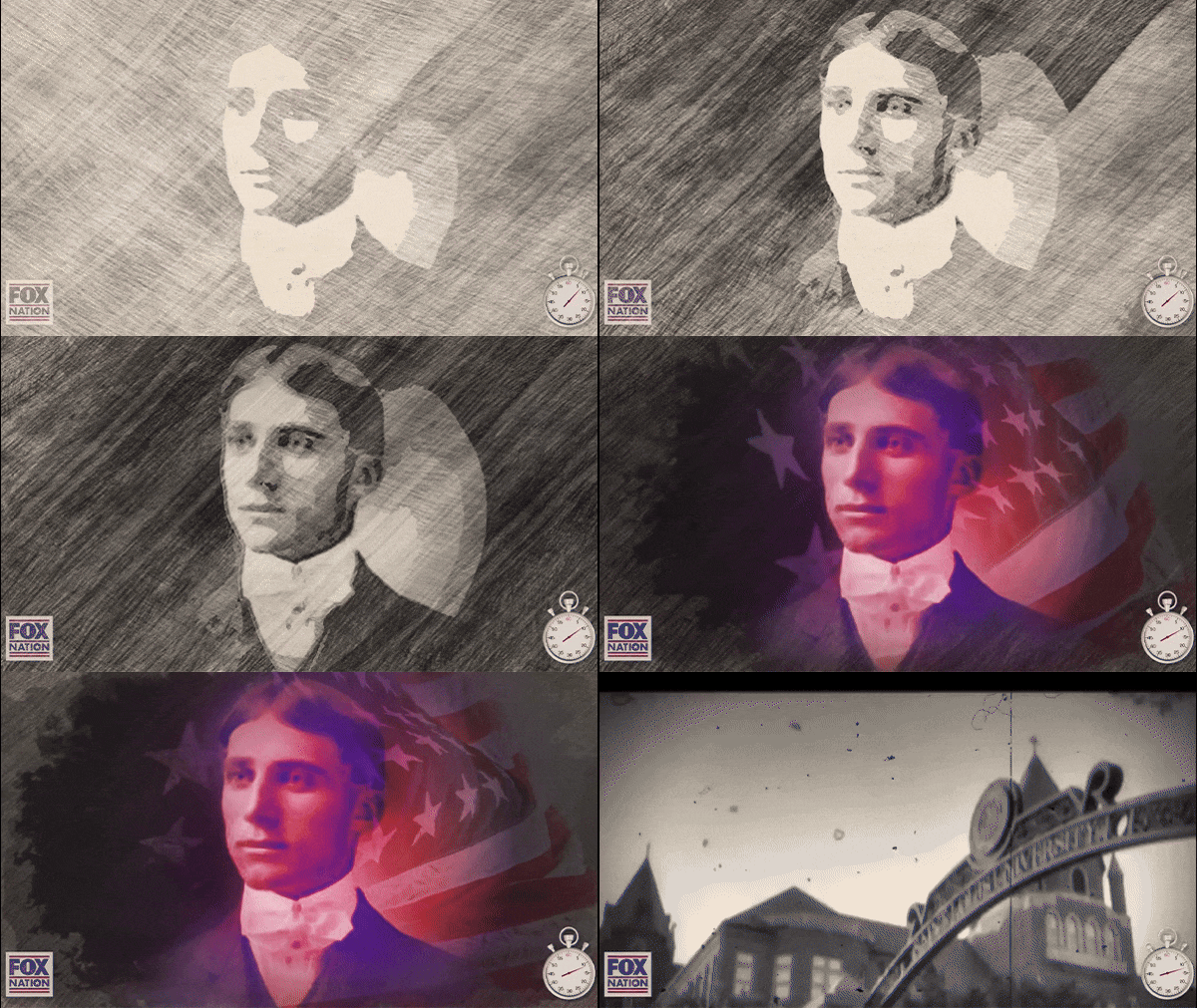
Imagine the United States of America without football — our most popular sport and a cherished cultural spectacle.
No Friday night lights, Saturday afternoon madness or Super Bowl Sunday.
It nearly happened. Gruesome violence on the gridiron in the early 1900s spurred calls from pigskin prohibitionists to spike football.
St. Louis University star Bradbury Robinson was the first player to take a shot downfield to save football and beat the blitz that threatened to sack the popular but deadly sport.
FOX NATION’S NEW SERIES ‘MEET THE AMERICAN WHO’ TELLS OF ORDINARY AMERICANS WHO GAVE US EXTRAORDINARY INNOVATIONS
Robinson threw the first forward pass, and then the first touchdown pass, in the history of football.
His “Blue and White” beat Carroll College, 22-0, on Sept. 5, 1906, in Waukesha, Wisconsin.
Bradbury Robinson was a three-sport star and medical student at St. Louis University when he threw the first forward pass, and the first touchdown pass, in the history of football on Sept. 5, 1906. St. Louis University beat Carroll College 22-0, in a game played in Waukesha, Wisconsin. (Public Domain)
“I had worked on forward passing, and at the time the pass was introduced I was the only finished passer in the country,” Robinson said while speaking about his role in sports history at a conference in 1947.
The forward pass was a regulatory Hail Mary — a longshot chance to save a sport that had grown wildly popular on high school and college campuses but too deadly for millions of Americans to tolerate.
“I had worked on forward passing, and at the time the pass was introduced I was the only finished passer in the country.”
President Theodore Roosevelt called an audible from the White House that launched a new era in the history of the sport — and in America’s cultural heritage.
“Football was incredibly brutal and violent at the turn of the century,” author and football historian John J. Miller told Fox News Digital.
The Big Scrum: How Teddy Roosevelt Saved Football” by John J. Miller chronicles the high-powered effort to make football less deadly and more exciting. (Courtesy HarperCollins)
Miller is a journalism professor at Hillsdale College in Michigan and author of the 2011 book “The Big Scrum: How Teddy Roosevelt Saved Football.”
A total of 48 players were killed on the gridiron between 1900 and 1905, according to several sources.
“Brutality in playing a game should awaken the heartiest and most plainly shown contempt for the player guilty of it,” President Roosevelt said at the time.
MEET THE AMERICAN WHO WAS THE FIRST PAID PROFESSIONAL FOOTBALL PLAYER: PUDGE HEFFELFINGER
The First Football Fan called together college football rule-makers at the end of 1905 season. He demanded they find a way to make the sport safer to quell the anti-football uprising.
The forward pass proved their most important innovation.
Bradbury Robinson transferred from the University of Wisconsin to St. Louis University before the 1904 season. The powerhouse team participated in the 1904 Olympic Games in St. Louis, where they earned the distinction of the first and only gold medal “Olympic world’s champions” in American football. Bradbury Robinson, who threw the first forward pass in football history in 1906, is front row, second from right. (Public Domain)
“Without Roosevelt and the forward pass, what would have happened to football? Would the prohibitionists have won?” Miller said on NFL Films production “A Football Life: The Forward Pass.”
“Yes, they might have won. Football might have been abandoned. It might have been outlawed. It might have been erased from our cultural landscape.”
Intolerable death toll
Bradbury Norton Robinson Jr. was born on Feb. 1, 1884 in Bellevue, Ohio to Bradbury and Amelia Isabella (Lee) Robinson.
The first football game, a duel between Princeton and Rutgers, had been played only 15 years earlier.
Dad “Brad” Sr. was a Civil War veteran from Massachusetts who spent much of his life working on railroads. Mom Amelia was born in England.
The family moved to Wisconsin when the future pigskin pioneer was a child.
He proved a star high school athlete and made his way to the University of Wisconsin, where he saw playing time with the varsity football team as a freshman in 1903.
“Football might have been abandoned. It might have been outlawed. It might have been erased from our cultural landscape.”
He was reportedly dismissed from the football team after an altercation with another student.
He enrolled in St. Louis University the following season. He became a star on one of the most dominant teams of what was then considered western football.
Among other honors, St. Louis University holds the distinction of being the only team in history to win an Olympic gold medal in American football, according to university archivist Caitlin Stamm.
Bradley Robinson of SLU’s Blue and White football team throws the “first” forward pass to John Schneider, in this reconstructed image of the first forward pass in collegiate football, Nov. 3, 1906. (Excerpted from a composite image on page 190 in the SLU Blue and White Yearbook for 1907.) (Courtesy St. Louis University archives)
The 1904 Olympics were held in St. Louis that year, with American football, primarily a college game at the time, one of the featured sports.
St. Louis University went undefeated that year while the popularity of college football swept across the nation.
MEET THE AMERICAN WHO IS THE ‘TRUE FATHER OF BASEBALL,” NEW YORK CITY PHYSICAN DANIEL ’DOC’ ADAMS
But the 1905 season that followed proved intolerably deadly: A shocking 18 high school and college football players were killed on the field of play.
The cries to end the brutality and even ban the game presented political headwinds for the football-loving reformist president.
“President Theodore Roosevelt, whose son was on the freshman team at Harvard University, made it clear he wanted reforms amid calls by some to abolish the college game,” Smithsonian Magazine reported in 2010.
Theodore Roosevelt standing on a podium pointing into the crowd during a campaign rally speech, circa 1900s (original caption). (Getty Images)
University officials from across the nation met in New York City that December.
Smithsonian Magazine added, “They made a number of changes, including banning the ‘flying wedge,’ a mass formation that often caused serious injury, created the neutral zone between offense and defense and required teams to move 10 yards, not 5, in three downs.”
It also said, “Their biggest change was to make the forward pass legal, beginning the transformation of football into the modern game.”
“President Theodore Roosevelt … made it clear he wanted reforms amid calls by some to abolish the college game.”
Robinson reportedly got a heads-up on the pending rule changes from a family friend.
Wisconsin Gov. Robert M. La Follette Sr., according to numerous accounts, shared with Robinson a letter from the president hinting at the potential of the forward pass a year earlier.
Robinson became one of the first people in the nation to practice a new skill that backyard quarterbacks take for granted today: passing the pigskin.
Ball in the ‘shape of a watermelon’
St. Louis University brought in a new coach before that 1906 season: former Wisconsin assistant Eddie Cochems.
The forward-thinking coach was only 29 and apparently knew Robinson from their days at the University of Wisconsin. The football star reportedly urged school authorities to hire the new coach.
The 1906 St. Louis University football team was the first in history to take advantage of new rules and execute the forward pass. The team went 11-0 and outscored opponents 407-11. (Courtesy St. Louis University archives)
Their game plan to unleash the forward pass was formulated during a team retreat in Wisconsin.
“Cochem brought a team of 16 players to Lakeview, Wisconsin, and used the time to train them on how to use the forward pass,” Stamm, the St. Louis University archivist, told Fox News Digital.
MEET THE AMERICAN WHO CREATED NASCAR: BILL FRANCE SR., DAYTONA SPEED DEMON AND RACETRACK PIONEER
Among other things, players had to learn to throw a spiral.
Robinson proved a natural. He was able to throw a football accurately 40 yards downfield, said Stamm.
It was an incredible testament to his arm strength.
St. Louis University wowed fans at Sportsman’s Park when Bradbury Robinson threw a 48-yard pass on Nov. 3, 1906, in a 34-2 win over Kansas University. Robinson had thrown the first forward pass, and first touchdown pass, in football history earlier that season in a 22-0 win over Carroll College. (Courtesy St. Louis University archives)
“The ball he would have thrown would have been the shape of a watermelon,” said Miller.
Cochems adapted faster than most coaches to the new rules changes.
“Some of the new features are very acceptable,” he said in a preseason edition of the SLU publication Fleur de Lis.
“The ball he would have thrown would have been the shape of a watermelon.”
“I think that the quarterback kick and the forward-pass will develop many spectacular plays before the season closes.”
It took little time for his words to prove prophetic.
For more Lifestyle articles, visit foxnews.com/lifestyle
St. Louis University opened the 1906 season on September 5 against Carroll College at the end of the summer retreat.
It gave the Blue and White — SLU adopted its Billikens nickname five years later — a head start on history. Most programs would not play their first game until October.
Eddie B. Cochems, Physical Education Instructor and Football Coach at Saint Louis University (1906) (Courtesy St. Louis University Archives)
The first pass in the history of football fell incomplete. It was a turnover by the rules of the time.
Robinson’s second pass proved the potential for aerial fireworks ahead. He hit teammate Jack Schneider for a 20-yard score — the first touchdown pass in football history.
MEET THE AMERICAN WHO WAS REVERED AS THE ‘PATRON SAINT’ UNTIL HE WAS CANCELED: LENNI LENAPE CHIEF TAMMANY
“Robinson was an end and I was a fullback. But Brad could throw the ball a long way, so we switched positions for that one play,” Schneider recalled 50 years later for the St. Louis Post-Dispatch.
“We were told to run after the snap and just keep going until we heard the passer yell ‘hike’ or our name. So, I ran and ran. I was about to give up when I heard Robinson call. I turned and caught the ball a yard or so short of the goal and went over with it.”
Football match between Yale and Princeton, 1879. Walter Camp was captain of the 1879 Yale football team. Drawing by A.B. Frost. (Getty Images)
“Somebody had to be the first. Somebody had to take the risk and show the football world what the forward pass could do,” author Miller said of the transformational moment in sports history.
“I bet it was pretty exciting.”
Armed with a new weapon, the Blue and White went 11-0 and savaged opponents by a combined score of 407-11.
The game of football was off and flying.
Robinson thrilled football fans later in the season with 48-yard completion against Kansas University. It was an unfathomable achievement in a sport that only one year earlier had been a deadly war of attrition.
Football was taking off and flying.
A legend nearly lost
Bradbury Robinson died in Florida on March 7, 1949. He was 65 years old.
He served as a captain in the U.S. Army in World War I, after his football heroics, and is buried at Arlington National Cemetery.
CLICK HERE TO SUBSCRIBE TO FOX NATION
He enjoyed a distinguished career as a physician. Among other accomplishments, he worked in Europe after the war for U.S. Surgeon General Hugh S. Cumming.
Robinson was also credited in the 1940s as one of the first medical professionals to alert the world of the dangers of insecticide DDT in agriculture.
St. Louis University star Bradbury Robinson introduced the forward pass to football in 1906. SLU went 11-0 and stunned fans with a 48-yard pass against Kansas University. (Courtesy St. Louis University archives)
Robinson’s legacy as pigskin pioneer was nearly usurped by a legendary moment in football history.
The forward pass enjoyed a public relations coup in 1913. A little-known Catholic school from Indiana used the tactic to shock an eastern power in front of New York City media at West Point.
“The forward pass made the game both safer – and more exciting.”
Upstart Notre Dame smashed mighty Army, 35-13, as end and future coaching legend Knute Rockne caught two touchdown passes from Gus Dorais.
“The Westerners flashed the most sensational football that has been seen in the East this year,” The New York Times wrote of the event, “baffling the cadets with a style of open play and perfectly developed forward pass, which carried the victors down the field at 30 yards a clip.”
Knute Rockne is pictured here, as he appeared while he was captain of the Notre Dame football team. (Getty Images)
The forward pass perfected by small western schools had finally caught the attention of the eastern football establishment.
Notre Dame’s legend and affillation with the forward pass was cemented by the celebrated 1940 movie “Knute Rockne, All American,” starring Ronald Reagan.
Yet the claim to fame rightly belongs to St. Louis University, a school of firsts, said archivist Stamm.
Boomer Esiason, No. 7 of the Cincinnati Bengals, gets his pass off while under pressure from Kevin Fagan, No. 75 of the San Francisco 49ers, during Super Bowl XXIII on Jan. 22, 1989 at Joe Robbie Stadium in Miami, Florida. The 49ers won that Super Bowl 20-16. (Focus on Sport/Getty Images)
The institution, she noted, was both the first university and first medical school west of the Mississippi River; it was also the first federally recognized aviation school.
“It’s a long tradition of excellence and firsts,” she said. “Even in a sport we don’t participate in anymore, the forward pass is still a part of our heritage.”
The forward pass, said Miller, made the game both safer and more exciting.
Former NFL quarterback and sports personality Boomer Esiason claims the forward pass made football a uniquely American game.
Tom Brady attempted 12,050 passes in his legendary NFL career; Bradbury Robinson threw the first very football pass in 1906. (Maddie Meyer/Getty Images; Courtesy St. Louis University archives)
“Other countries don’t do this. They play rugby. They flip it back. They play soccer. They kick it,” Esiason said during the NFL Films production “A Football Life: The Forward Pass.”
To read more stories in this unique “Meet the American Who…” series from Fox News Digital, click here.
“We Americans are all about freedom and liberty. We can flip it back. We can kick it. But more importantly, we can throw it. Nobody can throw it like an American.”
Read the full article from Here



Dusty May is leaving Michigan for the Dallas Mavericks. What now?
Free Press sports writer Tony Garcia breaks down the “shocking” news of Michigan basketball coach Dusty May leaving for the NBA.
At the University of Michigan’s board of regents meeting on Thursday, June 25, interim president Domenico Grasso addressed the departure of former Michigan basketball coach Dusty May, calling the move a “bellwether” for college athletics.
May, who had reportedly agreed in principle to a contract extension with the Wolverines but had yet to sign it, left the program on Monday, June 22. One day later, he was in Brooklyn for the NBA Draft where his Dallas Mavericks selected his former player, Michigan forward Morez Johnson Jr., with the No. 9 overall pick.
“Our current system is in dire need of clarity and equitable reform,” Grasso said at the regents meeting. “Coach May told me that among his reasons for leaving were uncertainties and pressures involving the transfer portal and NIL support for student-athletes.
“He and I agree that the future of college sports is headed in the wrong direction.”
While Grasso did say the new “Protect College Sports Act” could provide “greater stability, clearer national standards and more consistent rules” to college athletics, he also said it has “deeply concerning provisions.”
“Rather than looking to conferences such as the Big Ten as models of athletic and academic excellence, it imposes restrictions that disproportionately affect the institution,” he said. “Among the most troubling provisions are targeted limits on conference expansion and realignment, as well as harmful restrictions on student athletes’ ability to benefit from additional NIL opportunities. These measures will reduce universities and conferences’ flexibility to adapt to changing conditions for student innovative opportunities.
“We want what’s best for the Big Ten and for Michigan. We are not going to sacrifice competitive advantage that we built for more than a century. We stand ready to work with legislators on a bill that will establish a system in which every university can compete and thrive for generations to come.”
May spent just two years in Ann Arbor but made a lasting mark on the program. He went 64-13 during his time, won the 2024-25 Big Ten Tournament championship, the 2025-26 Big Ten championship and finished his time in Ann Arbor defeating UConn, 69-63, to win the national championship on Monday, April 6.
“When my family and I came to Ann Arbor two years ago, we hoped we could help bring Michigan basketball back to where it belongs,” May said in a goodbye statement to U-M. “This wasn’t an easy decision. An opportunity came along that was right for my family and something I felt I needed to pursue, but that doesn’t change how much these last two years have meant to us.
“Thank you for trusting us, believing in us and making these last two years so much fun. It was an honor to coach at Michigan and wear the Block M.”
On Tuesday, June 23, Michigan athletic director Warde Manuel officially announced assistant basketball coach Mike Boynton Jr. would be appointed as interim head coach.
That set a clock for the transfer portal to open for U-M players on Friday, July 24, 31 days after Boynton’s appointment as interim.
Tony Garcia is the Michigan beat writer for the Detroit Free Press. Email him at apgarcia@freepress.com and follow him on X at @RealTonyGarcia.

Trading LaMelo Ball to the Minnesota Timberwolves will make the Charlotte Hornets worse in 2026-27. There is no denying that.
Ball was the lone driver of Charlotte’s top-five offense, speeding the Hornets’ fast-paced attack up and down and all around the floor to create open looks for himself and his talented teammates. LaMelo’s Gastonia shooting range, unorthodox handles, eagle-eyed passing, and his ability to heat up in a moment’s notice just simply cannot be aggregated in the interim.
With Ball on the floor, Charlotte’s offensive rating jumped by 11.6 points per 100 possessions, good for the 99th percentile among guards in the NBA. Kon Knueppel’s three-point percentage increased by 10.3 points when he shared the floor with Ball, and Brandon Miller shot 20.5% better at the rim (an area where he struggles) with LaMelo helping create looks for him.
Everyone who plays alongside LaMelo Ball gets better — the proof is in any publicly available number you can find.
Charlotte’s historically efficient offense cratered when LaMelo hit the bench, and trading him now, no matter what they got in return, will immediately set back the Hornets’ push to become the premier NBA franchise they aspire to be.
But what if I told you this move does make some sense in the Hornet’s long-term team build? And that Charlotte is justified to sell-high on their All-NBA caliber point guard? I’m not sure I believe it, so I’m going to try and convince myself as I attempt to convince you.
Justifying Charlotte’s Decision to Trade LaMelo Ball
I can understand some trepidation about building the whole plane out of LaMelo Ball. He only played a total of 105 games in the three seasons prior to 2025-26, and until that becomes the exception, not the norm, it will always be dangerous to have him as the centerpiece of a franchise.
LaMelo Ball played 72 games in 2025-26, the second-highest number of his young NBA career. The Hornets were cautious about over-taxing their star creator, only playing him 28 minutes per game, a career-low, and crafting a roster that was built to ease LaMelo’s burden.
Last summer, Charlotte targeted Tre Mann (which looks bad in hindsight), Collin Sexton, and Spencer Dinwidde to provide supplementary ball handling and lower the league-high 37.1% usage rate Ball racked up in 2024-25. Championships are won on the margins, and if you have to allocate extra resources to your point guard room as a parachute for a player like LaMelo, there’s a chance you’re missing out on some impact on the fringes of your roster.
Also, the skill sets of Ball, Knueppel, and Miller are quite redundant. They are all perimeter-focused offensive options who struggle to score in the paint. Charlotte could believe that it was necessary to move one of them in an attempt to diversify their offensive attack, and due to Kon and Brandon’s contract situation and LaMelo’s long-term health outlook (which the Hornets would know better than anybody, by the way), they decided that the time to sell-high on Ball was now.
How high would the ceiling of a fully-formed, maxed-out contractually Ball, Knueppel, and Miller trio even be? A second round exit assuming everything goes right? By trading Ball now, adding a talented front court piece in Naz Reid, creating the largest trade exception in league history, and setting yourself up to be a real player in trade talks about any disgruntled superstar, Jeff Peterson just created a number of avenues to rebuild this team around its burgeoning stars.
Could the package have been more robust? Sure. But there’s no guarantee another team with more assets to spare than Minnesota would have even registered more than nominal interst in LaMelo Ball. The market is the market. Peterson said last summer that he’ll push the chips in when the time is right, and if nothing else, he just added a few more to his stash.
There is also a chance that the Timberwolves look radically different when these swaps and picks are ready to convey. Minnesota’s asset reserves are bone dry, starting center Rudy Gobert is on the back-nine of his NBA career, and the Western Conference has a couple of well-positioned juggernauts that the Wolves will have to navigate every year that they employ Anthony Edwards and Ball.
And what if Edwards becomes disillusioned with his standing in Minnesota and forces his way out before his five-year, $244M contract expires in 2028-29? Or what if he leaves that summer in free agency? The Hornets will have the opportunity to pick up the pieces and feast off of the wreckage in Minnesota in that nightmare scenario for the Timberwolves.
There has to be more bubbling underneath the surface for Charlotte to be willing to take the massive PR hit of trading LaMelo Ball just weeks after the franchise played some of the best basketball in the league for an extended period. There is an argument to be made that this deal says more about Charlotte’s lack of belief in the ceiling of a LaMelo-led team than anything else.
And there is merit to that.
Ball has played in four Play-In Tournament games and struggled mighitly in three of them. When the game slows down and becomes increasingly more physical, Ball has failed to hold up. The Hornets must be projecting that Ball’s postseason struggles will continue in Minnesota, capping the long-term ceiling of the Timberwolves.
This is a bet against a couple of things: LaMelo Ball’s long-term health, the viability of a back court duo of Ball and Edwards, and Minnestoa’s asset-poor state. I’m not sure if it’s a bet I would have been willing to make, but it is the one Jeff Peterson and the Hornets decided to.
And whether you like it or not, the dice have been thrown.
There is now more pressure than ever on the shoulders of Jeff Peterson. He somehow pulled off the rare feat of making his team worse in the short term while sending the expectations of his fanbase through the roof. There has to be more moves coming from Charlotte. There has to.
Which is why I’m calling on you to holster your torches and pitchforks for now. In a vacuum, this deal is a tough one to swallow. LaMelo Ball brought unquantifiable joy to the city of Charlotte and spearheaded a run that awoke the long dormant basketball-crazed city. Not only did his impact on winning supersede the narratives around him, his impact on the franchise’s bottom line did as well. The city loved LaMelo, and it is a shame that he was sent packing just as things were starting to percolate for the first time in his Hornets career.
However, if it is a part of a larger plan that reshapes the Hornets’ roster into a group that can compete at a high level in the NBA playoffs, then I will tip my cap to Peterson and his team. Winning does cure all at the end of the day, right?
Subscribe to our FREE Newsletter for the latest news and updates on the Charlotte Hornets
Follow

KANSAS CITY, Mo. (KCTV) – The Missouri State Highway Patrol is investigating a shooting involving a Kansas City Police officer.
MSHP said the shooting occurred near 27th St. and Jackson Avenue.
Authorities said an officer on a motorcycle was stopped at a stop sign at the intersection of Spruce and 27th.
It’s unclear why, but police said the suspect had a rifle and started shooting at the officer. The officer returned shots and the suspect ran into the woods, where officers arrested him.
MSHP said the weapon had yet to be located, as of 4:20 p.m.
Authorities said neither the officer nor the suspect were injured and the suspect was taken into custody.
This is a breaking news story. KCTV5 will update as more information becomes available.
Copyright 2026 KCTV. All rights reserved.
-

 Michigan44 seconds ago
Michigan president has strong words for college sports after Dusty May exit
-

 Massachusetts8 minutes ago
Mass. lawmakers prioritizing 100 high-risk locations to implement wrong-way driving prevention measures – Boston News, Weather, Sports | WHDH 7News
-

 Minnesota10 minutes ago
Rationalizing Charlotte’s Shocking Decision to Trade LaMelo Ball to Minnesota
-

 Mississippi16 minutes ago
Mississippi Legislature will talk school choice, redistricting in 2027
-

 Missouri23 minutes ago
Missouri Highway Patrol investigating KCPD officer involved shooting
-
Montana26 minutes ago
Montana DEQ works toward impairment designation for Big Hole River
-

 Nebraska31 minutes ago
Tunnel Talk: 5-for-5 impact on Nebraska volleyball, reseat update
-

 Nevada38 minutes ago
Terrible’s takeover of Primm gets Nevada regulatory approval


