Midwest
Meet the American who gave flight to football, Bradbury Robinson, college star threw first forward pass

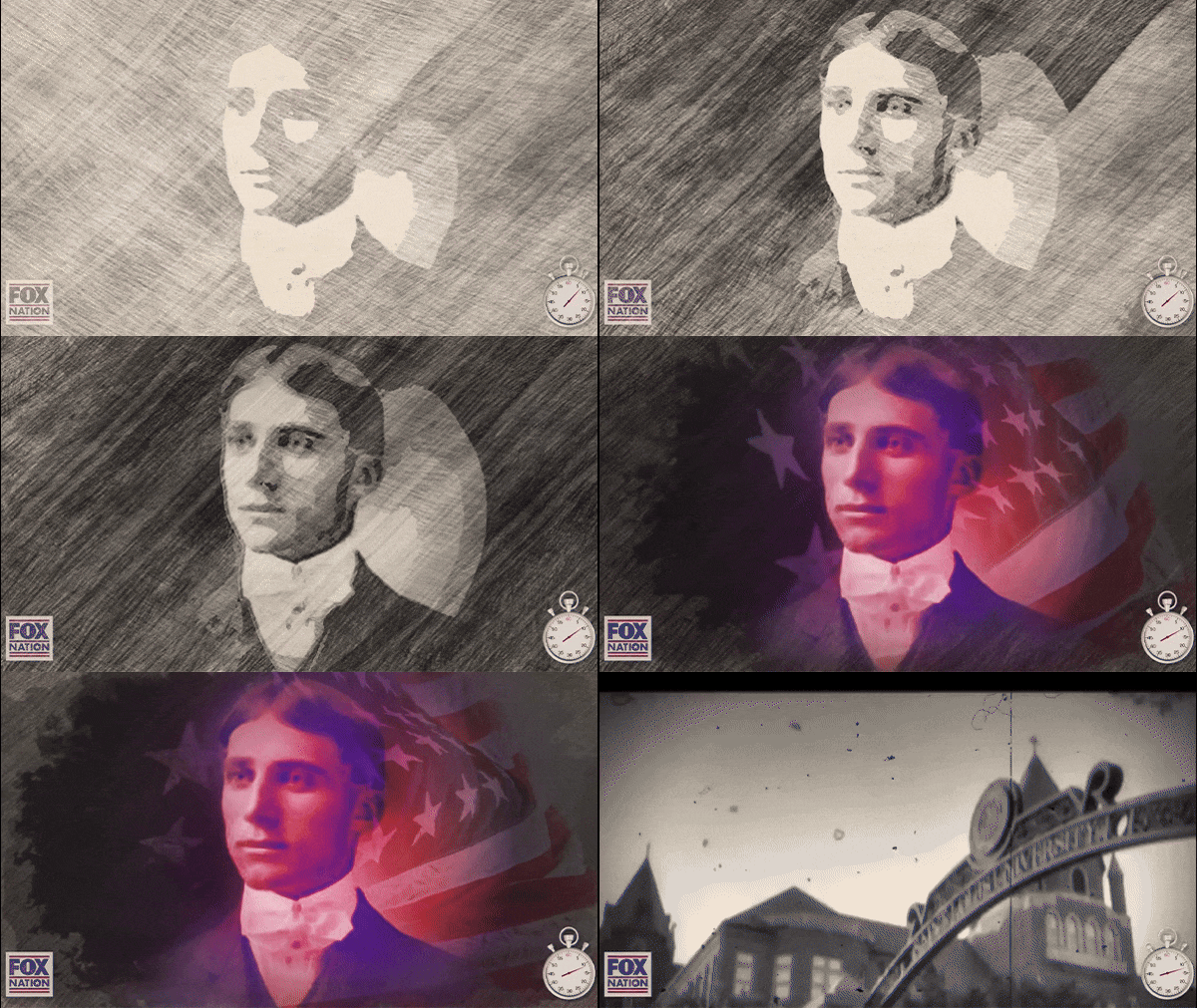
Imagine the United States of America without football — our most popular sport and a cherished cultural spectacle.
No Friday night lights, Saturday afternoon madness or Super Bowl Sunday.
It nearly happened. Gruesome violence on the gridiron in the early 1900s spurred calls from pigskin prohibitionists to spike football.
St. Louis University star Bradbury Robinson was the first player to take a shot downfield to save football and beat the blitz that threatened to sack the popular but deadly sport.
FOX NATION’S NEW SERIES ‘MEET THE AMERICAN WHO’ TELLS OF ORDINARY AMERICANS WHO GAVE US EXTRAORDINARY INNOVATIONS
Robinson threw the first forward pass, and then the first touchdown pass, in the history of football.
His “Blue and White” beat Carroll College, 22-0, on Sept. 5, 1906, in Waukesha, Wisconsin.
Bradbury Robinson was a three-sport star and medical student at St. Louis University when he threw the first forward pass, and the first touchdown pass, in the history of football on Sept. 5, 1906. St. Louis University beat Carroll College 22-0, in a game played in Waukesha, Wisconsin. (Public Domain)
“I had worked on forward passing, and at the time the pass was introduced I was the only finished passer in the country,” Robinson said while speaking about his role in sports history at a conference in 1947.
The forward pass was a regulatory Hail Mary — a longshot chance to save a sport that had grown wildly popular on high school and college campuses but too deadly for millions of Americans to tolerate.
“I had worked on forward passing, and at the time the pass was introduced I was the only finished passer in the country.”
President Theodore Roosevelt called an audible from the White House that launched a new era in the history of the sport — and in America’s cultural heritage.
“Football was incredibly brutal and violent at the turn of the century,” author and football historian John J. Miller told Fox News Digital.
The Big Scrum: How Teddy Roosevelt Saved Football” by John J. Miller chronicles the high-powered effort to make football less deadly and more exciting. (Courtesy HarperCollins)
Miller is a journalism professor at Hillsdale College in Michigan and author of the 2011 book “The Big Scrum: How Teddy Roosevelt Saved Football.”
A total of 48 players were killed on the gridiron between 1900 and 1905, according to several sources.
“Brutality in playing a game should awaken the heartiest and most plainly shown contempt for the player guilty of it,” President Roosevelt said at the time.
MEET THE AMERICAN WHO WAS THE FIRST PAID PROFESSIONAL FOOTBALL PLAYER: PUDGE HEFFELFINGER
The First Football Fan called together college football rule-makers at the end of 1905 season. He demanded they find a way to make the sport safer to quell the anti-football uprising.
The forward pass proved their most important innovation.
Bradbury Robinson transferred from the University of Wisconsin to St. Louis University before the 1904 season. The powerhouse team participated in the 1904 Olympic Games in St. Louis, where they earned the distinction of the first and only gold medal “Olympic world’s champions” in American football. Bradbury Robinson, who threw the first forward pass in football history in 1906, is front row, second from right. (Public Domain)
“Without Roosevelt and the forward pass, what would have happened to football? Would the prohibitionists have won?” Miller said on NFL Films production “A Football Life: The Forward Pass.”
“Yes, they might have won. Football might have been abandoned. It might have been outlawed. It might have been erased from our cultural landscape.”
Intolerable death toll
Bradbury Norton Robinson Jr. was born on Feb. 1, 1884 in Bellevue, Ohio to Bradbury and Amelia Isabella (Lee) Robinson.
The first football game, a duel between Princeton and Rutgers, had been played only 15 years earlier.
Dad “Brad” Sr. was a Civil War veteran from Massachusetts who spent much of his life working on railroads. Mom Amelia was born in England.
The family moved to Wisconsin when the future pigskin pioneer was a child.
He proved a star high school athlete and made his way to the University of Wisconsin, where he saw playing time with the varsity football team as a freshman in 1903.
“Football might have been abandoned. It might have been outlawed. It might have been erased from our cultural landscape.”
He was reportedly dismissed from the football team after an altercation with another student.
He enrolled in St. Louis University the following season. He became a star on one of the most dominant teams of what was then considered western football.
Among other honors, St. Louis University holds the distinction of being the only team in history to win an Olympic gold medal in American football, according to university archivist Caitlin Stamm.
Bradley Robinson of SLU’s Blue and White football team throws the “first” forward pass to John Schneider, in this reconstructed image of the first forward pass in collegiate football, Nov. 3, 1906. (Excerpted from a composite image on page 190 in the SLU Blue and White Yearbook for 1907.) (Courtesy St. Louis University archives)
The 1904 Olympics were held in St. Louis that year, with American football, primarily a college game at the time, one of the featured sports.
St. Louis University went undefeated that year while the popularity of college football swept across the nation.
MEET THE AMERICAN WHO IS THE ‘TRUE FATHER OF BASEBALL,” NEW YORK CITY PHYSICAN DANIEL ’DOC’ ADAMS
But the 1905 season that followed proved intolerably deadly: A shocking 18 high school and college football players were killed on the field of play.
The cries to end the brutality and even ban the game presented political headwinds for the football-loving reformist president.
“President Theodore Roosevelt, whose son was on the freshman team at Harvard University, made it clear he wanted reforms amid calls by some to abolish the college game,” Smithsonian Magazine reported in 2010.
Theodore Roosevelt standing on a podium pointing into the crowd during a campaign rally speech, circa 1900s (original caption). (Getty Images)
University officials from across the nation met in New York City that December.
Smithsonian Magazine added, “They made a number of changes, including banning the ‘flying wedge,’ a mass formation that often caused serious injury, created the neutral zone between offense and defense and required teams to move 10 yards, not 5, in three downs.”
It also said, “Their biggest change was to make the forward pass legal, beginning the transformation of football into the modern game.”
“President Theodore Roosevelt … made it clear he wanted reforms amid calls by some to abolish the college game.”
Robinson reportedly got a heads-up on the pending rule changes from a family friend.
Wisconsin Gov. Robert M. La Follette Sr., according to numerous accounts, shared with Robinson a letter from the president hinting at the potential of the forward pass a year earlier.
Robinson became one of the first people in the nation to practice a new skill that backyard quarterbacks take for granted today: passing the pigskin.
Ball in the ‘shape of a watermelon’
St. Louis University brought in a new coach before that 1906 season: former Wisconsin assistant Eddie Cochems.
The forward-thinking coach was only 29 and apparently knew Robinson from their days at the University of Wisconsin. The football star reportedly urged school authorities to hire the new coach.
The 1906 St. Louis University football team was the first in history to take advantage of new rules and execute the forward pass. The team went 11-0 and outscored opponents 407-11. (Courtesy St. Louis University archives)
Their game plan to unleash the forward pass was formulated during a team retreat in Wisconsin.
“Cochem brought a team of 16 players to Lakeview, Wisconsin, and used the time to train them on how to use the forward pass,” Stamm, the St. Louis University archivist, told Fox News Digital.
MEET THE AMERICAN WHO CREATED NASCAR: BILL FRANCE SR., DAYTONA SPEED DEMON AND RACETRACK PIONEER
Among other things, players had to learn to throw a spiral.
Robinson proved a natural. He was able to throw a football accurately 40 yards downfield, said Stamm.
It was an incredible testament to his arm strength.
St. Louis University wowed fans at Sportsman’s Park when Bradbury Robinson threw a 48-yard pass on Nov. 3, 1906, in a 34-2 win over Kansas University. Robinson had thrown the first forward pass, and first touchdown pass, in football history earlier that season in a 22-0 win over Carroll College. (Courtesy St. Louis University archives)
“The ball he would have thrown would have been the shape of a watermelon,” said Miller.
Cochems adapted faster than most coaches to the new rules changes.
“Some of the new features are very acceptable,” he said in a preseason edition of the SLU publication Fleur de Lis.
“The ball he would have thrown would have been the shape of a watermelon.”
“I think that the quarterback kick and the forward-pass will develop many spectacular plays before the season closes.”
It took little time for his words to prove prophetic.
For more Lifestyle articles, visit foxnews.com/lifestyle
St. Louis University opened the 1906 season on September 5 against Carroll College at the end of the summer retreat.
It gave the Blue and White — SLU adopted its Billikens nickname five years later — a head start on history. Most programs would not play their first game until October.
Eddie B. Cochems, Physical Education Instructor and Football Coach at Saint Louis University (1906) (Courtesy St. Louis University Archives)
The first pass in the history of football fell incomplete. It was a turnover by the rules of the time.
Robinson’s second pass proved the potential for aerial fireworks ahead. He hit teammate Jack Schneider for a 20-yard score — the first touchdown pass in football history.
MEET THE AMERICAN WHO WAS REVERED AS THE ‘PATRON SAINT’ UNTIL HE WAS CANCELED: LENNI LENAPE CHIEF TAMMANY
“Robinson was an end and I was a fullback. But Brad could throw the ball a long way, so we switched positions for that one play,” Schneider recalled 50 years later for the St. Louis Post-Dispatch.
“We were told to run after the snap and just keep going until we heard the passer yell ‘hike’ or our name. So, I ran and ran. I was about to give up when I heard Robinson call. I turned and caught the ball a yard or so short of the goal and went over with it.”
Football match between Yale and Princeton, 1879. Walter Camp was captain of the 1879 Yale football team. Drawing by A.B. Frost. (Getty Images)
“Somebody had to be the first. Somebody had to take the risk and show the football world what the forward pass could do,” author Miller said of the transformational moment in sports history.
“I bet it was pretty exciting.”
Armed with a new weapon, the Blue and White went 11-0 and savaged opponents by a combined score of 407-11.
The game of football was off and flying.
Robinson thrilled football fans later in the season with 48-yard completion against Kansas University. It was an unfathomable achievement in a sport that only one year earlier had been a deadly war of attrition.
Football was taking off and flying.
A legend nearly lost
Bradbury Robinson died in Florida on March 7, 1949. He was 65 years old.
He served as a captain in the U.S. Army in World War I, after his football heroics, and is buried at Arlington National Cemetery.
CLICK HERE TO SUBSCRIBE TO FOX NATION
He enjoyed a distinguished career as a physician. Among other accomplishments, he worked in Europe after the war for U.S. Surgeon General Hugh S. Cumming.
Robinson was also credited in the 1940s as one of the first medical professionals to alert the world of the dangers of insecticide DDT in agriculture.
St. Louis University star Bradbury Robinson introduced the forward pass to football in 1906. SLU went 11-0 and stunned fans with a 48-yard pass against Kansas University. (Courtesy St. Louis University archives)
Robinson’s legacy as pigskin pioneer was nearly usurped by a legendary moment in football history.
The forward pass enjoyed a public relations coup in 1913. A little-known Catholic school from Indiana used the tactic to shock an eastern power in front of New York City media at West Point.
“The forward pass made the game both safer – and more exciting.”
Upstart Notre Dame smashed mighty Army, 35-13, as end and future coaching legend Knute Rockne caught two touchdown passes from Gus Dorais.
“The Westerners flashed the most sensational football that has been seen in the East this year,” The New York Times wrote of the event, “baffling the cadets with a style of open play and perfectly developed forward pass, which carried the victors down the field at 30 yards a clip.”
Knute Rockne is pictured here, as he appeared while he was captain of the Notre Dame football team. (Getty Images)
The forward pass perfected by small western schools had finally caught the attention of the eastern football establishment.
Notre Dame’s legend and affillation with the forward pass was cemented by the celebrated 1940 movie “Knute Rockne, All American,” starring Ronald Reagan.
Yet the claim to fame rightly belongs to St. Louis University, a school of firsts, said archivist Stamm.
Boomer Esiason, No. 7 of the Cincinnati Bengals, gets his pass off while under pressure from Kevin Fagan, No. 75 of the San Francisco 49ers, during Super Bowl XXIII on Jan. 22, 1989 at Joe Robbie Stadium in Miami, Florida. The 49ers won that Super Bowl 20-16. (Focus on Sport/Getty Images)
The institution, she noted, was both the first university and first medical school west of the Mississippi River; it was also the first federally recognized aviation school.
“It’s a long tradition of excellence and firsts,” she said. “Even in a sport we don’t participate in anymore, the forward pass is still a part of our heritage.”
The forward pass, said Miller, made the game both safer and more exciting.
Former NFL quarterback and sports personality Boomer Esiason claims the forward pass made football a uniquely American game.
Tom Brady attempted 12,050 passes in his legendary NFL career; Bradbury Robinson threw the first very football pass in 1906. (Maddie Meyer/Getty Images; Courtesy St. Louis University archives)
“Other countries don’t do this. They play rugby. They flip it back. They play soccer. They kick it,” Esiason said during the NFL Films production “A Football Life: The Forward Pass.”
To read more stories in this unique “Meet the American Who…” series from Fox News Digital, click here.
“We Americans are all about freedom and liberty. We can flip it back. We can kick it. But more importantly, we can throw it. Nobody can throw it like an American.”
Read the full article from Here


RAPID CITY, S.D. (KOTA) – The South Dakota Supreme Court has upheld the convictions of a Pennington County man sentenced for threatening a Box Elder resident with a handgun during a 2025 home invasion.
In a unanimous decision, the court affirmed the convictions of Chris David Kujawa, who was found guilty of first-degree burglary and aggravated assault with a deadly weapon. A Pennington County jury convicted Kujawa in May 2025, and he was sentenced to concurrent 12-year prison terms.
According to trial testimony, Kujawa forced his way into a Box Elder home, accused the homeowner of stealing property and pointed a handgun at the victim’s head while threatening to kill him. The victim testified Kujawa also threatened his wife.
Kujawa appealed the convictions, arguing the trial court improperly limited questions about the victim’s prior convictions and incorrectly responded to a question from jurors during deliberations.
The Supreme Court rejected those arguments, finding that any error related to the victim’s prior conviction did not affect the outcome of the case and that the judge properly directed jurors to review instructions that accurately stated the law.
“The Supreme Court’s decision affirms the jury’s verdict and recognizes the strength of the evidence presented at trial,” Attorney General Marty Jackley said in a statement.
The Attorney General’s Office represented the state during the appeal.
See a spelling or grammatical error in our story? Please click here to report it.
Do you have a photo or video of a breaking news story? Send it to us here with a brief description.
Copyright 2026 KOTA. All rights reserved.


Greg Gard shares most rewarding part of Garding Against Cancer effort
Wisconsin basketball coach Greg Gard said the most rewarding part of his Garding Against Cancer initiative is ‘the people.’
MADISON – Greg Gard and Co. have landed another one of their top recruiting targets in the 2027 class.
Baboucarr Ann, a four-star recruit from Maple Grove, Minnesota, announced his commitment to Wisconsin men’s basketball via social media on June 25.
“Belief. Trust. Development. Family,” Ann said in a tweet. “That’s why I’m a Badger.”
Ann chose the Badgers over scholarship offers from Notre Dame, Iowa State and nearby Minnesota, among other high-major programs. 247 Sports has ranked the 6-foot-5 prospect No. 84 nationally and No. 1 in Minnesota.
He is the third UW commit in the 2027 class, joining Wauwatosa West guard Jalen Brown and 7-foot-1 center Jack Thelen. Brown also is a top-100 recruit in 247 Sports’ rankings.
Ann and Thelen are teammates both at Maple Grove and on the AAU circuit. Brad Davison, UW’s special assistant to the head coach, is a Maple Grove alum and had a key role in Ann’s recruitment.
While the rankings surely will fluctuate as other schools pick up more commitments, the Badgers have 247 Sports’ third-best recruiting class in the country. Iowa State and Illinois are the only higher-rated classes.

The Detroit Lions are facing a significant dilemma regarding a player selected in the first-round of the 2024 NFL Draft.
Cornerback Terrion Arnold is facing multiple felony charges stemming from an alleged robbery and kidnapping plot in Florida.
When drafted, the former Alabama Crimson Tide defensive back signed a four-year, $14,343,710 contract. The agreement included a $7,251,788 signing bonus and an average salary of $3,585,928 annually.
So at this point, Arnold has been paid more than half of his contract.
This year, Arnold was set to earn a base salary of $1,273,974, which included a roster bonus of $825,000. His cap hit is $3,911,921 this year and has dead cap hit of $9,127,816.
If the Lions decide to cut the 23-year-old, they would be on the hook for dead cap costs, but could in the future recoup monies based on the league’s conduct policy.
According to Spotrac, “Lions Terrion Arnold has 2-years, $4.8 M (guaranteed) remaining on his rookie contract, plus a potential 5th-year option for the 2028 season. Any suspension stemming from a violation of the league’s conduct polict would void the guarantees.”
In the short term, cutting Arnold is not significantly beneficial. The organization could save money in the future depending on if his decisions are deemed to have breech the clauses in his first NFL contract.
Detroit has options at the cornerback position if Arnold is no longer a part of the organization. Nick Whiteside, Rock Ya-Sin, Keith Abney and Ennis Rakestraw are all in the mix to earn playing time opposite of veteran D.J. Reed.
“It’s just the depth. Like, you’ve got guys that have played in games and that’s what you want. It’s not like you’re guessing on what you’re getting. You know what you’re going to get from those guys and so another year in the system, another year competing, he’s (Whiteside) going to be better,” said defensive backs coach Deshea Townsend. “And just that’s the thing about the NFL, you got to have guys who go out there and compete and he’s another one that’s capable of playing and it’s going to push everybody else in the room.”
Currently, the team has $19,338,873 (17th) available in cap space, based on the top-51 players on the roster.
#Lions CB Terrion Arnold has 2-years, $4.8M (guaranteed) remaining on his rookie contract, plus a potential 5th-year option for the 2028 season.
Any suspension stemming from a violation of the league’s conduct policy would void the guarantees.
— Spotrac (@spotrac) June 25, 2026
For more comprehensive Detroit Lions coverage and NFL insider analysis, follow us on X, @detroitpodcast, head on over to our Facebook page and give it a like, follow us on TikTok, subscribe to the Detroit Lions On SI Lone Wolves YouTube Channel for daily videos, news, member-exclusive content.
Follow
-

 Oklahoma2 minutes ago
What Houston Does Better Than Oklahoma State and Why It Matters
-

 Oregon7 minutes ago
Marion County may join 6 other counties to control garbage, recycling
-

 Pennsylvania14 minutes ago
The Dish: Caesar salad with a twist from Rivertown Taps in Phoenixville, Pa.
-

 Rhode Island17 minutes ago
RI becomes first state to establish grocery self-checkout limits
-

 South-Carolina22 minutes ago
Spartanburg’s Riley Vaughn named Gatorade Girls Track and Field Player of Year in SC
-

 South Dakota29 minutes ago
South Dakota Supreme Court upholds Box Elder burglary, assault convictions
-

 Tennessee32 minutes ago
Middle Tennessee man facing 64-count indictment involving child sex crimes, police say
-

 Texas38 minutes ago
A Judge Issued a Rebuke to the Texas GOP’s Claims About the East Plano Islamic Center

