Midwest
Michigan researchers discover eerie 1909 shipwreck at bottom of Lake Superior
Historians in Michigan recently announced that a shipwreck dating back more than a century has been discovered at the bottom of Lake Superior.
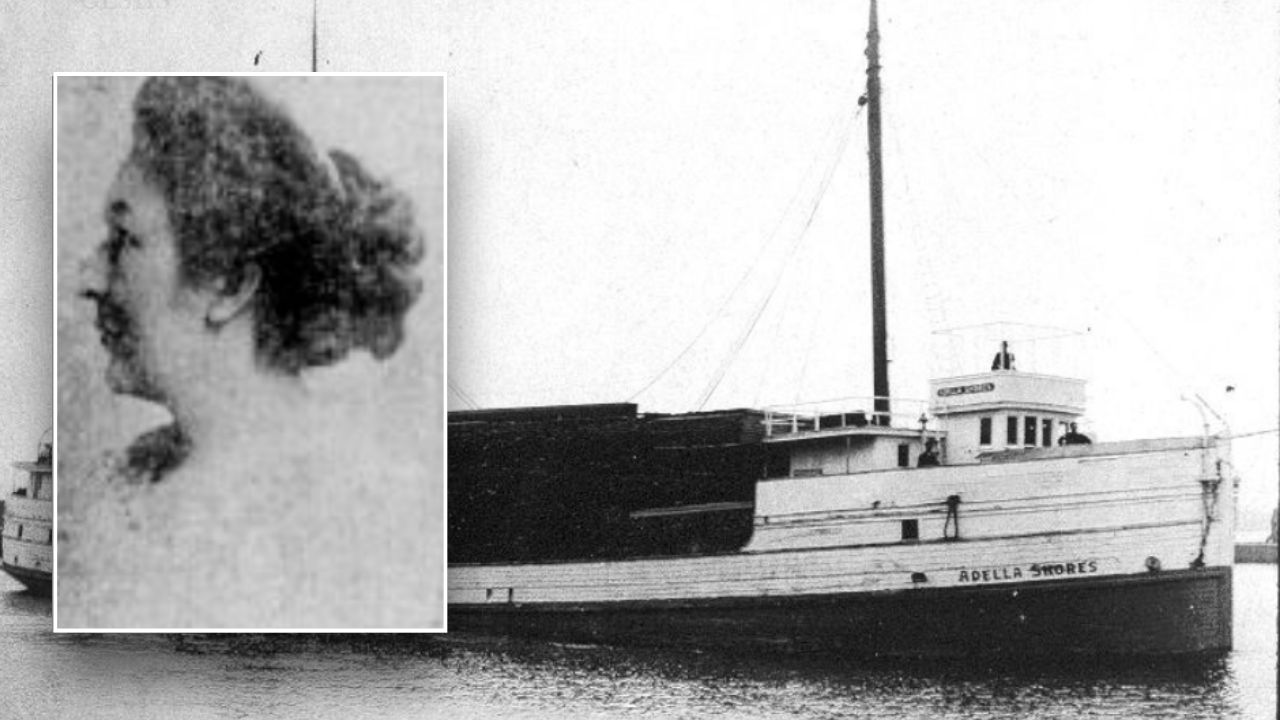
The Adella Shores, a wooden steamship built in 1894, was carrying salt to Duluth, Minnesota, when it mysteriously disappeared on May 1, 1909.
None of the ship’s 14 sailors were ever heard from again, according to the Great Lakes Shipwreck Historical Society (GLSHS), located in Paradise, Michigan.
The vessel’s name came from the company that built it, which was Shores Lumber Company, and the owner’s daughter — who was named Adella.
ANCIENT SHIPWRECKS, ARTIFACTS DATING AS EARLY AS 3000 BC UNCOVERED BY UNDERWATER RESEARCHERS
The GLSHS waited until the 115th commemoration of the ship’s disappearance before announcing that the wreck was discovered a few years ago.
The ship was spotted in the summer of 2021 thanks to the GLSHS’s side-scan sonar system.
The Adella Shores was named after the shipowner’s daughter, who was named Adella (inset, left). (Great Lakes Shipwreck Historical Society)
Researchers found the remains of the ship’s boiler, its cargo hold, its port bow and more on the bottom of Lake Superior.
Although debris was found, there was no sign of the sailors’ remains.
Bruce E. Lynn, executive director of the GLSHS, told Fox News Digital that shipwrecks in the Great Lakes were more common than one might expect.
MAN REVEALS ANCIENT COINS HE FOUND UNDER A CHURCH 60 YEARS AGO: ‘JUST CHILDREN ON A TREASURE HUNT’
“There are a variety of reasons for this, and the weather was often a prime factor,” he said.
“The lakes create their own micro-climates and conditions can change extremely quickly.”
The Adella Shores was spotted in the summer of 2021 thanks to the GLSHS’s side-scan sonar system. (Great Lakes Shipwreck Historical Society )
“Weather reporting was not as accurate as it is today, and ships like the Adella Shores could get caught in situations, very quickly, that they were unable to safely get out of,” Lynn added.
“Reduced visibility caused problems, too, and vessel collisions were not uncommon. There were far more ships operating.”
The Adella Shores sank two times before the fatal 1909 incident. Lynn said ice caused the ship to sink twice at docks, but a storm most likely caused the final shipwreck.
“Ships like the Adella Shores didn’t have radar or GPS … so they would often sail ‘blind’ through low visibility situations, sometimes leading to collision.”
The Adella Shores’ port bow was found during the underwater search. (Great Lakes Shipwreck Historical Society )
Lynn said that there are between 6,000 and 10,000 shipwrecks in the Great Lakes. Many have not been discovered yet, but officials from the GLSHS have found 12 in the past three years.
As to why the shipwreck wasn’t revealed until this week, historians say that such discoveries require years of research.
“People often ask us why we wait so long to release shipwrecks that we find,” Corey Adkins, GLSHS communications director, said in a press release.
“Every one of these stories is important and deserves to be told with the utmost honor and respect.”
“GLSHS has had some banner years of discovery … and a lot of research goes into each press release, ensuring that we tell the story accurately,” Adkins added.
A cargo winch from the Adella Shores was spotted at the bottom of Lake Superior. (Great Lakes Shipwreck Historical Society )
The Great Lakes Shipwreck Historical Society was founded in 1978 by “a group of divers, teachers and educators to commence exploration of historic shipwrecks in eastern Lake Superior, near Whitefish Point in Michigan’s scenic Upper Peninsula,” says the organization on its website.
The nonprofit group runs two museum sites on historic properties: The Great Lakes Shipwreck Museum, Whitefish Point Light Station, Whitefish Point; and the U.S. Weather Bureau Building, Soo Locks Park, Sault Sainte Marie, Michigan.
For more Lifestyle articles, visit www.foxnews.com/lifestyle.
Read the full article from Here

Detroit, MI
Inside Detroit’s Commercial Real Estate Comeback
The near-death and recovery of any great American city always starts with a story.
The genesis of Detroit’s rebirth goes back 16 years to when an intern stepped into the office of Dan Gilbert, founder and chairman of Rocket Mortgage (neé Quicken Loans), owner of the NBA’s Cleveland Cavaliers, and native son of the Motor City. The intern told Gilbert he was leaving for Chicago.
Gilbert was befuddled. Why would anyone leave? At the time, Quicken Loans employed more than 12,000 people and was the nation’s largest mortgage company, with its headquarters in a spacious suburban office in Livonia, Mich., about 20 miles west of Downtown Detroit.
“The intern said, ‘I want to be in a dynamic urban environment,’” recalled Jared Fleisher, CEO of Bedrock Detroit, the Gilbert family’s commercial real estate firm, about the misguided intern. “And a light bulb went off in Dan’s head. He realized, ‘If this company is going to attract the talent it needs to thrive, I need to be in an urban center, so I’m going to move my headquarters to where I grew up in Downtown Detroit.’’’
Unlike Henry Ford, who famously created two different municipalities by moving Ford Motor Company’s headquarters and production out to the Michigan suburbs of Highland Park and Dearborn in the early 20th century, Gilbert embraced the challenge of planting his businesses flag in Detroit proper, three years before the city filed the largest municipal bankruptcy in history in 2013.
“Everyone was running for the hills, but that’s when Dan said, ‘I’m going to go in,’” added Fleisher.
In the decade and a half since Gilbert made that decision to bring his firm into Downtown Detroit, the city itself has experienced nothing short of a cultural and economic renaissance, largely on the back of commercial real estate redevelopment and reinvestment, with no one deploying more capital and confidence back into the city than Gilbert and his different companies. Big questions like public safety have experienced a dramatic turnaround, with violent crime in 2024 reaching a low not seen since the 1960s, and 2025 numbers proving even better.
Through Bedrock Detroit (founded in 2011), Gilbert began purchasing and rehabilitating historic offices that had fallen into disrepair, like the Chrysler House, First National Building and the David Stott Building, all constructed before 1929. He then created a Blight Removal Task Force, seeded numerous local start-ups, and financed multiple grants that included gifting the city of Detroit $500 million to help low-income, underwater homeowners pay down property tax debt.
“They’ve helped Detroit in dealing with high taxes on homes, home-care grants, and numerous projects that have impacted various policies and the quality of life,” Mayor Mary Sheffield, who took office in January 2026, told Commercial Observer. “They don’t get the credit they deserve in the city, but they do a lot for small business growth and overall quality of life.”
All told, Bedrock Detroit has invested more than $7.5 billion across 140 different commercial real estate projects in Downtown Detroit, with a dogged focus on improving the central business district to attract companies and their workers.
“It’s about talent retention, and for many years the state was losing talent,” said Kiana Wenzell, co-executive director of Design Core Detroit, a nonprofit. “We educate talent, we have the highest concentration of industrial designers, we have colleges and universities nearby, but we were seeing a brain drain. People would get their degree here, but they wouldn’t stay here.”
To wit, on April 2, Bedrock Detroit, the Downtown Detroit Partnership, Move Detroit and more than 50 other partners announced the new “Make Detroit Home” initiative, a grant that will pay more than 300 residents up to $15,000 in stipends to support home down payments, renovations, rent or business expenses.
Bedrock’s coup de grace, however, is Hudson Detroit, a $1.5 billion, 1.5 million-square-foot mixed-use development that opened last year on the site of the old flagship department store of the J.L. Hudson Company, and includes a 49-story hotel and condo and a 12-story office building that is now the global headquarters of General Motors — making it Detroit’s first new office tower in 50 years.
“The broader revitalization play was genuinely organic,” said Fleisher. “Dan never said, ‘I’m going into Downtown Detroit to make it my ultimate mission and life’s work to bring back the city,’ but then it truly became his passion and has snowballed into his legacy, an incomparable legacy of a single human being helping bring back a great American city.”
While he was certainly the biggest catalyst, Gilbert has been far from alone in his conviction that Detroit — long considered the U.S. poster child for urban blight by the early 2010s — is not only worth saving, but is also an honest-to-God good and worthy investment.
J.P. Morgan Chase, using the federal New Markets Tax Credit (NMTC) program, and working with local community development financial institutions, has invested $2 billion into the city since 2014, including $160 million to build more than 3,800 units of affordable housing.
Through agreements with the city and numerous public private partnerships, J.P. Morgan’s community development arm has helped finance early childhood centers, charter schools, new housing, a three-mile light rail along the Q line that opened in 2017, and the modernization of Eastern Market, a marquee and historic commercial anchor, all within the last 12 years.
“Given the significant economic need, we really felt that we had to be part of the rebirth of Detroit,” said En Jung Kim, managing director of community development banking at J.P. Morgan Chase. “[And now] we think Detroit is a really powerful example of what happens when businesses, government, public-private partnerships and community partners come together.”
Another key ingredient in the recovery was the administration of Mayor Mike Duggan, who led Detroit from 2014 until 2026, and emphasized supporting the private sector on economic development while doing his part to clean up the city’s gloomy fiscal situation.
“We had 12 years of a really strong mayoral administration, and 10 years ago, unlike so many cities, we cleared out our legacy debt, went through largest municipal bankruptcy, restructured, preserved our cultural assets and pensions, and put ourselves in a better financial position,” said Eric Larson, CEO of the Downtown Detroit Partnership.
Then there’s Mike Ilitch, founder of Little Caesar’s Pizza, a Detroit native, and owner of the MLB’s Detroit Tigers and NHL’s Detroit Redwings. After restoring the 5,000-seat Fox Theatre performing arts center, which opened in 1928 and fell into disrepair by the late 1980s, Ilitch helped finance a new downtown stadium for the Tigers, Comerica Park, which opened in 2000, and another stadium a few blocks away for the Red Wings and NBA’s Detroit Pistons, Little Caesar’s Arena, which opened in 2017 (Ilitch died that year).
Together with the 65,000-seat Ford Field, which houses the NFL’s Detroit Lions, these three stadiums have made Detroit the only city in the U.S. that hosts all four big league sports teams in the same downtown nexus.
“Those were critical opportunities and investments that took place to not only house all four of our professional sports teams in a two-block radius, but to generate significant economic and entertainment activity,” said Larson. “Our ability to diversify hospitality, sports and entertainment has been a godsend to our downtown.’
The decisions by Gilbert, J.P. Morgan, Illich and numerous other local patrons have helped turn the city around. Over the last two years, Detroit experienced population growth for the first time since 1957 — an increase of 6,000 residents both years — outpacing not just all other localities in Michigan but the national average as well, according to the U.S. Census Bureau.
But there’s still more work to be done, and the city continues to lick the wounds from one of the more dramatic declines to befall an American downtown in the last 100 years — one that nearly proved fatal.
The decline
Detroit was once a crown jewel of the American Midwest.
After half a century of economic growth driven largely by the automobile industry and its Big Three automakers — as well as the weapons manufacturing those same factories accommodated as the “Arsenal of Democracy” during World War II in the 1940s — the city’s population topped 1.8 million people by 1950, making Detroit the fourth-largest city in America, with residents boasting the highest per capita income in the U.S. and highest global rate of automobile ownership at the time.
Only Chicago rivaled it as a Midwestern cultural hub. Detroit boasted of museums like the Detroit Institute of Arts and the Ford Institute, not to mention a wildly creative music scene, and some of the country’s greatest Mayan revival Art Deco architecture.
With a powerful and dependable manufacturing industry anchoring its economy, Detroit became a haven for Black migration from the 1920s to 1950s, and by midcentury the city had one of the strongest Black homeownership rates in the country.
But as suburban living exploded in the postwar years, and race relations worsened across the 1960s, Detroit began to suffer. Divisions reached their nadir following the 1967 “12th Street Riot,” among the deadliest and costliest riots the nation has ever seen.
Moreover, from the 1970s into the 1990s, globalization changed the nature of manufacturing economics across the Rust Belt, free-trade agreements and automation incapacitated unions, and newer, more fuel-efficient cars from Asia cut into the profit margins of Detroit’s Big Three automakers. Such changes shrank the tax base and cut into the budgets of state and local governments.
“There isn’t any one thing that caused [the decline], some of it was what happened nationally with race relations, but there were issues relative to the governance of the city, affordability, and there were issues with general reinvestment in the city, and the reduction of the overall job base,” explained Larson. “All those things contributed.”
The hits continued into the early 21st century. By 2010, Detroit’s population had declined 60 percent from its 1950 peak. Former Detroit Mayor Kwame Kilpatrick, who served from 2002 to 2008, was convicted of multiple felonies including mail fraud, wire fraud and racketeering and sentenced to 28 years in prison. (His sentence was commuted by President Trump in 2021.) And then came the Global Financial Crisis in 2008-9.
“Between 2008 and 2010, Detroit lost 110,000 people,” said Hilary Doe, president and CEO of the nonprofit Move Detroit and formerly the state’s chief growth officer. “In those two years, the economic shock hit people harder in Detroit and Michigan than many other places, as we had less economic diversification than elsewhere. We had been dealing with out-migration for a long time, really since 1991.”
In 2009, the city’s unemployment rate reached an appalling 29 percent, and the average price for a home in the city was a mere $7,500, with some going for only a few hundred dollars, according to The Guardian.
The city hit rock bottom in 2013, when it filed what was then the largest municipal bankruptcy in U.S. history, carrying a debt estimated at $18 billion. At the time, 40 percent of the city’s streetlights were not functioning, according to the city’s Public Light Authority.
Residents fled in droves. Detroit’s population declined roughly 28 percent between 2000 and 2015, according to Detroit Future City, a research nonprofit, and reached an all-time low of 639,000 in 2020.
One of the reasons Detroit’s greater metropolitan area suffered disproportionately from the white-collar flight was the unfortunate fact that it is essentially without the mass transit systems found in Chicago, Boston, Los Angeles and New York.
Moreover, rather than building dense multifamily apartments like those across New York, Detroit became a city filled with large single-family homes spread out on big tracts of land in a grid designed for automobiles rather than streetcars or subways.
“From a Jane Jacobs urbanist perspective, it’s a disaster,” said Matthew Temkin, co-founder of Greatwater Opportunity Capital, the largest multifamily firm in Detroit with more than 2,200 units across 40 properties. “Detroit’s real estate saw very little investment from 1960 to 2010, maybe fits and starts, but even to the extent investment did happen, it was hard to feel, because Detroit is so geographically massive. There are a handful of old neighborhoods with some density, but the vast majority of Detroit’s built landscape is single-family homes and sprawl.”
Temkin emphasized that the population loss, and accompanying urban blight, was magnified by the prevalence of single-family family homes rather than apartments (as beautiful and historic as they might be.)
“You have giant chunks of land where there’s only one house left on the block, and when it comes to emergency services, lighting, trash pickup, it’s an administrative nightmare,” he said.
COVID-19 didn’t help, as the fragile office sector emptied out for two years beginning in 2020, setting back much of the progress that Gilbert and others had jump-started.
“The challenge for Detroit is it got hit hard during COVID, as a big percentage of the economy was tied to office workers,” said Andrew Gibbs, managing director of real estate at Arctaris Impact Investors. “We didn’t see a lot of institutional capital come into the city across all asset classes. And property taxes are high, so it’s hard to pencil in new construction.”
But rather than wallow in the dueling threats of bankruptcy and the pandemic, Detroit stayed in the game, kept chipping away at different development projects and public-private partnerships, and has slowly seen its fortunes turn in the second half of the 2020s.
The comeback
As state and local officials started rightsizing Detroit’s balance sheet after the 2013 bankruptcy, Dan Gilbert began pouring money into different commercial real estate projects, gradually moving from renovating older, derelict office buildings into financing retail and hospitality business through grants, and eventually repurposing entire structures and building from the ground up.
“Dan said, ‘I need to create an ecosystem here if I’m really going to do this,’ and that led to investing in residential. If young folks are going to work downtown, they need to live downtown,” recalled Fleisher. “But people need somewhere to eat, and take their dry cleaning, so that started a focus on retail and the need for public spaces, so until 2017 it was all adaptive reuse.”
Then Gilbert decided to go vertical. Aside from the development of Hudson Detroit, the tallest skyscraper built in nearly 50 years, Bedrock invested $30 million in renovating the historic Book Tower, a 38-story Art Deco office, into a mixed-use hotel, apartment and workspace asset. It was recently named one of Architectural Digest‘s “11 Most Beautiful Repurposed Buildings” in the world.
“They made a really intentional decision to build a market in the downtown corridor, in particular,” said Doe. “But it required community leaders, neighborhoods and a real commitment from the city and folks who wanted to make this work. But Dan is one of those people who has had an enormous impact.”
Bedrock’s next big project is an even heavier lift: a $1.6 billion transformation of the superannuated Renaissance Center, formerly GM’s global headquarters and today a seven-tower office and entertainment complex that includes a 73-story hotel, still in use, and four 39-story office towers, all virtually abandoned, with each building connected by a subterranean network of underground parking, retail corridors, and pedestrian walkways — essentially everything one imagines a 1970s Brutalist nightmare to be.
“It’s 5.5 million square feet, 90 percent empty, functionally obsolete, and needs to be radically overhauled, but it’s also iconic,” explained Bedrock’s Fleisher. “If you enter Michigan or Detroit into Google or ChatGPT, you’ll get a picture of the Renaissance Center.”
While the project is still in the planning and financing phase, Bedrock’s end vision includes a total overhaul and redevelopment of the existing real estate and land to transform more than 30 acres of waterfront real estate into a link between the riverfront and central business district.
“The vision is to create the best waterfront district in the country, modeled on Chelsea Piers in New York, Navy Pier in Chicago, Fisherman’s Wharf in San Francisco,” said Fleisher.
But if Bedrock has been the main engine in powering Detroit’s real estate renaissance, the company is far from the only piston on the road to recovery, nor is Gilbert the only hometown hero who has put his money where his loyalty is.
“Detroit is unique, as it has a number of legacy families and organizations that have continued to be connected and committed across generations,” said Larson. “But we also have a very deep and proactive foundation community, and those two things recognized the need for intervention.”
In the early 2000s, Peter Karmanos, co-founder of software giant Compuware, and Edsel B. Ford II (great-grandson of Henry Ford), both Detroit natives, were instrumental in financing the redevelopment of Campus Martius Park, a 1.6-acre public square that is Detroit’s own version of Rockefeller Center with ice-skating, live performances and an annual Christmas tree lighting.
Billionaire sports team owners Steve Ballmer (L.A. Clippers), Bill Davidson (Detroit Pistons) and Ralph Wilson (Buffalo Bills), each Detroit natives, donated hundreds of millions of dollars to different causes across the city, with the latter two ensuring the city received generous contributions from their lucrative foundations following their deaths in 2009 and 2014.
The Kresge Foundation, with a $5 billion endowment, has been headquartered in Detroit for 102 years and is a consistent investor into the city’s infrastructure and waterfront; the Knight Foundation, while headquartered in Miami, partnered with several other groups to pool $816 million together to preserve the Detroit Institute of Arts’ collection and protect city pensions following the 2013 bankruptcy; and the Hudson-Webber Foundation and Skillman Foundation are both based in Detroit, where they’ve donated money to fund education and the arts.
Larson said the depth of relationships among its natives and wealthy sons is “almost a family-like atmosphere,” especially at levels of political and economic leadership.
“There’s a grittiness to our community and the lack of interest in letting the city fail,” he said. “People took it as a personal mission to find ways to support Detroit’s rebirth.”
Today, the foundation community is teaming with more than 50 other partners in the new “Make Detroit Home” initiative, announced this month, and aims to raise up to $10 million.
The relocation incentive follows earlier grant programs led by the Downtown Detroit Partnership that saw the city’s population grow 27 percent over a five-year period prior to COVID, and will organize field trips in concert with University of Michigan, Michigan State University and Wayne State University to induce graduates to stay local.
“It’s all really focused on doing what it takes to make sure we can retain residents who are already in the city and invite others to join us here in Detroit,” said Doe, who is leading the cause.
While city leaders like Doe, Larson, and Fleisher recognize there is more work to be done on returning Detroit to its mid-20th century glory, there’s no denying the city is stronger from having gone through the fires of such a public decline and near-fatal fall.
“I really do believe there’s something to a place that gets so far down that you can’t kick the can any further, and the DNA of Detroit is to rally,” said Larson. “And now we’ve found unbelievable pride and grit.”
Brian Pascus can be reached at bpascus@commercialobserver.com.
Milwaukee, WI
Sam Stair arrest is part of a bigger landlord issue, Milwaukee officials say
Watch surveillance footage of federal raid at S2 Real Estate office.
Federal agents arrested 18 people this week in a drug conspiracy case, including Sam Stair, the owner of S2 Real Estate, and his business manager.
Footage courtesy of U.S. Petro, editing by Angelica Edwards/ The Milwaukee Journal Sentinel
Milwaukee elected officials say the recent arrest and charging of a Milwaukee landlord in a sprawling drug case showed the city needs to take problematic landlords and the tenants who report them more seriously.
Sam Stair, 52, owner of S2 Real Estate Group, was arrested by federal agents early on April 22 and charged with multiple drug charges stemming from renting houses to be used for drug trafficking. In the week since the arrest, elected officials and community groups responded with alarm and said it showed a need for more to be done against problematic landlords.
“I’m angry. I’m disappointed,” said Ald. Jose Perez, who represents parts of the city’s south side and is president of the Common Council. “We want these properties to be caught sooner.”
Stair owns and manages over 150 properties, which have over 500 units and are mainly concentrated on the city’s south side. The charges against him and 17 others suggest a wide-ranging operation where Stair would lease homes that would be used by drug dealers either as stash houses, for storing drugs, or as trap houses, for selling drugs to dealers, according to a 176-page criminal complaint.
Stair, whose properties are the frequent subject of tenant complaints, is accused of earning over $1.5 million as part of this operation, which included using these dealers to manage his properties, including finding those addicted to drugs to rent the units to, according to court documents.
The case has been under investigation since May 2024.
Stair’s arrest and the charges against him have been pointed to by community members and organizations as a clear example of a gap in the city’s safety. On April 26, the public safety organization Common Ground pointed to it when promoting a plan for improving safety on the city’s South Side.
In a statement, the group said “negligent landlords” like Stair are hurting Milwaukee neighborhoods “in order to maximize their profits.”
“The victimization of these neighborhoods is systemic,” said Jack Eckblad, Milwaukee County District 4 Supervisor, who endorsed the safety plan. “It erodes trust in institutions like the police, like the fire department.”
At that event, Danyell Austin, a tenant of Stair’s, told the Journal Sentinel she and other tenants are left uncertain of how to move forward or whether to continue paying rent. Austin rents a commercial storefront from Stair’s company S2 Real Estate Group on West Greenfield Avenue and South Layton Boulevard.
Community Advocates, a nonprofit that helps low-income families meet their basic needs, recommends that tenants hold on to traditional rent payments, like checks, until further notice. However, if tenants are able to pay through their online portal, they should continue to do so, as that is typically more secure, said Shawanna Lindenberg, the organization’s housing department manager.
Austin has reported myriad concerns with the company to the council member in her district, JoCasta Zamarripa, mainly relating to unresolved maintenance issues which she continues to struggle with to this day.
In an interview prior to Stair’s arrest, Zamarripa told the Journal Sentinel she had received messages from a few constituents but was unaware of the severity of tenant complaints or Stair’s business model.
Austin said she’s not surprised that the city hadn’t acted against Stair before his arrest.
“He acts like he was untouchable,” Austin said. “He’s likeable, he has the money behind him, he knows that most people don’t have the financial stability to fight against him in court if it really comes to it.”
Stair is not the first Milwaukee landlord charged for drug dealing. In 2017, Kenneth D. Churchill III pleaded guilty to a charge of distributing heroin.
He was a significantly less prolific landlord than Stair. Churchill operated 12 properties and half had a designation as drug houses, the Journal Sentinel reported at the time.
Stair’s arrest and prior incidents like Churchill’s show the need for more coordination between the city and more attention to residents’ concerns, Perez said.
“I don’t think we’re making the connection with some of the complaints we have in the neighborhood with an enterprise similar to what we’ve seen in the news – a drug enterprise,” he said.
Stair’s arrest gives the city the opportunity to build off that momentum and hold other problematic landlords accountable, said Milwaukee County District 14 Supervisor Caroline Gomez-Tom, who represents parts of the city’s south side.
While many were unaware of Stair’s actions, Gomez-Tom said tenants were reporting concerns and deserved to be listened to.
“Sometimes, unfortunately, its falls to deaf ears. Either they’re reporting it to police or they’re reporting it to elected officials,” Gomez-Tom said. “The need is there for stronger responses to even the smallest concerns. If one person is reporting it, many other people are seeing it.”
Stair appeared in federal court on April 22 and remains in custody. He is due back in court for a detention hearing on April 27.
David Clarey is a public safety reporter at the Milwaukee Journal Sentinel. He can be reached at: dclarey@gannett.com.
Alyssa Salcedo covers Silver City, Layton Park and Burnham Park for the Journal Sentinel’s Neighborhood Dispatch. Contact: asalcedo@usatodayco.com.
Neighborhood Dispatch reporting is supported by Zilber Family Foundation, Bader Philanthropies, Journal Foundation, Northwestern Mutual Foundation, Greater Milwaukee Foundation, and reader contributions to the Journal Sentinel Community-Funded Journalism Project. Journal Sentinel editors maintain full editorial control over all content. To support this work, visit jsonline.com/support. Checks can be addressed to Local Media Foundation (memo: “JS Community Journalism”) and mailed to P.O. Box 85015, Chicago, IL 60689.
The JS Community-Funded Journalism Project is made possible through our partnership with Local Media Foundation, tax ID #36-4427750, a Section 501(c)(3) charitable trust affiliated with Local Media Association, and EnMotive, LLC, a subsidiary of USA TODAY Co., Inc. USA TODAY Co., Inc. is the parent company of this publication.
Minneapolis, MN
Minneapolis Police Chief’s Public Statements on Domestic Violence Cases Under Scrutiny After City Auditor Report
City Auditor Finds MPD Failed Allison Lussier and Recommends Formal Apology as Second Review Opens Into Davis Moturi Case
By Clint Combs | Minnesota Spokesman Recorder
A Minneapolis city auditor after-action review found MPD made serious missteps in the Allison Lussier domestic violence case, including never requesting the medical examiner’s report, and recommended a formal written apology to her family for Chief O’Hara’s public misstatements, as a second review opens into the Davis Moturi shooting.
Before Minneapolis Police Chief Brian O’Hara knew the full weight of what the city auditor would eventually find, he was talking too fast.
In February 2025, O’Hara told the Star Tribune that investigators could not establish that Allison Lussier had been murdered. “We cannot prove that this is a murder,” O’Hara said. “The fact that he had a history of domestic abuse does not create probable cause.”
The City Auditor’s After-Action Review revealed that the MPD never actually requested the medical examiner’s report until the auditors themselves asked for it while reviewing the case.
O’Hara went further. “Someone dead and decomposed with needles everywhere is not a sign that a crime occurred,” O’Hara said, adding that Lussier had sustained no other known injuries, like a fractured skull.
The Hennepin County Medical Examiner found that Lussier’s primary cause of death was a subdural hematoma, a collection of blood between the skull and the brain.
A crowd of domestic violence advocates and MPD staff attend the Minneapolis Audit Committee meeting to hear the long-delayed report.
Chief O’Hara’s words, spoken publicly and on record, are at the center of an auditor report that found MPD made several missteps in investigating domestic violence cases. The report recommended that MPD be formally required to issue a written apology to the Lussier family for public misstatements related to the medical examiner’s findings. By the time City Auditor Robert Timmerman gave his report to the Minneapolis committee and City Council members, O’Hara’s tone had finally shifted. “Jen again, I apologize. I’m sorry. We are committed to moving forward together,” O’Hara told Jana Williams, Lussier’s aunt. “I’m thankful again to Jana, to other community members that she invited that were present with us, advocates for their willingness to have conversation with us and to move forward and try and improve things for the future.”
Williams was not mollified.
The audit arrives as MPD faces intense scrutiny over a second high-profile failure. Davis Moturi, a Black Minneapolis man, reported 19 incidents of vandalism, property damage, harassment and threats in the year he had lived next door to his white neighbor, John Herbert Sawchak, many of them laced with racial slurs. Despite those repeated calls for help, Moturi was shot in the neck while pruning a tree in his own yard. The Moturi case prompted a second after-action review by the City Council.
The audits reveal that four officers auditors had hoped to interview were never reached. Three were on extended leaves of absence. One had left the department entirely. City Auditor Timmerman confirmed that when his office reached out to that departing officer, they received a single response: “I’m not going to participate.”
Council Member Aisha Chughtai noted that, to her understanding, the officer who separated from the department did so about one month after O’Hara issued a directive requiring officers to cooperate with auditors. Timmerman said he did not remember the exact date but confirmed his office had attempted contact and been refused.
The audit was further hampered by a jurisdictional wall. Timmerman’s office lacks authority to access Hennepin County Medical Examiner records, meaning auditors could not independently verify the contents of the medical examiner’s report on Lussier’s death.
“Public comments by MPD regarding violence against Native women are heavily scrutinized and should be held to a high standard,” Timmerman said. “We recommend that MPD be required to issue a letter or other statement to the family of Miss Lussier apologizing for public misstatements related to the medical examiner’s findings and report.”
Williams addressed the findings after the presentation. She named Sgt. Michael Heyer as the officer she believed had retired before speaking to auditors, and said Lussier’s lead homicide detective was the one who refused to participate. Timmerman would not confirm the identity or role of the officer who had separated from the department.
“You failed. Allison Lussier’s case you failed. Arionna Buckanaga case, you failed. You failed so many cases prior to this,” Williams said. “Hopefully we start hearing exactly what the gravity of today meant.”
Jana Williams speaks to reporters after City Auditor Robert Timmerman revealed systemic missteps in MPD investigations into the deaths of Allison Lussier and Davis Moturi.
The audit reported that officers and lieutenants inside MPD expressed low morale over public disagreements between Chief O’Hara and Hennepin County Attorney Mary Moriarty. Timmerman said that Moriarty made proactive efforts to communicate with top brass at MPD. Williams said that investigations into her niece were caught in what she described as a “cat-and-mouse game” between O’Hara and Moriarty. “Allison Lussier didn’t deserve this. Nobody deserved this today,” Williams said.
When Chughtai asked the chief’s office whether regular meetings between the chief and the county attorney were taking place, she was told no.
MPD and the HCAO stressed that their branches still maintain working relationships across many departments.
To prevent future audits from hitting the same walls, Timmerman said his office is pursuing subpoena authority from the state legislature, seeking powers parallel to those held by the state auditor and the legislative auditor. Council Member Soren Stevenson flagged that the next police contract negotiation should also address barriers from a collective bargaining agreement that currently prevents civilian investigators from holding supervisory roles.
Vanya Hogen, an attorney with Hogen Adams, detailed the internal pushback that stalled the reports.
“We did face a few limitations, such as early resistance from several MPD officers who requested the involvement of the Police Officers Federation of Minneapolis,” Hogen said. She noted this “disrupted the anticipated timeline” of the entire review process.
Williams was surprised that the auditor did not secure an interview from the medical examiner.
“You think that the city would have had some more recourse to push them to give an interview or at least a statement,” Williams said. “At least a statement, especially when you’ve got the chief of police blaming the medical examiner for calling off the crime scene.”
O’Hara said the Lussier homicide investigation remains open.
-
West Virginia3 minutes agoBuckhannon teen caught record-breaking golden rainbow trout for Gold Rush event
-
Wyoming9 minutes agoForty-six arrested for immigration violations during ‘Truck Around And Find Out’ detail in Wyoming
-
Crypto15 minutes agoRomania Blocks 300 Sites and Launches €5M Treatment Fund as Polymarket Ban Holds in Court
-
Finance21 minutes agoAI Financial Modeling Tests Show Need for Advisor Oversight
-
Fitness27 minutes agoExperts Reveal Most Effective Exercise To Lower Blood Pressure
-
Movie Reviews39 minutes agoForbidden Fruits – Review | Satirical Horror Comedy | Heaven of Horror
-
World51 minutes agoIndia's Paytm slumps over 8% after RBI cancels banking licence for its payments bank
-
News57 minutes agoMap: 3.3-Magnitude Earthquake Shakes Los Angeles Area