Midwest
Michigan researchers discover eerie 1909 shipwreck at bottom of Lake Superior

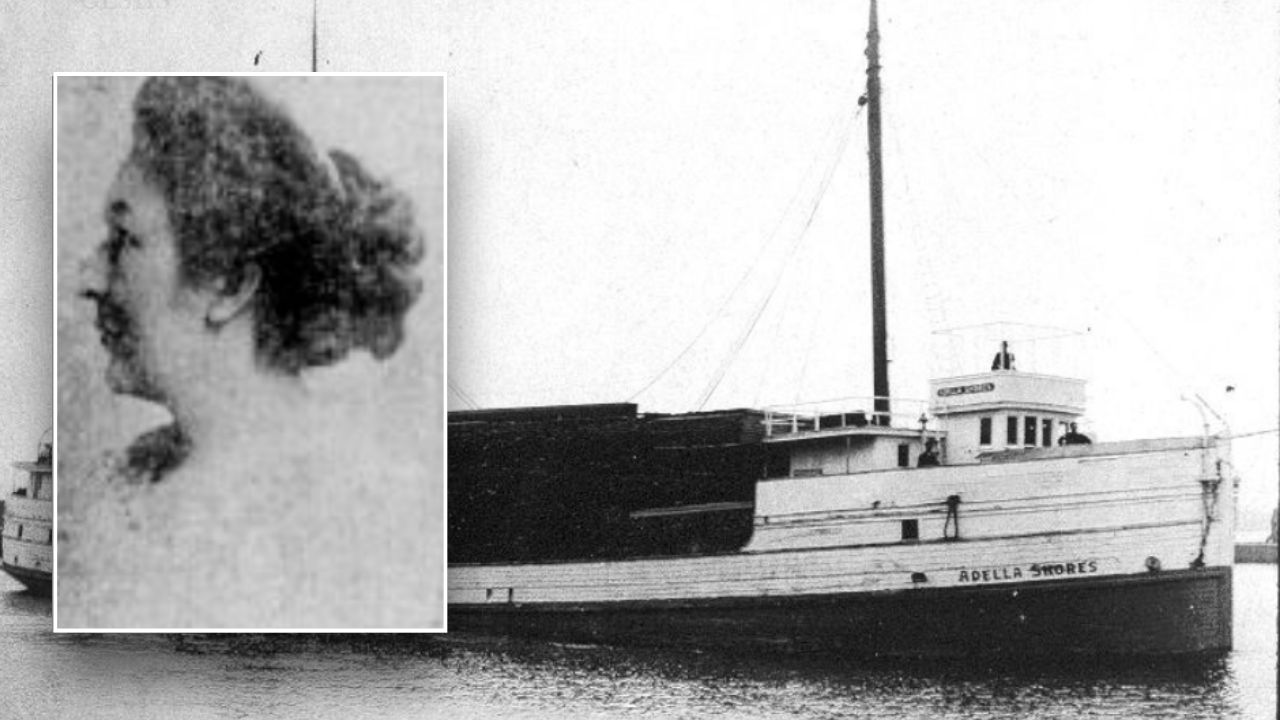
Historians in Michigan recently announced that a shipwreck dating back more than a century has been discovered at the bottom of Lake Superior.
The Adella Shores, a wooden steamship built in 1894, was carrying salt to Duluth, Minnesota, when it mysteriously disappeared on May 1, 1909.
None of the ship’s 14 sailors were ever heard from again, according to the Great Lakes Shipwreck Historical Society (GLSHS), located in Paradise, Michigan.
The vessel’s name came from the company that built it, which was Shores Lumber Company, and the owner’s daughter — who was named Adella.
ANCIENT SHIPWRECKS, ARTIFACTS DATING AS EARLY AS 3000 BC UNCOVERED BY UNDERWATER RESEARCHERS
The GLSHS waited until the 115th commemoration of the ship’s disappearance before announcing that the wreck was discovered a few years ago.
The ship was spotted in the summer of 2021 thanks to the GLSHS’s side-scan sonar system.
The Adella Shores was named after the shipowner’s daughter, who was named Adella (inset, left). (Great Lakes Shipwreck Historical Society)
Researchers found the remains of the ship’s boiler, its cargo hold, its port bow and more on the bottom of Lake Superior.
Although debris was found, there was no sign of the sailors’ remains.
Bruce E. Lynn, executive director of the GLSHS, told Fox News Digital that shipwrecks in the Great Lakes were more common than one might expect.
MAN REVEALS ANCIENT COINS HE FOUND UNDER A CHURCH 60 YEARS AGO: ‘JUST CHILDREN ON A TREASURE HUNT’
“There are a variety of reasons for this, and the weather was often a prime factor,” he said.
“The lakes create their own micro-climates and conditions can change extremely quickly.”
The Adella Shores was spotted in the summer of 2021 thanks to the GLSHS’s side-scan sonar system. (Great Lakes Shipwreck Historical Society )
“Weather reporting was not as accurate as it is today, and ships like the Adella Shores could get caught in situations, very quickly, that they were unable to safely get out of,” Lynn added.
“Reduced visibility caused problems, too, and vessel collisions were not uncommon. There were far more ships operating.”
The Adella Shores sank two times before the fatal 1909 incident. Lynn said ice caused the ship to sink twice at docks, but a storm most likely caused the final shipwreck.
“Ships like the Adella Shores didn’t have radar or GPS … so they would often sail ‘blind’ through low visibility situations, sometimes leading to collision.”
The Adella Shores’ port bow was found during the underwater search. (Great Lakes Shipwreck Historical Society )
Lynn said that there are between 6,000 and 10,000 shipwrecks in the Great Lakes. Many have not been discovered yet, but officials from the GLSHS have found 12 in the past three years.
As to why the shipwreck wasn’t revealed until this week, historians say that such discoveries require years of research.
“People often ask us why we wait so long to release shipwrecks that we find,” Corey Adkins, GLSHS communications director, said in a press release.
“Every one of these stories is important and deserves to be told with the utmost honor and respect.”
“GLSHS has had some banner years of discovery … and a lot of research goes into each press release, ensuring that we tell the story accurately,” Adkins added.
A cargo winch from the Adella Shores was spotted at the bottom of Lake Superior. (Great Lakes Shipwreck Historical Society )
The Great Lakes Shipwreck Historical Society was founded in 1978 by “a group of divers, teachers and educators to commence exploration of historic shipwrecks in eastern Lake Superior, near Whitefish Point in Michigan’s scenic Upper Peninsula,” says the organization on its website.
The nonprofit group runs two museum sites on historic properties: The Great Lakes Shipwreck Museum, Whitefish Point Light Station, Whitefish Point; and the U.S. Weather Bureau Building, Soo Locks Park, Sault Sainte Marie, Michigan.
For more Lifestyle articles, visit www.foxnews.com/lifestyle.
Read the full article from Here



What to know about PCBs and their impact on the Great Lakes, Wisconsin
PCBs are a class of more than 200 chemicals that are known to cause cancer.
An invasive shrimp is swimming in Lake Superior. This is the last Great Lake to be invaded — all five Great Lakes now are infested by the crustaceans..
Researchers for the first time have confirmed a breeding population of an invasive Black Sea-native shrimp in Lake Superior.
The number and extent of the shrimp’s spread in Lake Superior is not clear. However, there is a breeding population in the Duluth.
The findings by researchers at the University of Minnesota-Duluth, Lake Superior Research Institute at the University of Wisconsin Superior, and the Hobart and William Smith Colleges in New York, published in the Journal of Great Lakes Research in April, found that the shrimp are now reproducing and surviving year-round in the Duluth-Superior Harbor, the farthest west the European species has been confirmed.
“Samples we collected in 2025 from two locations in the Duluth-Superior Harbor, a major inland shipping port in the Great Lakes, contained juveniles, adult males, and (pregnant or with young) adult females, indicating a self-sustaining population. Additionally, we document earlier evidence from 2018 samples we collected in the harbor that contained two juvenile specimens,” the article in the Journal said.
In an interview on the CBC’s “Superior Morning” show with Mary-Jane Cormier on June 10, lead researcher Donn Branstrator, of the University of Minnesota, said studies in the Duluth-Superior Harbor this spring after ice was off the lake found adult males and females.
“It’s pretty clear evidence of overwintering,” Branstrator told Cormier. “It would be very unlikely for the population to extinguish (at this point).”
Branstrator told Cormier ongoing bi-weekly research in the harbor, and along the Lake Superior shoreline will exam those questions.
According to the research, the non-native shrimp, about a quarter to half inch long, were first detected in the lower Great Lakes in 2006 in lakes Michigan and Ontario. By 2008, they were found in lakes Huron and Erie as well.
“It has also spread to Oneida and Seneca Lakes in New York … as well as the St. Lawrence River and various canals in northern New York State,” the research said.
Branstrator said the Black and Caspian sea region natives, also have spread throughout Europe into areas they were not native. He said they likely hitchhiked with ballast or bilge water, but the exact mechanism will never be known.
What we know about bloody red shrimp.
What is a bloody red shrimp?
Bloody red shrimp are small crustaceans native to the Black Sea and Caspian Sea region of Europe. They are adapted for fresh and brackish water.
This freshwater shrimp can be ivory-yellow in color or translucent, but exhibits pigmented red pigment cells in the carapax and tail, according to the USGS.
The quarter to half inch long shrimp feed on both phytoplankton and zooplankton at various stages of life.
While relatively small, they are among the larger creatures in the Great Lakes feeding on those food sources.
“They are very large bodied, at the upper end of what we consider zooplankton,” Branstrator said.
Branstrator said the shrimp live in near-shore environments and like to hide in crevices during the day, making use of dock pilings, breakwaters and other human-made structures.
They come out at night and “swarm” together in groups of up to 135 per square foot, the University of Wisconsin Sea Grant said.
Bloody red shrimp have a lifespan of about nine months, grow to adults in just 45 days, and an produce up to four generations per year. Females have been documented to carry up to 66 eggs in a clutch. Broods carried by females in the Muskegon population ranged from two to seven.
Where have the shrimp been found?
The shrimp have spread throughout Europe and now have been found in all five Great Lakes, as well as some locations away from the lakes.
The recent study found a breeding population in the Duluth, Minnesota, harbor, the first in Lake Superior.
According to the research, the non-native shrimp, about a quarter to half inch long, were first detected in the lower Great Lakes in 2006 in lakes Michigan (near Muskegon) and Ontario. By 2008, they were found in lakes Huron and Erie as well.
A single specimen was found in Duluth in 2017, and two were found in 2018. It wasn’t until 2025 that the researchers found a sustaining population when they captured 81 individuals.
How did the shrimp arrive in the Great Lakes?
The shrimp likely hitched a ride in the ballast water of ocean-going vessels, although Branstrator noted during an interview on CBC’s “Superior Morning” that we will never know for certain.
He added that the shrimp have multiple opportunities to hitch rides with vessels during the shipping season.
What impact will the shrimp have on Lake Superior and the Great Lakes?
Branstrator said that question hasn’t been answered. They feed on the same sources as other water-dwelling creatures, but they are large enough that small fish may find them to be a new food source.
Are any shrimp native to the Great Lakes?
The opossom shrimp is a Great Lakes native and looks similar to the bloody red shrimp.

Missouri sportsbooks took $256,364,814 in wagers in May 2026, the lowest monthly handle since the market launched, yet operators posted their strongest revenue month yet at $21,250,814 on an 8.29% hold. The state collected $2,131,872 in tax. Six months after going live on December 1, 2025, Missouri has flipped the usual relationship between volume and revenue: handle keeps settling while revenue keeps climbing, because hold has risen steadily as the launch-period promotions fade. Online betting made up $252,593,427, or 98.53% of all wagers. Figures come from the Missouri Gaming Commission.
Missouri Sports Betting by Month, Since Launch
| Month | Handle | Online | Retail | GGR | Hold | State Tax |
|---|---|---|---|---|---|---|
| December 2025 | $543,039,131 | $538,881,520 | $4,157,612 | $20,758,443 | 3.82% | $521,201 |
| January 2026 | $385,138,868 | $380,412,197 | $4,726,670 | $6,703,555 | 1.74% | $137,873 |
| February 2026 | $277,005,418 | $273,285,304 | $3,720,114 | $10,301,007 | 3.72% | $1,214,627 |
| March 2026 | $329,355,588 | $324,060,170 | $5,295,418 | $20,757,550 | 6.30% | $2,178,985 |
| April 2026 | $273,397,863 | $269,884,804 | $3,513,059 | $20,284,270 | 7.42% | $2,028,427 |
| May 2026 | $256,364,814 | $252,593,427 | $3,771,387 | $21,250,814 | 8.29% | $2,131,873 |
Six Months In, Revenue Sets a Record
May marks a milestone worth pausing on. Missouri’s revenue reached its highest point yet even though its handle sank to a new low, a sign the market has moved past the giveaway-heavy launch phase and into steadier economics. Across its first six months, the state has now taken roughly $2.06 billion in total wagers, produced about $100.1 million in operator revenue, and delivered $8.2 million in tax. Crossing $100 million in cumulative revenue in half a year underlines how quickly Missouri established itself as a mid-sized market.
Handle Settles as the Launch Surge Fades
The volume side keeps normalizing. December’s $543 million opening was inflated by launch-day demand and heavy sign-up promotions, and handle has stepped down almost every month since, landing at $256.4 million in May, less than half that peak. Part of the decline is seasonal, with the sports calendar thinning as the basketball and hockey postseasons wind down and football stays months away. Part is simply the novelty wearing off. Mobile sportsbooks in Missouri continue to carry the market almost entirely, at 98.53% of May handle, a share that has held above 98% in every month since launch.
The Hold Keeps Climbing
The defining trend is the win rate. Hold ran at 3.82% in December, bottomed at 1.74% in January, then rose in four straight steps to 3.72%, 6.30%, 7.42%, and 8.29% in May. That climb is the engine behind the record revenue: as operators pull back the free bets and bonus play that suppressed early margins, more of each wagered dollar sticks. An 8.29% hold is still below the double-digit figures common in older markets, which suggests Missouri’s margin has further room to firm up as the market matures.
Compare All U.S. States

LINCOLN, Neb. (KOLN) – Like his father, Zack Erstad is a Husker. Erstad, the son of Hall of Fame baseball player Darin Erstad, joined the Nebraska men’s golf program on Tuesday.
Zack signed with the Huskers one month after winning a state championship at Lincoln East. With the Spartans, Erstad was a two-time NSAA champion. He was Class A’s individual runner-up in 2026. The previous year, Erstad claimed the Nebraska Junior PGA Championship title.
Erstad said joining the Huskers is a dream come true. The Nebraska newcomer grew up playing baseball and hockey. However, he focused solely on golf while in high school.
Click here to subscribe to our 10/11 NOW daily digest and breaking news alerts delivered straight to your email inbox.
Copyright 2026 KOLN. All rights reserved.
-

 Massachusetts2 minutes ago
Massachusetts dad on ‘adventure of a lifetime’ left fighting for his life in Fiji after noticing bug bite
-

 Minnesota7 minutes ago
Invasive ‘bloody red shrimp’ reach Lake Superior
-

 Mississippi14 minutes ago
Mississippi Lottery Mississippi Match 5, Cash 3 results for June 30, 2026
-

 Missouri17 minutes ago
Missouri Sports Betting May 2026: $256.4M Handle, Record $21.3M Revenue
-
Montana22 minutes ago
Montana Lottery Mega Millions, Big Sky Bonus results for June 30, 2026
-

 Nebraska29 minutes ago
Erstad joins Nebraska golf program
-

 Nevada32 minutes ago
‘Arrive Alive’ initiative with Nevada Department of Public Safety, FOX5
-

 New Hampshire37 minutes ago
This NH Short Film Festival Returns in July, and Every Film Clocks in at 15 Minutes or Less

