West
More blue cities using drones instead of police for some 911 calls, expert says: 'They can't get cops'

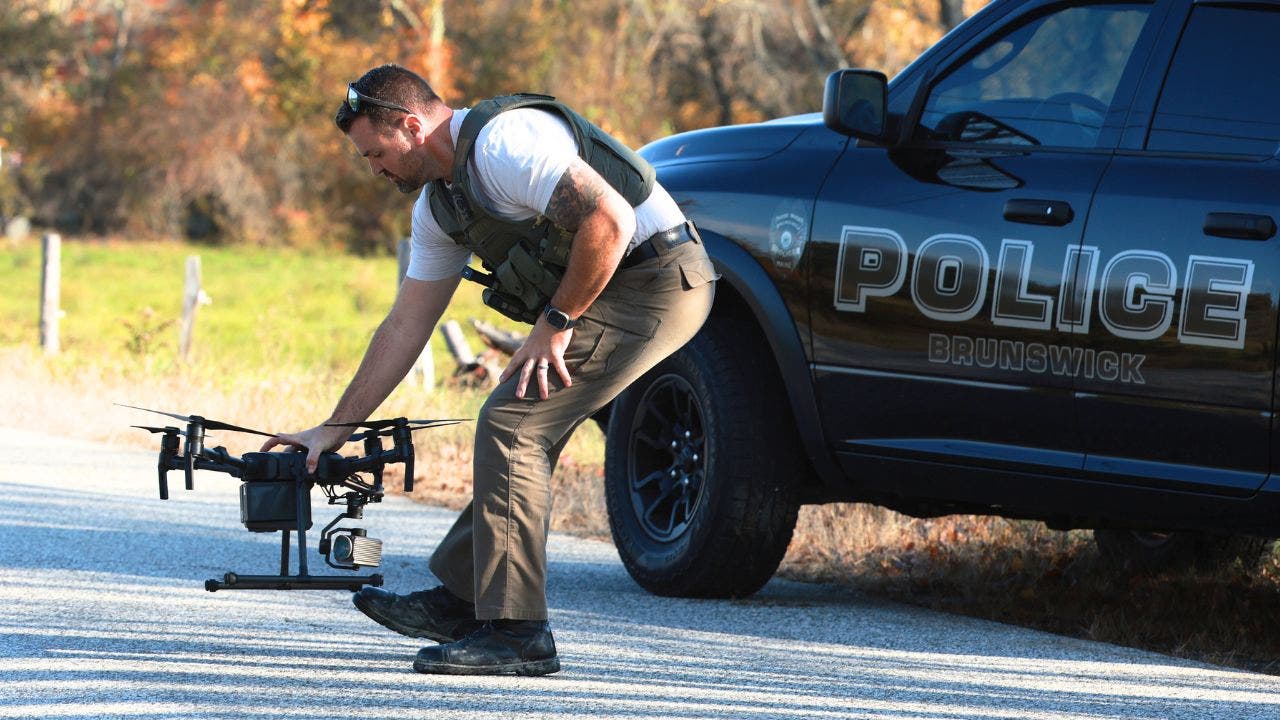
Quick, efficient and with a bird’s eye view of any scene, more police departments are embracing the use of drones to carry out law enforcement work, with some blue cities now even using them to respond to 911 calls.
Around 1,500 police departments across the country are currently using drones in some form, according to a report by the Electronic Frontier Foundation, a digital privacy group, with agencies deploying the technology for crowd control purposes, missing people searches, tracking fleeing suspects or mapping crime scenes.
Steep budget cuts and dwindling staff numbers in blue cities, in particular, make drones both an effective and cost-saving tool for police in Democratic strongholds.
COLORADO POLICE PLAN TO USE DRONES AS FIRST RESPONDERS, CALLING THE TECHNOLOGY ‘FUTURE OF LAW ENFORCEMENT’
A law enforcement official sets up a drone during a manhunt for suspect Robert Card following a mass shooting on Oct. 27, 2023, in Monmouth, Maine. (Joe Raedle/Getty Images)
Today’s police drones are much bigger than regular drones commonly used for recreational purposes, with much longer battery lives and features such as thermal sensors, loudspeakers, spotlights or beacons.
Several law enforcement agencies in Colorado, including the Denver Police Department, which has seen cuts due to its migrant crisis, are making plans to start dispatching drones instead of officers to respond to 911 calls and at least 20 agencies in Colorado’s Front Range already use drone technology for certain tasks.
The city of Chula Vista, California, was one of the first cities to use drones for 911 calls and has deployed unmanned aircraft nearly 20,000 times since 2018 to respond to emergency incidents such as crimes in progress, fires, traffic accidents and reports of dangerous subjects.
The use of the technology meant that in nearly 4,300 of those cases, officers were not physically required to respond to a location as the situation was properly assessed from a control room. Police in Beverly Hills, Santa Monica, Burbank, Fremont and Hawthorne as well as the Los Angeles County Sheriff’s Department also use the innovative technology in the state.
“Some of the cities that are rolling them out are rolling them out because they have no choice, because they can’t get cops to take the job.”
Last year, Chicago lawmakers passed a bill that allows police to use drones during special events like parades, walks, races but not during protests or demonstrations.
Elsewhere, the NYPD told Fox News Digital that it is rolling out drones to respond to possible 911 calls of shootings in the Big Apple.
“Some of the cities that are rolling them out are rolling them out because they have no choice, because they can’t get cops to take the job,” former NYPD inspector Paul Mauro told Fox News Digital. The NYPD saw an exodus of police in the wake of the defund the police movements, progressive policing reforms and anti-cop rhetoric sparked by the killing of George Floyd in 2020.
“And I think now a lot of cities, blue cities in particular, are starting to realize, well, we’ve thrown the baby out with the bathwater. We need cops. You see it in places like Seattle where they had the CHOPS (Capitol Hill Organized Protest), where they had these police no-go zones and people died. There were murders and all kinds of robberies, so there’s a realization that, OK, we do need policing. The use of technology has always been part of policing.”
“But at the end of the day it’s helpful, and it will potentially take some weight off of police because a drone can get there quickly – especially in a congested area like Manhattan – it can tell you what’s going on and how many cops [you need]. Is it an emergency? Is it a verified shooting? Is somebody bleeding out in the street?”
BEVERLY HILLS POLICE DRONE CATCHES BURGLARY SUSPECT FALL OFF LADDER INTO POOL
More blue city police departments are embracing the use of drones to carry out police work, with some cities now even using them to respond to 911 calls. (Wally Skalij/Los Angeles Times via Getty Images)
Maryland has also witnessed progressive laws to reform policing and the Montgomery County Police Department (MPD) began rolling out its “Drone as First Responder” (DFR) program in October in the wake of rising crime and a staff vacancy rate of 43%, according to police officials.
Since October, the drone system has been deployed over 850 times with an average response time of just under 49 seconds, according to police data.
The system was used mostly for theft, about 33% of the time, with reports of suspicious persons next on the list accounting for 15% of responses. Police say the deployment of drones meant that patrol units were not needed in over 120 instances.
The MPD has hailed the system for apprehending criminal suspects and allowing the agency to be more efficient with police resources by providing real-time information to ground officers.
Meanwhile, the NYPD’s new drone program is being piloted to supplement its gunshot detection system known as ShotSpotter, which alerts police to a possible shooting. Under the new drone system, five police precincts are being trialed to have drones immediately deployed to the scene when such an alert goes off. The five precincts include three in Brooklyn, one in the Bronx, and one in Manhattan at the Central Park Precinct.
A drone pilot remotely based in the NYPD’s Joint Operations Center in Lower Manhattan activates a drone to fly to the location of the gunfire, an NYPD spokesperson told Fox Digital.
“Prior to police officers’ arrival on the scene, officers will see what the drone sees in real time via their smartphones,” the spokesperson said. “This emerging technology stands to enhance situational awareness as officers arrive at scenes, promote officer safety, and help NYPD leadership deploy resources in an effective and efficient manner.”
Springfield police officer Tony Del Castillo takes out a new drone for a test flight at the city fuel depot in Springfield, Oregon. (Imagn)
Drone technology is developing at a rapid rate with Amazon already using it to deliver packages to customers.
BRINC, a Seattle-based drone company, has launched a purpose-built 911 response drone that can deliver life-saving medical supplies to a scene, such as EpiPens, defibrillators, personal floatation devices (PFDs) and naloxone (Narcan), as well as assessing low-priority calls without the need to dispatch personnel.
“Undeniably, they are an assist,” Mauro said of police drones. “It’s a force multiplier in departments that just can’t get enough people to cover the ground. In dense urban areas, the drones can get there faster, and very rural areas where it could take a cop 20 minutes to get to the accident site or the scene of the call, a drone can get there very quickly and let you know what you’re getting into.”
However, Mauro said that deploying police drones opens up a host of other issues, including privacy and civil rights concerns. In a report last year, the American Civil Liberties Union (ACLU) recommended guardrails be put in place to make sure the technology does not “evolve into much broader surveillance programs.”
The report states that police departments should not be able to roll out surveillance technologies without the consent of the community it serves.
“Good policies, including on usage limits, transparency, and privacy, should not be left up to police departments, but should be given legal force by a city council or other legislative body as part of a vote to approve a DFR program.”
The American Civil Liberties Union has raised privacy and surveillance concerns about the technology. (KAREN BLEIER/AFP via Getty Images)
The ACLU has called for strict privacy rules, usage limits for where drones can be deployed and for police to provide clear information about where and when surveillance drones are being operated.
Mauro said police departments need to figure out how to properly manage public requests, the man hours fetching that type of information might take, and what footage needs to be saved or deleted. He said the same issues came to the fore with the rollout of police body cameras.
“The police departments are going to be a blizzard with subpoenas for that footage,” Mauro said regarding drones.
“And I think the real key … is that there has to be significant human interaction with the drone. The drone has to be very subordinate to somebody who’s controlling it, it has to be police in real time watching what’s going on and making decisions and controlling the drone.”
“So look, there are a lot of issues relative to electronic surveillance that go beyond drones, and when you’re talking about a government that implicates the Constitution and the Bill of Rights, and so that makes things that much more volatile and complicated. It’s just something that has to be watched very closely.”
Read the full article from Here


Oregon Attorney General Dan Rayfield and attorneys general from 11 other states filed a lawsuit Monday seeking to block Paramount Skydance Corp.’s proposed $110 billion acquisition of Warner Bros. Discovery, arguing the merger would reduce competition and ultimately raise costs for consumers.
The lawsuit, filed in the U.S. District Court for the Northern District of California, alleges the merger violates the Clayton Act by substantially lessening competition in the film and television industries.
California, Arizona, Colorado, Connecticut, Massachusetts, Minnesota, Nevada, New Jersey, New Mexico, New York and Washington are the other states involved in the lawsuit.
The coalition said it is prepared to seek a temporary restraining order if the companies do not pause the deal as the case moves forward.
“If this massive corporate merger is allowed to go through, Oregonians will pay the price – through higher bills, fewer jobs, less choice at the box office, and fewer editorial voices,” Rayfield said in a press release on Monday. “Despite the federal regulators rubber-stamping this bad deal, we’re stepping up to protect families, small businesses, and Oregon’s film industry.”
READ ALSO | Warner Bros shareholders back $81B Paramount takeover in preliminary vote
According to the lawsuit, the combined company would control nearly one-third of U.S. theatrical film distribution and basic cable programming. The states argue the merger would eliminate competition between two of Hollywood’s five major film distributors and two of the nation’s five largest basic cable companies.
The complaint alleges the merger would reduce competition in theatrical film distribution, blockbuster movie releases and licensing basic cable television channels.
The filing follows Oregon’s investigation into the proposed merger. In early July, Rayfield asked a Multnomah County judge to compel Paramount to produce records the state said it had sought since June, including documents related to the company’s lobbying of the White House and U.S. Department of Justice.
“Paramount has already shown that they think they’re above the law by refusing to comply with Oregon’s investigation,” Rayfield said. “This litigation is the next step to protect Oregonians before irreparable harm is done.”
The U.S. Justice Department isn’t challenging the deal — and instead released an unusually lengthy statement in support, maintaining a Paramount-Warner combo would “increase competition across the media and entertainment ecosystem, with benefits for American consumers and workers,” according to a report from the Associated Press.
In a statement sent out on Monday, Paramount said the lawsuit “distorts settled antitrust law” and maintained its merger would create a “stronger competitor against dominant streaming and technology platforms who have harmed the market for theatrical exhibition and jobs in the entertainment industry.” Paramount went on to say it will “vigorously defend” the transaction.

This story was adapted from a radio broadcast script using artificial intelligence. Every story, including those adapted with AI, is reviewed by a human editor before publication to ensure that KSL’s editorial standards are upheld.
SALT LAKE CITY — As Utah looks for ways to meet growing electricity demand from data centers, artificial intelligence, manufacturing and population growth, nuclear energy has become part of the state’s energy conversation.
Gov. Spencer Cox has said Utah must embrace nuclear energy if it wants to meet surging electricity demand and remain competitive in the global economy.
“And as I’ve said many times, if you are serious about energy abundance, you have to be serious about nuclear energy,” Cox said.
Much of that demand is being driven by artificial intelligence data centers, which require enormous and reliable power supplies. Proponents say small modular reactors are the answer — offering stable, carbon-free electricity that traditional renewables struggle to match.
Critics, including downwinders and environmental advocates, said Utah’s history with radiation exposure should make state leaders more cautious.
Listen to parts one and two of the nuclear energy reporting on KSL News Daily below.
Advocates tout nuclear reliability and clean air benefits
John Kotek, senior vice president of policy and public affairs at the Nuclear Energy Institute, said nuclear power’s fuel cycle gives it an edge over fossil fuels.
“Once you fuel a nuclear reactor, it’ll run between 18 and 24 months before you have to shut it down and put new fuel in it,” Kotek said. “So you’re not dependent on shipments of coal or gas in a pipeline or what have you.”
Kotek added that nuclear energy produces no carbon emissions or air pollutants, saying it has “a real role to play in cleaning up air quality in the West.”
Dr. Tatjana Jevremovic, director of the nuclear lab at the University of Utah, said the math also favors uranium.
“The amount of energy you get out of a kilogram of uranium is about 10,000 times the amount of energy you get out of a kilogram of coal or petroleum,” Goodell said. “And also it is an energy source that has basically zero carbon emissions along with it.”
Environmental, health groups raise alarms
Not everyone is convinced the benefits outweigh the risks. Carmen Valdez, a senior policy associate at Heal Utah, said co-locating reactors with data centers creates compounding dangers.
“If something were to catch on fire, if something were to fail, you are now accumulating a lot of issues as well as creating toxic spaces,” Valdez said. “If we’re concerned about the cancers coming from data centers, what is the concern about a data center with a nuclear reactor, with spent fuel, on site?”
Valdez urged state lawmakers to invest instead in resources Utah already has in abundance.
“We are extremely equipped for solar. Maybe we should start looking at rooftop solar for our large communities and consumers,” Valdez said. “We have battery storage. We have so many opportunities.”
Waste disposal remains unresolved
Even nuclear supporters acknowledge one lingering challenge: the United States has no permanent disposal facility for radioactive waste.
“The very good part about spent nuclear fuel is that it’s very easy to manage. You put it in pools for a few years, you put it in these concrete and steel containers, and you can leave it on site,” Kotek said. “The challenge is, of course, it is radioactive, so it needs a long-term place to be stored and ultimately disposed.”
The Nuclear Regulatory Commission is an independent federal agency that licenses and regulates the civilian use of nuclear energy. Kotek said the commission has helped to significantly improve plant safety over decades of operation.
“We’ve been operating commercial nuclear power plants in the United States for more than 60 years,” Kotek said. “And when you do something that long, you learn a lot about it. You get good at it.”
Utah’s Downwinders say history demands caution
Between 1951 and 1962, the U.S. government conducted above-ground nuclear testing at what was then called the Nevada Test Site. As a result, the wind carried radioactive debris to thousands of people in Utah, Idaho, Nevada, Arizona and New Mexico.
The people subjected to that fallout are known as Downwinders. For Mary Dickson, a Downwinder and thyroid cancer survivor, the push for nuclear energy carries a deeply personal weight. Dickson advocates for Utahns harmed by radiation exposure from nuclear weapons testing, and she said the state’s history should give leaders pause.
Mary Dickson, a Downwinder and cancer survivor who grew up in Salt Lake City in the path of radioactive fallout during the Cold War, pauses while on a walk with her 3-year-old husky in the foothills in Salt Lake City on Saturday, May 2, 2026. (Tess Crowley, Deseret News)
“The idea that they would be so cavalier and just welcome nuclear energy and everything that goes with it, including nuclear waste, into our state makes us expendable,” Dickson said. “And you’d think with our legacy, we would be far, far more cautious and just say ‘no.’”
Dickson said the concern extends beyond reactors themselves.
“They’re pushing for the facilities for every step — to develop uranium for reactors, to mine it, mill it, fabricate it, enrich it, all of that,” Dickson said. “And they’re looking at these throughout the state.”
Modern reactors designed to contain worst-case scenarios
Goodell said residents worried about safety should consider the track record of communities that already live near nuclear plants. He said modern facilities are engineered with multiple layers of protection.
“We don’t just design them to prevent accidents. We design them to contain accidents, so that even in a worst-case scenario for a nuclear power plant, all of the nasty radioactive material will stay at the plant,” Goodell said.

Graphic accessed from the Downwinders.info website. It indicates which counties in Arizona, Idaho, Nevada, New Mexico, and Utah experienced fallout from nuclear testing.
Dickson acknowledged that newer technology is safer than past designs but said no system is foolproof. She called on Utahns to demand answers from government leaders and push for regulations that protect public health and safety.
Contributing | Simone Seikaly


See what a ‘super’ El Niño could bring
USA TODAY Network reporter Brandi D. Addison breaks down what a strong El Niño could mean for weather patterns across the country.
It may be the middle of July, but the Old Farmer’s Almanac is already looking ahead to the fall with cooler temperatures ahead.
The Almanac, which has been one of the most trusted weather prediction sources for more than two centuries, recently released its fall forecast, showing a wide range of weather throughout the United States.
But what about in the Washington DC region? Here’s what the Almanac says.
What is the fall weather forecast in the Washington DC area?
DC sits along the Almanac’s Atlantic Corridor, and that region should expect a “cool, dry” fall, according to the forecast.
“Expect cooler and wetter conditions than usual this fall,” the Old Farmer’s Almanac says. “Below average temperatures are forecast, along with an uptick in precipitation over traditional averages.”
Last year, DC received 6.53 inches of rain during September, October and November — significantly lower than the city’s 30-year average of 10.50 inches, according to the National Weather Service.
September’s average temperature was 72.2 degrees, with October at 60.3 and November at 49.9 degrees. The season had an average temperature of 60.8 degrees, slightly below the 30-year average of 61.0 degrees.
What does the Farmer’s Almanac say about winter in Washington DC?
In its long-range forecast, the Almanac forecasts above average temperatures this winter in DC with snowfall below normal.
“The coldest periods will occur in mid- to late-December and early and late January,” it says. “The snowiest periods will be in late December, early January, and late February.”
The Old Farmer’s Almanac says it is 80% accurate, but a 2017 University of Illinois study found it to be just 52% accurate.
-

 New Jersey5 minutes ago
Heat wave to bring near 100 degree weather. When does NJ heat wave start
-

 North Carolina17 minutes ago
E. 4th Street in Washington to close July 14-15 for sewer line replacement
-

 North Dakota23 minutes ago
Carmen Tweeten
-

 Ohio29 minutes ago
Come Hang Out With Your Fellow Autopians In Detroit And Ohio Next Week – The Autopian
-

 Oklahoma35 minutes ago
OKFB pleased with newly proposed settlement in long-running State of Oklahoma poultry case | Oklahoma Farm Bureau
-

 Oregon41 minutes ago
Oregon joins multistate lawsuit seeking to block Warner Bros.-Paramount merger
-

 Pennsylvania47 minutes ago
Governor Josh Shapiro signs overdue Pennsylvania state budget with bipartisan support
-

 Rhode Island53 minutes ago
Rhode Island Foundation is offering three composers $30,000 grants — applications due Aug. 10 – What’s Up Newp

