Hawaii
How solar + storage technologies are aiding Hawaii wildfire relief


In the early hours of August 8, a downed powerline ignited a fire along a roadside on the Hawaiian island of Maui. Wind from Hurricane Dora and dry brush grass fueled the flames that spread through 2,170 acres of Maui’s wooded hills and neighborhoods, leveling the historic coastal town of Lahaina.
More than 8,000 people were displaced from their homes, and 100 people died from the wildfire. The morning after it was extinguished, the Family Life Center, a nonprofit social service provider, was already devising plans to build temporary housing for the thousands of people displaced by the wildfire.
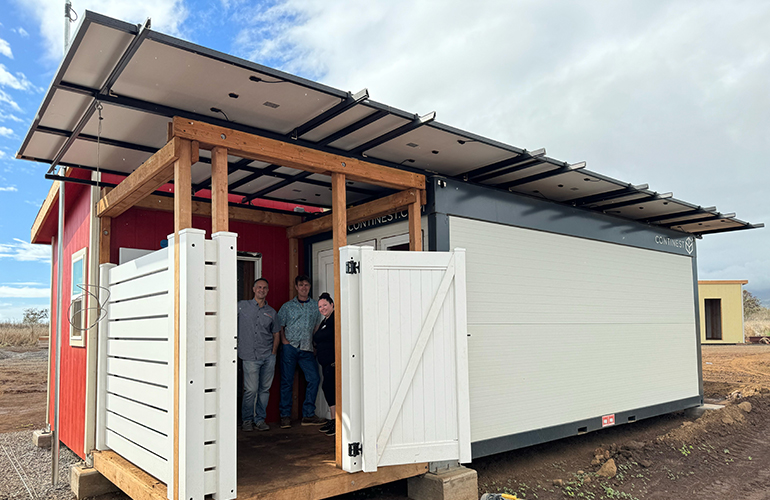
Solar has been installed on the prototype home at Ohana Hope Village. RevoluSun
“We know a lot of people from Lahaina that lost their homes, including some of our clients,” said Ashley Kelly, COO of the Family Life Center. “We tried envisioning a community where they would live, and so we thought of certain clients of ours and reflected on their lifestyles and what they would need.”
With the help of Hawaii Off Grid, a carbon-neutral architecture firm based in Maui, the Family Life Center is spearheading a temporary housing community project called Ohana Hope Village. Hawaii Off Grid provides pro bono architecture services for the Family Life Center and designed an 88-unit off-grid housing project powered by solar + storage technologies.
The housing units are pop-up containers that erect into 20-ft living spaces and will be outfitted with plumbing, bathrooms and a kitchen; a wooden veranda — or a lanai, as it’s locally called — will be built off the side of the building and solar panels will provide shading and additional living space. The goal is to give people a place to live with all the basic amenities expected from a home while the city rebuilds. Construction on the off-grid village is happening right now and should be completed in the next few months.
“If we were to follow what the utility wants us to do and have a 100- or 200-amp service and a meter on every single dwelling unit, or a massive master meter and conductor and transformer and the distribution, we’ll be looking at three- to four-times the cost,” said David Sellers, principal architect for Hawaii Off Grid. “Even though it’s not cheap, obviously, with batteries and PV … but it’s actually cheaper than us installing all of that heavy-duty infrastructure.”
A global and local effort
As the Ohana Hope Village project started to take shape, Kelly identified viable housing units from emergency shelter manufacturer Continest. The Family Life Center purchased the shelters, but none were available in the United States at the time. Continest’s other plant in Hungary had stock, so the company contacted the Hungarian minister of defense to coordinate with NATO to have a C-17 military aircraft transport the shelters to Lahaina.
“When that NATO C-17 landed and the multinational crew came out, I know we were all just crying,” Kelly said. “It was clearly from the other side of the world — help was coming, and our architects really needed the homes on site to really get our plans going.”
The site where the Hope Village is being built is 10 acres of land leased to the Life Center from King’s Cathedral Church for $1 a year. There is no electrical infrastructure on the property, so off-grid solar and energy storage will power the entire community. The project is engaging regional contractors with a focus of including locals displaced by the wildfire in the workforce.
“We also felt it was very important that the local community got to be part of the build,” Kelly said. “We weren’t bringing anyone in from the mainland or anything to build this. We really felt that was part of the healing process.”
Support has been extended from other laborers and material suppliers including RevoluSun, a solar contractor based in Oahu. Along with the nonprofit Footprint Project, RevoluSun has been sourcing and donating solar technologies and construction time to the Hope Village project.
Hans Harder, director of electrical at RevoluSun, is overseeing solar array design and construction, and helped build the system on the first housing unit at the Hope Village. The 7-kW array built on this single-dwelling unit is composed of JinkoSolar 410-W modules, IronRidge racking and Tesla Powerwall 2 battery backup. The remaining houses will have a similar solar wattage.

Ohana Hope Village will be composed of 88 units sourced from emergency housing manufacturer Continest. RevoluSun
The roof surface of the Continest shelter requires a few different mounting methods to secure the modules. Since these units are modular and expected at some point to fold back into the flat position in which they arrived, the solar installers cannot penetrate the roof.
The attachment on the roof surface itself is a stainless-steel welded tab that is adhered to a silicon roof membrane. All four top corners of the shelter have attachment points, like those found on shipping containers, so Harder ran a U-bolt through those gaps and secured them to the array’s mounting rail. Then to prevent wind uplift, steel wire comes down from the corners of the array and mounts to the bottom of the container.
These shelters will be outfitted with all electric appliances, so solar + storage will cover those energy needs. Every six housing units will be built around one community center composed of two 20-ft Continest shelters that will act as a gathering space with laundry facilities. Those will have a 17-kW solar array and energy storage for additional backup for the houses.
“I can’t wait to see it when it’s done,” Harder said. “Right now, it’s still hard to imagine that it’s going to be somewhere that people would want to live. But every time I go there, it does look a little bit closer to what the fancy architectural drawings look like.”
Making it work with what they have
There’s still plenty of work ahead for everyone involved in the Ohana Hope Village project. Sellers said Lahaina was already experiencing a housing crisis prior to the wildfire, and at last count, there are still more than 4,000 displaced Lahaina residents living in hotels.
Ohana will house, at most, 88 families and has already received 500 applications for residence. But it is poised to provide viable relief for Lahaina before the city can repair some of its destroyed infrastructure.
“We want to think about how we’re building in the temporary for emergency housing to show people how we should actually rebuild,” Sellers said.
That quickened construction timeline is possible partially through using renewable energy sources like solar. RevoluSun’s Harder said he witnessed Lahaina residents gathering at homes spared by the fires that were powered by solar, because nothing else around them had electricity. Solar contractors were among the first people to respond after the wildfire, and they powered portable Starlink internet routers with PV so people could contact their families.
The Ohana Hope Village is the next example of solar keeping the power flowing where other infrastructure had failed in Lahaina.
“Usually there’s this anxiety about having solar being completely off-grid, but that was one of the first decisions that was made,” Kelly said. “We had a lot of roundabouts with water and sewer, and the solar was solutioned pretty quickly. Once that decision was made, it was set.”
The Family Life Center hopes to have the housing project completed in the next few months. Kelly said monetary donations are the best way to support the Ohana Hope Village to help subsidize the cost of materials and labor. Donations can be made at ohanahopevillage.com.

Credit: RevoluSun


Hawaii
Tourist yells ‘I’m rich’ after beachgoers beg him to stop attacking endangered seal — before he’s detained

A tourist who threw a huge rock at an endangered Hawaiian monk seal in Maui boasted that he didn’t care about the consequences because he’s “rich” — before he was detained over the attack.
The man was filmed lifting a large rock from a beach and throwing it towards an endangered seal as it swam off the Lahaina shoreline last Tuesday, narrowly missing the animal’s head.
Kaylee Schnitzer, who filmed the video, can be heard yelling at the man: “What are you doing? Why would you throw a rock at it?”
She later told KHON 2: “We told him that we called the cops, and he was like, ‘I don’t care. Fine me, I’m rich.’ He said that, and he kept walking.”
The Division of Conservation and Resources Enforcement’s Maui Branch dispatched officers to the beach, where they detained the suspect. Hawaii’s Department of Land and Natural Resources said it will not be share the suspect’s identity as he has not been criminally charged at this time. He is understood to be a 37-year-old man from Seattle, Washington.
A viral video captured a tourist throwing a large rock at an endangered monk seal in Hawaii (KHON2)
Hawaiian monk seals are among the most endangered marine mammals in the world. Harassing, injuring or killing one is against both state and federal law, and violators may face fines or criminal penalties. The horrifying incident sparked online outrage and Schnitzer’s video went viral.
The seal, named “Lani,” is beloved by many residents in the area after returning to Lahaina following the 2023 wildfires. Maui Mayor Richard Bissen noted in an Instagram post that both members of his team and locals have “watched over and deeply cared for” Lani since her return.
“Let me be clear, this is not the kind of visitor we welcome on Maui,” Bissen said. “We welcome respectful visitors that understand that our cultural environment and wildlife must be treated with care and aloha. Behavior like this will not be tolerated.”

Monk seals are one of the most endangered marine mammals in the world (Hawaii Department of Land and Natural Resources)
State officials said the suspect was questioned by authorities and later released after he requested legal counsel.
The Department of Land and Natural Resources said it is investigating the incident and will turn over the findings to NOAA’s Office of Law Enforcement for possible federal action. The Independent has contacted the department for more information.
During a news conference on Wednesday, the Division of Conservation and Resources Enforcement Chief Jason Redulla said officials have not confirmed whether the seal was harmed by the rock.
Police reminded the public to avoid interactions with the protected species and report harmful behavior to authorities.

-

 News2 minutes ago
Video: Americans Exposed to Hantavirus on Cruise Ship Arrive in United States
-

 Politics8 minutes ago
Trump Proposes Suspending Federal Gas Tax Until Prices Fall
-

 Business14 minutes ago
Kennedy Is Driving a Vast Inquiry Into Vaccines, Despite His Public Silence
-

 Science20 minutes ago
A Fish That Hitches Rides Where the Sun Doesn’t Shine
-

 Health26 minutes ago
Doctors Reveal the 3 Surprising Weight-Loss Hacks Nobody Talks About
-

 Culture38 minutes ago
Do You Recognize These Snappy Lines From Popular Crime Novels?
-

 Lifestyle44 minutes ago
Thanks to ‘Mormon Wives,’ Dirty Soda Is a National Obsession
-

 Education50 minutes ago
Cursive Club, Where Students Learn With a Flourish