Denver, CO
Nikola Jokic passes Kareem Abdul-Jabbar for most assists by center in NBA history as Nuggets beat Magic


For his latest trick, Nikola Jokic dribbled into oncoming traffic and escaped unscathed.
Sometimes after he reels in a defensive rebound, the Nuggets center prefers to launch an aerial attack with one of his long outlet passes. This time, he brought the ball with him up on his usual route up the middle of the floor. Magic center Wendell Carter Jr. trailed him by a step. Up ahead, Tyus Jones veered into his lane from the left, sensing an opportunity to pick the pocket of a lumbering big man.
But Jokic is nimble. Before Jones could cut across his front side, he anticipated the attempted swipe and transferred his dribbling hand with a behind-the-back move that shouldn’t have looked so graceful. Jones whiffed. Carter caught up, but Jokic decelerated to allow him to pass. Then the newly minted best passing center of all time went behind the back again — this time, a dime to Jamal Murray, who finished the play with a lefty floater.
Denver’s stars were just showing off at that point in the third quarter of a 126-115 win over the Magic that wasn’t always so smooth-sailing.
It was a monumental night. At 30 years old and 302 days, Jokic passed Kareem Abdul-Jabbar on Thursday for the most assists by a center in NBA history. Coming into the game, all he needed was six to match Abdul-Jabbar’s career total of 5,660. He finished the evening with 13, highlighting a 23-point, 11-rebound triple-double.
“For those of us that love the history of the game, that one should be wrote about and talked about, and that should be a national story,” Nuggets coach David Adelman said. “Because that’s passing a guy that you could argue — if you just want to go by generations and not, ‘Who’s the best player of all time?’ and all the talk-talk stuff — Kareem is in the conversation. Look at his MVPs. Look at the winning. And our guy tonight from Denver just passed him in a category.”
“This is a time that I can be able to look back and appreciate all the years I’ve had to play this game with him,” Murray said. “It’s special. Passing Kareem in anything is pretty cool. So I think it just speaks to his greatness and how unselfish he is.”
Jokic has also passed other Hall of Famers including Michael Jordan and Allen Iverson on the all-time list this season, now ranking 50th overall in career assists. Next up for him to catch is another legendary passer, Larry Bird. Jokic is 28 away from tying him.
“I always say the assist makes two people happy (instead of one). My coach ‘Deki,’ he always said that,” Jokic said Thursday, paying homage to the late Golden State Warriors and Mega Basket coach Dejan Milojevic.
“Maybe it’s not a splashy pass or whatever,” the three-time MVP continued, “but I think when you make the right play, you’re going to feel good about yourself.”
Adelman was especially adamant about the historical significance of the occasion. He gave Jokic the game ball in Denver’s locker room after the win.
“It’s such a cool thing, because it’s Kareem, who was passed by LeBron (James) as the all-time leading scorer, which puts in perspective who Nikola passed,” Adelman said. “So it’s a celebration of both people. It’s somebody that completely changed the game. The sky hook. The longevity. … I feel like in the modern era, we talk about Tom Brady and all these people. But go look at Kareem. The guy changed his name while he played. The guy plays 20-plus years and, until the very end, was impactful on teams that went to the Finals. So for Nikola to pass him, I think, says a lot. And if we’re going to celebrate what LeBron did, (we should celebrate this also). And I know it’s a different kind of thing because it’s a center, it’s a position. I’ll just keep saying it. Just don’t get tired of this, because it’s unique.”
Jokic is also closing in on Oscar Robertson for second all-time in triple-doubles. Thursday was his 177th, bringing him within four of the iconic guard. He became the first center in league history to average a triple-double last season, and he’s on pace to do so again this year with 29.8 points, 12.4 rebounds and 10.8 assists per game.
Orlando called a timeout after Jokic and Murray combined for that saucy transition bucket in the third quarter. As they sauntered to the huddle, Nuggets assistant coaches Ognjen Stojakovic and JJ Barea could only laugh at the duo’s skill and panache.

“That’s how kind of we made our staple in that second unit growing up, was just the give-and-go,” Murray said of Jokic’s passing. “… A lot of give-and-go, and you could see his court vision and his fluidity.”
The Nuggets did most of their work Thursday during an astonishing second quarter. They flipped a 47-33 deficit with a 35-7 run that only took the last 6:26 of the first half. Murray scored 20 of his 32 points in the frame. Reserve point guard Jalen Pickett ignited the comeback and was a plus-26 in eight minutes of playing time that quarter.
Both teams were short-handed at Ball Arena. Orlando was fending without Franz Wagner and Jalen Suggs. Denver was down three of its best defenders with Peyton Watson (right trunk contusion) ruled out shortly before tip, joining Christian Braun and Aaron Gordon on the shelf.
In Watson’s place, Bruce Brown started his first game as a Denver Nugget since April 9, 2023. David Adelman used 10 of his 11 available players, including Julian Strawther, who was cleared to play earlier this week after missing a month with a back injury.
Orlando mounted mini-comebacks throughout the second half, eventually narrowing a 21-point gap to 121-115 with 90 seconds to go.
Moments earlier during a Nuggets timeout, Ball Arena had displayed a graphic commemorating Jokic’s all-time assists achievement. The crowd greeted him with a round of applause as he returned to the court. Then he treated Denver to one more beauty of an assist, passing out of a double-team with a missile across the court to Cam Johnson in the backside corner. His open 3-pointer sealed the win.
“It’s a celebration of our guy, of a Denver Nugget, and it’s a celebration of NBA history, all in the same place,” Adelman said. “And we all got to be there to see it.”



Getty
Peyton Watson #8 of the Denver Nuggets is a potential Lakers free-agent target.
The Los Angeles Lakers are still exploring means to improve their roster ahead of the upcoming season. Moves have been made already, but there are opportunities to add more talent around Luka Doncic.
One potential target for L.A. is Denver Nuggets star, Peyton Watson. In a proposed multi-team deal involving the Miami Heat and New Orleans Pelicans, the Lakers could land the high upside talent.
In the deal:
Both Watson and Jones have been linked with a move to L.A. this offseason, but no deal has been able to push forward. This proposal offers a chance to get both with one swing.
Lakers’ Outline for Acquiring Peyton Watson Through Trade
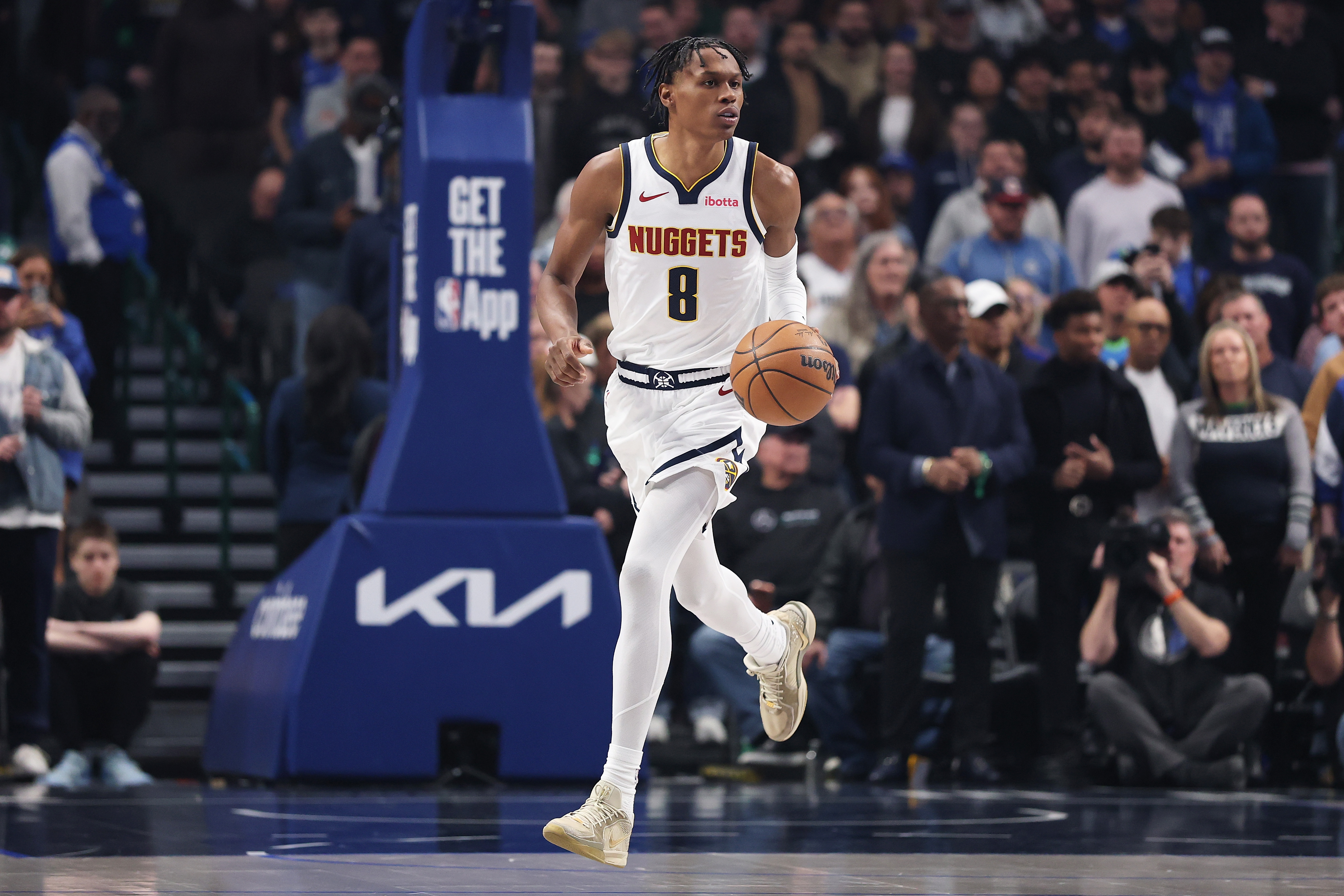
GettyDALLAS, TEXAS – JANUARY 14: Peyton Watson #8 of the Denver Nuggets handles the ball during a game against the Dallas Mavericks at American Airlines Center on January 14, 2026 in Dallas, Texas.
Watson, 23, is a restricted free agent, which makes any approach difficult. The Nuggets could match any offer to retain him and are reportedly planning to do so.
The 6-foot-8 star is coming off a breakout season in Mile High City, averaging 14.6 points, 4.9 rebounds, 2.1 assists and 1.1 blocks per game. He shot 49.1% from the field and 41.1% from three while starting 40 of his 54 appearances.
Watson’s camp is reportedly seeking north of $25 million per year which is unfavorable for the Nuggets at this point. Denver already has huge commitments to Nikola Jokic, Jamal Murray, Anthony Gordon and Christian Braun.
The Lakers can capitalize on the Nuggets’ need to move for pieces for flexibility and pitch a move for Watson. There would be adequate space to fit in the incoming star with the outgoings in this framework.
The Lakers can offer Watson a multi-year deal that doesn’t affect their flexibility. Vanderbilt’s outgoing deal is the most notable, which is why the Lakers have put him at the top of their moving list for now.
Watson’s Upside and Adding Herb Jones to the Roster

GettyLuka Doncic #77 of the Los Angeles Lakers passes the ball as he is pressured by Herbert Jones #2 and Jeremiah Fears #0 of the the New Orleans Pelicans during the second quarter of an 2025 Emirates NBA Cup game at Smoothie King Center on November 14, 2025 in New Orleans, Louisiana.
The Lakers would also get Jones out of this trade from the Pelicans. He is on a three-year, $68 million extension going through 2028-29 with a player option. His cap hit for 2026-27 sits at around $14.9 million.
With Watson and Jones, the Lakers would be bringing in roughly $38 million worth of salary, adding both Saddiq Rey for depth while sending out only about $26 million. This scenario would push L.A. well over its luxury limit but not into restrictive zones.
A potential lineup having Watson and Jones alongside Doncic, Austin Reaves and the newly acquired Walker Kessler, is positioned to be a strong core.
The real hurdle is getting Denver to move on from Watson. The franchise is committed to keeping him, even if it means giving up one of their more seasoned stars. They did activate a qualifying offer, making him restricted and they intend to match offers. Although a sign-and-trade is not impossible and the Lakers can work with that.
Adel Ahmad Adel is a writer with over five years of experience covering the NBA. His work has appeared on various media platforms, both national and local. More about Adel Ahmad
Denver, CO
One tree at a time: Denver nonprofit works to close shade gap as heat dome threatens neighborhoods

DENVER — Some Denver neighborhoods are far more vulnerable to this weekend’s incoming heat dome than others — and the difference comes down to trees.
The Valverde neighborhood on the city’s west side has about 9% canopy cover, leaving residents with little shade as temperatures climb toward triple digits.
▶️ WATCH: Denver7’s Claire Lavezzorio learns more about The Park People and how it is helping neighborhoods in Denver.
One tree at a time: Denver nonprofit works to close shade gap as heat dome threatens neighborhoods
Kim Yuan-Farrell, executive director of The Park People, a nonprofit that plants trees in underserved neighborhoods, said the disparity across Denver is stark.
“We have some neighborhoods that have wonderful canopy cover, like 20 to 30% of those neighborhoods are forested. Then a number of our neighborhoods have really low canopy cover, between four or 8% where it’s just significantly less,” Yuan-Farrell said.
Denver7
The Park People identified 28 neighborhoods in need of more tree cover, including Westwood, Globeville and Northeast Park Hill.
Trees can cool an area by 15 to 20 degrees, making a significant difference.
The National Weather Service (NWS) warned the heat dome could last through next weekend.
“The exceptional thing about this is how long it will last,” said NWS meteorologist Russell Danielson. “If you do have trees to take shelter under, it does actually cool down the temperature a decent amount.”
Yuan-Farrell said trees are more than a comfort — they are a critical piece of urban infrastructure.

Denver7
“We really consider it a really essential element of green infrastructure, a real nature-based solution to a lot of these really serious local environmental problems,” Yuan-Farrell said.
In the map below, explore Denver’s libraries and rec centers that welcome the public in from the heat during business hours.
When asked whether Denver has a long road ahead, she did not hesitate.
“We have a lot of work ahead of us,” Yuan-Farrell said. “And we really need our whole community to get involved in that.”
The Park People plant anywhere from 1,200 to 2,000 trees a year. You can apply for one in your yard. Planting is set to begin in September.

Denver7 | Your Voice: Get in touch with Claire Lavezzorio
Denver7’s Claire Lavezzorio covers topics that have an impact across Colorado. If you’d like to get in touch with Claire, fill out the form below to send her an email.

To the well-trained eye, Denver figured to be one of the epicenters of this NBA offseason.
With two starters due for a combined $25.8 million salary increase, and with a potential rising star on the bench determined to land a lucrative contract extension, something had to give. The Nuggets were about to get too expensive for owner Stan Kroenke to stomach. Especially after their debacle of a playoff run, which ended before it could begin.
This was the prevailing sentiment for two months leading up to free agency. Almost all Nuggets-related chatter, both inside and outside Ball Arena, was about which player(s) they would sacrifice in a trade. Team president Josh Kroenke poured jet fuel on the rumor mill when he declared in May that “everything is on the table” except trading three-time MVP center Nikola Jokic.
Another high-ranking official in the Kroenke sports empire, Kevin Demoff, had hinted months earlier that Denver’s inclination might be to avoid the luxury tax entirely next season as to avoid paying the NBA’s punitive “repeater tax” rates. That was long before the Nuggets revealed to their power brokers that they were nowhere close to championship-worthy.
So, uh, what’s going on in Denver?
More than a week since the league’s free agency period began, most teams have completed their offseason business. The Nuggets have been puzzlingly idle. A few highlights so far: Tim Hardaway Jr. leaving for Miami as expected, Jonas Valanciunas getting waived for salary cap relief as expected, Marvin Bagley III and Tyus Jones signing one-year deals.
Going all-in or playing it conservatively?
Something doesn’t add up. As in, it adds up to a sum that continues to leave most NBA observers skeptical. Denver is leaving everyone guessing right now, even other teams.
Should fans be frustrated by the lack of action? Encouraged by it? Or is everything simply on hold?
There are two sides to this to unpack: the financial and basketball perspectives. They’re obviously intertwined, but when trying to make sense of this situation, it’s best to start with the financial side, because that was an obstacle that seemed to be motivating Denver’s roster decisions even before the on-court problems that emerged against Minnesota.
Before last season, the Nuggets were choosing between two extension-eligible 2022 draftees who had one year remaining on their rookie contracts: Christian Braun and Peyton Watson. They chose Braun, the more proven player at that point, an efficient 15-point-per-game starter the previous season, and a strong (if flawed) defender. They signed him to a five-year deal that would go into effect in 2026. They felt comfortable taking Watson to restricted free agency and maybe even losing him. Three years into his career, he seemed to be developing into a solid 3-and-D bench player, and maybe not much more than that.
The Nuggets were looking ahead to their 2026-27 payroll and didn’t want to commit large chunks of money to both players. Watson told The Denver Post in October: “From what I understand, it was just a financial business decision. Obviously, with the new CBA and the second apron, things of that nature, they wanted to stay out of that.”
Braun went on to have an injury-riddled season, the worst of his career. Watson had the best season of his career, particularly by showcasing his off-the-dribble ability when Jokic was hurt in January.
And so the Nuggets knew they would be entering the 2026 offseason with six starter-level players whose combined salary would result in a roster payroll above all three tax thresholds: the luxury tax ($200.4 million), first apron ($209 million) and second apron ($221.7 million). They wanted to keep Watson, recognizing the importance of his two-way talent and athleticism. They signaled as much to other teams.
If their previous actions had already indicated they were prepared to sacrifice him to stay under the second apron, then changing course and keeping him would surely mean sacrificing someone else.
This was the foundational logic that led people around the NBA to believe they were almost guaranteed to trade a starter. An oversimplification of the salary cap math looked like this: Lose one of your six starter-level players to get under the second apron, or lose two to duck the tax entirely. Perhaps other creative ways to shed salary would emerge, but this was the basic state of the union. Jon Wallace and Ben Tenzer would be tasked with threading the needle between cutting payroll and improving the roster.
From this perspective, the fact that Denver has not traded any of the six starter-level players yet can ironically be interpreted as an aggressive stance, not a conservative one. The moves that were expected to have happened by now would’ve been motivated primarily by money, not purely by basketball. Could it be that the Kroenkes are going all-in to chase a second championship? Suddenly, in the last few days, there’s been reporting from national media outlets such as The Athletic that “Denver’s ownership has not given its front office a mandate to cut costs.” The Post has been told similarly.
But that didn’t seem to be the case three weeks ago when the Nuggets were actively exploring the trade market for Braun and Cam Johnson, as The Post and other outlets reported.
What can it mean? Maybe there’s been a change of heart, and an executive decision has been made to spend lavishly. Maybe it’s connected to the team’s pursuit of LeBron James in free agency (how do you even begin to pitch him on coming to Denver if you’re not willing to pay up?), or maybe it’s a reaction to Jokic’s decision to wait one more year to sign a new extension. As direct as he was in publicly stating his plan to sign next summer, maybe the pressure of him entering the last guaranteed season of his current contract scared the Nuggets straight.
Maybe this is an earnest, full-throttle statement of championship intent.
Or maybe the abrupt timing of this leakage is a little too convenient.

Gauging the Watson market
The Nuggets have multiple reasons to want the rest of the NBA to believe they’re working with a blank check right now. One of those reasons: Watson.
Negotiations have clearly not gone smoothly. The line of demarcation is $25 million. That’s Braun’s average annual value on his new contract — the deal Denver prioritized over Watson — and now it’s the number Watson’s camp can fixate on. His side can point to last season and claim that going forward, he is worth the same amount or more. The Nuggets can point to the previous three years and say Braun’s overall body of work is better so far. As this is happening, another team is reportedly lingering, with a desire to poach Watson. The Clippers reside in his hometown, and they’ve already made moves this summer to get younger and clear their books.
Watson is a restricted free agent, meaning the Clippers must extend him an offer sheet, the terms of which Denver can match to retain him. Offer-sheeting a player can be risky because it ties down your cap until the situation is resolved, with no guarantee that you will successfully land the player you’re targeting. The Nuggets are saying behind the scenes that they’re prepared to match any offer sheet. Basically, they’re trying to scare off LA (and any other suitor) by indicating the offer sheet would be a waste of time, and the only real way to get Watson from them is to execute a sign-and-trade, sending Denver other assets in exchange for the right to sign the RFA. Utah just did this with Walker Kessler, who ended up with the Lakers via sign-and-trade. How can you bolster your leverage in a situation like this? By signaling publicly that you’re willing to pay an exorbitant payroll and tax bill to keep Watson and everyone else.
This also sends a message that you aren’t desperate to trade a starter (or two) to keep Watson — that you’re more than happy to hold on to Johnson, Braun, Aaron Gordon, or Jamal Murray if the offer isn’t strong enough.
If there is a spending mandate, then other teams might look to take advantage with low-ball trade offers.
So maybe the lack of a spending mandate could turn out to be a bluff for leverage. Or maybe it’s a real edict, a genuine commitment to competitiveness at all costs. There’s almost no way to know for sure until the Nuggets take an action to back up their words. For now, inaction has the appearance of aggression, as Denver attempts to feel out the market.
Certainly, it seems like the key domino will be how the Watson dilemma works itself out — either in the form of a contract extension, or an unmatched offer sheet, or a sign-and-trade, or a begrudgingly accepted qualifying offer ($6.5 million).
ESPN front office expert Bobby Marks (a former NBA executive) projected this week that if the Nuggets retain Watson at a $25 million cap hit and don’t trade any starters, their luxury tax bill next season would exceed $170 million — an almost unprecedented amount that includes second apron and repeater tax penalties. That’s in addition to what the raw roster payroll would be.
Between player salaries and taxes, it would be a $400 million team.
Which finally brings us to the basketball perspective on Denver’s offseason holding pattern. It would be one thing to pay that much if the Nuggets had just lost the NBA Finals in a tight six-game series with their current roster — if they knew for a fact that a championship was barely out of reach last season.
But the Nuggets didn’t make the Finals. They didn’t win a single playoff series. They lost in the first round to an injured opponent. They weren’t close.
Fans of an NBA team obviously have no obligation to care about the dent in a billionaire owner’s wallet. But it’s also reasonable enough for Nuggets fans to want change this offseason, independent of the financial complications. There’s a fair case to be made that Denver should be pursuing trades purely based on basketball, even if the Kroenkes have decided they’re willing to spend like few owners have ever spent. Perimeter defense, shot creation depth, downhill quickness and frontcourt physicality are all visibly lacking.
It’s just that the reason fans want change might not be exactly aligned with the reason this ownership group would want change.
It’s difficult to imagine the Nuggets feeling satisfied with the results of the last three seasons enough to truly run it back with the same top six players and less depth.
Then consider that those six players are aging. Then consider that the cost of those six players is multiplying.
That’s more than enough evidence to leave you wondering if Denver’s silence is misleading.
Want more Nuggets news? Sign up for the Nuggets Insider to get all our NBA analysis.
-

 Los Angeles, Ca38 minutes ago
New details emerge in fatal stabbing of boy in El Monte
-

 Detroit, MI1 hour ago
1 dead, 1 injured after two-vehicle crash at Collingwood and Belleterre in Detroit
-

 San Francisco, CA1 hour ago
4 arrested, 3 cited after brawl following Giants vs. Rockies game at Oracle Park
-

 Dallas, TX1 hour ago
Mark Cuban takes legal action against Dallas Mavericks ownership over potential new arena deal
-

 Miami, FL1 hour ago
South Florida Dirt: A timeline of the Vacchi vs. Stern legal battle
-

 Boston, MA1 hour ago
Tall Ships begin historic Boston parade of sails
-

 Denver, CO2 hours ago
Lakers Proposed to Land Peyton Watson in Massive 9-Player Blockbuster Trade
-

 Seattle, WA2 hours ago
Cyclists fill backroads for annual summer Seattle-to-Portland ride

