West
Candy tours of America: 5 delectable destinations for sweet family memories

The Candy Man, in an earlier era in American pop culture, was portrayed as a kindly magician who charmed children with the secret ingredient to turn sunshine into dreamy sweet confections.
“He mixes it with love / And makes the world taste good,” late multimedia performer Sammy Davis Jr. sang in his signature tune.
Candy as a symbol of love is more than just a bubble-gum pop music lyric, according to renowned candy scholar and historian Susan Benjamin of West Virginia.
BANANA-FOCUSED FOOD TRUCK IN NEW JERSEY SERVES UP FRUITY, FROZEN TREATS” ‘CLEAN AND REFRESHING’
“People love candy because it’s food people eat when they’re having fun and going to parties or going to movies, and those kinds of things,” she told Fox News Digital.
Benjamin is the author of 10 books, including “Sweet as Sin: The Unwrapped Story of How Candy Became America’s Favorite Pleasure.”
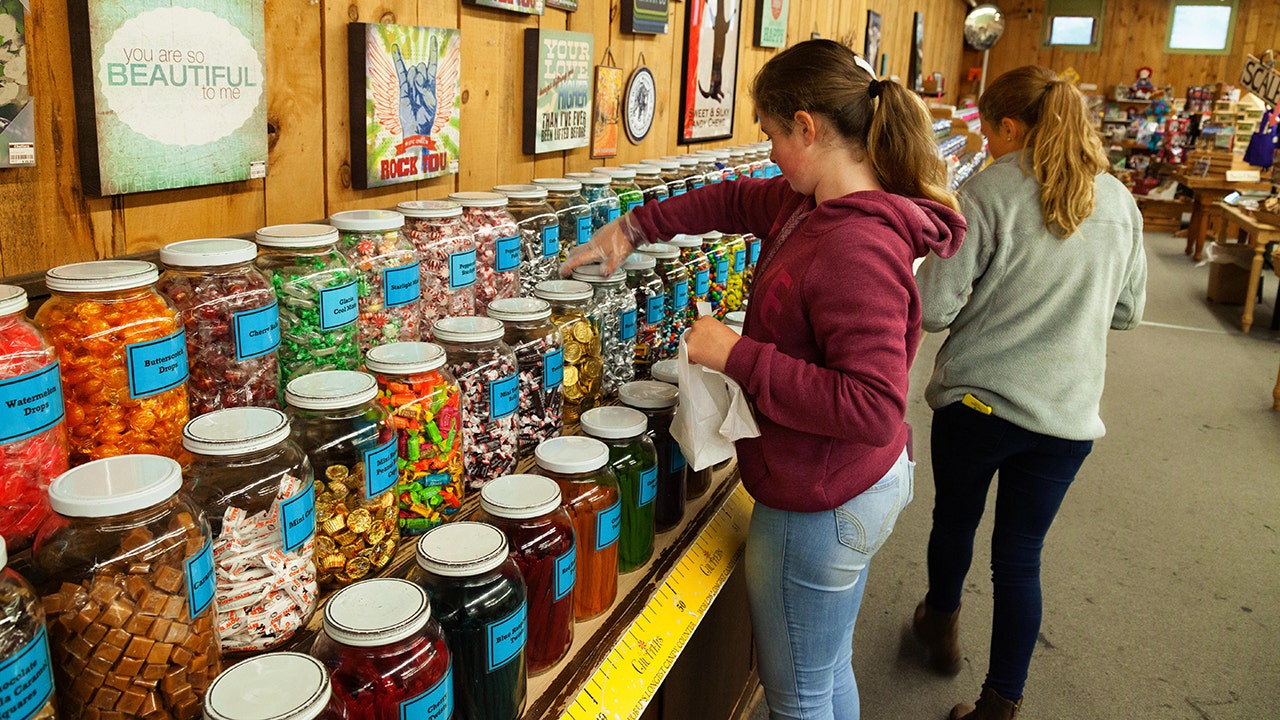
Teenagers are shown shopping for sweets at Chutters candy store, Littleton, New Hampshire. (Imagedoc/Alamy Stock Photo)
She added, “Mostly people love candy because the people we love gave it to us when we were children. We continue as we get older to give or receive candy as a sign of love.”
The American candy industry gives parents and children plenty of chances to make sweet memories by enjoying the nation’s best candy stores, tours and museums.
Here are five.
B.A. Sweetie Candy Co. of Cleveland, Ohio
Acclaimed as “the world’s largest candy store,” this Cleveland colossus of confections is a 74-year-old local institution.
It proudly proclaims that it can satisfy the sweetest teeth at the biggest candy klatch.
B.A. Sweetie of Cleveland, Ohio claims it has more than 1,000 pounds of Tootsie Rolls available to sell at any time. (imac/Alamy Stock Photo)
“Whether you need 1,000 pounds of Tootsie Rolls for a parade, or a half of a pound for your belly, we have it and we have it now,” B.A. Sweetie Candy Co. says on its website.
It also touts its status as one of Cleveland’s most popular tourist attractions.
Chutters of Littleton, New Hampshire
Wedged into the White Mountains of New Hampshire is this idyllic New England Main Street general store that features the world’s longest candy counter.
CRACKER JACK, IMMORTALIZED IN BASEBALL ANTHEM, IS A GRAND-SLAM RECIPE AT HOME, TOO
The claim is confirmed by Guinness World Records.
It measures Chutters’ single continuous tabletop of sweetness at 111 feet, 11 inches long.
On its website, Chutters says it offers “yesterday’s favorites and hard-to-find-flavors, to the best of today’s most sought-after treats.”
Chutters candy store of Littleton, New Hampshire, has the world’s longest candy counter, according to Guinness World Records. (Kumar Sriskandan/Alamy Stock Photo)
It also offers a “vast array of sours and Gummies, gourmet and traditional jellybeans, chocolates, licorice, caramels, and nostalgic pieces.”
Jelly Belly Candy Co. of Fairfield, California
The famous jelly-bean maker offers both self-guided and guided tours of its California confections factory seven days a week.
SHOOFLY PIE WAS BORN IN THE USA: ENTHUSIASTS BAKE PI DAY CLAIM OF ‘MORE AMERICAN’ THAN APPLE PRODUCTS
Self-guided tours can be done on a walk-in basis.
Guided tours require a reservation.
Close-up shot of an assortment of multi-colored Jelly Belly jelly beans in California, April 18, 2021. (Smith Collection/Gado/Getty Images)
Tours follow a quarter-mile route above the factory, looking down on where love and sugar are whipped into jellybeans.
There’s a Jelly Belly Jelly Bean art gallery and — for mom, dad and other grownups — chocolate tastings paired with local wines.
Pez Visitor Center of Orange, Connecticut
Pez candies, those crunchy blocks of sugar, are recognized globally for their plastic toy dispensers topped by a myriad of human, animal or other forms.
Originating in Austria in the 1920s, Pez has been made in Connecticut since 1973.
The company opened its visitor center in 2011.
The Pez Visitors Center opened in Orange, Connecticut in 2011. (Alamy)
Here’s a little-known Pez dispenser of knowledge: The name is an abbreviation of “Pfefferminz,” the German word for peppermint.
True Treats of Harper’s Ferry, West Virginia
Calling itself “the nation’s only research-based candy store,” True Treats was founded by author and candy historian Susan Benjamin.
An interior shot of the IT’SUGAR store on Broadway in Greenwich Village. A display of Mary Janes candy is shown for sale by the ounce. (Ira Berger/Alamy Stock Photo)
It’s located in historic Harper’s Ferry, little more than an hour’s drive northwest of Washington, D.C., and has been lauded nationally.
“This isn’t so much a candy store as it is a museum that sells its Confectionery displays.”
“This isn’t so much a candy store as it is a museum that sells its Confectionery displays,” Washington Magazine wrote in an homage to the candy collection.
“True Treats traces the history of old-school sweets — and we mean old, old school, like hickory bark, enjoyed by the Iroquois — to 19th-century Buttermints and retro faves such as Goo Goo Clusters, Mary Janes, and Squirrel Nut Zippers.”
For more Lifestyle articles, visit www.foxnews.com/lifestyle.
Read the full article from Here


Three firefighters died and two were injured while tackling fires on the Colorado-Utah border, the U.S. Wildland Fire Service reported Sunday.
The agency — created earlier this year to streamline firefighting and fire reduction across public lands — said the firefighters had been part of an interagency response to the Knowles and Gore fires on Saturday.
“The U.S. Wildland Fire Service stands united with the USDA Forest Service in grief and in our unwavering support for the loved ones left behind. Their bravery, dedication, and sacrifice will never be forgotten,” it said in a statement on Facebook.
The agency said it would share more information when it is available to be released.
Wildfire activity has intensified across the western United States, as consecutive days of hot, dry and windy weather have fueled flames in Utah, Arizona and elsewhere as new fires popped up across the region.
The largest blaze, the Cottonwood Fire, was burning in rugged terrain in southwest Utah. It ballooned Saturday to more than 144 square miles (373 square kilometers) after marching through canyons and mountainsides, destroying part of a ski resort and other summer cabins along the way.
Authorities in Beaver County began working with fire teams on Saturday to assess the extent of the damage, but no estimates were immediately available. Gov. Spencer Cox in a post on social media called it bleak, but he thanked crews for what he called “several miraculous stops and saves.”
The cliffs and steep slopes have made the job even harder, said Alyssa Mason, a spokesperson assigned to the fire.
“It’s hard to get dozers and other heavy equipment into that. It’s hard to get engines into that,” she said. “It doesn’t make it impossible to firefight, but it does just kind of slow things down.”
Hundreds of firefighters have been arriving in the arid state to battle new starts as well as those that have been growing because of what forecasters called critical fire weather — dangerously low humidity levels, warm temperatures and gusty winds.
The danger is even higher this year because of Utah’s record-low snowpack and its warmest winter on record. Much of the West is grappling with similar conditions, according to the National Interagency Fire Center.
From Alaska to Florida, crews worked Saturday to corral dozens of fires, including three dozen that were classified as large and uncontained.
Nationally, nearly 3 million acres (1.2 million hectares) have burned since the start of the year. That is more than the 10-year average.
The conditions in Utah were critical enough for Gov. Spencer Cox to declare an emergency earlier this week and clear the way for the state to ban fireworks ahead of the July Fourth holiday. The order comes as Utah is experiencing one of the most severe wildfire seasons in recent history, fueled by historic drought conditions.
State officials said that over the past week, Utah has seen an increase in wildfire starts, with each fire showing unprecedented behavior. These starts have stretched the state’s wildland firefighting capabilities, State Forester Jamie Barnes said.
Colorado Gov. Jared Polis also declared an emergency on Saturday, and authorized the use of the National Guard to tackle the fires.
Forecasters with the National Weather Service over recent days have been issuing red flag warnings for a wide swath of the West, from California to Arizona and New Mexico.
South of Grand Canyon National Park, authorities said the flames of a new wildfire were moving away from Grand Canyon Village and the nearby community of Tusayan on Saturday. But about 50 miles (80 kilometers) away, another fire prompted Coconino County officials to issue evacuation orders for those near Kendrick Mountain.
Parts of northern Arizona were without power Saturday as the utility serving the area initiated a safety shut-off in hopes of lessening the wildfire risk.
Power shutoffs have become more common in the West as wildfire risk has expanded. It is usually a last resort after utility forecasters weigh factors like sustained wind and gust speeds, available fuels and topography.
With extreme fire conditions persisting in Utah, Rocky Mountain Power also shut off power lines serving Beaver County and other areas.

In 2025, professor Bruce Houghton retired from the University of Hawaii at Manoa after 25 years as the Gordon A. Macdonald chair of volcanology. He was only the second person to hold the position in the past half century. With his retirement, let’s reflect on a career that helped shape how scientists understand explosive eruptions, volcanic hazards, and how communities live with active volcanoes.
Born and educated in New Zealand, Houghton established himself as a leading volcanologist at the Institute of Geological and Nuclear Sciences New Zealand before joining the University of Hawaii in 2000. In Hawaii, he became not only a researcher and professor, but also the state volcanologist.
Much of Houghton’s scientific work focused on a deceptively simple question: what can volcanic deposits tell us about the processes that created them? His answer is that the details matter. The textures and densities of erupted volcanic particles, their organization in volcanic deposits, and how they travel in the atmosphere are not just measurements. They are clues to how magma rises, releases gas, interacts with the vent environment, and ultimately erupts.
Houghton also pioneered the application of high-speed, high-resolution imaging of active volcanoes to quantify eruption processes with unprecedented spatial and temporal resolution. The impact of this work is reflected in a research record that includes more than $8 million in research funding since 2000, 291 journal publications, and nearly 20,000 references to his work.
His research challenged the common perception that basaltic volcanoes such as Kilauea and Mauna Loa are relatively simple compared with explosive volcanoes elsewhere in the world. Houghton showed that basaltic eruptions can display a remarkable range of explosive behavior, from exceptionally weak bubble bursts to powerful explosive activity. Basaltic eruptions can shift rapidly and reversibly through a spectrum of styles in a single event, from pulsating gas emission and episodic bursts to Hawaiian fountaining and more explosive eruptions. His work demonstrated that these changes often depend on shallow conduit processes and the vent environment, not just magma composition.
Houghton remained deeply connected to Hawaii’s volcanoes and communities. He worked closely with scientists at the U.S. Geological Survey Hawaiian Volcano Observatory and participated in the scientific response to both the 2008-2018 summit lava lake eruption and the 2018 lower East Rift Zone eruption of Kilauea.
His influence extended far beyond his own research through the generations of students he mentored — 17 doctoral students at the University of Hawaii, four in New Zealand, and two in Iceland — many of whom now work in universities, geological surveys, volcano observatories, and emergency management organizations around the world. During the 2018 eruption, many former and current University of Hawaii students who trained under Houghton played important roles in the response, demonstrating the lasting impact of his commitment to education, mentorship, and public service.
Houghton also refused to separate volcano science from the human world around it. He championed the idea that volcanic crises are not purely scientific events; decisions by residents, emergency managers, planners, and elected officials can strongly influence how communities experience volcanic hazards.
Throughout his career, he advocated for closer collaboration between volcanologists, social scientists, emergency managers, and educators. As science director of the National Disaster Preparedness Training Center at the University of Hawaii, he helped develop training programs connecting volcanic science with emergency preparedness and public safety.
The scientific community recognized Houghton’s contributions through numerous honors. In 2017, he received the Thorarinsson Medal, the highest award in international volcanology. He was also elected a fellow of the American Geophysical Union, the Geological Society of America, and the Royal Society of New Zealand.
In 2025, he was named the world’s second-highest-ranked physical volcanologist based on publications, citations, awards, and impact. He was president of the Geological Society of New Zealand (at age 28!) and deputy secretary-general of the International Association of Volcanology.
Although Houghton has retired from his roles in Hawaii and returned to New Zealand, his connections to volcanology here remain strong. His continuing collaborations, including studies of Kilauea’s ongoing episodic lava-fountaining eruption, ensure that his influence extends well beyond his years at the University of Hawaii. As volcanic activity continues in Hawaii, many of the scientists, ideas, and approaches that guide our understanding of eruptions will continue to reflect the lasting influence of Bruce Houghton.
Volcano Activity Updates
Kilauea has been erupting episodically within the summit caldera since Dec. 23, 2024. Its USGS Volcano Alert level is ADVISORY.
Episode 49 of summit lava fountaining happened for 7.5 hours on June 14. Summit region inflation since the end of episode 49 indicates that another fountaining episode is possible. Models currently indicate that episode 50 is most likely to occur between June 25-27. No unusual activity has been noted along Kilauea’s East Rift Zone or Southwest Rift Zone.
Mauna Loa is not erupting. Its USGS Volcano Alert Level is at NORMAL.
Eight earthquakes were reported felt in the Hawaiian Islands during the past week. Those above magnitude-3 are: a M3.6 earthquake 14 km (8 mi) S of Volcano at 7 km (4 mi) depth on June 24 at 8:29 a.m., a M3.2 earthquake 13 km (8 mi) SSE of Fern Forest at 6 km (3 mi) depth on June 23 at 9 a.m. HST, a M3.8 earthquake 21 km (13 mi) S of Honaunau-Napoopoo at 5 km (3 mi) depth on June 22 at 6:20 a.m., and a M3.1 earthquake 12 km (7 mi) SSE of Volcano at 6 km (3 mi) depth on June 20 at 7:55 p.m.
Please visit HVO’s website for past Volcano Watch articles, Kilauea and Mauna Loa updates, volcano photos, maps, recent earthquake information, and more. Email questions to askHVO@usgs.gov.

SALMON — State officials are celebrating the grand opening of Idaho’s newest state park.
Twin Peaks Ranch State Park at 199 Twin Peaks Ranch Road between Challis and Salmon, opened in May. The Idaho Department of Parks and Recreation recently acquired the 670-acre site from a private landowner and hosted a ribbon-cutting and open house on Saturday.
The park offers a variety of amenities, including 25 full-service cabins, a lodge and a restaurant. It also has a disc golf course, a rodeo arena and an equestrian center.
“We’ll be able to stage horseback tours out of that area,” Ryan Buffington, the department’s East Region manager who serves as the park’s spokesman,” told EastIdahoNews.com in May. “We’re working with the U.S. Forest Service and the U.S. Bureau of Land Management to designate an off-highway vehicle trailhead as well.”
RELATED | Small mining community near Challis rose and fell in 30 years, and now it’s one of Idaho’s ghost towns
Two campgrounds are in development on the property for future use — one accommodating off-highway vehicles and the other catering to people on horseback.
Community members, local leaders and visitors across the state attended Saturday’s open house. Muzzie Braun from Challis-based band Braun Brothers Reunion was there, as was Salmon Back Country Horsemen Association. Multiple food vendors were there as well, including Water’s Edge Food Truck, and Taco Wagon Food Truck.
In a June 18 news release, Idaho Parks and Recreation Director Susan Buxton said she’s excited to celebrate the opening of Idaho’s 30th state park, and the 28th one under the department’s management.
“Opening Twin Peaks Ranch State Park marks a historic milestone for Idaho Parks and Recreation,” Buxton said. “This park serves as a gateway to endless outdoor recreation opportunities while creating a premier destination for visitors seeking adventure, relaxation and unforgettable experiences.”
Twin Peaks Ranch is the first newly acquired standalone state park in nearly 30 years. Thousand Springs in Gooding County, which is a natural discharge point for the Eastern Snake Plain Aquifer, wasn’t recognized as an official state park until 2005. The designation merged four natural landmarks — Malad Gorge, Niagara Springs, Billingsley Creek and Ritter Island — into one unified site.
RELATED | Curtailment order targets 924 groundwater rights across eastern Idaho
Heyburn State Park, created in 1908, is Idaho’s oldest state park, according to the University of Idaho. The donation of the Harriman family’s 11,000-acre ranch to the State of Idaho in 1963 — what is now Harriman State Park — led to the creation of the Idaho Department of Parks and Recreation.
RELATED | Disputed Idaho bill signed into law despite strong opposition in eastern Idaho
Buffington says the Moore family sold the Twin Peaks Ranch property to the State of Idaho in October. They bought it in 2018. It began operating as a guest ranch in the 1990s, but had been a dude ranch for 40 years before that.
While there is evidence of early settlements on the property in the 1890s, Buffington says its definitive history begins in the 1950s. E. DuPont bought it, built five cabins and ran it as a dude ranch. It was sold to another private holding in the 1970s, and more amenities were added.
Buffington says multiple Moore family members were involved in the ranch when they bought it eight years ago. Many of them backed out over time, and managing it became “too challenging.” That’s what led the family to list it for sale.
The State of Idaho saw the listing and bought it from them. Buffington says they were thrilled with the idea of it becoming public property that everyone could enjoy.
“Twin Peaks Ranch State Park represents a significant investment in Idaho’s public lands and local communities. The project reflects IDPR’s mission to improve quality of life through outdoor recreation and resource stewardship while expanding public access to some of Idaho’s most scenic and unspoiled landscapes,” the news release says. “The park is expected to deliver lasting benefits to recreation, conservation, tourism, and community well-being for generations to come.”
Department officials say Twin Peaks Ranch State Park is ideal for corporate retreats, weddings, family reunions and other events. To make a reservation or learn more, call 208-894-2290 or visit the website.
=htmlentities(get_the_title())?>%0D%0A%0D%0A=get_permalink()?>%0D%0A%0D%0A=htmlentities(‘For more stories like this one, be sure to visit https://www.eastidahonews.com/ for all of the latest news, community events and more.’)?>&subject=Check%20out%20this%20story%20from%20EastIdahoNews” class=”fa-stack jDialog”>
-

 Colorado1 minute ago
3 firefighters killed, 2 injured fighting wildfires near Colorado-Utah border
-

 Connecticut6 minutes ago
CT Lottery Powerball, Cash 5 winning numbers for June 27, 2026
-

 Delaware13 minutes ago
LGBTQ+ advocates look to open Wilmington visitor center, museum
-

 Florida16 minutes ago
Winner and Loser of the Week in Florida politics — Week of 6.21.26
-

 Georgia21 minutes ago
First Alert Forecast: Heat advisory issued for parts of east Georgia amidst building heat wave
-

 Hawaii28 minutes ago
Volcano Watch: A hui hou to a giant of volcanology – West Hawaii Today
-

 Idaho31 minutes ago
Idaho celebrates grand opening of first new state park in over 2 decades – East Idaho News
-

 Illinois36 minutes ago
Southern Illinois Airport Authority celebrates 76 years with ‘Big Bang Birthday Bash’

