West
Bryan Kohberger case: Judge denies prosecutors' request for personality testing

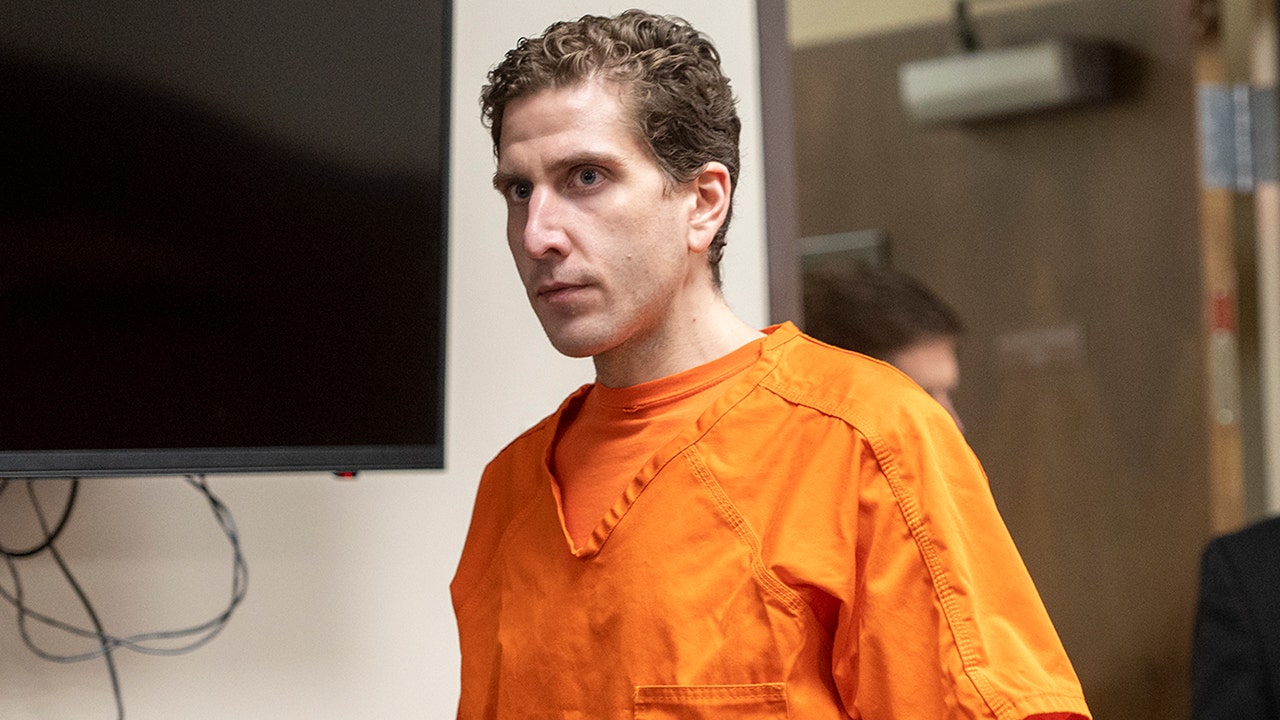
A judge in Idaho has denied prosecutors’ request to conduct personality testing on quadruple murder suspect Bryan Kohberger.
Kohberger is charged with first-degree murder in the deaths of University of Idaho students Kaylee Goncalves, 21, Xana Kernodle, 20, Madison Mogen, 21, and Ethan Chapin, 20. The former Washington State University student was also charged with one felony count of burglary.
In an order Wednesday, Judge Steven Hippler denied the state’s request to perform a personality test on Kohberger, citing time constraints.
Hippler wrote that “any new potential diagnoses or evidence uncovered through personality testing may elicit the need for further testing,” which would require more time to be spent.
IDAHO JUDGE SLAMS BRYAN KOHBERGER’S ‘HOLLOW’ ATTEMPT TO DODGE DEATH PENALTY IN LATEST BLOW TO DEFENSE
Bryan Kohberger enters the courtroom for his arraignment in Latah County District Court May 22, 2023, in Moscow, Idaho (Zach Wilkinson/Pool/Getty Images)
He also wrote that the use of a personality test has the potential to uncover “new mental health diagnoses” that haven’t been disclosed, which could cross a legal line since Kohberger only gave up privacy rights for conditions he has revealed.
Kohberger’s defense team won’t be permitted to bring up testimony about Kohberger having a “personality disorder.”
FOLLOW THE FOX TRUE CRIME TEAM ON X
Hippler also extended a deadline for rebuttal disclosure, which gives prosecutors more time for their expert to complete a behavioral health examination. Prosecutors are seeking to rebut defense experts who claimed Kohberger has autism, obsessive-compulsive disorder and attention deficit hyperactivity disorder.
The judge gave prosecutors until May 27 to complete the report but noted Kohberger’s defense team cannot be present during the mental health examination.
Timeline of Nov. 13, 2022:
- 4 a.m.: Suspect arrives at house
- Between 4 and 4:17: Time of murders
- 4:19: Roommate calls 3 victims, no one answers
- 4:22 to 4:24: Surviving roommates text each other from inside house
- 4:27: Roommate calls victims again; no one answers
- 4:32: Roommate texts Goncalves ‘Pls answer’
- 10:23: Surviving roommate texts victims; no one answers
- 11:39: Roommate calls her father
- 12 p.m.: 911 call placed from roommate’s phone
SIGN UP TO GET THE TRUE CRIME NEWSLETTER
In a separate order, Hippler ruled that Kohberger’s immediate family members can remain in the courtroom for the duration of the trial, even though prosecutors plan on calling some of them as witnesses.
In April, Hippler denied two separate motions from Kohberger’s defense team to exclude the death penalty from being used in this case.
JUDGE RULES DEATH PENALTY TO REMAIN AS POSSIBLE PUNISHMENT AMID BRYAN KOHBERGER AUTISM DIAGNOSIS
Bryan Kohberger, accused of murder, arrives for a hearing on cameras in the courtroom in Latah County District Court Sept. 13, 2023, in Moscow, Idaho. (Ted S. Warren/Pool/Getty Images)
During an April 9 hearing, the defense team argued that the death penalty should be struck because discovery produced by prosecutors has been both voluminous and unorganized.
Hippler, in his response, wrote that Kohberger’s complaints about the amount of discovery produced “ring hollow.”
Bryan Kohberger in Latah County court in Moscow, Idaho, Aug. 18, 2023. (August Frank/ Lewiston Tribune)
“[Kohberger] has been receiving discovery in the same manner for over two years,” Hippler wrote. “[Kohberger] has not sought additional resources … to hire additional staff to review discovery or obtain litigation document control software to help organize and sort the evidence. His lead counsel insisted that she be allowed to take on a second high-profile capital case despite the voluminous discovery in this case.”
GET REAL-TIME UPDATES DIRECTLY ON THE TRUE CRIME HUB
Fox News’ Dan Springer contributed to this report.
Read the full article from Here


Presidio Heights is proving to be a center of gravity as luxury housing supply in San Francisco vanishes and the city’s well-to-do scramble to claim their slice of the artificial intelligence industry’s nerve center.
On the same day last week, the city recorded two home sales in the wealthy neighborhood for $9.2 million and $10 million.
The first reflected the fortunes being created by the AI industry. Venture capitalist Kenneth Wallace and his wife, Moriah Lewis, sold their five-bed, 4,755-square-foot home at 3875 Clay Street for $9.2 million. Josh McAdam of Sotheby’s International Realty represented the seller. The property last sold for $6.8 million in 2021.
The buyer initially kept their name hidden behind a Delaware-incorporated LLC named after the property’s address. However, according to public loan documents, the LLC is managed by Daniel Berrios and Kimberly Tan, a couple in their early 30s who graduated from Stanford into the San Francisco tech sector. Berrios works on special projects at OpenAI, and Tan is an investing partner with blue chip venture capital firm Andreessen Horowitz. Wells Fargo Bank provided a $5.4 million loan for the purchase.
Ten blocks east, sellers Herbert and Shwu-Ling Wei sold their six-bed, 5,000 square-foot home at 2881 Jackson Street for $10 million. Kyle Vineyard, a CPA with Realize Tax Advisors, is the trustee of the buyer, RKLA Trust. It is unclear whether Vineyard’s involvement is purely professional or if he’s connected to the trust.
The home last sold in 2014 for $6.8 million.
Presidio Heights, the neighborhood that runs along Presidio Park at San Francisco’s north end, has experienced a hot streak during the first half of 2026. Earlier this month, two mansions in the area sold for a combined $32 million, marking the fourth and fifth sales this year to eclipse $10 million. There were seven sales above that benchmark in Presidio Heights in all of 2025, according to Zillow data.
San Francisco, where the median home sale fetches $2.2 million, is dealing with its own version of champagne problems: a mansion shortage. The AI boom has attracted a wave of high-paid employees, apparently leaving the city with more millionaires than mansions. Steep capital gains taxes have made some mansion owners hesitant to let go of their property. Others are holding out for the expected spike in luxury home demand following Anthropic and OpenAI’s initial public offerings of stock, which are expected to come later this year.
Residential
San Francisco
Single-family, condo spike as AI boom meets Lurie administration to reverse “doom loop”
Residential
San Francisco
San Francisco’s mansion shortage claims two more trophy homes
Residential
San Francisco
AI boom pushes San Francisco median home prices north of $2M
Residential
San Francisco
SF’s high-end headache: “Egregious shortage of mansions”
Read more

Denver, CO
Denver Transplant Games sets Guinness World Record for most living donors, recipients in one place at one time

DENVER — The biennial Transplant Games wrapped up in Denver this week, bringing hundreds of organ donors and recipients together to compete in everything from cycling and swimming to darts and trivia at venues all over the city.
In fact, the games set a Guinness World Record for most living donors and recipients in one place at one time, with 966 gathering at the Colorado Convention Center.
PREVIOUS COVERAGE: Transplant Games bringing competition, life-saving message to Denver
Angela Laino, who used to live in Boulder, came back to Colorado to compete in the games. She donated a kidney to a stranger in January before running in the 5K event.
“I’m what they call a non-directed living kidney donor, which means that I don’t know who my recipient was,” she explained. “So I just said, ‘Whoever needs my kidney, I’m sure they’ll find the best match for it.’”
- Watch the full story in the video player below.
Transplant Games in Denver sets Guinness World Record
Laino said she was inspired by her job, working “on and off” as a dialysis social worker for 17 years.
“I really saw the challenges that my patients faced,” she said. “I saw what they had to go through to get on the [transplant] wait list… I know what transplant means for people. I’ve seen it firsthand. And to be able to see them come out here, compete, they’re doing basketball, they’re doing badminton, they’re swimming, they’re cycling, they’re running. They are living their full lives, and that’s really what transplant can do for people.”
Denver7
Laino said the games unite the community and show off its resilience.
“When you go through the transplant process, sometimes you feel alone, you feel like you’re the only one going through this,” Laino said. “And then you come to an event like this and you literally see thousands of people. You see recipients, living donors, donor families coming together for the same cause. It’s really inspiring, because it really helps to get the word out, spread awareness about the organ shortage, and it shows people what recipients and donors can do after they have the surgery.”
Dr. Michael O’Shea — a nephrologist, a doctor who cares for kidney disease patients and the kidneys in general — agrees. But he said more needs to be down to support patients and spread the word about the need for organ donations.
Denver7
The National Kidney Foundation estimates 37 million Americans have Chronic Kidney Disease, which occurs when kidneys cannot filter the blood properly, leading to serious health issues. Because symptoms can be minimal in early stages of the disease, many patients don’t realize they have it.
“I think education about kidney transplant, both on the patient side as well as on the potential donor side, could be markedly ramped up and improved,” Dr. O’Shea said. “It’s struggles with communication between transplant centers, patients, and community nephrologists. No one’s fault. It’s just a very complicated delivery system.”
In the case of kidneys, people can become diseased donors — who register to donate in the case of their sudden death — or living donors, who donate one kidney will relying on the other. Dr. O’Shea said both are critical to meet nationwide demand for life-saving transplants, though the living donations tend to have a longer lifespan — around roughly 20 years — for recipients.
“A number of folks get transplanted every year off this list,” O’Shea explained. “It is also true that a greater number of folks get added to the list every year.”
To register to become a deceased donor, Coloradans can visit their local Department of Motor Vehicles office or visit registerme.org.
O’Shea said those considering living donations face an “exceedingly small” medical risk for end-stage kidney disease, but should consult with their doctor about the decision.
Even as the games leave Denver, a reminder will stick around through the summer. Denver Parks and Recreation, the Downtown Denver Partnership and DaVita have partnered to set up a basketball court in Skyline Park near Arapahoe and 17th Streets, in order to keep the spirit of the games alive and honor the resilience of organ donors, recipients and their families.

Denver7 | Your Voice: Get in touch with Ryan Fish
Denver7’s Ryan Fish covers stories that have an impact in all of Colorado’s communities, but specializes in covering artificial intelligence, technology, aviation and space. If you’d like to get in touch with Ryan, fill out the form below to send him an email.

SEATTLE — Seattle police are investigating a shooting that left a 17-year-old boy injured early Thursday morning in the High Point neighborhood.
At about 12:48 a.m., dispatchers received multiple reports of rapid gunfire near Sylvan Way Southwest and Southwest Morgan Street.
Officers arrived and found a 17-year-old boy suffering from a gunshot wound to the hip area. Medics transported the teen to Harborview Medical Center in serious but stable condition.
Before officers located the victim, they found a car that had crashed and become disabled near Sylvan Way Southwest and Delridge Way Southwest. Police said multiple suspects were seen running from the vehicle through a nearby Home Depot parking lot.
Officers cordoned off the area and searched for the suspects with assistance from the K-9 Unit, but were unable to locate them. Police recovered the vehicle and impounded it for processing.
During the incident, gunfire struck at least three vehicles and two buildings. No other injuries were reported.
Officers processed multiple nearby scenes and recovered evidence before clearing the area. Detectives with the Gun Violence Reduction Unit will lead the investigation.
-

 Detroit, MI6 minutes ago
Would Detroit Lions Salary Cap Be Wrecked If Terrion Arnold Gets Cut?
-

 San Francisco, CA16 minutes ago
Two more Presidio Heights homes reach $10M range as luxury supply dwindles
-

 Dallas, TX21 minutes ago
One Dallas Cowboys Contract That Will Age Poorly in 2026
-

 Miami, FL28 minutes ago
Live updates: Today’s South Florida News
-
 Boston, MA31 minutes ago
A federal judge in Boston has blocked parts of Trump’s order to limit voting by mail
-
Denver, CO36 minutes ago
Denver Transplant Games sets Guinness World Record for most living donors, recipients in one place at one time
-

 Seattle, WA43 minutes ago
17-year-old boy shot in High Point, multiple suspects seen running from crashed car
-

 San Diego, CA46 minutes ago
Foodie forecast: A new cafe opens in La Jolla’s Arcade building

