Alaska
Scientists discover volcano-like structure in Arctic Ocean off Alaska • Alaska Beacon


Scientists aboard a U.S. Coast Guard icebreaker have discovered something unusual in the Arctic Ocean off northern Alaska: a volcano-like structure rising more than 500 meters from the seafloor and possibly emitting gas.
The discovery came as scientists from different organizations were aboard the Healy, one of two polar-class Coast Guard icebreaking cutters, were working on a mission to better understand uncharted waters in the Chukchi and Beaufort seas north of Alaska.
Although the structure rises well above the seabed, it tops out at about 1,600 meters below the water’s surface, so it is too deep to pose any risks to navigation, the Coast Guard said in a statement. However, there appears to be a plume of gas rising from the structure that nearly reaches the water’s surface, the Coast Guard said.
The discovery is part of a project called the Alaskan Arctic Coast Port Access Route Study. The project is surveying what have been uncharted waters and collecting depth data along a corridor that the Coast Guard has proposed to be a preferred vessel route between Utqiagvik, the nation’s northernmost community, and the U.S.-Canada border. The project is making use of equipment aboard the Healy to gather data and create detailed images of the seafloor and objects along the proposed Utqiagvik-to-Canada corridor.
Multiple organizations are collaborating on the project, which is in its first phase: the U.S. National Science Foundation, the National Oceanic and Atmospheric Administration, and the University of New Hampshire, along with the Coast Guard.
Capt. Meghan McGovern, the commanding officer of the NOAA Ship Fairweather, is part of the Healy mapping team and commented on the discovery.
“Although data analysis is ongoing, these findings are exciting and offer insight into what may exist beneath the ocean’s surface, much of which is unknown in this region,” McGovern said in a Coast Guard statement. “The coordination and partnerships during this mission fill critical gaps in the region for all waterway users and provide a foundation for safe navigation in the Arctic.”
The port access route study accomplishments came despite some difficulties endured earlier in the year by the Healy, its crew and its visiting scientists.
The Healy had to cut short one of its Arctic research cruises after a fire broke out in its electrical system in July, when the ship was sailing off the coast of Canada’s Banks Island. The Healy returned to its home port of Seattle for repairs, then sailed back north on Oct. 1 to resume this year’s Arctic mission.
The Healy is the only Coast Guard icebreaker designed to support scientific research. This year, it hosted 20 early career scientists, along with their mentors, to help them gain Arctic research experience and skills.

GET THE MORNING HEADLINES.



SAND POINT, Alaska (KTUU) – A teenage boy who was last seen Monday when the canoe he was in tipped over has been found by a dive team in a lake near Sand Point, according to a person familiar with the situation.
Alaska’s News Source confirmed with the person, who is close to the search efforts, that the dive team found 15-year-old Kaipo Kaminanga deceased Thursday in Red Cove Lake, located a short drive from the town of Sand Point on the Aleutian Island chain.
Kaminanga was last seen canoeing with three other friends on Monday when the boat tipped over.
A search and rescue operation ensued shortly after.
Alaska Dive Search Rescue and Recovery Team posted on Facebook Thursday night that they were able to “locate and recover” Kaminanga at around 5 p.m. Thursday.
“We are glad we could bring closure to his family, friends and community,” the post said.
This is a breaking news story and will be updated when more details become available.
See a spelling or grammar error? Report it to web@ktuu.com
Copyright 2026 KTUU. All rights reserved.

This is a tax tutorial for gubernatorial candidates, for legislators who will report to work next year and for the Alaska public.
Think of it as homework, with more than eight months to complete the assignment that is not due until the November election. The homework is intended to inform, not settle the debate over a state sales tax or state income tax — or neither, which is the preferred option for many Alaskans.
But for those Alaskans willing to consider a tax as a personal responsibility to help fund schools, roads, public safety, child care, state troopers, prisons, foster care and everything else necessary for healthy and productive lives, someday they will need to decide on a state income tax or a state sales tax after they accept the checkbook reality that oil and Permanent Fund earnings are not enough.
This homework assignment is intended to get people thinking with facts, not emotions. Electing the right candidates will be the first test.
Alaskans have until the next election because nothing will change this year. It will take a new political alignment led by a reality-based governor to organize support in the Legislature and among the public.
But next year, maybe, with the right elected leadership, Alaskans can debate a state sales tax or personal income tax. Plus, of course, corporate taxes and oil production taxes, but those are for another school day.
One of the biggest arguments in favor of a state sales tax is that visitors would pay it. Yes, they would, but not as much as many Alaskans think.
Air travel is exempt from sales taxes. So are cruise ship tickets. That’s federal law, which means much of what tourists spend on their Alaska vacation is beyond the reach of a state sales tax.
Cutting further into potential revenues, state and federal law exempts flightseeing tours from sales tax, which is a particularly costly exemption when you think about how much visitors spend on airplane and helicopter tours.
That leaves sales tax supporters collecting from tourists on T-shirts, gifts for grandchildren, artwork, postcards, hotels, Airbnb, car rentals and restaurant meals. Still a substantial take for taxes, but far short of total tourism spending.
An argument against a state sales tax is that more than 100 cities and boroughs already depend on local sales taxes to pay for schools and other public services. Try to imagine what a state tax piled on top of a local tax would do to kill shopping in Homer, already at 7.85%, or Kodiak, Wrangell and Cordova, all at 7%, and all the other municipalities.
Supporters of an income tax say it would share the responsibility burden with nonresidents who earn income in Alaska and then return home to spend their money.
Almost one in four workers in Alaska in 2024 were nonresidents, as reported by the state Department of Labor in January. That doesn’t include federal employees, active-duty military or self-employed people.
Nonresidents earned roughly $3.8 billion, or about 17% of every dollar covered in the report.
However, many of those nonresident workers are lower-wage and seasonal, employed in the seafood processing and tourism industries, unlikely to pay much in income taxes. But a tax could be structured so that they pay something, which is fair.
Meanwhile, higher-wage workers in oil and gas, mining, construction and airlines (freight and passenger service) would pay taxes on their income earned in Alaska, which also is fair.
It comes down to what would direct more of the tax burden to nonresidents: a tax on income or on visitor spending. Wages or wasabi-crusted salmon dinners.
Larry Persily is a longtime Alaska journalist, with breaks for federal, state and municipal public policy work in Alaska and Washington, D.C. He lives in Anchorage and is publisher of the Wrangell Sentinel weekly newspaper.
• • •
The Anchorage Daily News welcomes a broad range of viewpoints. To submit a piece for consideration, email commentary(at)adn.com. Send submissions shorter than 200 words to letters@adn.com or click here to submit via any web browser. Read our full guidelines for letters and commentaries here.

ANCHORAGE, Alaska (KTUU) – Two brothers from Nome recently stood at the summit of Mount Kilimanjaro in Africa, planting an Alaska flag at 19,000 feet above the African plains.
The Hoogendorns completed the seven-day climb — five and a half days up and a day and a half down — trekking through rainforest, desert, and alpine terrain before reaching snow near the summit. The climb marks their third of the world’s seven summits.
Night hike to the top
The brothers began their final summit push at midnight, hiking through the night to reach the top by dawn.
“It was almost like a dream,” Oliver said. “Because we hiked through the night. We started the summit hike at midnight when you’re supposed to be sleeping. So, it was kind of like, not mind boggling, but disorienting. Because you’re hiking all night, but then you get to the top and you can finally see. It’s totally different from what you’d expect.”
At the summit, temperatures hovered around 10 degrees — a familiar range for the Nome brothers. Their guides repeatedly urged them to put on jackets, but the brothers declined.
“We got to the crater, and it was dark out and then it started getting brighter out,” Wilson said. “And then you could slowly see the crater like illuminating and it’s huge. It’s like 3 miles across or something. Like you could fly a plane down on the crater and be circles if you want to. Really dramatic view.”
A team of 17 for two climbers
Unlike their previous expeditions, the brothers were supported by a crew of 17 — including porters, a cook, guides, a summit assistant, and a tent setup crew.
The experience deviated from their earlier climbs, where they carried their own food, melted snow for water, and navigated routes independently.
“I felt spoiled,” Wilson said. “I was like, man, the next mountain’s gonna be kind of hard after being spoiled.”
Alaska flag on every summit
Oliver carried the same full-size Alaska flag on all three of his major summits, including in South America and Denali in North America, despite the added weight in his pack.
“I take it everywhere these days,” Oliver said. “It’s always cool to bring it out. And then people ask, you know, ‘where’s that flag from?’ Say Alaska.”
When asked about his motivation for the expeditions, Wilson said “I guess to like inspire other people. Because it seems like a lot of people think they can’t do something, but if you just try it, you probably won’t do good the first time, but second time you’ll do better. Because you just got to try it out. Believe in yourself.”
Background and next goals
The Hoogendorns won the reality competition series “Race to Survive: Alaska” in 2023. In 2019, they were the first to climb Mount McKinley and ski down that season. Oliver also started a biking trip from the tip of South America to Prudhoe Bay with hopes of still completing it.
Kilimanjaro is their third summit. The brothers said they hope to eventually complete all seven summits, with Mount Vinson in Antarctica among the peaks they are considering next… all while taking Alaska with them every step of the way.
See a spelling or grammar error? Report it to web@ktuu.com
Copyright 2026 KTUU. All rights reserved.

Video: The Web of Companies Owned by Elon Musk
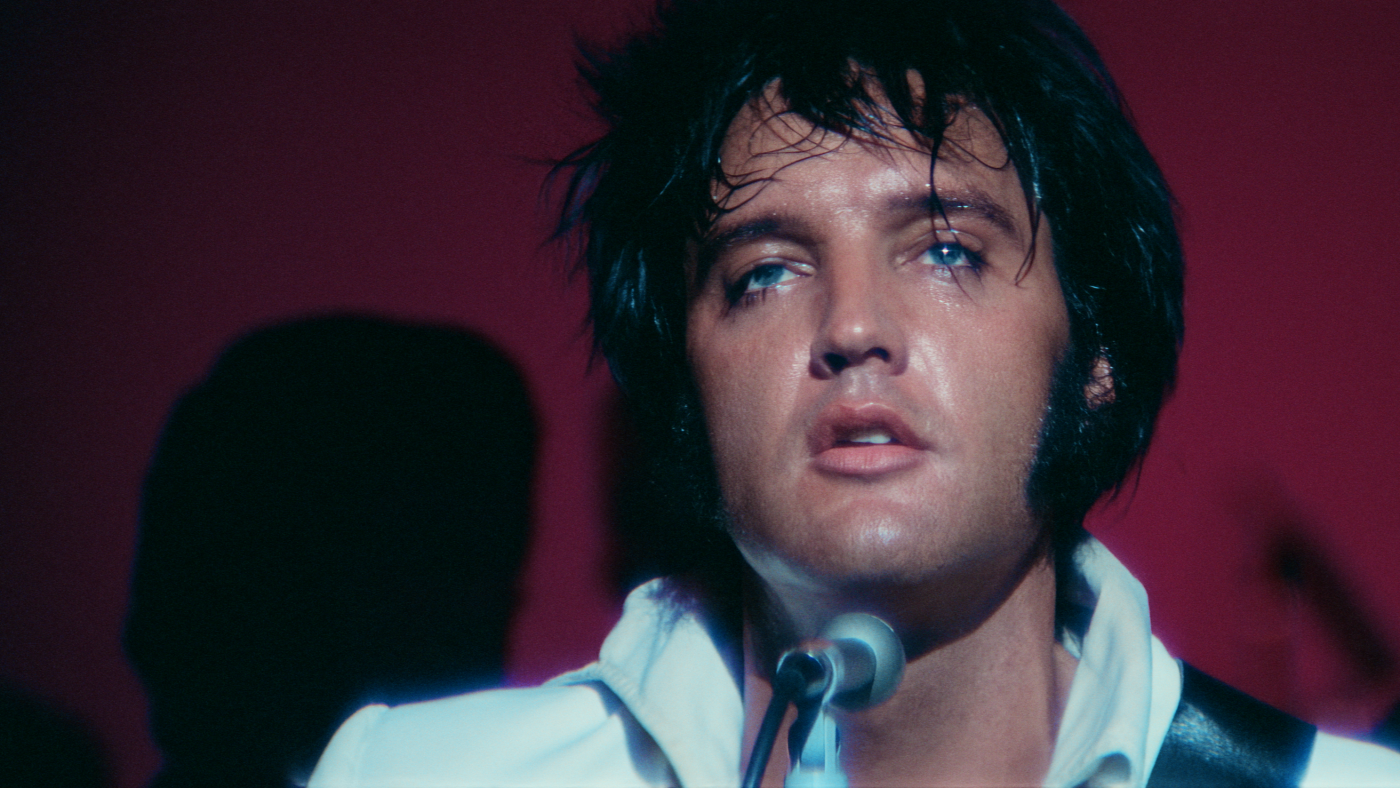
Baz Luhrmann will make you fall in love with Elvis Presley

Here’s your first look at Kratos in Amazon’s God of War show

State Dept authorizes non-essential US Embassy personnel in Jerusalem to depart ahead of possible Iran strikes

Where Iran’s ballistic missiles can reach — and how close they are to the US

Florida High School Football Rankings: Top 25 teams – Oct. 21

Cleary's 21 help Le Moyne down Central Connecticut State 69-64 in OT

How old is Bo Nix? What to know about Oregon quarterback ahead of 2024 NFL Draft

99th annual Pony Swim held in Virginia

Indiana Members Credit Union announced as new anchor tenant at Bottleworks District
Where Iran’s ballistic missiles can reach — and how close they are to the US

Has India’s influence in Afghanistan grown under the Taliban?

Bill Clinton to testify before House committee investigating Epstein links

Read Judge Schiltz’s Order

Vulnerable House Dem lashes out at Trump’s ‘racist’ SOTU challenge: ‘That was uncomfortable’
-

 World2 days ago
Exclusive: DeepSeek withholds latest AI model from US chipmakers including Nvidia, sources say
-

 Massachusetts2 days ago
Mother and daughter injured in Taunton house explosion
-

 Montana1 week ago
2026 MHSA Montana Wrestling State Championship Brackets And Results – FloWrestling
-

 Oklahoma1 week ago
Wildfires rage in Oklahoma as thousands urged to evacuate a small city
-

 Louisiana4 days ago
Wildfire near Gum Swamp Road in Livingston Parish now under control; more than 200 acres burned
-

 Technology6 days ago
YouTube TV billing scam emails are hitting inboxes
-

 Denver, CO2 days ago
10 acres charred, 5 injured in Thornton grass fire, evacuation orders lifted
-

 Technology6 days ago
Stellantis is in a crisis of its own making