Education
The Youngest Pandemic Children Are Now in School, and Struggling


The pandemic’s babies, toddlers and preschoolers are now school-age, and the impact on them is becoming increasingly clear: Many are showing signs of being academically and developmentally behind.
Interviews with more than two dozen teachers, pediatricians and early childhood experts depicted a generation less likely to have age-appropriate skills — to be able to hold a pencil, communicate their needs, identify shapes and letters, manage their emotions or solve problems with peers.
A variety of scientific evidence has also found that the pandemic seems to have affected some young children’s early development. Boys were more affected than girls, studies have found.
“I definitely think children born then have had developmental challenges compared to prior years,” said Dr. Jaime Peterson, a pediatrician at Oregon Health and Science University, whose research is on kindergarten readiness. “We asked them to wear masks, not see adults, not play with kids. We really severed those interactions, and you don’t get that time back for kids.”
The pandemic’s effect on older children — who were sent home during school closures, and lost significant ground in math and reading — has been well documented. But the impact on the youngest children is in some ways surprising: They were not in formal school when the pandemic began, and at an age when children spend a lot of time at home anyway.
The early years, though, are most critical for brain development. Researchers said several aspects of the pandemic affected young children — parental stress, less exposure to people, lower preschool attendance, more time on screens and less time playing.
Yet because their brains are developing so rapidly, they are also well positioned to catch up, experts said.
The youngest children represent “a pandemic tsunami” headed for the American education system, said Joel Ryan, who works with a network of Head Start and state preschool centers in Washington State, where he has seen an increase in speech delays and behavioral problems.
Not every young child is showing delays. Children at schools that are mostly Black or Hispanic or where most families have lower incomes are the most behind, according to data released Monday by Curriculum Associates, whose tests are given in thousands of U.S. schools. Students from higher-income families are more on pace with historical trends.
But “most, if not all, young students were impacted academically to some degree,” said Kristen Huff, vice president for assessment and research at Curriculum Associates.
Recovery is possible, experts said, though young children have not been a main focus of $122 billion in federal aid distributed to school districts to help students recover.
“We 100 percent have the tools to help kids and families recover,” said Catherine Monk, a clinical psychologist and professor at Columbia, and a chair of a research project on mothers and babies in the pandemic. “But do we know how to distribute, in a fair way, access to the services they need?”
What’s different now?
“I spent a long time just teaching kids to sit still on the carpet for one book. That’s something I didn’t need to do before.”
David Feldman, kindergarten teacher, St. Petersburg, Fla.
“We are talking 4- and 5-year-olds who are throwing chairs, biting, hitting, without the self-regulation.”
Tommy Sheridan, deputy director, National Head Start Association
Brook Allen, in Martin, Tenn., has taught kindergarten for 11 years. This year, for the first time, she said, several students could barely speak, several were not toilet trained, and several did not have the fine motor skills to hold a pencil.
Children don’t engage in imaginative play or seek out other children the way they used to, said Michaela Frederick, a pre-K teacher for students with learning delays in Sharon, Tenn. She’s had to replace small building materials in her classroom with big soft blocks because students’ fine motor skills weren’t developed enough to manipulate them.
Michaela Frederick, a pre-K teacher in Sharon, Tenn., playing a stacking game with a student.
Aaron Hardin for The New York Times Preschoolers do not have the same fine motor skills as they did prepandemic, Ms. Frederick said.
Aaron Hardin for The New York Times
Perhaps the biggest difference Lissa O’Rourke has noticed among her preschoolers in St. Augustine, Fla., has been their inability to regulate their emotions: “It was knocking over chairs, it was throwing things, it was hitting their peers, hitting their teachers.”
Data from schools underscores what early childhood professionals have noticed.
Children who just finished second grade, who were as young as 3 or 4 when the pandemic began, remain behind children the same age prepandemic, particularly in math, according to the new Curriculum Associates data. Of particular concern, the students who are the furthest behind are making the least progress catching up.
The youngest students’ performance is “in stark contrast” to older elementary school children, who have caught up much more, the researchers said. The new analysis examined testing data from about four million children, with cohorts before and after the pandemic.
Data from Cincinnati Public Schools is another example: Just 28 percent of kindergarten students began this school year prepared, down from 36 percent before the pandemic, according to research from Cincinnati Children’s Hospital.
How did this happen?
“They don’t have the muscle strength because everything they are doing at home is screen time. They are just swiping.”
Sarrah Hovis, preschool teacher, Roseville, Mich.
“I have more kids in kindergarten who have never been in school.”
Terrance Anfield, kindergarten teacher, Indianapolis
One explanation for young children’s struggles, childhood development experts say, is parental stress during the pandemic.
A baby who is exposed to more stress will show more activation on brain imaging scans in “the parts of that baby’s brain that focus on fear and focus on aggression,” said Rahil D. Briggs, a child psychologist with Zero to Three, a nonprofit that focuses on early childhood. That leaves less energy for parts of the brain focused on language, exploration and learning, she said.
During lockdowns, children also spent less time overhearing adult interactions that exposed them to new language, like at the grocery store or the library. And they spent less time playing with other children.
Kelsey Schnur, 32, of Sharpsville, Pa., pulled her daughter, Finley, from child care during the pandemic. Finley, then a toddler, colored, did puzzles and read books at home.
But when she finally enrolled in preschool, she struggled to adjust, her mother said. She was diagnosed with separation anxiety and selective mutism.
“It was very eye-opening to see,” said Ms. Schnur, who works in early childhood education. “They can have all of the education experiences and knowledge, but that socialization is so key.”
Preschool attendance can significantly boost kindergarten preparedness, research has found. But in many states, preschool attendance is still below prepandemic levels. Survey data suggests low-income families have not returned at the same rate as higher-income families.
“I have never had such a small class,” said Analilia Sanchez, who had nine children in her preschool class in El Paso this year. She typically has at least 16. “I think they got used to having them at home — that fear of being around the other kids, the germs.”
Time on screens also spiked during the pandemic — as parents juggled work and children cooped up at home — and screen time stayed up after lockdowns ended. Many teachers and early childhood experts believe this affected children’s attention spans and fine motor skills. Long periods of screen time have been associated with developmental delays.
Heidi Tringali, an occupational therapist in Charlotte, N.C., playing with a patient.
Travis Dove for The New York Times
Children are showing effects of spending time on screens, Ms. Tringali said, including shorter attention spans, less core strength and delayed social skills.
Travis Dove for The New York Times
Heidi Tringali, a pediatric occupational therapist in Charlotte, N.C., said she and her colleagues are seeing many more families contact them with children who don’t fit into typical diagnoses.
She is seeing “visual problems, core strength, social skills, attention — all the deficits,” she said. “We really see the difference in them not being out playing.”
Can children catch up?
“I’m actually happy with the majority of their growth.”
Michael LoMedico, second-grade teacher, Yonkers, N.Y.
“They just crave consistency that they didn’t get.”
Emily Sampley, substitute teacher, Sioux Falls, S.D.
It’s too early to know whether young children will experience long-term effects from the pandemic, but researchers say there are reasons to be optimistic.
“It is absolutely possible to catch up, if we catch things early,” said Dr. Dani Dumitriu, a pediatrician and neuroscientist at Columbia and chair of the study on pandemic newborns. “There is nothing deterministic about a brain at six months.”
There may also have been benefits to being young in the pandemic, she and others said, like increased resiliency and more time with family.
Some places have invested in programs to support young children, like a Tennessee district that is doubling the number of teaching assistants in kindergarten classrooms next school year and adding a preschool class for students needing extra support.
Oregon used some federal pandemic aid money to start a program to help prepare children and parents for kindergarten the summer before.
For many students, simply being in school is the first step.
Sarrah Hovis, a preschool teacher in Roseville, Mich., has seen plenty of the pandemic’s impact in her classroom. Some children can’t open a bag of chips, because they lack finger strength. More of her students are missing many days of school, a national problem since the pandemic.
But she has also seen great progress. By the end of this year, some of her students were counting to 100, and even adding and subtracting.
“If the kids come to school,” she said, “they do learn.”


In our national memory, George Washington is a mythic figure, cast in metal, carved in stone. His leadership, first as general, then as president, is so intertwined with the roots of this country that it is sometimes hard to separate the man from the idea of America. How does one imagine the living presence of such an icon, much less embody him?
There is a small fraternity of men bold enough to try. At historical parks and commemorations from Virginia to Seattle, these interpreters (their preferred term) transform themselves into Washington. Each has his own approach, but what all their representations seek to capture is a legacy that has endured from his time to ours. If America, at least in part, is an idea, then our national project becomes, like theirs, an act of interpretation, an imperfect attempt to translate some idealized vision into the messy reality of our own time.
— Ezekiel Kweku
“By some strange quirk
of genetics, I have
Washington’s exact
dimensions. Where my
sleeves fall on my wrist,
the size of my chest, the
size of my thighs, where
the breeches fall to my
knees, are all identical.”
John Koopman, 67, often performs
while riding his horse, Bear. He
has portrayed Washington for 20 years.
James Fryer, 70, wears a replica of a general’s uniform that Washington designed himself. He recently completed training to portray Washington for the nonprofit Historic Philadelphia.
“Some people portray George as a marble statue. I don’t do a marble George. I am interested in talking to everyone, even those who yell at me because George was a slave owner. I want to respect them, try to educate them, or maybe even inspire them.”
Vern Frykholm, 77, was moved to bring his interpretation of Washington to Washington State, where he lives, after seeing a 2011 performance in Pennsylvania.
Dean Malissa, 73, signs his personal
correspondence, including emails,
as Washington did: “Your Most Humble
and Obedient Servant.” He became
the Official George Washington
at Mount Vernon in 2004, and held
that role for nearly 20 years.
“I describe him sometimes as just a dude. I look at him and think, I could see myself in the same world, making similar bad decisions or similar good decisions.”
Daniel Cross, 39, portrayed a young Washington at Virginia’s Colonial Williamsburg until last year. He now works with organizations around the country.
Curt Radabaugh, 62, has 13,000 history books in his personal library, including several hundred about Washington. He is a veteran of the U.S. Marines and a retired police officer.
“He’s a mentor, a father
figure, and not only in the
sense that he’s a patriarch
of the country. Because
I grew up without a
father, he kind of became
my surrogate father.”
Brian Hilton, 58, says he researches
Washington’s era every morning before
his children get up and at night after
they go to bed. He is a high school history
teacher near Richmond, Va.
Daniel Shippey, 57, partners on interpretations with his wife, Kelly, who portrays Martha Washington. Kelly researched 18th-century hair techniques to create her husband’s costume hairstyle. They live in Virginia.
“You’re playing the myth of George Washington as well as the historical figure. I make his voice a little firmer and deeper than it probably was in real life. I play him a little funnier than he probably was. In reality, if you came to see him, he probably wouldn’t talk to you as much as I do.”
Doug Thomas, 53, is Washington’s second cousin nine times removed.
John Godzieba, 67, has reenacted
the crossing of the Delaware as
Washington every Christmas for the
past 16 years at Pennsylvania’s
Washington Crossing Historic Park.
“In many ways I don’t look like him. My eye color is wrong. My nose is wrong. My hair color is wrong. I wouldn’t have cast myself in this role.”
Ron Carnegie, 64, has portrayed Washington at Colonial Williamsburg for 20 years.
Ryan Williams, 37, is a veteran who specializes in playing a young Washington during the French and Indian War. He lives in Virginia.
“Some people portray
Washington almost
like a superhero.
I like to bring out that
he has faults. He’s a
person like you or me.”
Michael Grillo, 64, is a historical
tailor who hand-sews his own clothes
for reenactments. He also makes
period props, including two American
battle flags and pewter mugs
engraved with Washington’s crest.
Martin Schoeller is a photographer and director known for his close-up portraits of everyone from world leaders and celebrities to female bodybuilders. For this project, he used a large format camera to photograph 13 historical interpreters of George Washington — many of whom arrived in full uniform — over three days in Virginia and New York City.
Additional reporting by Tenzin D. Tsagong. Interviews have been edited and condensed for length and clarity. Top quotes from Brian Hilton, Daniel Shippey and Daniel Cross.
Produced by Sara Barrett, Danny DeBelius and Sam Whitney. Additional production by Olivia James.
One task the robots can take from us? Cleaning. Especially hard-to-access windows. So when writers Caroline Mullen and Evan Dent found this little guy — whose government name is “EcoVacs Winbot Mini” — they were intrigued. Could he clean the uncleanable? Caroline and Evan put their robot friend to the test at both the Wirecutter office and a high-rise apartment. Is a robo-window cleaner more effective than scrubbing yourself?

new video loaded: School Year Cut Short and Aid Delivery Slowed Amid Fuel Crisis in Cuba

By McKinnon de Kuyper
June 22, 2026
-
 Lifestyle30 minutes ago
10 new books you won’t want to miss in July
-

 Technology41 minutes ago
Discord accidentally banned over 8,000 people for posting grids and other ‘benign’ images
-

 World46 minutes ago
Video shows bomb rock Damascus hotel where French President Macron is staying during Syrian state visit
-

 Politics53 minutes ago
Trump could hand prized stealth jets to NATO ally once seen as alliance headache
-

 Health55 minutes ago
Common gym supplement could help fight depression, new research suggests
-

 Sports1 hour ago
SJSU was told of decades-old allegations against volleyball coach during controversial 2024 season
-
 Business1 hour ago
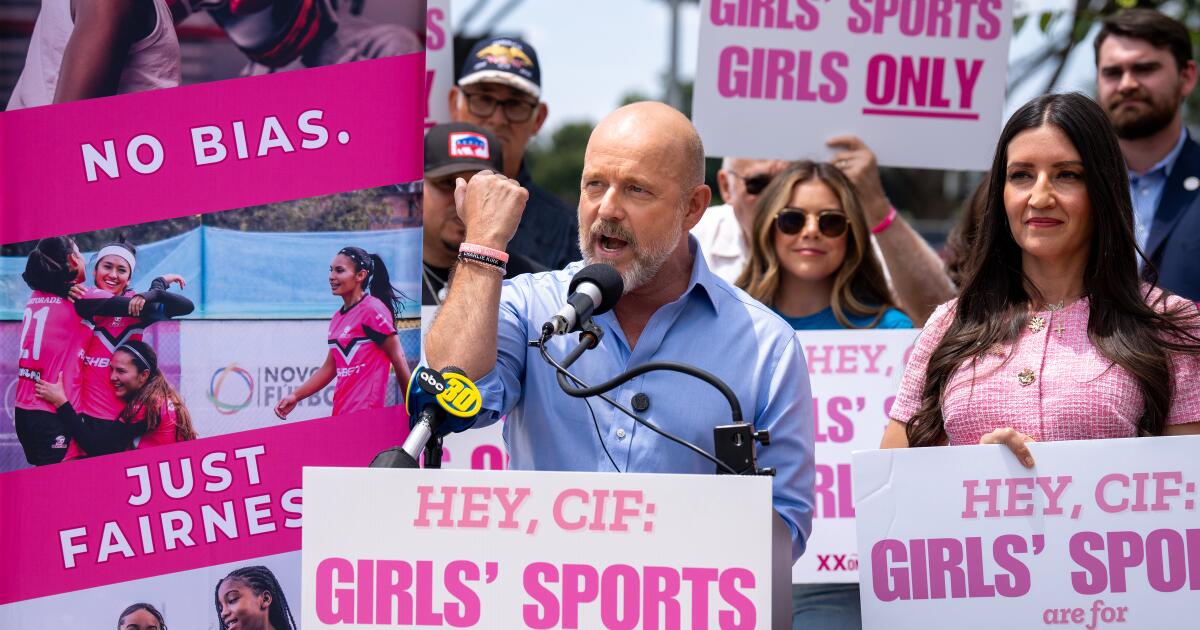
Commentary: How right-wing anti-transgender attacks led to a Supreme Court ruling upholding sex discrimination
-
 Entertainment1 hour ago
Even if you know his crowd work clips and not his name, comedian Jeff Arcuri is ready to meet you

