Entertainment
Brenton Wood, 'Oogum Boogum Song' crooner who captivated Latino listeners, dies at 83

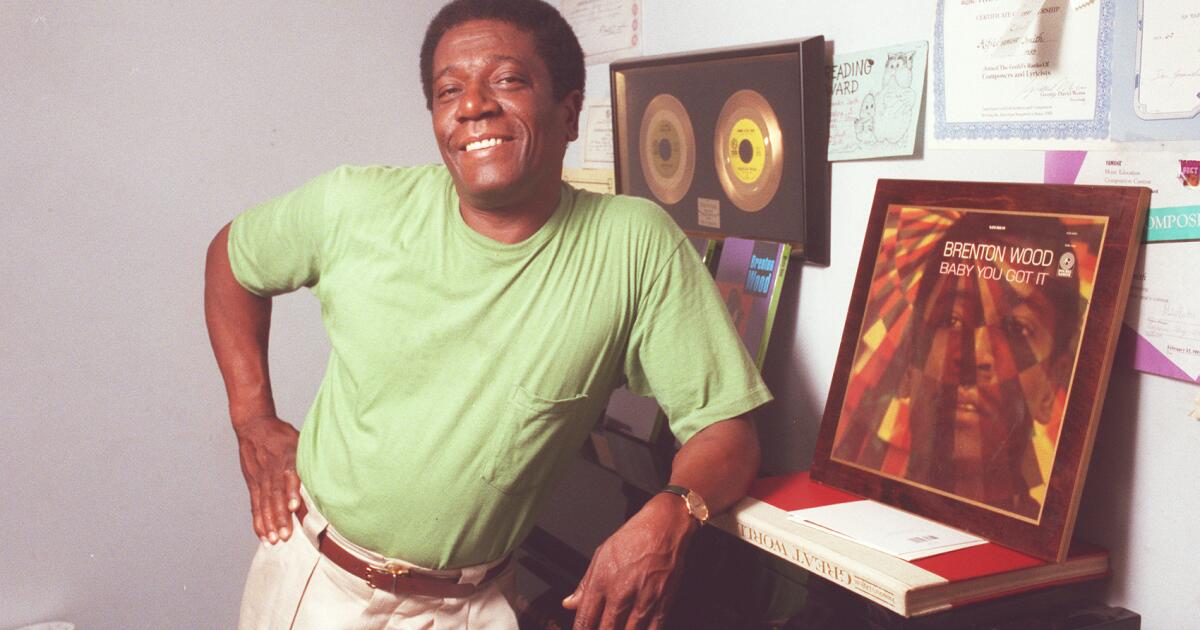
In 1967, Brenton Wood looked as if he was on the cusp of mainstream success.
The Compton crooner’s single “The Oogum Boogum Song” became a hit and ranked 34th and 19th on the Billboard’s Hot 100 and Top Selling R&B Singles charts, respectively. A few months later, Wood debuted his second hit, “Gimme Little Sign,” which peaked at No. 9 on Billboard’s Hot 100.
Wood, who was born Alfred Jesse Smith, died Friday of natural causes at his home in Moreno Valley, his manager and assistant Manny Gallegos confirmed to Variety. He was 83.
Wood’s slinky and upbeat tunes are infectious. His seductive and affable manner of describing the essence of a budding romance in layman’s terms is inviting. Whether solo or with a partner, it’s easy to groove to the beat.
Wood continued releasing tracks but none ever garnered similar success. Frustrated with the music industry, he quit for a couple of years, then inched back onto the club circuit. There, he found an audience that would sustain him for decades: Latinos.
He would play major California cities, then travel through Mexico and into Arizona before returning home. As his audience aged, Wood began to perform on themed cruises and at festivals with Chicano musical luminaries including Los Lobos, Thee Midniters and Ozomatli. Wood’s romantic oldies resonated with a new generation of lovebirds, becoming a soundtrack of Southern California life — literally, as Wood found a third career as a performer at weddings, quinceañeras and anniversary parties.
Bob Merlis, a former executive for Warner Bros. Records and co-author of “Heart & Soul: A Celebration of Black Music Style in America 1930-1975,” described the artist as a “local hero” to L.A. — a “standard bearer for the Southern California pop soul scene.”
“Nothing else sounded like them,” said Merlis, who now runs a public relations and consulting firm. “It was so different and that instrumentation is very unusual.”
“They’ve kind of picked me out of the whole batch, and they keep me going,” Wood told The Times in 1992. “I appreciate it, because if I was waiting for the big boys to call, I’d have died a long time ago.”
Wood’s lyrics captured the cat-and-mouse chase of a first love, the kind of infatuation that makes people act a fool. He encapsulated that all-too-familiar yearning to whisk away a lover to bask in their honeymoon paradise. But he also wrote about heartache — and the triumphant moment when the pain wears off.
“Latinos like to dedicate songs, and his songs are good for that,” radio veteran Art Laboe told The Times in 1992. “It’s not the big hits they like. It’s songs like ‘Take a Chance,’ ‘I Think You’ve Got Your Fools Mixed Up’ — if a girl’s having trouble with her boyfriend, she’ll dedicate that to him.”
The songwriter was born July 26, 1941, in Shreveport, La., and moved west to San Pedro when he was 3. He moved throughout L.A.’s inner cities, selling papers and fish and shining shoes until he created a career in the music industry.
Wood was 7 when a pianist mesmerized him. Without a television set at home, he spent hours at the park, watching and mimicking the performer, using two fingers to tap on imaginary keys until he got his own piano. At 10, Brenton Wood wrote his first song about a man who wanted to be a bird. It was cheerful and rhymed but lacked oomph.
He found his groove when he met his first girlfriend. Then, the words flowed out.
The Compton High School graduate enrolled at East Los Angeles College and sang in local R&B groups such as Little Freddie and the Rockets and the Quotations in the 1950s before he went solo. He took on his stage name, Brenton Wood, from the wealthy L.A. enclave of Brentwood, where a manager lived.
Wood’s “The Oogum Boogum Song” came entirely by accident. He was working the graveyard shift at Harvey Aluminum in Torrance when the melody came to him.
“It took me about six weeks, because I had to switch the verses around about a hundred times,” he told the San Diego Union-Tribune in 2000. “That was a song about fashion changes in the ’60s with bell-bottom hip-huggers and high-heeled boots and all the different styles of clothes the girls were wearing — hot pants and all that stuff.”
The bouncy track was later featured in Cameron Crowe’s “Almost Famous” and Olivia Wilde’s “Don’t Worry Darling.”
“It was one of the best feelings you could have,” Wood told Cal State Fullerton’s Titan TV in 2014.
By 1970, he founded Mr. Wood Records and produced other artists’ singles. Latino listeners were already embracing him as one of their own.
Chicano music historian Gene Aguilera recalls being “glued up” to his little transistor radio as a teen, listening to Wood’s “Gimmie Little Sign” mixed in with the Beatles and the Supremes on KRLA-AM 1110 all within an hour. Walking his neighborhood, he would hear Wood’s voice along with Thee Midniters wafting in the background, emanating from nearby parties or from lowriders cruising down Whittier Boulevard, bumping his tunes.
“Even though he wasn’t born here, he’s just forever going to be etched in our consciousness,” said Aguilera, who last saw the artist perform at a local park in Baldwin Park before the pandemic.
“His music was really accepted by East L.A. because of the slow groove he’s got, very soulful, that people from East L.A. just love.”
Vega is a former Times staff writer.

Movie Reviews
‘Night Nurse’ Review: A Caretaker Explores Her Kink for Elder Abuse in the Year’s Strangest Erotic Thriller

There are any number of erotic thrillers in which rich old men are robbed blind and/or left for dead, but Georgia Bernstein’s admirably bizarre “Night Nurse” might be the first movie of its kind where elder abuse is the source — and possible subject— of its erotic thrills. If there are others, I’m not sure I want to know.
But this woozy debut feature doesn’t rely on its audience being turned on by the relationship between a nubile caretaker and her dementia-addled patient. Their psychosexual bond, meanwhile, hinges on cold-calling vulnerable old people under the guise of a grandchild in financial distress. (“I’m in trouble, nana, send me $10,000 or I’ll be left to rot in jail!” That sort of thing). With its slim wisp of a premise stretched into a Strickland-esque dreamscape that substitutes kink for conflict, the film itself hardly seems convinced by its own wrinkled lust — all desperate kisses and non-touching poses of subservience. More important to Bernstein is what that lust reveals about her characters’ deepest needs, specifically how their need to care and be cared for can be as easily perverted as any other form of desire.

As moody and weightless as the noir-accented score that blows through the movie like a curlicue gust of wind in an old cartoon (credit to musicians Sam Clapp and Steven Jackson), “Night Nurse” lacks the pulse required for its stray feelings to come alive. Still, the film ambiently taps into the latent eroticism of teasing out the distance between how you see yourself and who you really are. Bernstein plays with that distance like a telephone cord wrapped around her fingers, and Eleni — played by the excellent newcomer Cemre Paksoy, powerfully helpless — only frays even more as the receiver is brought near the hook. “Everything I did before today wasn’t me,” the nurse tells co-worker Mona (Eleonore Hendricks) after starting a new job at an Illinois retirement home. “It was somebody else.”
What she did before today remains unexplored (specifically, what she did to get herself fired from her last gig), but I’m guessing she’s probably changed less than she thought. There’s a faraway flicker in her eyes the moment she catches the vibe between Mona and Douglas (a ribald and elusive Bruce McKenzie), a white-haired seventysomething who shows early signs of dementia but still commands an undiminished sexual energy. “I’m not an invalid,” he coos as Mona bathes him in the tub, to which she replies, “yes, you are,” in a supplicant tone that hints at a rich history of power games between them.
Later that same night, Douglas will force Eleni to call a stranger, pretend that she’s their granddaughter, and ask for money — he’ll wrap the phone cord around the nurse’s body as she talks and shove her against the wall as they kiss. She’s into it. So into it that he has to clarify the terms of his whole deal: “If you’re looking for a pogo stick, I’m really not your guy.” But Eleni isn’t looking for anything to bounce on. She just wants to be needed, and maybe to need someone in return. Someone who will see her for who she really is and allow her the fantasy of pretending she isn’t being herself when she cons vulnerable strangers out of their money — when she exploits how enthralled those strangers are by the care they have for their loved ones.
“Night Nurse” doesn’t belabor the psychology, as Bernstein prefers to express her story through heavy-lidded suggestion. Somnambulating from the moment it starts, the film moves through a series of beautifully arranged poses that stretch their latent meaning thin across the surface (Lidia Nikonova’s cinematography lacquers every shot with a seductive dreaminess). We see Douglas smoking in a lawn chair with Mona and Eleni curled around his feet. Eleni riding in the backseat of a convertible as the wind blows through her curls. The full staff of nurses — all of them under Douglas’ sway — stumbling around his condo in a state of zonked out bliss as they roll on the prescription drugs they’ve stolen from the residents.
Once you’ve seen one shot of this movie, you’ve practically seen them all, at least until things escalate during a rushed and unsatisfying third act that forces Eleni into an honest confrontation with herself. People will do just about anything to feel needed — they’ll give whatever degree of care allows them to receive it in return. “Night Nurse” understands that desire, but remains far too numb to treat it.
Grade: C+
The Independent Film Company will relase “Night Nurse” in theaters on Friday, July 10.
Entertainment
Lucas Museum to give free annual passes to South L.A. neighbors, host community preview day

The Lucas Museum of Narrative Art, which is moving at light speed toward its Sept. 22 opening, announced Thursday that it will give free annual passes to its South L.A. neighbors living in the 90037 ZIP Code. The 300,000-square-foot, $1-billion museum located in Exposition Park will also host a special community preview day on Sept. 13, more than a week before the general public gets to step inside.
The 90037 ZIP Code has a population of more than 65,000 and is bordered roughly by the 110 Freeway to the west, Slauson Avenue to the south, Central Avenue to the east and Martin Luther King Jr. Boulevard to the north. Residents can register for passes at lucasmuseum.org/lm37 and will be alerted in August when the program launches. Pass holders can reserve tickets for themselves and one guest.
Tickets for non-pass holders go on sale July 21. They cost $25 for adults and $21 for seniors. Kids 17 and under are free.
“Storytelling has the power to bring people together and create a sense of community,” said Lucas Museum Chief Executive Tracey Bates in a news release about the program. “Through LM37, we are inviting our South Los Angeles neighbors to make the museum part of their lives and take their own path of discovery through the art, programs and experiences that will help shape this new cultural hub for Los Angeles.”
The community preview day is designed to give local business owners, community partners, civic leaders and registered LM37 pass holders a sneak peak of the 10,000 square feet of exhibition space, as well as the expansive gardens with 11 acres of park space.
The opening programming, curated by co-founder George Lucas, features 20 inaugural exhibitions across more than 30 galleries, including one titled “Star Wars in Motion,” containing vehicle designs, high-speed racers, flying vessels, props, costumes and illustrations from the first six films in the beloved franchise.
More than 1,200 objects will be on display from Lucas’ personal collection of narrative art. Highlights include work by Norman Rockwell and Dorothea Lange, as well as a variety of manga, children’s book illustrations and comics.

Last year’s “Superman” ended with Iggy Pop singing “Because I’m a punk rocker, yes I am” — an ironic coda for a superlatively square hero. But it rings straightforwardly true for Superman’s cousin.
Milly Alcock’s Kara Zor-El, or Supergirl, sports not a spandex suit but a Blondie T-shirt. When we meet her in Craig Gillespie’s “Supergirl,” she’s been on an interstellar bender for days. She’s more Courtney Love than Clark Kent.
Nonchalant and sarcastic, Kara is also a little Han Solo-ish, you might say, given that she moves capriciously through the galaxy in her junky spaceship while getting in fights in extraterrestrial bars. She’s a welcome, jagged riff on more buttoned-up superheroes, and Alcock is terrific in the role. If only “Supergirl” was as good as she is.
While the latest DC release, and second under James Gunn’s stewardship, has its moments, “Supergirl” struggles to match Kara’s punk-rock energy with an equally spirited supporting cast and story.
Skepticism seems to have gathered for “Supergirl” ahead of its release. Many fans have argued it wasn’t the right next step for DC Universe. But I’m not so sure. Alcock’s breezy cameo in “Superman” was one of that movie’s highlights. Handing the follow-up to her, and her faithful floating dog Krypto, strikes me as an extremely natural next step. When in doubt, follow the dog.
And much of “Supergirl” is winning. It resides almost entirely in space, touching down only momentarily on Earth. In its consistently creative production design, clever needle drops and underdog story arc, “Supergirl” resides a little closer to Gunn’s “Guardians of the Galaxy” movies than other DC entries. Its outer space is filled with cosmic detritus, mean characters and cute critters. Seth Rogen as the voice of a tiny alien co-piloting a space bus is an inspired concoction, as is a shabbier sci-fi realm with rest stops along the intergalactic highway.
-

 Los Angeles, Ca35 minutes ago
California teen e-biker baiting police to chase tracked by drone, arrested
-

 Detroit, MI54 minutes ago
Our picks for state\nSenate from Wayne Co. | Endorsements
-

 San Francisco, CA1 hour ago
Man reported missing in San Francisco
-

 Dallas, TX1 hour ago
How to buy France World Cup semifinal soccer tickets in Dallas
-

 Miami, FL1 hour ago
Miami-Dade Schools names six semifinalists for superintendent
-

 Boston, MA1 hour ago
Lawsuit: ICE detained East Boston father despite legal status
-

 Denver, CO1 hour ago
Victor Marx wins GOP primary for Colorado governor, defeating veteran lawmaker after unorthodox campaign
-

 Seattle, WA2 hours ago
Widower of pregnant woman who was shot to death in Seattle sues homelessness authority

