Alaska
Arctic air and gusty winds keep Alaska cold


ANCHORAGE, Alaska (KTUU) – Clear and cold, with winter winds added in will be the weather across much of mainland Alaska as the workweek ends and the weekend begins. And that will make for a very cold start to March!
An Arctic airmass has been moving south across the state over the last several days. Below-zero temperatures returned with the frigid airmass, with the coldest temperatures hitting the Interior. In parts of the Alaska Range, a wind chill advisory is in effect for wind chills of 50 to 60 below zero.
Wind chills will be very low in the highway area of Thompson Pass, which is under travel restrictions. The pass was closed to traffic at 6 p.m. Thursday. Updates from the Alaska Department of Transportation are expected at 8 a.m. Friday.
Winds were strong over Southcentral and will remain strong through the end of the week. Seward saw a gust up to 60 mph, Palmer at 53, and in Seldovia, a gust of 49 mph.
A new storm that will impact the state early next week is already over western Aleutians.
Bundle up, winter still has some attitude!
Copyright 2024 KTUU. All rights reserved.





Alaska
‘He’s truly a legend in Alaska and beyond’: Loved ones remember Dick Griffith ahead of AK Sports Hall of Fame induction

ANCHORAGE, Alaska (KTUU) – In June, his life of adventure and innovation will be immortalized in the Alaska Sports Hall of Fame. But on Tuesday, it’s the memories he formed with countless others that earned its moment in the spotlight.
Dick Griffith, a man known for his epic nature exhibitions and an early user of the packraft, was honored at the Anchorage Museum earlier this week. It was a time for friends and family to reminisce about the near-century long outdoorsman.
“It was really moving for me,” former Alaska Mountain and Wilderness Classic runner and longtime friend of Griffith, Roman Dial, said. “I tried just to give a straight description of his life, like a bare bones, and it was hard not to weep a little bit because he meant a lot to me.”
Dial met Griffith in 1982, just before the first ever running of the classic. That interaction led to many lessons.
“I met him when I was at an influential age and he kind of changed my whole perspective about how to travel through the wilderness,” Dial said.
Dial was one of many Griffith appeared to impact in his 98 years on planet Earth. During the two-hour ceremony, which Dial led in organizing, several different individuals took the time to speak about him. Those stories ranged from surviving multiple bear encounters in the Alaska bush to simple meetups at the Eagle River Nature Center, of which Griffith was a big supporter.
Years later, those same people will soon see Griffith’s legacy remembered forever. Speaking with AK Sports HOF Executive Director Harlow Robinson in December, he said the legacy Griffith leaves behind was immense.
‘He’s truly a legend in Alaska and beyond both for his arctic exploration and being the first person to trek the arctic coast of North America and he’s got an amazing history pre-Alaska of white water rafter and river exploration,“ he said. ”He lived to be 98 years old and never slowed down until the end of his life.”
His accomplishments include traversing over 10,000 miles by foot and raft throughout his life. His longest trek, a 4,000-mile journey from Unalakleet to Hudson Bay in Canada, took nearly 12 years and almost a dozen annual trips.
“He imagined things that he would do and then he went and did them,” Dial said. “He didn’t look to see what other people did.”
Now just months out from that and many accomplishments being put in the public eye, Dial said the takeaways from Griffith’s experiences are universal.
“I hope that they take away not just the keep moving idea, but like to build a community and stay in touch with your community and to include people in what you do. But on the other hand, feed your own soul in whatever way it takes. I think he was really good at that,” Dial said.
He was a man remembered for time on the trail and his compassion to those he kept dear.
“He was affectionate, like in his own way. he cared about you,” Dial said. ”I’m not a big believer in the afterlife, but if there is one, you know, he’s up there with a big grin on his face, loving every minute of it.”
See a spelling or grammar error? Report it to web@ktuu.com
Copyright 2026 KTUU. All rights reserved.

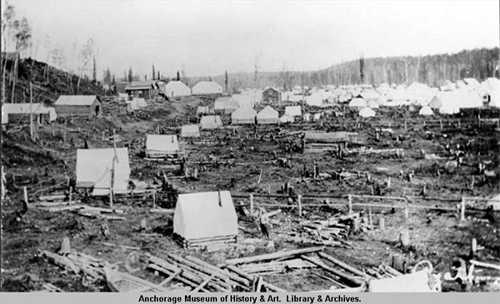
It was 111 years ago today that Anchorage began as the largest Alaskan city it is at present.
It was April 9th, 1915 that President Woodrow Wilson made his final decision as to the route of the Alaska Railroad from Seward to Fairbanks. The route led to the move of the headquarters from Seward to the tent city at Ship Creek in Anchorage, causing a boom in the area’s population.
2,ooo individuals from the Knik area scrambled to the Ship Creek area at first word of the railroad construction and this lawless, muddy area quickly became the foundation of the city of Anchorage.
The tent city would dissolve a mere three months later when 600 fixed lots were auctioned off on the bluffs above the creek and the townsite of Anchorage was formed.

The 2026 Traditional Games begin in the capital city on Friday. Around 200 participants from around the state and at least three other countries will compete through Sunday at Juneau Douglas High School: Yadaa.at Kalé.
The free event is co-hosted by the Central Council of the Tlingit and Haida Indian Tribes of Alaska and Sealaska Heritage Institute, with an opening ceremony featuring a parade of the athletes Saturday at 12:30 p.m.
KTOO’s Mike Lane spoke with coach, competitor and co-founder Kyle Kaayak’w Worl to learn about the importance of the games and what’s new this year.
Listen:
The following transcript has been lightly edited for clarity.
Mike Lane: What exactly are the games?
Kyle Worl: So the event has a collection of Indigenous games, and they’re mostly from the north, the Arctic. So you have the high kicks that are traditional Iñupiaq or Inuit games. We have stick pulls from the Interior Dene people. But this year, we’ve kind of broadened the perspective of traditional games and we are also including some traditional games in the form of workshops from our guests from New Zealand and Mexico. And then we have some canoeing activity as well, which is canoeing is one of our traditional forms of games here in Southeast as well.
Mike Lane: How many events are there in total?
Kyle Worl: There are 12 competitive events where you can medal in. They hold cultural significance.
The seal hop is a game that is based on a hunting technique that was used in the Arctic to sneak up to seals laying out on the ice flow. And back when harpoons were used, you had to be able to get in range to hand throw that harpoon, and simply walking up to the seal wouldn’t work, you’d scare it off and it would jump back in the ocean. So the hunters developed a technique to hop like a seal to sneak up to the seal, and that’s what this game is based on. You’re in a like a push-up position on your hands and toes, and you have to hop for the greatest distance and the furthest distance places in the game, and it’s a game of both endurance and also pain tolerance. You’ll see the athletes, they’ll sometimes break skin as they hop on their their knuckles. It depends on the age groups — high schoolers, boys, they hop on their first knuckles, but the adults that compete have to hop on a closed fist. So we’ll see some pretty battered hands with broken skin as they go along the gym floor.
Mike Lane: You’ve got people coming from all over the world to compete and also put on some workshops.
Kyle Worl: Yeah. So this event has grown every year, and it’s, we always say, what can we do next year to bring it to the next level? And we wanted to bring a more international perspective to the games, because we know there’s there’s traditional games from all across the world. So we have teams from New Zealand and Mexico. Even Labrador in far eastern Canada is coming. So it’s very much a sporting event, but it’s also a cultural exchange, and that’s a really important aspect of this, is our sports are connected to our culture, and we want to make this an opportunity to learn from each other and learn about the variety of Indigenous games. So on Friday, we’ll have workshops with our Maori guests and our Mexican athletes. I know the Mexican workshop is an Aztec hip ball game where they have a, I think it’s like a 10 pound rubber ball that you hit with your hips. It’s been highlighted in movies like “El Dorado” and such, that’s where I first heard about it.
But it’s pretty cool to think that after all these years, we’re having these international guests come to our event, that it’s really grown into something pretty amazing. So we’re pretty excited.
Mike Lane: Who participates. I mean, is there an age range?
Kyle Worl: The minimum age is 11, and we have three age categories. We have middle school — which is sixth, seventh and eighth — high school, ninth through 12th. And then we have an open adult category.
Mike Lane: So 11 years old is the Youngest and what’s the oldest?
Kyle Worl: Because we have an adult division, some of the coaches of these high school teams also sign up. I’m not sure who the oldest is, but I’m sure there’s going to be a few people in their 40s, maybe older.
Mike Lane: So there’s no ceiling?
Kyle Worl: No upper age limit. You’re never too old to do the games. And I always say there’s a game for everyone. They’re not all about jumping and kicking, which may get harder with age. We have games like the Dene stick pull, which is a technique based game, and it’s based on grabbing a salmon out of the water. So it’s, it’s more about balance and technique. We have archery too, and there’s a lot of skill to it but it’s not something that’s going to hurt your leg.
Mike Lane: And there’s artwork.
Kyle Worl: Yeah. So we’re really lucky that Corinne James agreed to design our 2026, shirts, and she did a formline design of Nalukataq, which is the blanket toss from the Iñupiaq people. And she did her interpretation in formline. It’s a really beautiful design. It’s going to be on all of our shirts. We have a pin made of it. So we’ve been really lucky to get really amazing Southeast Tlingit, Haida, Tsimshian artists to provide us art each year.
Mike Lane: Kyle, thanks for your time.
Kyle Worl: Thank you.

Kitchen of Kindness: A local nonprofit in Northern Nevada aims to feed those in need

Meditation In Merrimack | Paddle Plunge | Debo Ray Performs | Antiques Road Show: NH Patch Weekender

New Jersey 12th Congressional District Primary Debate: A Student-Led Forum – Insider NJ

Route 66 Visitors Center hosts free New Mexico concert series in Albuquerque

2026 DI men’s ice hockey championship: Bracket, schedule, scores

Florida High School Football Rankings: Top 25 teams – Oct. 21

How old is Bo Nix? What to know about Oregon quarterback ahead of 2024 NFL Draft

Cleary's 21 help Le Moyne down Central Connecticut State 69-64 in OT

99th annual Pony Swim held in Virginia

Indiana Members Credit Union announced as new anchor tenant at Bottleworks District

Rep Randy Fine joins House Freedom Caucus: ‘Strongest group of conservative patriots in Congress’

Trump issues NATO ultimatum to reopen Strait of Hormuz ‘within days’

Women are getting most of the new jobs. What’s going on with men?

Video: How Trump’s Advisers Felt About Going to War With Iran

Unearthed clip exposes shocking claim by Newsom’s wife about inmates at violent California prison
-

 Atlanta, GA5 days ago
1 teenage girl killed, another injured in shooting at Piedmont Park, police say
-

 Education1 week ago
Video: We Put Dyson’s $600 Vacuum to the Test
-

 Movie Reviews1 week ago
Vaazha 2 first half review: Hashir anchors a lively, chaos-filled teen tale
-

 Georgia3 days ago
Georgia House Special Runoff Election 2026 Live Results
-

 Education1 week ago
Video: YouTube’s C.E.O. on the Rise of Video and the Decline of Reading
-

 Pennsylvania4 days ago
Parents charged after toddler injured by wolf at Pennsylvania zoo
-

 Education1 week ago
Video: Toy Testing with a Discerning Bodega Cat
-
 Milwaukee, WI4 days ago
Potawatomi Casino Hotel evacuated after fire breaks out in rooftop HVAC system