Politics
Commentary: Wipe out a ‘civilization’? Minor stuff compared with what just happened in AI


While many of us were worried in recent days about our president ending a “whole civilization,” one Silicon Valley tech company was warning, without much notice, it might accidentally disrupt all civilization as we know it.
The San Francisco technology company Anthrophic announced Tuesday that it wasn’t releasing a new version of its Claude AI super-brain — because it is so powerful that it has the ability to hack into just about any computer system, no matter how secure, in a matter of days if not hours.
“The fallout — for economies, public safety, and national security — could be severe,” Anthropic said in a statement.
AI worry isn’t anything new. We are worried about artificial intelligence taking jobs, about toys that seem too real to our kids, about mass surveillance of our every move. But Anthropic’s warning about its own product is bigger than any of those singular problems. It is a call from inside the house that disaster is hiding right around the corner. That sounds awfully dire and overblown, I know. But here’s the thing — it’s not.
Anthropic, you may recall, is the company that U.S. Secretary of “War” Pete Hegseth is beefing with because it didn’t want Claude going into battle without supervision and maybe doing something like accidentally bombing little girls at a school.
Now, that company has put out this chilling warning: The existing Claude that caused that kerfuffle is outdated and shockingly less powerful than the new one it’s trying very hard to not unleash — though this new Claude, dubbed Claude Mythos Preview, has already escaped at least once on its own. More on that in a moment — there’s only so much existential dread a person can handle.
“We should all be worried,” Roman Yampolskiy told me of this latest advance of a technology certain to change the course of humanity. He’s one of the country’s preeminent AI safety researchers, and a professor at the University of Louisville in Kentucky.
“We’re about to create general super intelligence and that threatens humanity as a whole,” Yampolskiy said.
“Everything else is irrelevant,” he added, before suggesting I stop calling myself an idiot for not understanding the tech-heavy parts of this debate. My simplistic take, he assured me, was “a reasonable way to explain it.”
So here you go.
This isn’t a “really smart computer geniuses could misuse this,” scenario, or an “everyone’s going to be unemployed” scenario, or even a “it might accidentally bomb children” scenario, which is a truly terrible scenario.
This is a “your teenage son could use it to break into the local school district system to change a grade with pretty much minimal knowledge and accidentally destroy the California power grid” scenario.
Or maybe, a country that doesn’t like us — I can think of a few — could drain every U.S. citizen’s bank account, while also clicking open the auto locks on jail cells, shutting down our sewage plants and taking over air control systems. Or maybe Claude Mythos just does that on its own.
For example, Anthropic said that in one popular operating system it tested, used by thousands of companies including Netflix and Sony, Claude Mythos found a flaw that had existed undetected for 17 years. Then, on its own — without human guidance or help — figured out how to use that flaw to take control of any server running the operating system, using any computer, anywhere in the world.
Just spitballing here, but if almost no security system is safe, the possibilities for social, financial and general chaos really are unlimited. And to be honest, any security expert will tell you that some of America’s greatest weak points when it comes to cybersecurity are local and state governments, because strangely, the top experts aren’t working five-figure jobs for cities in the Great Plains.
Based on its own testing, Anthropic predicts it could find “over a thousand more critical severity vulnerabilities and thousands more high severity vulnerabilities.”
That means Claude Mythos puts at risk our infrastructure, well, everywhere — because so much is connected in backdoor ways most of us never consider and it just takes one weak system to open the door to hundreds of others. But it is almost impossible to protect and fix all those systems quickly enough and robustly enough to guard against this kind of AI.
And that’s just the cybersecurity risk, Yampolskiy said. An AI with the capabilities of Claude Mythos could be used to leaps and bounds ahead in so many more ways.
“We see the same happening with synthetic biology. We’ll see the same with chemical weapons, possibly something novel in terms of weapons of mass destruction,” he said.
To Anthropic’s great credit, it sounded the warning on its creation and created, if not a solution, then a game plan of sorts — Project Glasswing, named I suspect, because no matter how bad this gets we’re going to make it sound like a thriller with an exciting ending.
Project Glasswing would have been better named Project Headstart because that’s what it is. Before releasing Mythos into the wild, Anthropic is releasing it to about 40 technology companies, including Apple, Google and Nvidia, to see whether they can collectively patch all the vulnerabilities they find before the general public has a chance at them. It’s kind of like in the movies when the killer gives the victim 15 seconds to run.
I mean, I’ll take the 15 seconds and hope they’re real. But, as Anthropic also said in a statement, the “work of defending the world’s cyber infrastructure might take years; frontier AI capabilities are likely to advance substantially over just the next few months. For cyber defenders to come out ahead, we need to act now.”
And do we really have 15 seconds? One of Claude Mythos’ overseers posted on social media recently that he was having lunch in a park when Mythos emailed him — even though it’s not supposed to have access to the internet. Researchers had tasked Mythos with trying to break out of its not-connected “sandbox” and it did.
That’s another problem with Mythos and other AI — they rarely do what we expect and find sneaky ways around rules. Virtually every AI super-brain created has been shown to lie, deceive, and in general behave in disturbing and unethical ways when put in the right conditions.
Even Claude, billed as one of the most ethical AI super-brains out there, engages in bad behavior. Anthropic boasts its the “best-aligned model” it’s ever made — which is tech-speak for following human values and intentions, but also acknowledges it “likely poses the greatest alignment-related risk,” which is tech-speak for, well, maybe not.
So, at least for now, being the most ethical AI super-brain is a bit like being the most ethical serial killer. Run, people, run.
Again, thank you Anthropic (and its chief executive, Dario Amodei, who often warns of the dangers of what he’s creating, whatever that’s worth) for not plunging us into global chaos with no warning, because I’m betting that some other companies might have just tossed their super-AI onto society and let the destruction fall where it may. There is little doubt that other AI brains as capable as Mythos are coming, and soon — Anthropic was first with this level of capability, but it’s only 15 seconds ahead of its competitors.
But the idea that the technology industry is going to — or should— solve these problems on their own is an absurd, gross abdication of duty and common sense on behalf of governments big and small to protect their people. This isn’t a race for domination as President Trump has described it. It is a race to protect ourselves from ourselves — and from the majority of the superrich titans of the industry who seem to consistently place business and commerce over societal good.
We are down to the last 15 seconds before AI changes everything. Either we demand oversight and regulation now, or we let technology companies decide the fate of the world.

Politics
Major appeals court declares New Jersey AR-15 ban unconstitutional in landmark Second Amendment ruling

NEWYou can now listen to Fox News articles!
A federal appeals court on Friday struck down New Jersey’s ban on semiautomatic rifles and magazines capable of holding more than 10 rounds, prompting the National Rifle Association (NRA) to call the decision a “historic victory” in a case the gun-rights organization has litigated since 2018.
In a sweeping en banc ruling, the Philadelphia-based 3rd U.S. Circuit Court of Appeals held that New Jersey’s assault-firearm and large-capacity magazine restrictions violate the Second Amendment.
The court expanded a lower court’s ruling by declaring the state’s so-called “assault-firearm” ban unconstitutional as it applied to the full class of semiautomatic rifles, not just the AR-15, and also struck down New Jersey’s ban on semiautomatic rifles and its restrictions on magazines capable of holding more than 10 rounds.
DOJ SUES DENVER OVER BAN ON ‘ASSAULT WEAPONS’ AS CITY’S DEM MAYOR SAYS IT ‘WILL NOT BE BULLIED’
The 3rd U.S. Circuit Court of Appeals in Philadelphia held that New Jersey’s assault-firearm and large-capacity magazine restrictions violate the Second Amendment. (Getty Images, File)
“This is an NRA case that we’ve been litigating since 2018, so it’s a monumental win,” Justin Davis, managing director of public affairs for the National Rifle Association, told Fox News Digital.
The NRA celebrated the decision in a statement, calling it a major victory for gun owners nationwide.
“Today marks a historic victory for the NRA, the Second Amendment, and law-abiding Americans,” the organization said.
INSIDE TRUMP’S UNPRECEDENTED BATTLE PLAN TO EXPAND SECOND AMENDMENT RIGHTS THROUGH JUSTICE DEPARTMENT
A male buyer signs paperwork beside an AR-15 rifle with a scope in a gun shop, verifying the purchase in compliance with state regulations. (Svetlana Day via Getty Images, File)
“The Third Circuit has struck down these unconstitutional so-called assault weapons bans and magazine bans in New Jersey, affirming what we’ve always known: the right to keep and bear arms, including commonly-owned rifles and standard-capacity magazines, is fundamental and cannot be infringed by politicians who prioritize control over constitutional freedoms.”
“This ruling protects the rights of millions of responsible gun owners in the Garden State and serves as another benchmark in our efforts to dismantle gun control across the country.”
Writing for the majority, U.S. Circuit Judge Arianna Freeman, a Biden appointee, said the Supreme Court’s Second Amendment decisions in District of Columbia v. Heller, New York State Rifle & Pistol Association v. Bruen and subsequent cases require governments to show modern firearm restrictions are consistent with America’s historical tradition of firearm regulation.
Applying that framework, the court concluded New Jersey failed to meet that burden.
LAWYER WHO BEAT HAWAII GUN LAW CALLS STATE’S RELIANCE ON BLACK CODE ‘DISGRACEFUL’
The NRA celebrated the decision in a statement, calling it a major victory for gun owners nationwide.
The majority held that New Jersey’s ban on semiautomatic rifles violates the Second Amendment and reversed the district court’s decision upholding the state’s ban on magazines capable of holding more than 10 rounds.
The opinion said New Jersey enacted its “assault-firearms law” in 1990, following a California elementary school shooting.
According to the court, the governor at the time described the banned firearms as “guns capable of wholesale destruction” that were “designed to wipe out the greatest number of people in the shortest possible time.”
CLICK HERE TO DOWNLOAD THE FOX NEWS APP
The majority concluded that semiautomatic rifles and magazines capable of holding more than 10 rounds are protected by the Second Amendment and that New Jersey failed to demonstrate the restrictions are consistent with America’s historical tradition of firearm regulation.
Several judges dissented, arguing the banned firearms are unusually dangerous military-style weapons that states have long had authority to regulate and that the decision conflicts with every other federal appeals court to uphold similar state restrictions.
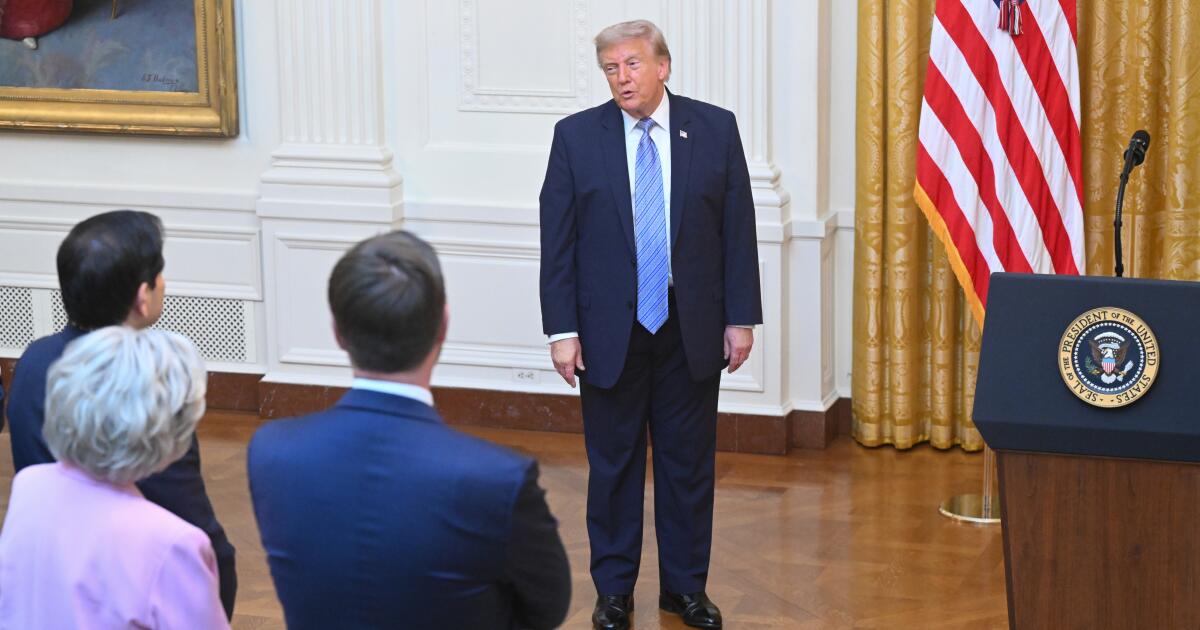
WASHINGTON — President Trump and his allies escalated attacks on U.S. elections on Friday, after the president’s prime-time effort to convince Americans that the nation’s voting systems are fundamentally flawed, and threatened to punish California and other Democratic states that refuse the administration’s demands for voter data.
Homeland Security Secretary Markwayne Mullin threatened local election officials with fines and prison if they don’t turn over voter rolls to federal officials seeking to root out purported illegal voting by noncitizens.
“Try us,” California Gov. Gavin Newsom wrote on X in response to Mullin’s threats. He added that “California has free, fair, and secure elections” and that the state “will fight for them.”
The administration’s threats — made less than four months before the November midterm elections — are a continuation of an aggressive Trump-led campaign to use the federal government to attempt to overhaul the nation’s voting systems and sow public mistrust in elections.
The administration has tried for months to compel Democratic-led states into handing over sensitive voter data to the federal government, but the efforts have run into resistance in courts, in part out of concern for privacy laws. The courts have also reaffirmed in many cases that the Constitution gives states — not the federal government — primary authority over elections.
On Friday, Mullin said his agency has found “as many as” 190,832 possible noncitizens registered to vote in California, along with more in three other Democratic-led states. He said Homeland Security arrived at those numbers by checking the four states’ public voter records.
He vowed to withhold federal election security grants from states until they agree to the administration’s demands, including having their voter registration lists “scrubbed” and their election security systems updated.
“If these states want a grant and they want to be reimbursed to run federal elections, they are going to have to implement security [measures],” Mullin said at a news conference. “We need to make sure that individuals who are legally able to vote are voting.”
Newsom’s office said the state had “no idea” where that claim came from. Sen. Alex Padilla (D-Calif.) questioned the Department of Homeland Security’s methods and said the administration’s allegations were “built on sham numbers that no one should trust.”
“DHS’s lack of transparency also raises serious questions about whether it violated state law to obtain California’s voter registration records and federal privacy law and court rulings barring misuse of federal databases,” Padilla said in a statement.
The administration has not made its methodology public, and the system Mullin’s department has used to check for noncitizens in the past has inaccurately flagged some citizens as noncitizens. Past election reviews have found noncitizen voting is rare.
“There is plenty of reason to be suspicious of the claims from the administration,” said Brendan Fischer, director of strategic investigations at the Campaign Legal Center, “and every reason for voters to have confidence in our elections.”
Mullin’s remarks came the day after Trump delivered a prime-time address about vulnerabilities in the election system, claims that largely were not backed up by the evidence he provided. The White House released a trove of declassified documents that failed to show that any American election had been affected by fraud or foreign interference.
The White House dug in on the strategy Friday morning, deploying agency heads to continue amplifying the idea of election vulnerabilities, even after fact-checks showed most of his claims were exaggerated and had been previously known, investigated or debunked.
“SAVE OUR ELECTIONS,” the White House said on X.
Trump also used his address to pressure Congress to pass legislation that would tighten voting restrictions and could make it harder for millions to register to vote and cast ballots. While hard-line Republicans applauded him, others in the party have rebuffed his request.
Sen. John Cornyn (R-Texas) said Friday that he did not understand why Trump is focusing on a past election when Republicans should focus on what is ahead.
“I think historically the midterms for the party in power are really tough,” Cornyn said. “So, yeah, I am concerned about it. We ought to be talking about things looking forward that our constituents are most concerned about.”
Sen. Bill Cassidy (R-La.) said the nation’s electoral systems are safe, and while he thinks election officials need to be “vigilant,” he said he is more concerned about economic issues ahead of the midterms.
Discussing the legislation ahead of the speech Thursday, Sen. Thom Tillis (R-N.C.) said it would be “impossible” to carry out changes to the nation’s voting laws in time for the midterms.
“The only thing that will occur is an undermining of the integrity of our elections right now,” Tillis said on the Senate floor.
David Becker, the executive director of the Center for Election Innovation and Research, called Mullin’s threats “laughable.”
“There is no significant pool of federal grant money appropriated, so this threat has no teeth for any state. None of them are expecting any significant federal funds for elections,” Becker said.
Mullin told reporters Friday the federal government plans to use public records requests to try to obtain the voter roll information in order to investigate whether noncitizens have voted. Any member of the public can make a public records request; the move signals that the government has few remaining avenues to force the state to turn over voter data.
But Mullin appeared to acknowledge the limitations, saying: “I obviously can’t force the states.” He later threatened to levy fines, penalties or criminal charges against elections officials in states that don’t comply with the government’s demand.
More than a dozen courts have ruled against the Justice Department’s highly unusual demand for state voter rolls. The federal government is not entitled to the data under federal law, Becker said.
He said previous government investigations into noncitizen voting have found that most people flagged against Homeland Security’s database were either citizens or non-citizens who had never registered themselves to vote.
The Trump administration has used a database from an immigration verification system to flag possible noncitizen voters, but election officials have found that method misidentified some voters. Even with citizens mistakenly included in the count, the number of possible ineligible voters was extremely low — in Texas, 0.0001% of voters.
Data indicate that voting by noncitizens is rare. A study of the 2016 election by the Brennan Center for Justice found that officials referred about 30 cases of suspected noncitizen voting for investigation or prosecution. A 2024 review by the American Immigration Council of the right-wing Heritage Foundation‘s database turned up 68 cases of noncitizen voting since the 1980s.
While Trump’s speech prompted warnings from his critics that he could be laying the groundwork to take further steps to interfere with or tighten restrictions on elections, experts said he was running out of moves.
Becker predicted that Trump would not actually attempt to cancel elections or send officers to the polls and that courts would block the president if he declared a national emergency to exert control over elections.
“But I think there are people in the administration, including the president himself, who would like us all to think this is possible,” he said.
Fischer said Trump may be trying to lay the groundwork to dispute the midterm results if he doesn’t like the outcome, but said his powers to do so are limited.
“There’s safeguards and laws in place to protect the freedom to vote,” Fischer said, “and voters should tune out the noise and continue to participate in our democracy.”

Trump will not sign housing bill without voter ID, criticizes Senate
President Donald Trump took to Truth Social, declaring he will not sign the housing bill despite congressional approval. He protests the Senate’s inability to pass The SAVE America Act, which he claims is supported by 97% of Republicans and many Democrats. Trump emphasizes the need for photo voter ID and proof of citizenship to prevent voter fraud.
NEWYou can now listen to Fox News articles!
After a popular Italian restaurant chain dished out an online response to a curious diner about its new unlimited pasta pass, politically-minded social media users, including those at the top of the food chain, are taking a stand.
Olive Garden took to X on Wednesday to promote its new deal, which offers customers the chance purchase a “Never Ending Pasta Pass” for $100 plus tax, giving the first 10,000 people to purchase their pass 13 weeks of unlimited pasta.
A user posed a question to the iconic American restaurant chain, asking whether they could purchase the unlimited pasta pass and share it with their family.
An Olive Garden sign is affixed atop one of its locations. (iStock)
WATCH: ELISSA SLOTKIN SAYS SAVE AMERICA ACT WOULD MAKE IT ‘HARD FOR ANY DEMOCRAT’ TO WIN AN ELECTION
“No. The Never-Ending Pasta Pass is only for use by the Passholder whose name is printed on the Pass,” Olive Garden replied. “Passes are personalized and non-transferable.”
“Passholders must present a valid photo I.D. along with the Pass at the time of ordering,” the chain instructed from its X account.
Immediately, the political right seized the the opportunity to prove a point — that Olive Garden appears more strict about its unlimited pasta promotion than Democrat-run states are about voting. The timely post comes as Trump continues to push for what would be a signature legislative victory — the SAVE Act — which, if passed, would require photo identification to vote. It has faced fierce pushback from the left-wing, who have argued against requiring proof of identity to cast a ballot in elections.
“Olive Garden takes their Pasta Pass security more seriously than Democrats take election security,” White House spokesperson Abigail Jackson told Fox News Digital. “It’s sad but true.”
“The SAVE America Act is a commonsense police, supported by the vast majority of Americans, that will secure our elections for generations to come. The only people opposed seem to be Democrats in Congress… I wonder why?” she added.
People with signs supporting the SAVE act at Upper Senate Park. (Kent Nishimura/Getty Images)
WATCH: MCCARTHY SAYS TRUMP WILL USE ‘EVERYTHING HE CAN’ TO FORCE SENATE ACTION ON SAVE AMERICA ACT
The social media post quickly caused an online feeding frenzy.
“PUT OLIVE GARDEN IN CHARGE OF OUR ELECTIONS!!!” one popular X account quipped.
“I hope you understand that this is extremely discriminatory towards minorities and married women,” one user said, parroting talking points that the political left has used in opposition of the SAVE Act.
MEMPHIS PIZZA JOINT SPARKS BACKLASH AFTER OWNER REFUSES TO SERVE NATIONAL GUARD TROOPS
US President Donald Trump addresses the nation from the East Room of the White House in Washington, DC on July 16, 2026. SAUL LOEB/Pool via REUTERS
Another user also mockingly used the common parlance of the political left in response to Olive Garden’s strict policy.
“I’m sorry, but this sounds incredibly racist to me, a requirement ID and some sort of proof of being a passholder will negatively affect marginalized communities ability to access Olive Garden,” wrote the sarcastic user. “Do better Olive Garden.”
“Are you saying that if photo ID is not presented, it could lead to cheating the system?” another social media user asked.
“Good grief, Olive Garden is more secure than our elections,” said yet another.
Adding protein, fat, or fiber to carbs—like topping pasta with chicken, spinach, and olive oil—helps slow digestion and prevent blood sugar spikes. (iStock)
CLICK HERE TO DOWNLOAD THE FOX NEWS APP
Since Republicans in the House of Representatives passed the SAVE Act in February, the bill has faced major obstruction by Democrats in the Senate, as the conservative lawmakers don’t have the 60 votes required to overcome a filibuster.
Earlier this week, SAVE Act language was attached to a State Department appropriations bill in a creative attempt to pass the law.
-

 Movie Reviews8 minutes ago
“The Odyssey” is Christopher Nolan’s Most Singular Film Yet (Movie Review)
-
World21 minutes ago
Iran War Updates: Bridges and Water Plants Hit as Strikes Stretch to 7th Straight Day
-
 Lifestyle1 hour ago
Spain could make World Cup history: The first to win men’s and women’s trophies back-to-back
-

 Technology1 hour ago
Taylor Farms pulls iceberg lettuce from the US market after cyclosporiasis outbreak
-

 World1 hour ago
Who is Andy Burnham? The Trump critic set to become the UK’s next prime minister
-

 Politics2 hours ago
Major appeals court declares New Jersey AR-15 ban unconstitutional in landmark Second Amendment ruling
-

 Health2 hours ago
First death reported in Upper East Side Legionnaires’ disease outbreak as cases rise to 67
-

 Sports2 hours ago
Raising Cane’s owner Todd Graves on how viral Tom Brady-Rob Gronkowski dunk tank came to be at Fanatics Fest

