Sports
F1’s rising star Franco Colapinto has already been compared to Messi, but will the hype last?


Stardom in Argentina is a unique cultural phenomenon, particularly for the country’s professional athletes. In a nation where sport is debated as passionately as politics and world affairs, one is more likely to be polarizing than universally admired.
Which is why the story of rising Formula 1 star Franco Colapinto is unique.
The 21-year-old Argentine replaced Williams’ American driver Logan Sargeant in August. Since then, Colapinto has experienced a constant whirlwind as one of F1’s most popular newcomers. His best finish was eighth place at September’s Azerbaijan Grand Prix. He was the first South American in F1 history to finish in the top 12 in his first three races.
But even a casual observer of F1 knows that Colapinto is still many miles away from breaking into its aristocracy.
In Argentina, that matters not. Colapinto is flying the Argentina flag in one of world sport’s most visible arenas. He has captivated the nation within a few months. His youthful personality and approachability as a sought-after public figure have endeared him to his countrymen and women, who don’t always appreciate their idols.
Diego Maradona and Lionel Messi are both Argentine football royalty but took wildly different paths to kingship. Maradona was a diamond in the rough, unearthed from the humble Buenos Aires neighborhood of Villa Fiorito. A people’s champion from an early age, the brash and unapologetically outspoken Maradona would go from phenom to deity in Argentina after leading his national team to glory at the 1986 World Cup in Mexico.
Maradona led Argentina to a World Cup trophy in 1986. (Archivo El Grafico, Getty Images)
Messi, meanwhile, was discovered on the dirt pitches of Rosario, 300km from capital Buenos Aires, as a pre-teen with local club Newell’s Old Boys. He was quickly spotted by an agent who connected Messi’s family with decision-makers at leading Spanish club Barcelona. At 13, Messi moved from Rosario to Europe, etching his own story into the annals of world football while away from home.
Like Colapinto, who left Argentina for Italy at 14 to pursue racing, Messi’s formative years took place thousands of miles from his homeland. Despite Messi’s unworldly talent, he had a distant relationship with Argentina’s public. He became a pariah, labeled a foreigner after losing four major finals with the national team. The press was Messi’s principal nemesis. He was ostracized before he was idolized.
Today, Messi is revered as a resilient legend after leading Argentina to the World Cup title two years ago and back-to-back Copa America trophies in 2021 and 2024. His transformation is now a case study of how Argentines measure success in sports. It’s not a cautionary tale for Colapinto, though.
In a football-crazed country such as Argentina (and throughout South America), F1 is a niche sport. It’s luxurious and virtually unattainable — the cultural opposite of football.
Colapinto’s ascension has also coincided with one of the greatest moments for Argentine football. Previously vilified as underachievers, Messi and his teammates have reached a new level of celebrity. They are social media and popular culture darlings. Once easy targets for criticism, national-team players are now routinely celebrated and defended by the press. Their success united the country and softened a notoriously toxic media environment.

(Peter Fox, Getty Images)
The timing has been ideal for Colapinto. The Argentine press has already referred to him as a genius and a generational talent — plaudits that have been reserved back home for Maradona, Messi, former tennis star Gabriela Sabatini and NBA legend Emanuel Ginobili. Pundits have audaciously said that Colapinto is the next Ayrton Senna.
The late Senna, an F1 icon, sits rightfully alongside Brazil’s greatest footballers, including Pelé, Zico and Ronaldo. By contrast, the hype has intensified around Colapinto so much that, in some media circles, he has been compared to Messi.
“I don’t think I’m anywhere near Leo Messi,” Colapinto recently told the Fast and the Curious podcast. “He’s at another level and I cannot believe that people compare me to Leo. I’m like ‘What’s wrong with you?’.”
Diario Olé columnist Diego Macias described Colapinto as “the ideal combo”.
“There’s a vibe about him, he’s witty and laid back, and he could give lessons on charisma and empathy to more than a few people. He doesn’t have a ceiling,” Macias wrote.
He certainly is a marketer’s dream. Colapinto is a social media influencer who has quickly amassed more than 3million followers on Instagram. The trail of paparazzi that follows him around the world seems to grow, as well. Naturally, Colapinto is a football fan. He revealed recently that he supports Buenos Aires club Boca Juniors.
At the Italian Grand Prix in September, Colapinto’s F1 debut, hordes of fans waving Boca and Argentina jerseys showed up to support him. Argentina national team coach Lionel Scaloni told reporters on the day of the race that he was watching Colapinto compete at Monza on a split screen alongside an English Premier League match.
Swept along by the excitement, Scaloni said it was “very strange” to have been distracted by something other than football.
“It’s exciting for Argentines to have a driver, and for him to have done it the way he did: the crowd in Monza with the flags, the fans going wild… I congratulate him. We’re proud to have a Formula 1 driver in the top category,” said Scaloni.
Although he preferred to not name which ones have reached out to him, Colapinto said that he has spoken to several current Argentina national-team players about his current success. “It’s very big for the country, and they are just enjoying the moment, and yes, it’s great,” he said.
It’s been a steady climb towards the mainstream for Colapinto.
There isn’t a day that he isn’t part of Argentina’s daily sports coverage. He has earned sponsorship deals from Argentina-based companies such as YPF, an oil and gas conglomerate that also sponsors the national football team. Argentine DJ and producer Bizarrap joined software firm Globant and e-commerce company Mercado Libre to provide Colapinto with the financial backing he needed to compete in F1.
Colapinto is innocently brash. He has good looks, is media-friendly and has shown courage on the track. That is the ideal combo in today’s sporting landscape, where athletes are their brand. Before the Mexico City Grand Prix last weekend, Colapinto was featured in a humorous race-inspired ad for Mercado Libre. He also graced the cover of Forbes magazine’s Mexico edition on the eve of the race.
“Formula 1 is now seeing how much they miss those Latino fans and those Argentine fans, because they have been extremely insane,” Colapinto told reporters before the race in Mexico City. “In only a couple of races, they have gone crazy and the support that they have, I honestly haven’t seen it in any other driver. It’s special and unique.”
Even if he does not yet have a guaranteed F1 seat for the 2025 season, in Argentina, he has become just as popular as Lewis Hamilton, Max Verstappen, Lando Norris and Charles Leclerc. In Latin America, Colapinto joins Mexican driver Sergio ‘Checo’ Perez as the bearers of the region’s rich history with F1.
“What a lot of us believed in the past was that it was impossible for an Argentine driver to get to Formula 1,” Colapinto said. “It’s great to see so many Latinos all together. You can see in other sports there was some fighting between the Brazilians and the Mexicans and Argentinians but now in Formula 1, in motorsport, it looks like everyone is together and everyone is supporting me, like the Brazilians, the Mexicans and the Argentinians.”
In Argentina, almost everything associated with the furor surrounding Colapinto has gone viral on social media. After he finished 12th in Mexico (ahead of Perez and Fernando Alonso), cameras captured the Ferrari pit watching the media and fan frenzy that now follows him on F1 Sundays.
“I love you, Franco!,” one woman screamed. Diario Olé’s caption on a photo of the scene read, “The Ferrari team trying to understand the craziness around Colapinto.”
Last week, a popular restaurant in Buenos Aires added Colapinto to its menu. El Antojo (The Craving) has become known for shaping its milanesa, a breaded beef cutlet that is the unofficial national dish of Argentina, into the likeness of celebrities. Messi and Argentina teammate Emiliano Martinez, as well as former national-team winger Angel Di Maria, have previously been honored in breadcrumbs.
Colapinto has not returned home since going from an unknown amateur to a cult hero in Argentina. Asked how he is adjusting to his new life as a megastar, he replied in typically humble terms.
“It’s been a lot, and luckily I haven’t gone to Argentina yet, so I don’t know how it’s down there, but from what I hear it’s going a bit crazy,” he said. “I love the support that I get.”
Colapinto hasn’t won anything yet in a sport defined by pole positions, top speeds and perennial championships. His future in F1 is also uncertain, as he is not guaranteed a drive with Williams next season. Nevertheless, Colapinto is riding a wave of attention in Argentina that is coexisting with Messi’s acclaim.
Argentina has the world’s best national football team, which has led to an ongoing commemoration by the press of its recent accomplishments. From a sporting perspective, things are as good as they have ever been.
Will Colapinto continue to benefit from this newfound praise or will his star rise based on consistent sporting merit? One thing is certain: Argentina’s hunger for more trophies is matched only by their passion for sporting prestige.
Luke Smith contributed to this story.
(Top photo: Joe Portlock / Getty Images)





Sports
Folarin Balogun admits that red-card reversal affected USA World Cup teammates: ‘A lot of outside noise’

NEWYou can now listen to Fox News articles!
The United States Men’s National Team had all the momentum when Folarin Balogun’s red card from the Round of 32 was suspended, giving him a chance to play in the Round of 16 — at least, that’s what American soccer fans thought.
The day before the USMNT’s Round of 16 game against Belgium, which Balogun was originally supposed to miss because of a red card in the previous game, FIFA ruled that he would be eligible.
The ruling added to what was already a huge controversy, as it was argued Balogun should not have been red-carded in the first place. Nonetheless, Balogun was active despite an appeal and strong reaction from Belgium.
United States forward Folarin Balogun kicks the ball against Bosnia and Herzegovina in the Round of 32 of the 2026 FIFA World Cup at Levi’s Stadium in Santa Clara, California. (David Gonzales)
However, it was hardly a needle-mover, as Belgium embarrassed the Stars and Stripes with a 4-1 win. If anything, the needle might have moved the wrong way, Balogun himself said.
“My initial reaction was I was happy to be back in the team, but when I kind of started to reflect, I knew it was going to cause a lot of controversy, and I could almost see within my teammates a bit of nerves, because it is something that is so unique,” Balogun told CBS on Tuesday.
“The closer we got to the game, I tried to just focus as best as I could, but it was difficult. A lot of outside noise and that’s hard to avoid.”
Balogun said the entire situation was “confusing,” as the team was initially practicing without him. But the team found out on the bus to practice that Balogun would be active.
“Everybody was screaming and shouting,” Balogun said.
BELGIUM MANAGER PRAISES CLASSY GESTURE BY FOLARIN BALOGUN AFTER RED CARD CONTROVERSY: ‘I REALLY LIKED THAT’
Folarin Balogun of the U.S. celebrates scoring their first goal during the FIFA World Cup 2026 Round of 32 match against Bosnia and Herzegovina in Santa Clara, California. (Phil Noble / Reuters via Imagn Images)
But that did not change the whirlwind of emotions, which may or may not have contributed to the loss.
“It’s more just being able to separate the emotion from the job at hand. We’re all professionals, so it’s not something I think was too difficult to be able to separate once we got over the initial announcement. You saw it was a difficult game against Belgium and that can kind of overshadow whether we were focused or not. From me being inside the camp and inside the setup, I know we had full concentration going into the game,” he said.
President Donald Trump admitted to calling FIFA President Gianni Infantino to ask for a review of the red card.
“All I did was, I asked for a review, because I didn’t think it was a foul,” Trump said. “And again, I’m good at this stuff. I didn’t think it was a foul. I thought it was two great athletes who crashed into each other and got entangled. That was not a guy punching somebody in the face or anything that would be different.
Team USA striker Folarin Balogun celebrates scoring a goal during the FIFA World Cup 2026 Round of 32 match against Bosnia and Herzegovina at Levi’s Stadium in Santa Clara, California. (Jamie Squire/Getty Images)
CLICK HERE TO DOWNLOAD THE FOX NEWS APP
“I think it’s a terrible… if they wouldn’t allow a top player, maybe the best, maybe among the best on the team, to play, I think it would have had a big stain. I relayed it. I didn’t tell him what to do. I don’t believe he made the decision. I think it was a committee that made the decision, and they made the right decision because, No. 1, it wasn’t a foul, and you want to see a game with your best players.”
Belgium was knocked out by Spain in the quarterfinals, and Spain will face France in the first semifinal match Tuesday in Atlanta.
Follow Fox News Digital’s sports coverage on X, and subscribe to the Fox News Sports Huddle newsletter.
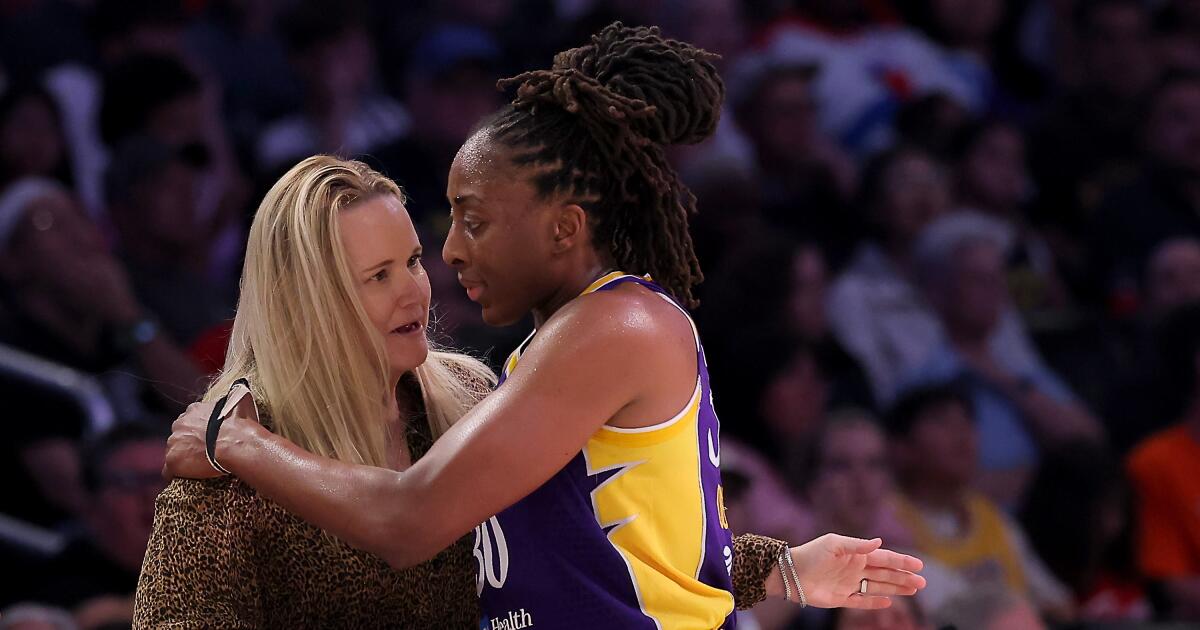
A day after general manager Raegan Pebley was fired, the Sparks were in Atlanta and seemingly still focused on trying to reach the playoffs this year.
The suggestion that Pebley’s removal was a sign that the team is performing poorly didn’t sit well with coach Lynne Roberts.
“I don’t think we underachieved last year and this year is still going,” Roberts said in Atlanta on Monday before the team’s loss to the Dream. “For where we want to get, that’s not where we want to be, but we tripled our win total in my first year — that’s not underachieving. We haven’t hit our stride, we’ve been injured all year. Hopefully we get [Kelsey Plum] and Cam [Brink] back. Our system is designed around KP. I’m not close to thinking we are underachieving.”
Pebley and the rest of the Sparks’ organization signaled a clear intention to compete this season, signing veterans Nneka Ogwumike and Erica Wheeler in the offseason, signing Dearica Hamby to a three-year deal and trading for Ariel Atkins.
The Sparks’ Rae Burrell protects the ball under pressure the Chicago Sky’s Natasha Cloud at Crypto.com Arena on July 10.
(Luiza Moraes / Getty Images)
They are still in the playoff race midway through the season, but have the second-worst defensive rating in the WNBA and sit a game below the postseason cutoff line.
They have competed without Plum, their top scorer, for 12 games and former No. 2 overall pick Brink during the past nine contests.
But even with their struggles, culminating in an 82-64 loss to Seattle on July 6, the Sparks responded well with consecutive home wins against Indiana and Chicago. After those games, Roberts seemed to think the team was moving in the right direction, but team owners made a major change.
The Sparks have a decision to make about how hard they want to push the rest of this season as the team flirts with missing the playoffs for a sixth consecutive season. With the trade deadline on Aug. 2, they could make some moves to improve this season or sell off their veteran assets and attempt to rebuild again.
The Sparks haven’t made the playoffs since 2020 and have made some controversial moves while trying to snap out of the slump.
In addition to the questionable trade of 2024 fourth overall pick Rickea Jackson to Chicago for veteran Atkins this offseason, Pebley traded the picks that would become Storm post duo Awa Fam and Dominique Malonga for Plum and Kia Nurse. In her sole season with the Sparks, Nurse averaged 7.6 points per game.
Pebley also traded the No. 8 pick in 2024 (that later was used to draft Alissa Pili) to Chicago for Julie Allemand and Li Yueru, then lost Allemand in the expansion draft. Yueru was sent to Seattle in the Plum trade and is now playing with Dallas. The Sparks’ 2025 first-round draft pick Sarah Ashlee Barker was left unprotected and went to Portland in the expansion draft.
The Sparks waived their top pick in this year’s draft, Ta’Niya Latson, after barely playing, and she has gone on to join Las Vegas. Sania Feagin, a 2025 first-round draft pick, was waived and signed with Portland.
Most of those moves, though, came after the Sparks lost the top spot in the 2025 draft lottery to Dallas, which selected Paige Bueckers with the No. 1 pick. Before the lottery result, it seemed like the Sparks — who went 8-32 in 2024 before that draft — were lining up for a youth movement led by Brink and Bueckers. A lineup of those three, a healthy Feagin, Barker and Allemand would be an entirely different kind of team.
Once that failed, they focused on adding veterans who could win now and have only managed modest improvement.
The Sparks have their next two first-round draft picks and four players still on rookie contracts after this season (Brink, Chance Gray, Kate Martin and Pili). Brink is their lone lottery pick left from their disappointing past six seasons. (Pili was a top-10 pick, but she has struggled to stay on a WNBA roster and just signed a player developmental contract with the Sparks this month.)
Pebley told The Times in an interview on Friday that she was open to making moves to compete at the deadline this year.

Players on the Sparks’ bench celebrate during a win over the Chicago Sky at Crypto.com Arena on July 10.
(Luiza Moraes / Getty Images)
“We are in a space where we are here to win,” she said. “This is a city that wants to win. We have an ownership that wants to win. You see what they’re doing with the Lakers. You see what they’ve done already with the Dodgers. … We have to always continue to invest in the roster. We have a responsibility to always listen and be aware of what’s out there.”
A league source not authorized to discuss trade conversations publicly told The Times that Pebley had been aggressive ahead of the deadline, and now teams are unsure what approach the Sparks will take moving forward.
“I found out when everybody else did,” Roberts said of Pebley’s firing. “It was a surprise. She’s a good friend of mine. I think the tone is set that we need to keep building and get the Sparks back to where they have been. That’s been the tone. Raegan did some great things for our org in that regard and improved a lot of things. That work can’t go undenied. It’s full-steam ahead and I’m focused on what I can do.”
It would be difficult to move some of their heftier contracts, especially since WNBA teams cannot take on more salary than their remaining cap space allows in a trade. Hamby, 32, is signed for two more years for more than $1 million per season. Atkins is also signed for two years at $1 million-plus and is having a career-worst offensive season, shooting 36.4% with 8.7 points per game.
Wheeler, 35, has another year left on her deal, but a $625,000 cap hit for a player who would be a backup point guard on most teams is a tough sell.
Plum and Ogwumike are on expiring deals, and the Sparks’ most valuable roster asset, Rae Burrell, is a restricted free agent, but one of the few young players left on the Sparks’ roster.
The Sparks have a limited $86,000 in cap space, too, so if they decide they want to buy at the deadline, they have to find a way to clear space.
They enter the trade deadline period in a difficult spot as a team in purgatory that just fired its general manager.
Yet what they decide to do in the next month might be the most clearest sign of their ambition and hope for the future.

NEWYou can now listen to Fox News articles!
ATLANTA — The FBI and Atlanta Police Department are getting ready for a massive security operation ahead of the World Cup semifinals between England and Argentina at Atlanta Stadium.
Both agencies have used drones to search for potential threats on the ground and in the sky. The FBI is enforcing the Federal Aviation Administration’s Temporary Flight Restrictions around the venue.
The FBI has confiscated more than 600 drones nationwide since the World Cup began. Special Agent in Charge of the FBI Atlanta Field Office Marlo Graham said 86 of those drones were seized in Atlanta.
Graham said the FBI uses a “mechanism” that allows agents to see unauthorized drones in restricted airspace. Agents then work to mitigate the threat posed by unknown drones.
“We’ve been able to safely land drones that have been unauthorized in the flight restricted area,” Graham said.
The FBI has confiscated more than 600 drones at World Cup events since the tournament started. (FBI Atlanta)
While the FBI treats every drone as a potential threat, Graham said the threat level can increase depending on the size of the drone and how close it gets to the stadium.
“Obviously, the closer to the venue, the larger the crowd. We are fortunate here in Atlanta that we have a closed dome stadium,” Graham said. “We don’t want the game to be impacted because a hobbyist couldn’t control their drone, and it lands right when one of our star players was getting ready to score a goal.”
EXCLUSIVE: FBI ADDS ALLEGED COVID FRAUDSTER TO MOST WANTED LIST
The Atlanta Police Department’s Drone Unit has helped the FBI track down people suspected of flying in restricted zones.
Sgt. Kindu Franklin said most of the people caught flying drones around World Cup venues are hobbyists with no intent to harm the crowd of soccer fans below.
“In some cases, they just recently bought a drone just for FIFA to get some of the cool footage that they want to put up on their social media,” Franklin said. “There are different ways that you can weaponize these drones. So, we’re operating in a proactive manner.”
The Atlanta Police Department’s drone mission at the World Cup focuses on surveillance. (FOX)
The Atlanta Police Department’s drone mission is focused on surveillance. Officers are looking for potential threats, traffic issues and people the FBI suspects are flying drones illegally.
“So, what we want to do is give our command staff a view that they can’t get from the ground,” Sgt. James Cunningham with APD’s Drone Unit said.
ARMED MAN ARRESTED AT US CAPITOL BARRICADE AS POLICE PROBE WHY HE DROVE ONTO RESTRICTED GROUNDS
Cunningham’s unit can launch drones remotely from handheld controllers. Other drones are launched from docking stations strategically placed across the city, and officers control them from the back of an SUV using a computer and a PlayStation controller.
The Atlanta Police Department launches some drones from docks strategically placed across the city. They are controlled by a computer and a PlayStation controller. (Fox News)
The drone docks are used year-round to help the police get an aerial view of emergency situations before officers arrive. The computer shows the drone pilot where all the police body cameras and vehicles are in the area, allowing them to communicate better with officers on the ground.
For the World Cup, the drone docks let the department have more eyes in the sky and respond to emergencies faster.
“It’s going to cut down time. We’re going to get there quick. And then you’re going to get an aerial perspective of what you can’t see on the ground,” Cunningham said.
The Atlanta Police Department launches some drones from docks to get more eyes in the sky and respond to emergencies faster. (Fox News)
Cunningham said the drone unit has completed more than 1,400 flights and logged more than 550 flight hours since the beginning of June.
“Some people haven’t even done that in years or haven’t even reached those numbers in the life of their drone unit,” Cunningham said.
“We train for the environment. We live here, so we know what to expect,” Anais Paredes, an APD drone pilot, said.
CLICK HERE TO DOWNLOAD THE FOX NEWS APP
The FBI is asking that hobbyist drone pilots know the Temporary Flight Restrictions in their area before taking off.
There is a one-mile restriction around World Cup stadiums on non-match days, and a three-mile restriction on game day.
-

 Technology6 minutes ago
Nintendo’s Switch 2 bundle that includes a game is $50 off
-

 World12 minutes ago
Inside Israel’s mission to train civilians to stop the next Oct 7-like terror attack
-

 Politics18 minutes ago
Trump reveals who he’s eyeing to replace Lindsey Graham
-

 Health24 minutes ago
Notable figures who died from the same heart condition linked to Lindsey Graham’s death
-

 Sports30 minutes ago
Folarin Balogun admits that red-card reversal affected USA World Cup teammates: ‘A lot of outside noise’
-

 Technology36 minutes ago
Humanoid robots perform live surgery in world first
-
 Business42 minutes ago
A ‘next generation studio’ for YouTube creators
-
 Entertainment48 minutes ago
Finn Wolfhard is taking ‘control of the narrative’

